Better to Live Under Robber Barons

Barony feels old. When we first played the new Royal Edition, my mind automatically sorted it into the early 2000s. It fits the period. The feudal setting. The perfect information. The simple rules. Even the emphasis on direct conflict. This is what Eurogames once resembled, before the endless recombination of systems into recursive engines and checklists of scoring criteria. Before everybody decided to chase that Vital Lacerda money.
But Barony is not old. Not that old. Marc André designed this thing a mere decade ago, in 2015. That’s a year after he gave us Splendor! The same year Trickerion: Legends of Illusion hit the scene!
As a not-quite-throwback, Barony is an interesting case study. In some ways it’s refreshing; in others, it’s mired in sensibilities the hobby has largely left behind.
Roamin’ Out of Memory

I don’t know how I missed Roam the first time around. Every so often Ryan Laukat releases something like this, a twenty-minute title that stands in contrast to his sprawling adventures like Sleeping Gods, its sequel Distant Skies, or even time-conscious fare like Creature Caravan. Minor artifacts, in other words, but artifacts that shoulder more weight than their diminutive frames would otherwise indicate. Like ants. Or dung beetles.
Roam is no exception to the dung beetle rule. I’m pretty sure I played it way back when, only to slip from my memory like so much sand. It isn’t that the game isn’t pleasant, or even quietly clever. It simply lacks the pizzazz that might have otherwise marked it as a staple filler.
Trick-Taking Tranche
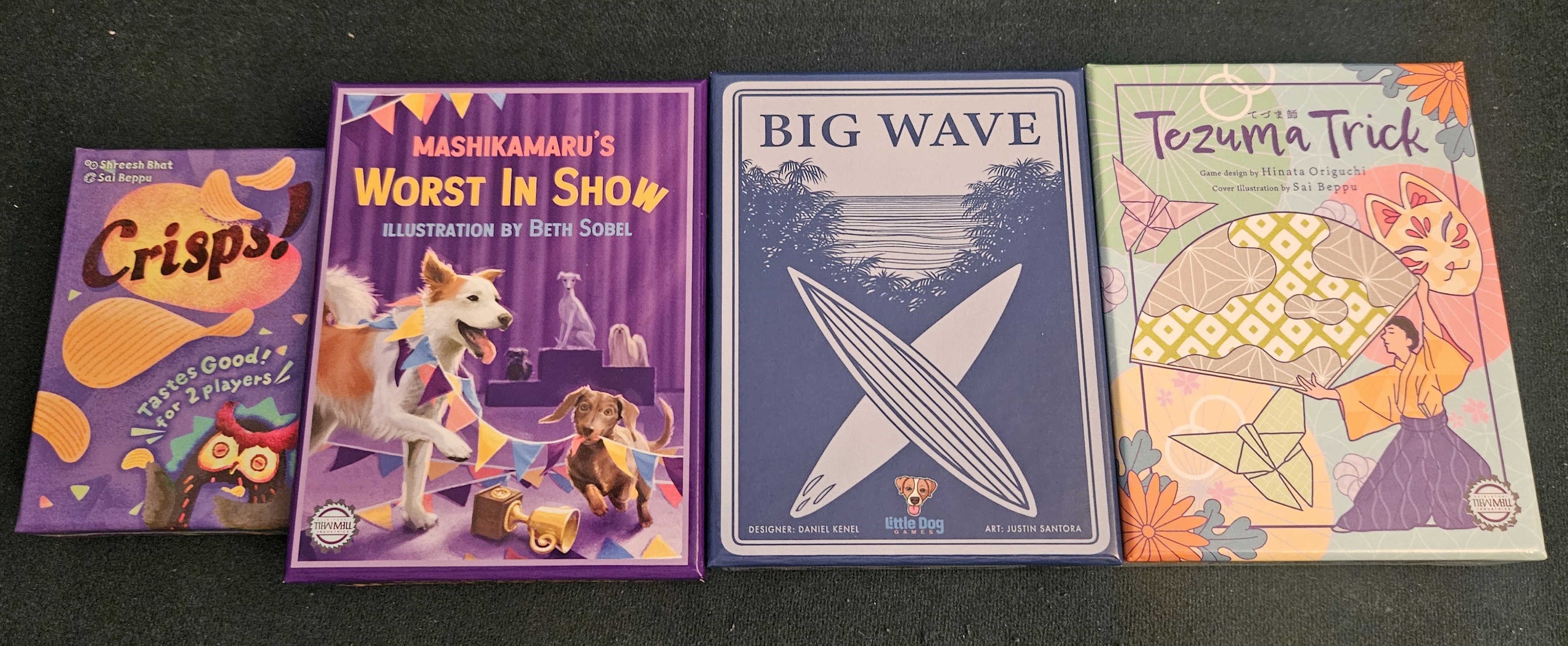
All I play anymore is trick-taking games. Or at least that’s the case when I receive another tranche of the things from New Mill Industries. There are four this time around — five, actually, although I wasn’t sent the last one for some reason — and I’ve gotta say, there’s not a stinker in the bunch. Let’s figure out which is the best of the pack.
Summer Ludens

Yesterday, my car thermometer clocked 104°. Granted, our car is black, which means it regularly measures temperatures about ten degrees too warm, but still, that’s too damn hot.
Like everybody else descended from pioneers who decided to settle in the desert, we’re always on the lookout for ways to beat the heat. Our answer, like our answer to every other apprehension, has been board games. What follows are the ten titles that are helping my family cope with the Great American Bake-Off.
Life in First-Person

There’s an exercise I sometimes use in class to help my students break out of their modern mindset. Everyone gets a sheet of paper and swears to avoid looking at anyone else’s work until we’re finished. Then I ask them to draw a picture of where they are in the world. To place themselves within their surroundings.
For most modern people, the reflex is to draw a map. The layout of the lecture hall, the nearby buildings, maybe our city or state or country. This isn’t universal; those with aphantasia might create rudimentary images, while my more artistically minded students sketch the nearby mountains. (Or me, sitting at the front of the class, looking more pouchy and tired than I’d prefer.) But in most cases, maybe seventy to eighty percent of the time, they draw a map. Bird’s eye view, top-down, like something you’d see on a navigation tool.
And then we talk. Because for most humans in most places and most times, a map was an impossibility. Perhaps surveyors and astronomers had created one, a painstaking process that still resulted in an unreliable thing with uncharted gaps and “here be dragons” scrawled in the margins. More often, the best one could hope for was a series of landmarks. A settlement here, a strange rock over there, a mountain or lake on the horizon. Your world was a series of visual cues, a vast maw that threatened to swallow you up the instant you strayed from its stepping stones.
This modern tendency to locate ourselves on a map creeps into our thinking about… well, everything. The identity of our kinsmen, neighbors, and rivals. The spaces that can be considered safe or dangerous. The distance between points. Our place within a country, continent, time zone, planet, ecology. Who we are.
Way more important than any of that identity junk, of course, is that maps also make their way into board games. Whether we’re talking about hex grids or squiggly provinces, nearly every board game about kingdom-building or exploration stands its players on firm footing, located safely within the confines of a perfectly scaled representation of reality.
Except for Vantage.
Christ and His Saints Were Asleep

Hot take: any time period dubbed “THE ANARCHY” was probably a bummer. The specific Anarchy referred to in The Anarchy, the latest flip-and-write game by Bobby Hill, was a fifteen-year war of succession fought between the Empress Matilda and King Stephen across Normandy and southern England during the twelfth century. Which, in case you missed the memo on the merits of every century, was itself something of a bummer.
Here’s the good news. While The Anarchy might have been a big ole stink-pickle for everyone involved, Hill’s version offers the exact opposite. Building on the systems he established in Hadrian’s Wall, this is a complex but thrilling portrayal of Medieval warfare, tower defense, and brewing, with a heady dose of modern combo-building for good effect.
Space-Cast! #47. Bun Bangers

Hot Streak! Off-brand mascots and gambling degeneracy have never been more in fashion. For today’s Space-Cast!, we’re joined by Jon Perry to discuss his mascot-racing board game, its connections to the digital collection UFO 50, and the particulars of adaptation and artistic medium. Now that’s a mouthful!
Listen here or download here. Timestamps can be found after the jump.
Skyblivionrockmarsh

Way back in 2011, Todd Howard let it slip that Skyrim would have “unlimited dragons,” dragging surprised reactions from the internet. Don’t believe me? Here’s pre-People Make Games, pre-Shut Up & Sit Down Quintin Smith’s press release on the matter. It’s pleasingly sarcastic. Because, you know, “unlimited nouns” has always been the Elder Scrolls’ whole thing. This is the fantasy series that made volume its defining metric. Depth? Nah. Enjoyment? Get outta here. Kelvins? Only if you’re talking about Lord Kelvyn, the Redguard Knight of the True Horn. No, really. Like I said, unlimited nouns.
Which brings us to The Elder Scrolls: Betrayal of the Second Era, Chip Theory’s adaptation of not only Skyrim, not only Oblivion, not only Morrowind, not only those other ones nobody talks about anymore, but the whole dang universe with its boundless recreations, provided your recreational interests are limited to hoofing across fantasy landscapes and murdering fantasy gobbos. It comes with a bazillion components, weighs so much that it should have a team lift warning on the box, and costs as much as twenty-five burritos from my favorite local burrito place.
You heard that right. Despite my policy on the matter, this thing is so pricey that I think it warrants some discussion. First, though, I want to walk you through the shape of an average TES:BOTSE campaign.
She’s a Grisly Monster, I Assure You

You know the story. Buncha monsters storm Mount Olympus. The pantheon is in a scramble. Who’s this coming to save the day — Hercules? More like Hunk-ules.
Reiner Knizia’s Ichor isn’t Disney’s Hercules, and thank the gods for that, although Tyler Miles Lockett’s illustrations do somewhat resemble the Gerald Scarfe amphorae look of the animated feature. When I previewed the thing a year back, I liked it somewhat less than its sibling title Iliad. Now that they’re both finished and on my table, though, I’ve been giving Ichor a second look. And while it’s still the zanier and less measured of the pair, there’s so much to appreciate about Knizia’s portrayal of this divine brawl that I can’t help but be charmed.
Let Me Not Then Die Ingloriously

You know that moment in every ancient battle scene, whether in film or video games, where the lines have collapsed and now the burly infantry boys are fighting one on one, everybody mixed together and slashing wildly? Bonus points when two rival heroes spot each other in the fray and start murdering their way toward one another, hellbent on a personal duel where nobody will happen to spear them through the backside.
Sorry to disappoint, but those scenes are pure invention. There simply weren’t enough suicidal soldiers in the ancient world for such an engagement. Still, it looks hella cool, and it’s significantly easier to stage than an actual line of infantry trying to scare their opposite number into freaking out and running away.
One of my favorite things about Reiner Knizia’s Iliad, which I previewed last year, is the way it evokes those haphazard murder-thons, Greek boys in blue and red squaring off in a checkers-grid melee. Sure, the game is smart and all that, providing a thinky two-player match of wits that emphasizes clever investments over brute strength. But I’m really here for the chaos.

 SPACE-BIFF!