Category Archives: Board Game
Fate of the Public Domain Monsters

When it comes to board game settings, I’m about as energized by the appearance of H.P. Lovecraft’s Cthulhu as by anything featuring zombies — as in, yeah, they’re overdone, but at least they’re easy to design around. Just as zombies provide baked-in behavior (walk and bite, walk and bite), the presence of Cthulhu & Co. means you know what you’re getting yourself into. Hooded cultists, the coastal hamlets of New England, encroaching madness, and the Arkham that isn’t associated with Batman. It’s thematic shorthand for “watch your health and sanity meters.”
It might be possible to say that Fate of the Elder Gods does the setting a service by letting you don the robes of the cultists themselves as you strive to summon your chosen mind-flaying monster, but it’s hardly the first to do so. Instead, we’ll have to settle for celebrating the fact that it’s a surprisingly good screw-your-buddies affair.
More Than 878 Vikings

There’s something insecure about the title of 878: Vikings — Invasions of England, as though the creators weren’t sure they’d sufficiently clarified their intent. It’s set in the year 878, check. Also there are Vikings, sure. And they’re invading England, right. The only missing elements are motive, opportunity, and outcome.
Clunky title aside, 878: Vikings is a successor to Academy Games’ Birth of America series, which featured the rather-good 1775: Rebellion. And for the most part, it’s as fun as being on the pitching side of a monastery raid.
What Spring Is Like on Jupiter and Mars

I’m a huge fan of Joseph Fatula’s Leaving Earth and its expansion Outer Planets. They’re messy in some ways, but that’s precisely why I like them — much like actual space exploration, they’re a cross between careful preparation and outrageous risk-taking, between brute-forcing the math and forgetting to take a heat shield on your trip to Venus. Back to the drawing board you go, again and again, until you get it right. Or somewhere closer to right than you were before, anyway.
Leaving Earth’s second expansion, Stations, feels like a microcosm of the whole thing, and not just because it’s all about adding a ton of extra depth to the exploration of the inner planets. Rather, in between offering new toys, new objectives, and new wonders to uncover, it still can’t seem to shrug off its former messiness, and even seems insistent on adding a few new problems.
Jerkforce

At first glance, I gave Downforce a pass. After all, of Restoration Games’ opening catalog of refurbished games from times past, my interest was more piqued by Stop Thief! and Indulgence, in part because I’ve never been partial to racing games.
I couldn’t have been more wrong. Downforce is not only the best of the three, it’s also hardly a racing game at all. Instead, it’s a game about being the biggest jerk on the track and coming away filthy rich.
The Eleventh Cardboard

Mistborn: House War is a bit of an odd duck. Based on Brandon Sanderson’s much-loved series, it sees you taking command of Vin, Kelsier, and the rest of those scrappy rebels as they seek to topple the rapacious Final Empire.
Except, oops, it isn’t about that at all. Instead, House War’s protagonists are the first book’s sub-baddies, the Great Houses who squabble, gossip, and often lend that “rapacious” an uncomfortable edge. And they’d very much like to kill off the heroes of the books.
Tic Tac On-the-Go

OK Play isn’t the usual sort of thing I write about, but… um…
All right, look, I don’t have an excuse. Deep down, all we’re doing in this hobby is playing with toys, and OK Play looked like it would be fun to play with. Not necessarily by following its rules, but just by clicking it around. It’s sixty little squares of plastic attached to four prongs that are connected to a carabiner. And yeah, it’s a lot of fun to goof around with. I basically use it like a stress ball or fidget spinner. Clickety clack clickety clack. 10/10.
Do Androids Dream of Electric Algebra?

Sentient is a bit of a weird one. By plugging robots into your mainframe — and doing your best to keep things orderly when their growing awareness starts to kick back — you hope to position your company at the forefront of the sentient revolution. It sounds like the first act of a robot uprising story, not a game designed around basic algebraic operations.
It doesn’t help that the game’s setting is about as substantial as chalk dust. As a thought experiment, my gaming group redesigned the whole thing on the spot to be about trying to persuade our pal Geoff to do us a favor, wherein his mental states — things like “playing Angry Birds right now” and “has another question about the rules” — might begin to affect our collective mood. It worked just fine.
But that’s where Sentient sets itself apart, because in spite of its insubstantial fluff and algebra-based gameplay — or perhaps thanks to it — it’s a surprisingly excellent filler.
A Few Acres of Stardust

Martin Wallace birthed a new subgenre with A Few Acres of Snow. Here was deck-building but tied to a map, every single location represented by a card. Seizing territory not only meant extra points and opportunities, but also more regions to administer, and your deck and hand could gradually choke on bureaucratic smoke that distracted from the conflict at hand. It was deviously clever. Also incomplete.
Wallace’s Mythotopia sought to fix up the concept, broadening it from two to four players and sanding down some of the system’s rougher edges while giving others their due. It made for a good time, as far as I’m concerned, though still an experience where a single pulled thread might unravel the whole thing.
Now Wallace is back with A Handful of Stars, the last in his trilogy of deck-building-on-a-map games. And as we’ve come to expect, there are some excellent ideas on display here — and a few that could have used some extra work.
Hotline Jacksonville
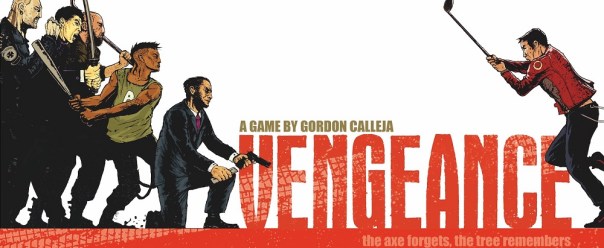
Every so often, along comes a game sporting a sense of style and rocking a ‘tude, making itself known with a crash and a holler. Much like a toddler who’s climbed onto the counter and tossed a dish onto the floor.
Vengeance forces you to sit up and take note, is what I’m saying. Emulating the likes of Payback, Kill Bill, and the snazzy digital Hotline Miami, it’s the sort of game that sends you bum-rushing into a room packed full of no-gooders, swinging and shooting until they’re dead and you’re barely limping, then hitting repeat until some nebulous concept of revenge has been fulfilled.
It also happens to resemble one of those corpses your protagonist will undoubtedly leave sprawled behind them. But we’ll get to that.
Ascendancy: The Next Generation

Star Trek: Ascendancy was not only among my favorite games of 2016, but also one of its most unique for how defiantly (yeah, that’s a reference) it clung to the vision of Star Trek. It was sprawling and dangerous, complete with a burgeoning playtime and the possibility of player elimination. But it was also as sleek and streamlined as a Starfleet vessel, every single turn — nay, pretty much every move — cast as an episode of the original series, with planets and cultures and deadly space phenomenons popping onto the table. It was rife with political intrigue, border tensions, shaky alliances, and a futurist’s appreciation for technology.
Well, buckle up — or don’t, because real Starfleet ships don’t have seat belts — because now that its first two expansions are out, Ascendancy is better than ever.

 SPACE-BIFF!