Author Archives: Dan Thurot
The Gone Samaritan

It’s a rare board game that leaves me as conflicted as Ezra and Nehemiah, the latest creation from design duo Shem Phillips and Sam Macdonald.
Set during the resettlement of Jerusalem following the Babylonian Captivity, it sees players rebuilding the destroyed temple and walls of the city, strengthening the priestly classes, and translating and preaching the torah. As much a work of Biblical exegesis as it is a plaything, it calls to mind the golden darics mentioned by its sources: where one side of these coins features an expressive slice of history, the other is little more than an empty divot.
Agon-izing
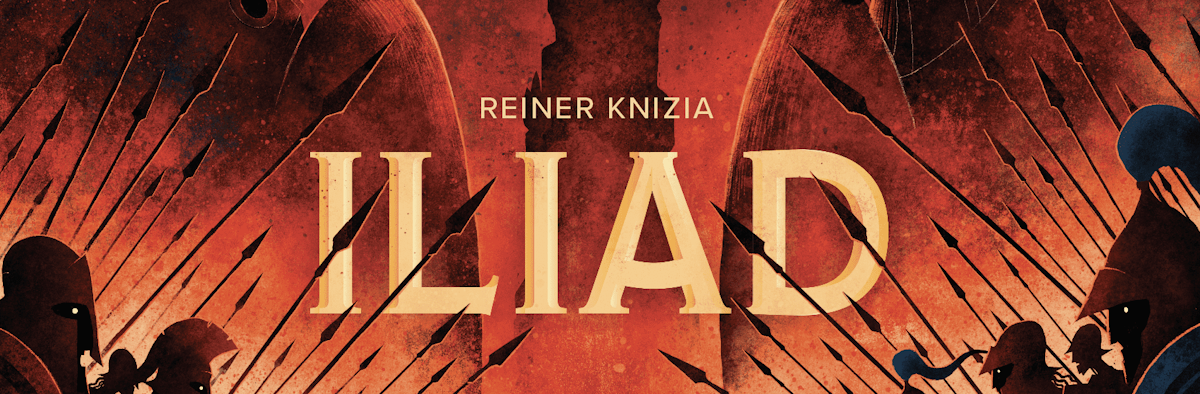
Yesterday we took a look at Ichor, the forthcoming Reiner Knizia abstract-adjacent game about warring gods and monsters. Today we’re investigating its companion piece, Iliad, a bustling melee that’s as much about picking your battles as it is about shoving pieces around a board. It’s also a novel title from Knizia rather than being a remaster of an earlier effort.
Godblood
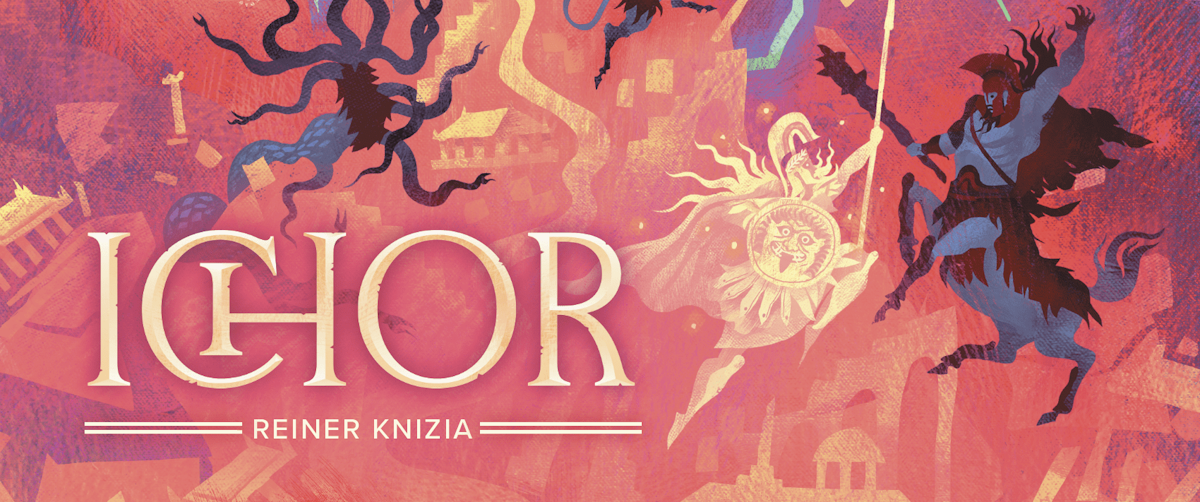
There’s a hallmark to a great Reiner Knizia game. When learning the thing, you say, “That’s it?” Five minutes into your first session, you go, “Oh, that’s it.” What initially seemed too simple is revealed as a bottomless puddle, a glassy mirror that belies the fathoms lurking below the surface.
Ichor is one of two Knizias forthcoming from Bitewing Games. It’s a reimagining of an earlier Knizia title, Clinch, which appeared in Spielbox Magazine in 1993 and was produced as the abstract game Tiku. In 2009 it received an upgrade in the form of Battle for Olympus. Ichor follows closely on the heels of that game, but with a series of adjustments and improvements that make it an absolute python on the battlefield. No, not the snake python. The dragon Python.
What an A**hole

There’s a moment that perfectly crystallizes the spirit of Jenna Felli’s latest game, a title every bit as unhinged and out of step with the broader hobby as the rest of her greatest hits, Dûhr: The Lesser Houses, Cosmic Frog, and The Mirroring of Mary King.
For most of the game’s duration, you’ve been assembling swarms of flies. Mayflies, dragonflies, deer flies — all varieties, illustrated by Rowan Morgan with a crispness that wouldn’t feel out of place in a children’s book of entomology. Then, outta nowheres, BLAM, they are here, drawn in color and motion at odds with the stillness of those flies. And they’re going to wreck somebody’s day.
It’s Murray.
Murray the Frog.
Murray the A**hole Frog.
Lucy in the Floorboards with Shadows

Flashback: Lucy is designed to be impossible to talk about. Remember the first time anybody played a legacy game? How there were sealed envelopes and boxes? That moment players were instructed to look under the insert? Nowadays I reflexively check under there any time a game seems like it might be hiding something from me.
I won’t spill whether something lurks under the insert of Flashback: Lucy, but there are discoveries to be made. The phrase “delight and surprise” is overused, but that’s precisely the emotion the team behind Flashback: Lucy managed to dredge from this leathery old sack.
Expanditions

I didn’t love Expeditions, Jamey Stegmaier’s follow-up to Scythe. For a game with such an enticing setting, it was sterile and undifferentiated, more zoned out than Zone. But when Gears of Corruption showed up at my doorstep, I was eager to return to this meteor-blasted Siberia with my trusty animal companion and rusty mech. That’s a good sign. Right?
Right-ish. Gears of Corruption does indeed improve on the game it’s expanding. But like a few splashes of paint over the rusted flanks of my crawling longship, there’s only so much it can do.
Stand Up by Sitting Down!

We all feel it. Told to work faster, work harder, produce more, keep that line flying till it’s near vertical. Shown the lives we could lead if we earned enough, big houses that overlook smaller houses, seats at the foot of the owner’s table, whining for scraps. Threatened with losing everything — our roofs, our kids, our health — if we don’t keep our heads down and play along.
In 1934, the CEO of General Motors, Alfred P. Sloan, Jr., took home one hundred times the average American wage. That’s one of many tidbits written into the margins of Striking Flint, John du Bois’s latest title and spiritual partner to Heading Forward. Like that earlier game, which pitted the player’s recovery from a traumatic brain injury against the deadlines of a health insurance company, Striking Flint offers an empathetic glimpse into an overlooked reality of American livelihood. It begins with the 1936-7 General Motors sit-down strike of Flint, Michigan.
Chuck Me in the Ocean

In 1943, to mask the upcoming invasion of Sicily, the Allies undertook a massive intelligence project. Called Operation Barclay, it included a number of smaller projects. The most famous of these, Operation Mincemeat, dumped a corpse with falsified information off the coast of Spain. Others included an inflatable landing force indicating a landing zone in the Balkans and increased resistance activity in Greece. The German High Command fell for the ruse, diverting ten divisions and the Italian navy eastward.
Now Maurice Suckling has turned this landmark deception into a board game. Operation Barclay is the latest in Salt & Pepper Games’ catalog of unusual wargames, following up on Resist!, The Hunt, and The Battle of Versailles. It’s the most abstract, most teachable, and least grounded of the bunch, for better and for worse.
Must Follow

All I play anymore is trick-taking games.
Which can be a good thing when the trick-takers in question are this interesting. We’ve looked at some of the titles from New Mill Industries in the past. Their modus operandi is to produce good trick-takers that might otherwise go unexamined. Today’s examples are Japanese imports, both of them slightly older, which tinker with the “must follow” rule common to the genre.
Friends Don’t Let Friends Slay Alone
Cards on the table: I prefer Monster Train.
But it would be folly to deny that MegaCrit’s Slay the Spire has wielded massive influence over the digital deck-building sphere. Without Slay the Spire, an entire cohort of excellent successors would never have strode forward to claim the throne. Still, despite the odds, Slay the Spire remains unbeaten, a modern classic that’s less a game and more akin to a digital addiction.
How Gary Dworetsky got the go-ahead to adapt it for tabletop is beyond me. Don’t get me wrong, Dworetsky is a talented designer, and his previous game, Imperium: The Contention, as unfortunately titled as it may be, was fantastic. But it was also his only previous game. There’s probably some insider baseball we’re not privy to.
Not that it matters. Whatever its provenance, Slay the Spire: The Board Game is here. And it’s good. Every bit as good as the video game. Which isn’t the same as saying it’s an essential title.

 SPACE-BIFF!