Author Archives: Dan Thurot
Caught in the Tangle of These Power Lines

The difference between a good stacking game and a truly memorable one is slender. Like the components themselves, every element needs to be weighted precisely, neither too heavy nor too light. Without a solid foundation, the merest wiggle or imbalance can send the entire structure tumbling down.
Nekojima, designed by Karen Nguyen and David Carmona, qualifies as a good stacking game. I’d even staple a “very” in front of that. But a keeper? It’s a few whiskers shy of that distinction.
Pugna Quin Percutias

One of my favorite things about board games is their ability to shine a spotlight on the undusted corners of history. Take Brad Smith’s Comet, a solitaire game about the titular resistance group and underground escape route that crossed from Belgium to Spain and helped over 700 Allied airmen escape back to Britain over the course of the war. It’s one of those tidbits I had an inkling of, but hadn’t given much consideration until I sat down at a table to reenact the smallest fraction of the hazards they faced.
Make no mistake, these were monumental acts of heroism, performed by civilian safe-house keepers and trail guides, under threat of arrest and execution, and conducted without firing a shot. Indeed, that was the Comet Line’s motto: Pugna Quin Percutias. To fight without arms. In many respects, an even more courageous proposition than taking up the rifle.
See Shells She Sells

In an age when so many board games are designed as ludic dogpiles, heaping as many mechanisms and tracks onto a board as humanly possible, it’s little oddities like Seaside that prove the inverse. You can do so much with a single idea.
Here, Bryan Burgoyne’s idea is simple. On your turn you draw a tile. Each face shows a different action. You select one, either tossing the tile into the sea or claiming it for your stretch of beach. Barring a few specifics, you could start playing right now.
Infinite Gest
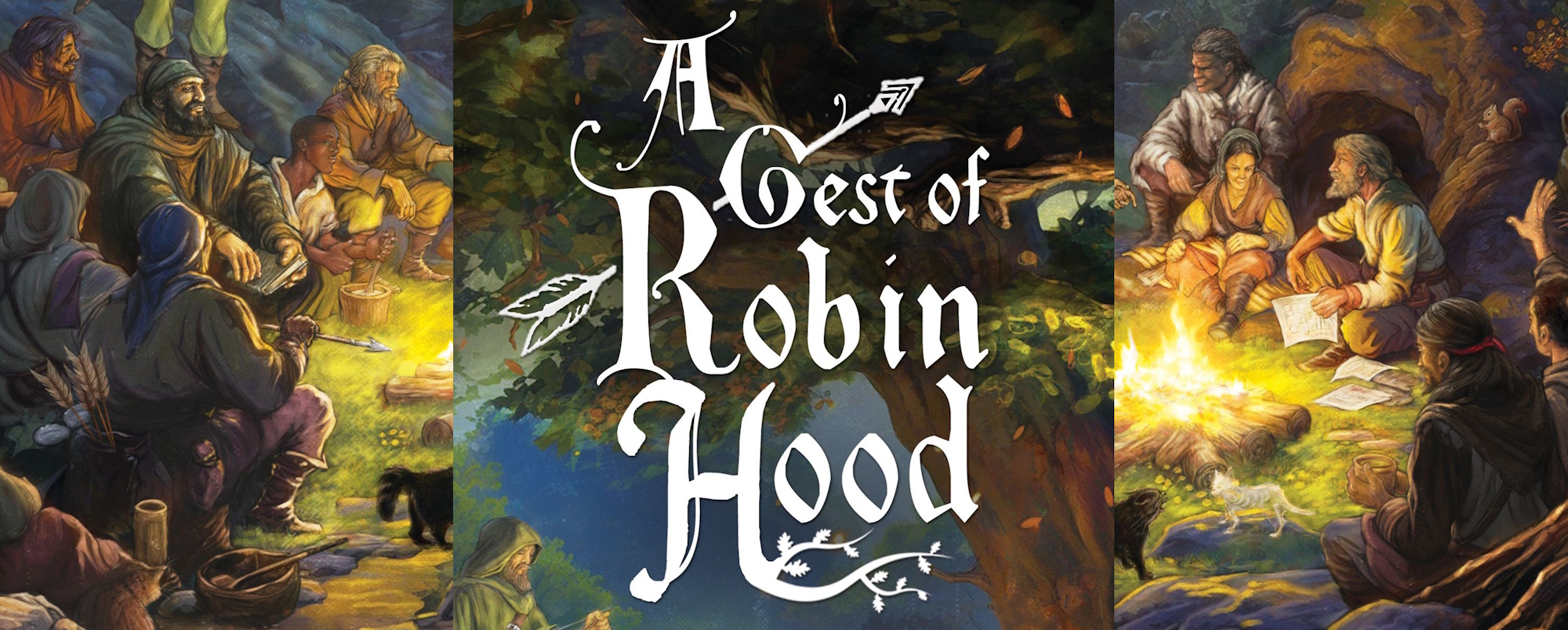
One of my professors believed that every generation needed to retell the story of Julius Caesar. In her mind, the story functioned as a sort of cultural tonic. Tyrant or hero, victim or opportunist — Caesar was a lens through which generations current and future might better witness themselves.
In playing Fred Serval’s A Gest of Robin Rood, the second installment in the Irregular Conflicts Series, itself a spinoff of the long-running COIN Series, the same could be said of everybody’s favorite forest fox. Is he a vagabond, robbing the rich for no other reason than because their wealth is there for the taking? Is he a lower-class hero, uplifting the poor? Has he been coopted by the gentlefolk, elevated to a lordling deprived of his privileges? Is he a crusader? A jokester? A kingsman? Does he venerate the Virgin Mary or has Maid Marian been invented to take her place? Eventually he’ll move into his gritty teenage years and relitigate the Battle of Normandy. Shhh. He gets embarrassed when we talk about that.
Those Dying Generations at Their Song

Playing Defenders of the Wild, a poem comes to mind: “Sailing to Byzantium,” William Butler Yeats’ lament of old age and concern over whether anything remains after this life. I considered recording a recitation to embed in this article, but you’d be better off hearing it from Dermot Crowley.
Choo Choo Choom

The concept behind Stephen Kerr’s Metrorunner seems like a misbegotten effort to put a finger on a pulse of what’s hot in board games. What are folks into these days? Trains. Netrunner. Oh my gosh. What if we made a game about trains and netrunning.
But it isn’t like some of my favorite board games aren’t about wackadoo topics. For all I know, some combination of turnstile-jumping and encryption-cracking is poised to become my favorite mashup of all time.
Still could be. Won’t be Metrorunner, though.
Spot the Difference

I’ve never seen a tutorial quite as apt as the one that begins Perspectives. Designed by Matthew Dunstan and Dave Neale, Perspectives is a detective game. You know the drill: across three cases you will assemble evidence, match serial numbers, and answer a string of questions to determine whether you’re the next Encyclopedia Brown or a brown paper bag. The wrinkle is that you can only see a portion of the evidence. Mayhap a perspective of the evidence. See where we’re going with this? As wrinkles go, there aren’t many quite this redefining. It’s less of a wrinkle and more of an origami fold, a crease that transforms the entire structure into something new.
Space-Cast! #39. Arcing

Ever heard of Arcs? Cole Wehrle has! Today on the Space-Cast!, we’re joined by the little-known indie designer himself to discuss Arcs from a few unusual angles: the debt it owes to trick-taking, the many literary inspirations behind the game, and its unusual development process. Also of note, some comparisons between Arcs and Brian Boru, a sidebar book recommendation, and Wehrle’s wariness of Balatro. Truly, we’re covering everything!
Listen here or download here. Timestamps can be found after the jump.
Country Directions

“Landmarks” isn’t the best title for Rodrigo Rego and Danilo Valente’s Landmarks, and not only because a heap of other board games go by the same moniker. (We are all of us indentured to SEO.) Rather, it’s because “Landmarks” sounds like one of those games where you’re visiting a bunch of state parks. Bo-ring. It deserves better.
Picture the solipsistic vocabulary terror of Vlaada Chvátil’s Codenames, the cooperative nature of its own spinoff Duet, and an adventure that sees players dodging traps, digging up treasure, and managing a dwindling water supply. That’s Landmarks. It’s sublime.
Apart from that title. Landmarks. Landmarks. Blech.
Gonna Decimate Them Like You Did to Me

I’ve never read Robert Kirkman’s Invincible, and I’ve watched exactly one (1) episode of the animated show. In that time, my takeaway was that this was a more grounded, gritty, and realistic — yeah, we’re stretching that word to the breaking point — approach to superhero mythology. Kinda like every other modern take on superheroes.
What I’m saying is that I don’t have any nostalgia or reverence for the source material, no allegiance that would prevent me from telling you that Kevin Spak’s Invincible: The Hero-Building Game is a big ole stinker.
But in a twist worthy of a penultimate issue’s final panel, Invincible isn’t a stinker. Not at all.

 SPACE-BIFF!