Author Archives: Dan Thurot
That’s No Shadow Moon
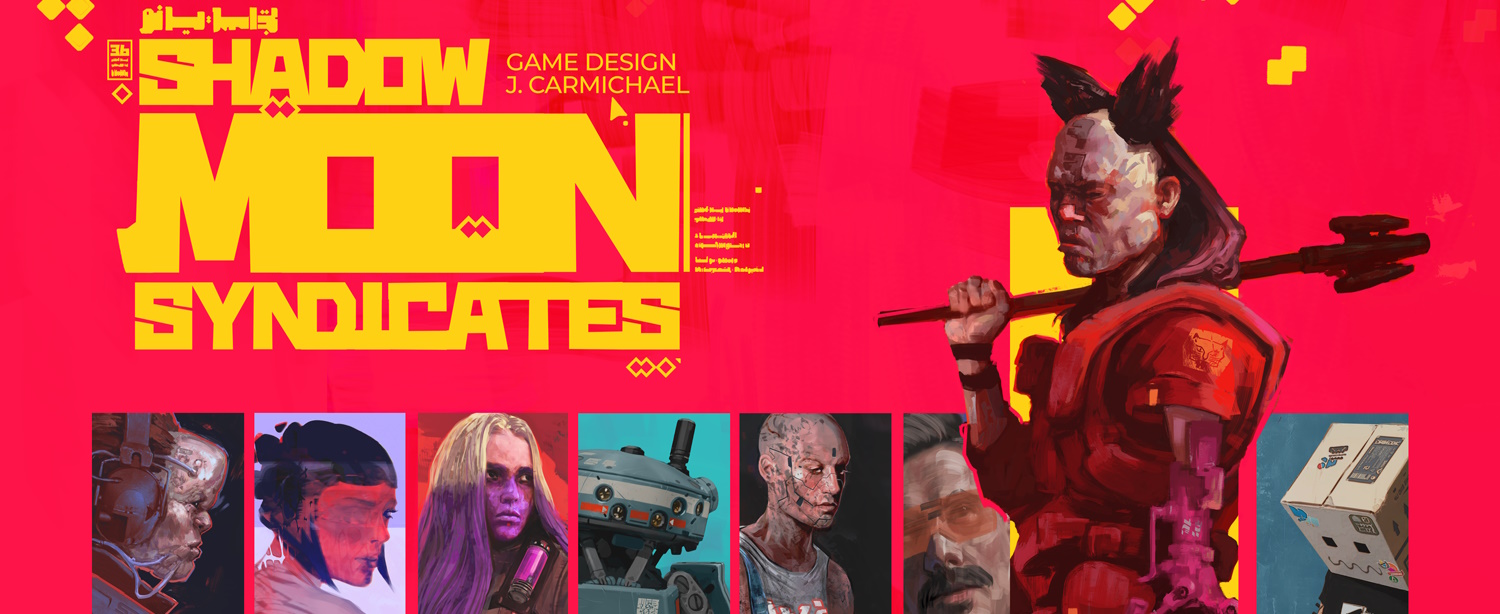
Shadow Moon Syndicates, the second design by Jarrod Carmichael, brings out my inner cynic. It might have something to do with the setting, all grungy piping and colorful gangs grappling over the guts of a husked-out asteroid. Or it might be the particular blend of chip-stacking, hand-building, and shifting objectives, which feels like somebody played Paolo Mori’s Ethnos and wondered why it wasn’t more complicated.
But then I come back to the star of this particular showdown: the cards. Oh, those cards! What marvelous little bastards!
Gouge Out Thine Own Eye

What if Magic: The Gathering were way nastier? That’s too clean a pitch for Personal Vendetta, the auteur project from designer-illustrator-publisher Nick Meccia, but it communicates the gist. It’s a rare game that sports such congruity between gameplay, artwork, and internal motifs; everything about Personal Vendetta both unsettles and services its central notion that to annihilate your clones, you must also annihilate a portion of yourself.
Be warned, this one isn’t for the faint of heart or stomach. One of my oldest friends got woozy just drawing from the deck.
Strip Poker

Peter Hayward is on a roll. This year alone he’s released Converge and Things in Rings, and now he’s enabling my lifelong dream of cheating at cards in Las Vegas (and getting away with it, obv). Vegas Strip offers all the glitz and false glamour of its titular location, plus the satisfaction of thieving from the biggest and most legalized thieves of them all. It’s a real hoot.
Three Phases of Six Moons

The past is not a foreign country but an act of imagination, one that can have greater or lesser fidelity to something that once happened, but one that also remains forever out of reach. The best we can do is stretch and maybe, just maybe, graze fingers with the unnameable.
Like true history or old starlight, City of Six Moons is an unrecoverable thing. Created by Amabel Holland, this is a radical design from a designer known for pushing boundaries. By now you may have heard of the game’s conceit: in a medium defined by its attempts to crystallize authorial intent as perfectly as possible, City of Six Moons is instead presented in a foreign language, offered to Holland by alien visitors and then transmitted to us as a signal garbled over the airwaves. Somewhere underneath the static is a playable game. On our plane, the designer refuses to clarify any rules or offer correction.
Over the past four months, I have grappled with City of Six Moons. I have studied its rulebook by lamplight and fallen asleep with its symbols dancing under my eyelids. This is the story of how I translated the game — or, perhaps, how I didn’t.
Intertidal Zone

High Tide is wonderful. Designed by Marceline Leiman and currently only slated to be sold in limited quantities at the forthcoming Indie Games Night Market in December, its petite format conceals surprising breadth, the way a seashell might contain a mollusk or hermit crab or the whole rounded cacophony of the ocean.
Much Delayed

It’s unclear what to make of Expect Delays, the two-player board game by Patrick Brennan. This head-to-head affair locks rival subway operators in a petty grievance to move the most locals, snap up all the express passes, and gunk up one another’s lines with tourists. They wield preternatural command over which trains break down or get repaired. I get the feeling that Brennan has never been stuck in traffic.
But at least its play-space looks great.
On Banditry
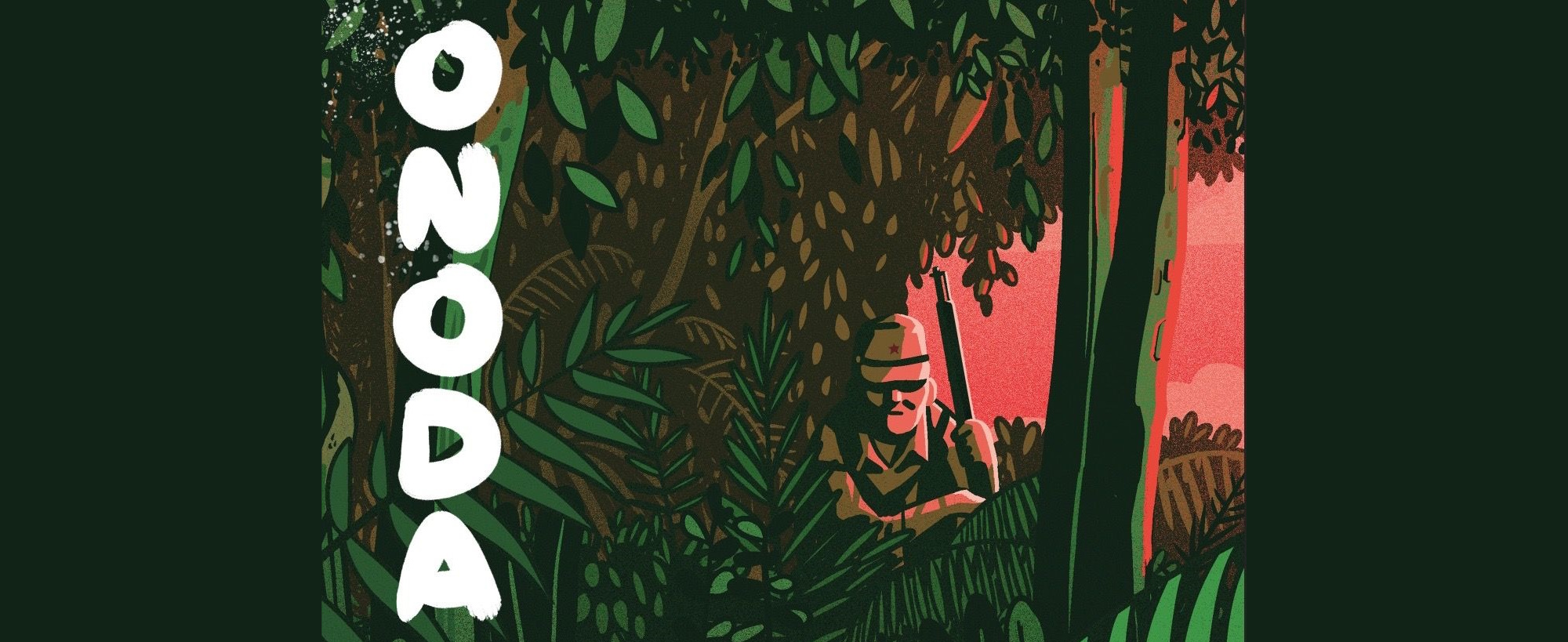
In 1944, during the height of the Second World War, a young intelligence officer named Hiroo Onoda was deployed to Lubang Island in the Philippines. Only two months passed before American and Philippine Commonwealth soldiers retook Lubang. Yet Onoda continued to fight, first with a trio of companions and eventually on his own, until in 1974 he was ordered to stand down by the same superior officer who had commanded him to continue the fight at all costs. When he surrendered his sword and rifle to President Marcos, Onoda became the second-longest holdout of the Imperial Japanese Army. He had been fighting for nearly thirty years.
Onoda’s story has taken on legendary proportions. His autobiography, No Surrender: My Thirty-Year War, was an international bestseller. German director Werner Herzog authored a fictionalized account in The Twilight World; French director Arthur Harari co-wrote and shot a film, Onoda: 10,000 Nights in the Jungle. These depictions were many things: poetic, darkly humorous, paeans to duty and masculinity and tenacity. Also, they were carefully scrubbed of the thirty murders Onoda’s band had committed against civilian farmers.
Now Onoda is a board game by Pako Gradaille. Like previous tellings of Onoda’s story, there’s a certain degree of credulity to Gradaille’s version of events. In a surprise twist, however, in cardboard this story has finally received a more complicated, tentative, and morally textured accounting.
Another Imperium

With a few years behind us, returning to Imperium is like catching up with an old friend. A messy friend, one who hasn’t ever gotten their life together, but a good friend who’s never given me reason to regret their acquaintance. When Nigel Buckle and Dávid Turczi first unveiled their hybrid deck-builder / civilization game, there was so much material that it had to be split across two separate boxes, Classics and Legends. Horizons adds half as much again to the collection, and shows these designers once again at their most creative.
Intergalactic Knizia, Verse Three: Orbit
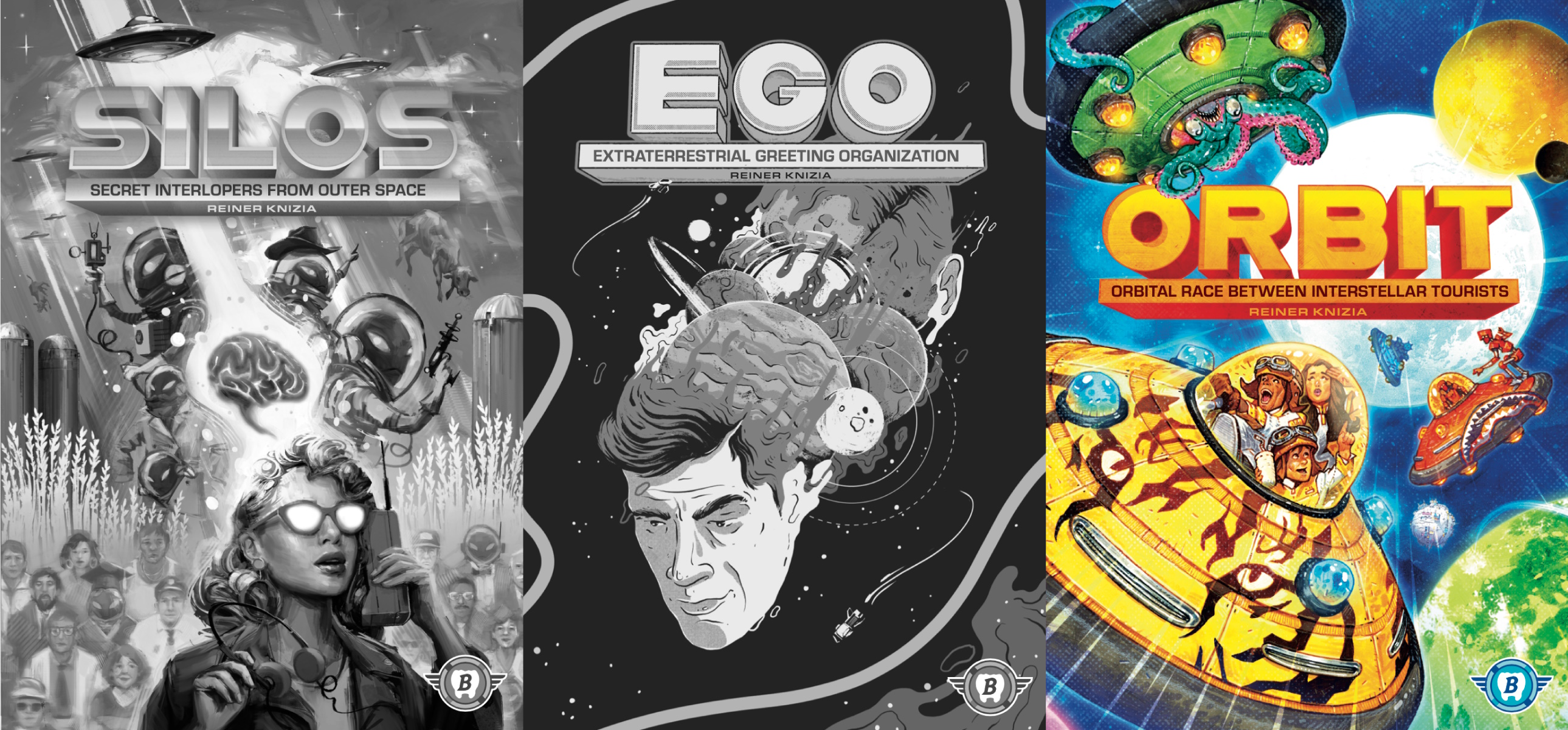
It is the future. The year 2,000. After enduring alien abductions in Silos and a testy diplomatic delegation in Ego, humanity has become just as insipid as ever. That’s the subject of Orbit, the third and final volume in Reiner Knizia’s intergalactic trilogy and the first title of the saga that doesn’t improve on one of the Good Doctor’s older games.
As reluctant as I am to say it, it shows.
Intergalactic Knizia, Verse Two: Ego

As luck would have it, getting abducted by cow-loving aliens isn’t the worst thing to ever happen to humanity. That’s right, Reiner Knizia’s Silos provides an unexpectedly happy ending. No longer prod-fodder for extraterrestrials, we now stand on the cusp of entering the intergalactic community.
Ego is the second volume in Reiner Knizia’s intergalactic trilogy. With a single vessel prepped for interstellar voyage, diplomats from every nation are ready to explore the farthest reaches of deep space. Their five-year mission: to make friends with strange new peoples; to swap technology to our mutual benefit; to hopefully not embarrass our species too badly. Don’t count on that last one.

 SPACE-BIFF!