Business Bazongas

I like weird games (derogatory) almost as much as I like weird games (complimentary).
Belinda’s Big Bonus is a weird game (weird).
Having your game designed by Amabel Holland sets certain expectations, despite any difficulties in pinning her down to a single genre or register. Similarly, basing a game on an erotic novel series, in this case Belinda Blinked by Rocky Flintstone, also sets certain expectations. Yet Belinda’s Big Bonus isn’t especially erotic. I wouldn’t call it funny, either, although it’s possible I’m just not in on the joke. Neither does it strike me as “so bad it’s good.” Mostly, it’s twice as complicated as one would expect from a licensed game. It reminds me of nothing so much as one of those business guys whose entire life is conducted through Google Calendar invites.
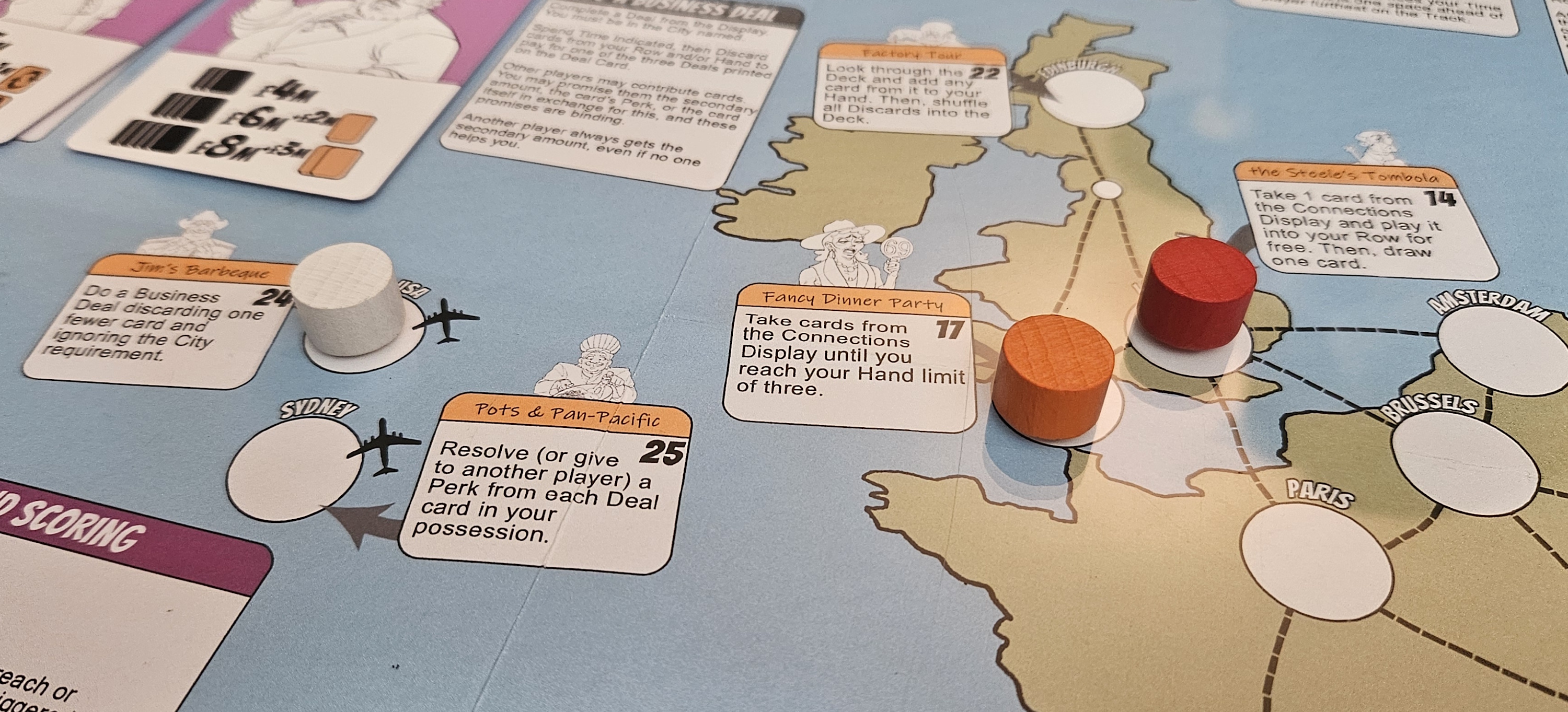
There is travel, but this is not a travel game.
First of all, we should open with a disclaimer. I know very little about Belinda Blinked. I considered reading the first one as research for this review — “research,” I say — but decided against it. Sometimes knowing less is knowing more. That’s our motto here in the United States. It’s written on our dollars and everything. While scant few people are going to play this thing sans foreknowledge, I happen to be one of them, and if there’s any one quality a critic requires, it’s the resolute belief that one’s experiences are valid no matter how uninformed. Here I stand.
Which is to say, perhaps Belinda Blinked is about managing one’s schedule, suffering from jet-lag, and mixing up which actions cost which payment. Maybe. In which case, may I offer my deepest apologies to Holland, Flintstone, and Belinda herself. Forgive this prude, for he knows not what he do.
At the game’s outset, players step into the not-yet-broken-in business shoes of interns at Steele’s Pots and Pans. Their task is to earn some millions of pounds for the company. They do this by…
Look, this is the first problem with Belinda’s Big Bonus, and it’s a doozy. As any gaming evangelical knows, it’s hard enough describing a board game to newcomers, and Belinda’s Big Bonus is no board game for newcomers. There are mechanisms aplenty in this trunk, packed together like someone mixed the first-aid kit with the snack bag. There’s a calendar timekeeping system, the kind popularized by Martin Wallace titles, and cards that may exist either in a market, your hand, or a tableau, with interactions dependent on their current source — except sometimes they can be spent from two of those places, and the rulebook is conversational and, although it’s amusing, this doesn’t lend itself to learning the damn thing.
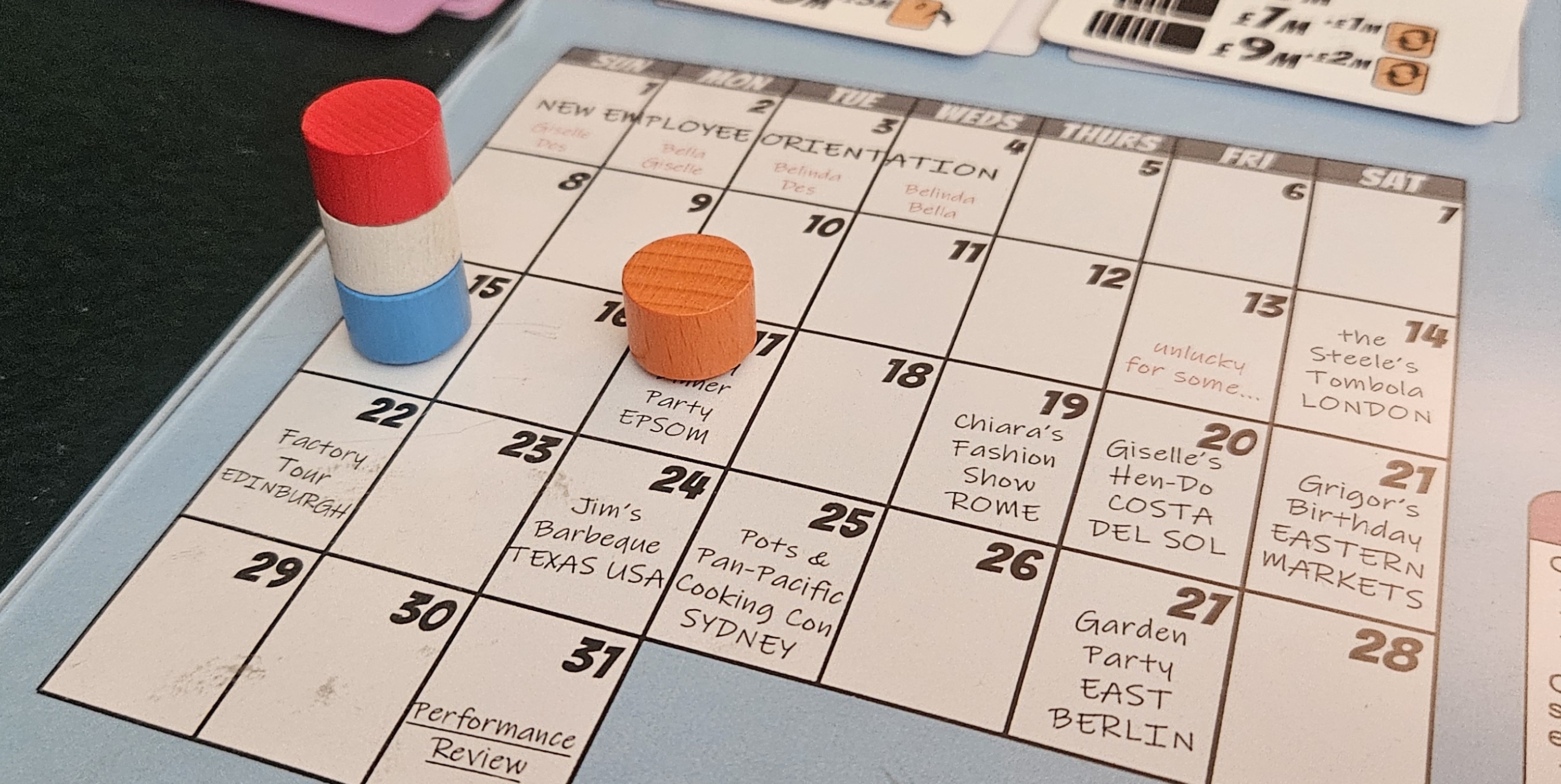
Scheduling, but this is not a scheduling game.
Here’s the short version. Turns are variable, conducted by whomever is farthest back on the calendar. On those turns, you spend some amount of time to make connections — which is to say, put cards into your tableau from either the market or your hand — do spy stuff — gain cards into your hand, from the deck this time — rest to refresh the cards in your tableau, make a business deal by throwing away the cards you painstakingly contacted or spied upon — and, in the process, try to persuade your fellow players to spend some of their cards instead, because these business deals are often collaborative and dole out benefits to multiple players — or perhaps visit a calendar event on the appointed date to gain some advantage.
If that sounds confusing, try teaching it. I’m no stranger to Holland’s more tangled designs, but this one found the most uncomfortable spot on the seesaw between complexity and anticipation: the fulcrum. Belinda’s Big Bonus feels like it should be a light game, looks like a light game, has that licensed light-game air to it, and then, kapow, but a kapow more like a punch to the schnoz than something erotic, it smacks you with a clutter of ideas.
For all that, there is an interesting game in here. The gist is that you need to build out your tableau and hand in order to spend those same cards to make business deals. Along the way, your characters provide something like an engine.
There’s even a narrative to the whole thing. Sir James Godwin makes it easier to attract Bella Ridley to your work group. Meanwhile, James Spooner, the Laird of Gretna Green, brings Cosmo Macaroon into the fold through some act of espionage. Later, your connections to Bella and Cosmo will help you make a deal in Texas, USA for nine million pounds sterling. Unfortunately, that same deal enriches a rival intern by five million pounds, so you try to squeeze some contribution from so-and-so at the table rather than merely handing the commission to whichever competitor is sitting in last place.
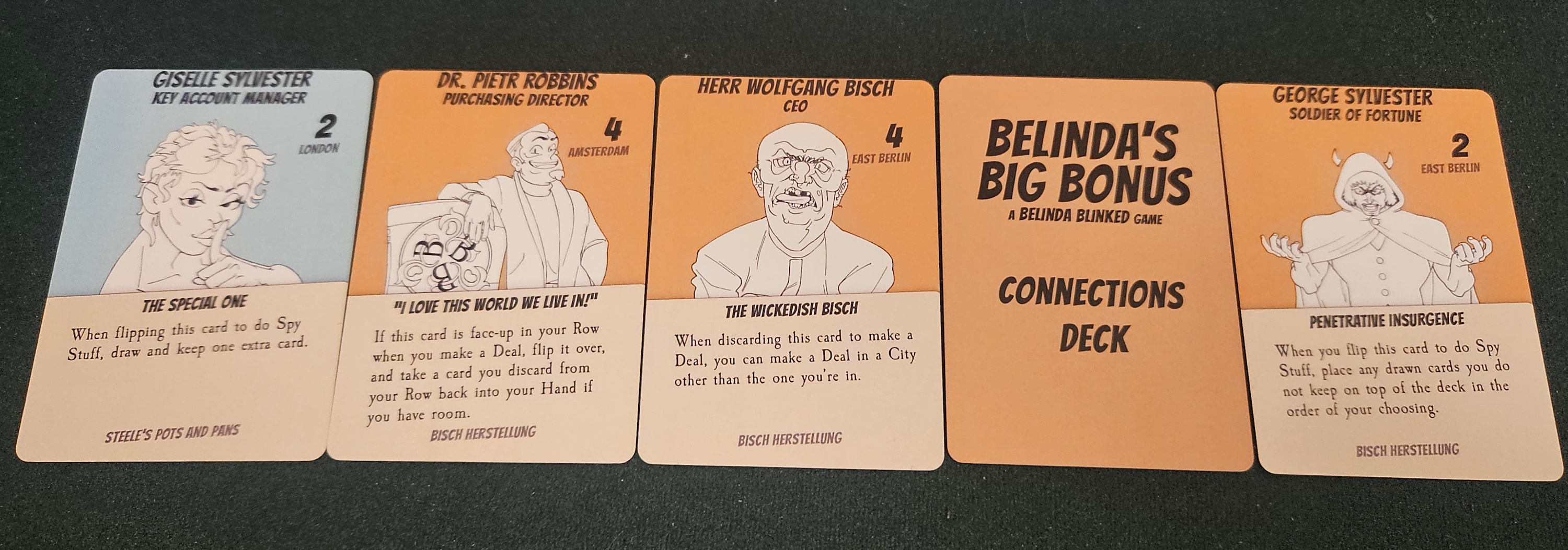
Odd people, but this is not an odd people game… well, scratch that. It’s an odd people game.
Those are genuine dramatic and narrative beats! Along the way, though, Belinda’s Big Bonus is burdened by bloated bits. It’s easy to paint oneself into a corner, for instance, by spending too many cards on an eager deal. This can leave one player sitting around with very little to do but play catch-up. And, hey, that’s their fault, right? If we were playing one of Holland’s cube-rail games, such a possibility would act as evidence of the game’s forthrightness. But here, the possibility comes across less like an honest appraisal of the perils of betting everything on some bad stock tips, and more like an unexpected heel-turn on the game’s part.
Here’s another example. Belinda’s Big Bonus includes the possibility of a traitor moment. When the game concludes, the player in last place might reveal that they now hold the majority of connections to Steele’s rival firm, Bisch Herstellung. This turns them into “the special one” and wins the game in a sudden coup. Cool!
Except, like everything else in Belinda’s Big Bonus, the rules governing the reveal are so text-heavy that it doesn’t feel like an amusing capstone. It’s closer to checking a technical manual to see if you’ve successfully told a joke. It isn’t hard, exactly. Nothing in the game is hard. But it’s less fluid than it ought to be, keeping everybody’s attention on these mismatched processes rather than on the parade of characters and situations strutting across the table.
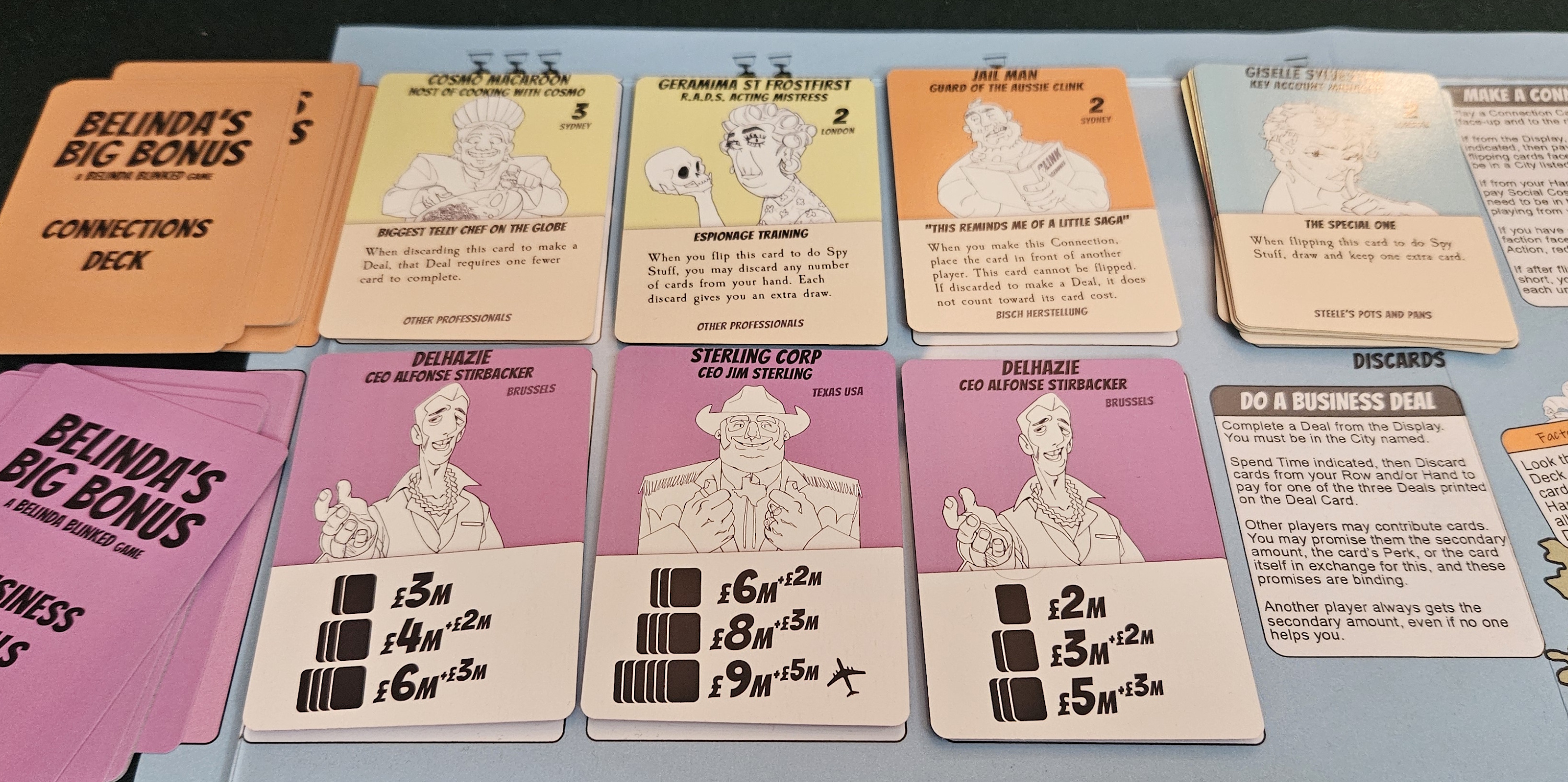
Buncha great hangs.
Then again, maybe I’m not in on the joke. Maybe a Belinda Blinked game should be more complicated than most licensed titles. Maybe it should buck common sense by being an erotic game with no eroticism, a business game with no head for business, a whimsy with lots of rules printed on the board. Maybe it should be a big meta-joke at my expense. Maybe this game doesn’t exist for anyone but me, and it was sent to me solely so that everybody could point and laugh and say, ha ha, you took our prank earnestly, you big stupid fool, you moron, you lame-o.
That would be okay. I don’t mind. In the game’s cast of characters, I feel most like the guy anxiously cleaning a stain from his tie. I don’t need to get everything. Sometimes, I even revel in how little I understand. For example, I’ve had a lovely time not understanding Belinda’s Big Bonus. Maybe you’ll have a lovely time not understanding it as well. Just don’t say I didn’t warn you.
A complimentary copy of Belinda’s Big Bonus was provided by the publisher.
(If what I’m doing at Space-Biff! is valuable to you in some way, please consider dropping by my Patreon campaign or Ko-fi. Right now, supporters can read about which films I watched in 2025, including some brief thoughts on each. That’s 44 movies! That’s a lot, unless you see, like, 45 or more movies in a year!)
Posted on April 6, 2026, in Board Game and tagged Amabel Holland, Belinda's Big Bonus, Board Games, Hollandspiele. Bookmark the permalink. 3 Comments.

 SPACE-BIFF!
Important context: Belinda Blinked is the self-published erotic novel at the heart of the very funny podcast My Dad Wrote a Porno, where the author’s son reads a chapter of the book out loud two of his best friends every episode. The novel is completely incoherent and not at all sexy, and it sounds like this board game did it justice
I am familiar with and enjoy The Belinda Blinked source material. I certainly had a time not understanding Belinda’s Big Bonus, and it was probably one and only.
Ouch! I’m sorry to hear that, Ben.