Silver & Gold & Cinnabar & Verdigris

When I play Inkwell, I think about other games. That isn’t a slight on Inkwell’s quality, necessarily, nor a reflection on my fidelity to whichever title happens to be on the table at the moment. It’s just the sort of game that sets the mind to wandering. I have yet to play it without somebody mentioning Azul, for instance, and Sagrada isn’t a distant touchstone either.
The big one, though, is Alf Seegert’s Illumination, an overlooked quip from five years back that also dressed up its players as monks illuminating manuscripts under the stern eye of a passing abbot. And while it might seem like the parallel is entirely in the setting, it’s really the gentleness that does it, the warmth, the do-no-harm-ness of the whole thing. As a game, Inkwell isn’t only about monks; it’s downright monkish.
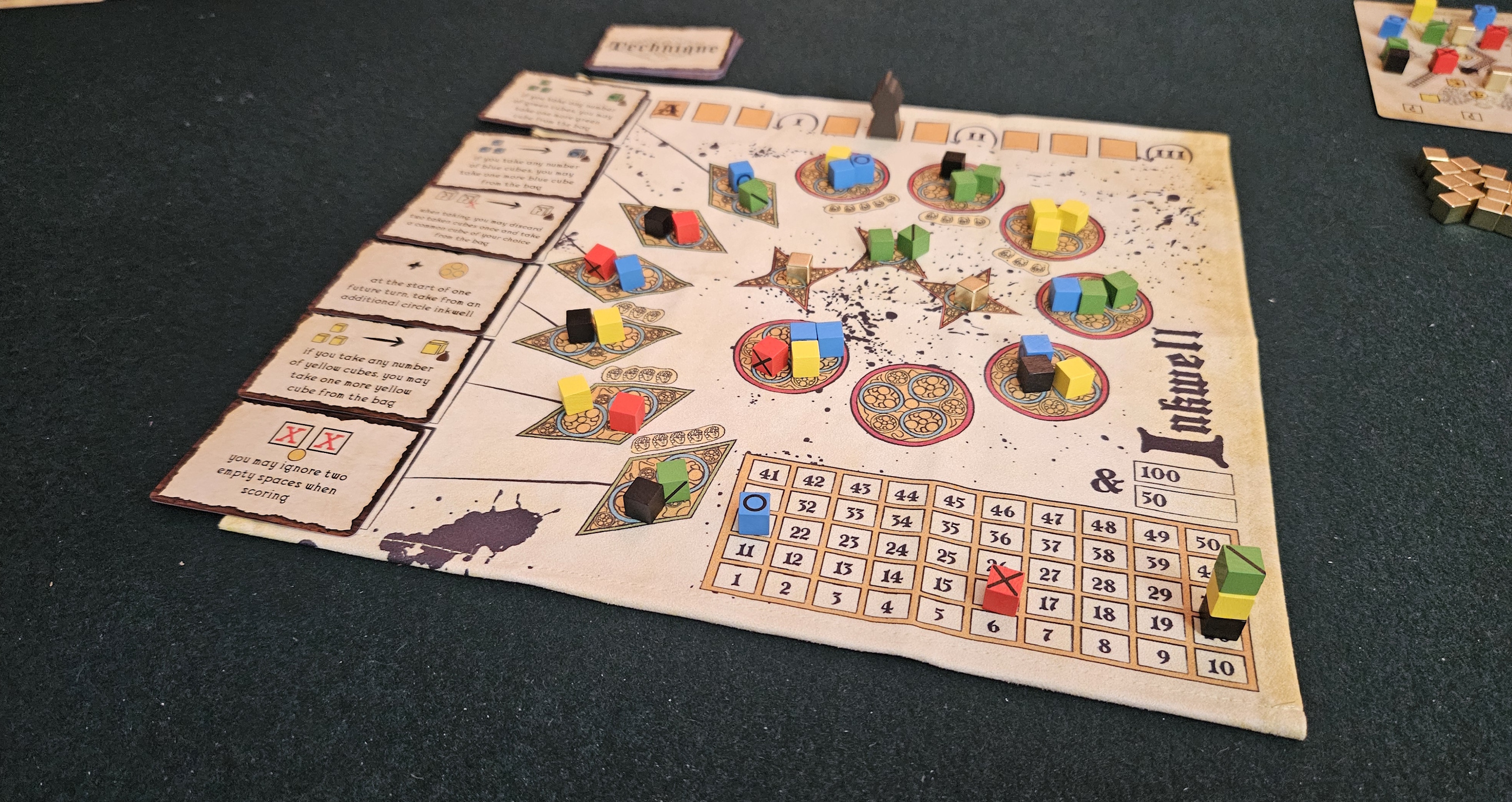
Ah, many pots of pigment. A monk’s dream.
It begins with a page. Not quite a blank page, although one imagines the parchment fresh. For the sake of gameplay, the page is scrawled with the outlines of what will soon become vibrant illustrations: saints and angels, wreaths and knots, lions penned by someone who has clearly never seen a lion, scenes of Eden, holy babes that appear twice of age of the Lord at his crucifixion. Touching these illustrations are squares, each the size of a small wooden cube. Sometimes these squares appear in other spots, too, free of any illustration, but still ready to accept daubs and brush-strokes.
Your goal is to fill that page with color. Reds, blues, yellows, greens, deep charcoal blacks. Maybe some gold leaf. Gold is wild, capable of making up a shortfall elsewhere — because it’s gold, obviously — but it’s also sometimes required in special circumstances. Some spaces are blank, beckoning for leftovers. That or scoring multipliers.
These cubes must be drafted from the central mat, itself represented as a swirl of ink-pots. There are three types to draw from. Circular pots hold the most ink, three cubes at the beginning. Star spaces hold gold, but usually only a single cube’s worth, marking them as a tradeoff between quality and quantity. Diamonds are the most interesting, offering a meager two cubes, but also technique cards, special abilities that gradually hone your monk’s abilities.
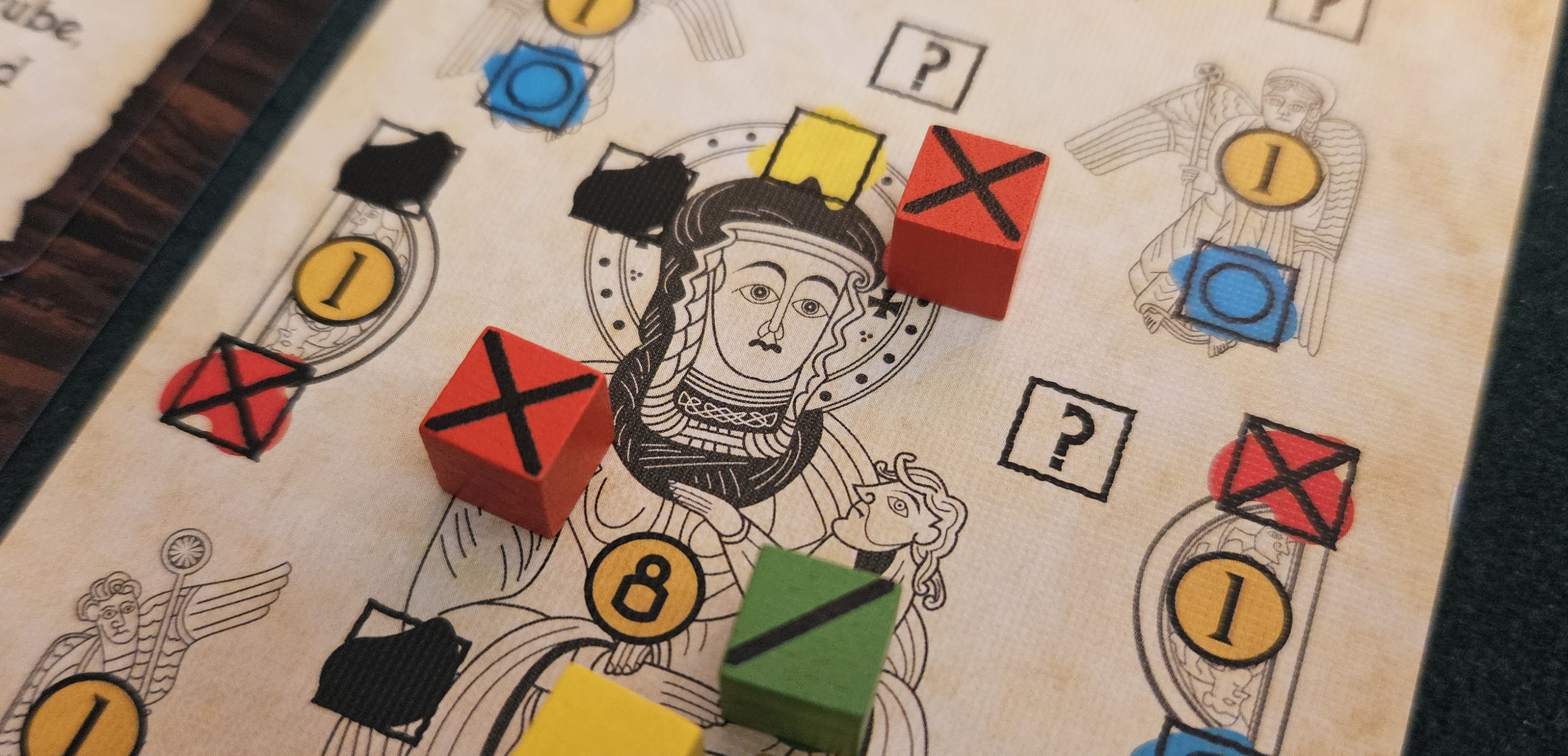
Creepy adult baby Jesus and all.
One turn at a time, players go around and select which inkwells to draw from. There’s some potential for blocking, but it’s a relatively remote concept here, especially in the page’s early moments when any color will serve. The effect is trancelike, meditative, as close to multiplayer solitaire as design collective Jasper Beatrix has gotten thus far. The most burdensome restriction is that you aren’t permitted to draw from an inkwell unless you can actually use every last drop and employ every technique card. This makes blocking even less likely, instead reinforcing the game’s gentle proceedings. It’s possible to grab as many cubes as possible, but that might make the page difficult to fill. Better to proceed steadily, like the proverbial tortoise.
There is some pressure, however light. Whenever one of those varieties of inkwell is depleted — circle, star, or diamond — the abbot marches one step across the mat. He’s here to oversee your work, and at various points he may force the table to turn the page. This scores all those illustrations and color cubes, potentially leaving some work undone. It’s better to turn the page of your own volition, at the time of your choosing, but it’s hard to say exactly when the abbot will peek into the scriptorium to ensure the commissions are being fulfilled.
Over time, your accumulated techniques produce little engines, to use a game-word that would have meant something very different to our monks. But there’s some spark of the Latin gignere to these flashes of talent, reflected in the way they speak to an artistry now long displaced. Some techniques bestow extra cubes, perhaps when a specific color is drawn or the abbot marches down the hall, evoking the scribe, bent over his masterwork and taskmaster at once, carefully measuring every drop to its uttermost potential. Others let you claim cubes as a one- or two-time bonus, the medieval equivalent of double-dipping. Others still let you store a few cubes to the side, or rearrange them on the page, saving your palimpsest scrapings for reuse elsewhere.
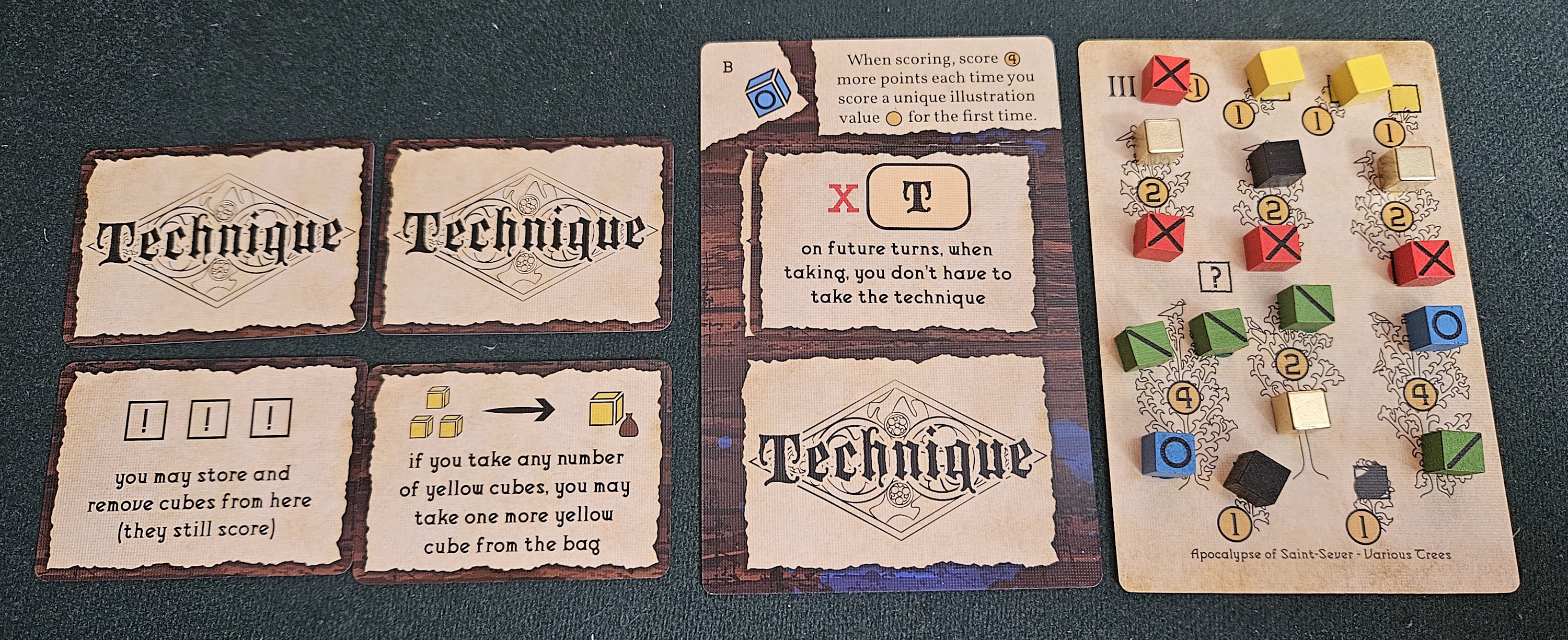
With the right techniques, the third page can be a breeze.
In some ways, Inkwell is also itself a palimpsest. There are traces of other games here, possibly better or more interesting games. The most pronounced is Azul; it’s impossible to look at the circular inkwells and not see that game’s rounded factories and Starburst-sized ceramics. There are other traces, too, impressions on the parchment that can still be made out despite the game’s clean presentation. Playing Inkwell, it’s hard to escape the feeling that we’ve gone through these motions before.
Of course we have, if only because nothing under the sun is new. None these actions are wholly novel. But Inkwell feels a little closer to its peers than some games. Especially Jasper Beatrix games, with their penchant for novelty and mechanical introspection. Inkwell is no Pacts, with its dissection of I-split-you-choose gameplay, no Here Lies with its decoupling of detective games from rigid logic, no Signal and communication, no Scream Park and tableau-building.
But for all its similarity to other games, there are still reasons to recommend it. For example, I appreciate the open-ended nature of its conundrum, one where each selection feels like another window into a broad decision-space, rather than a binary best or worst pick. It’s rare that a single inkwell feels like the answer to a puzzle so much as one more question. Another brushstroke, perhaps, another inlay of gold. Those other games use artistry as their backdrop; Inkwell, by contrast, feels like artistry. More specifically, it feels like that slender space between commercial reality — deadlines and managers, limited resources, coworkers who sometimes take the pigments you need without meaning any harm — and the aspiration to fashion something that will endure the centuries.
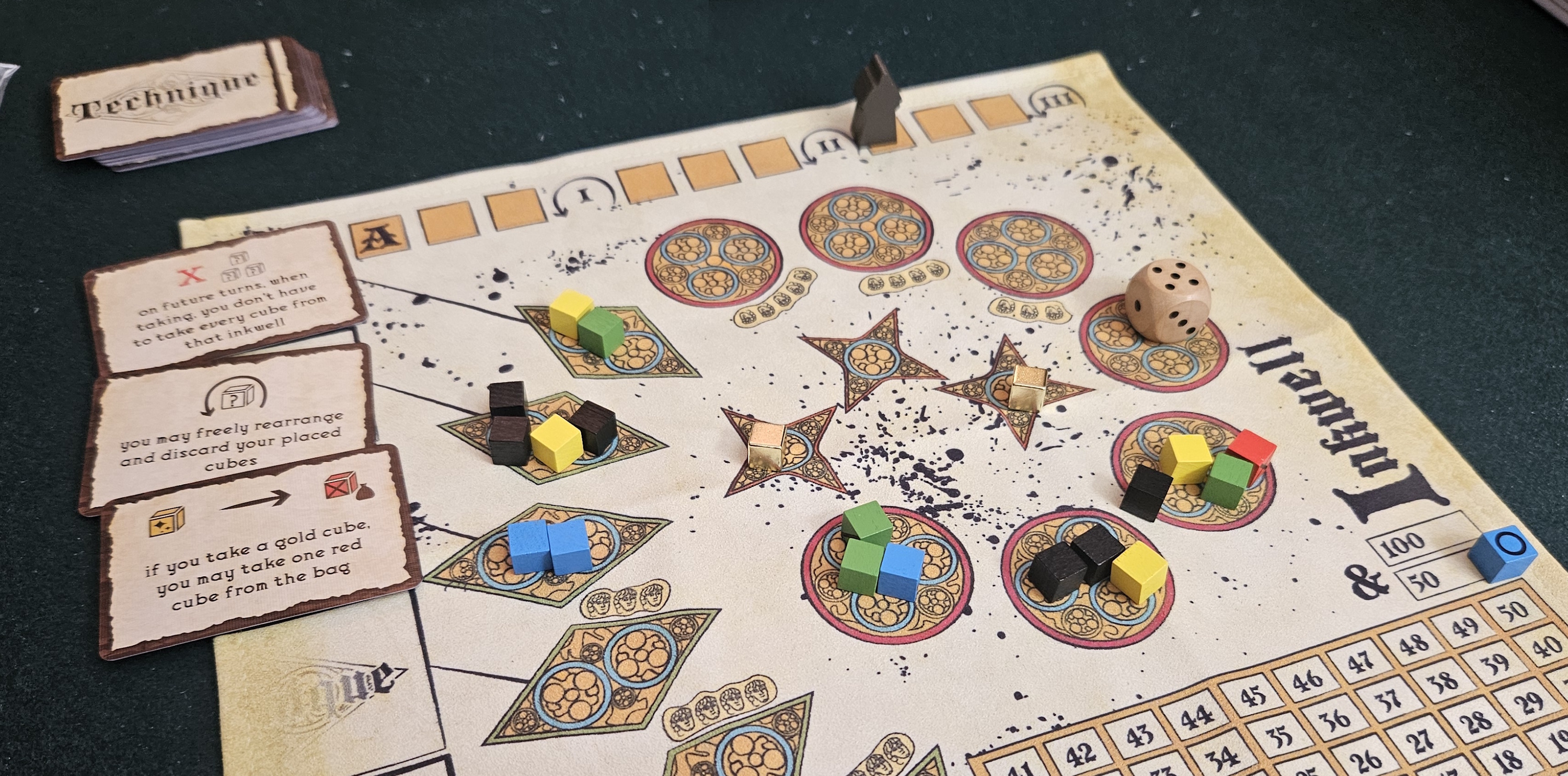
The foolish monk Dicelius, also known as SOLOBOT, offers a nice diversion.
Where does that put Inkwell, in the end? It’s hard to say. As a game, it occupies a peculiar middle ground. It lacks the brain-tickling nature of its heavier inspirations, the emphasis on puzzling and position, but ventures a little closer to its source material than those games have ever managed.
More than that, Inkwell is reassuring. It feels like a weighted blanket, the game equivalent of a movie like The Taste of Things, all soft sensation and creamy sunlight and lulled senses. The outcome is neither the strongest nor the weakest of Jasper Beatrix’s collective output, but offers a lovely and gentle visit to a faraway time and place nonetheless.
A complimentary copy of Inkwell was provided by the publisher.
(If what I’m doing at Space-Biff! is valuable to you in some way, please consider dropping by my Patreon campaign or Ko-fi. Right now, supporters can read about which films I watched in 2025, including some brief thoughts on each. That’s 44 movies! That’s a lot, unless you see, like, 45 or more movies in a year!)
Posted on April 2, 2026, in Board Game and tagged Board Games, DVC Games, Inkwell. Bookmark the permalink. 5 Comments.

 SPACE-BIFF!
I don’t suppose you had a chance to test drive the solo version?
I did! It’s basically a race to hit 100 points before a dumb monk, represented by a roll of a d6, brings the abbot down on your head. It’s pleasant, but not the most robust automata out there.
palimpsest is a fun word
Sure is! Sounds like something from a book about magic.
[scene opens as CLEESE in Abbot garb stands behind IDLE who sits hunched over a scrivener’s desk]
[CLEESE] “Looks good, looks good… oi, what’s with this baby, then?”
[IDLE] “This one? It’s the Baby Jesus, sir!”
[CLEESE] “Is it?”
[IDLE] “Yes, I’m quite proud of-“
[CLEESE] “Because what I’m seeing on this page is an ordinary baby. A plain, un-remarkable, un-divinely-sired, uninteresting in any way baby. One held in the arms of someone who an hour ago ate mushrooms they found growing on the stable floor.”
[IDLE] “Well uh, all babies look a bit alike, right?”
[CLEESE] “Do they? Are you saying our Lord and Savior is… ordinary? Just like any other to fall out of a virgin, eh?”
[IDLE] “I uh… I can put a bit more gold le-“
[CLEESE] “Gold leaf? Throw money at the problem?! No, what you can do is make sure the baby looks like our Lord! Everyone should know immediately that they’re looking at Christ Jesus, a child unlike any birthed before or since! And you can have it on my desk by sundown or you can pack your pens and leave!”
[IDLE] *mumbling* “Make it like Christ… oh, I’ll make it like Christ all right…”
[CLEESE then moves to JONES, also seated at a scrivener’s desk and making robot noises]