Job in Sparta
Gods & Mortals, designed by William Borg Barthet and Artyom Nichipurov — the latter of whom brought us the excellent Trick Shot and even excellenter Guards of Atlantis II — happens to be one of my favorite things: a total theological dumpster fire. There’s a purity to Graeco-Roman Polytheism, with its wild gods that are best placated or avoided. It isn’t until Hebrew and Christian religion start bellyaching about God’s goodness that the pantheon’s previous badness became — clap your hands between each letter — P R O B L E M A T I C. What does it mean when the Creator places a wager with his court prosecutor for a man’s soul? It means a problem for how we understand the universe. A big spoiled amphora of a problem.
In other words, Gods & Mortals is Greek myth by way of the Book of Job. As you might expect, it’s incredible.
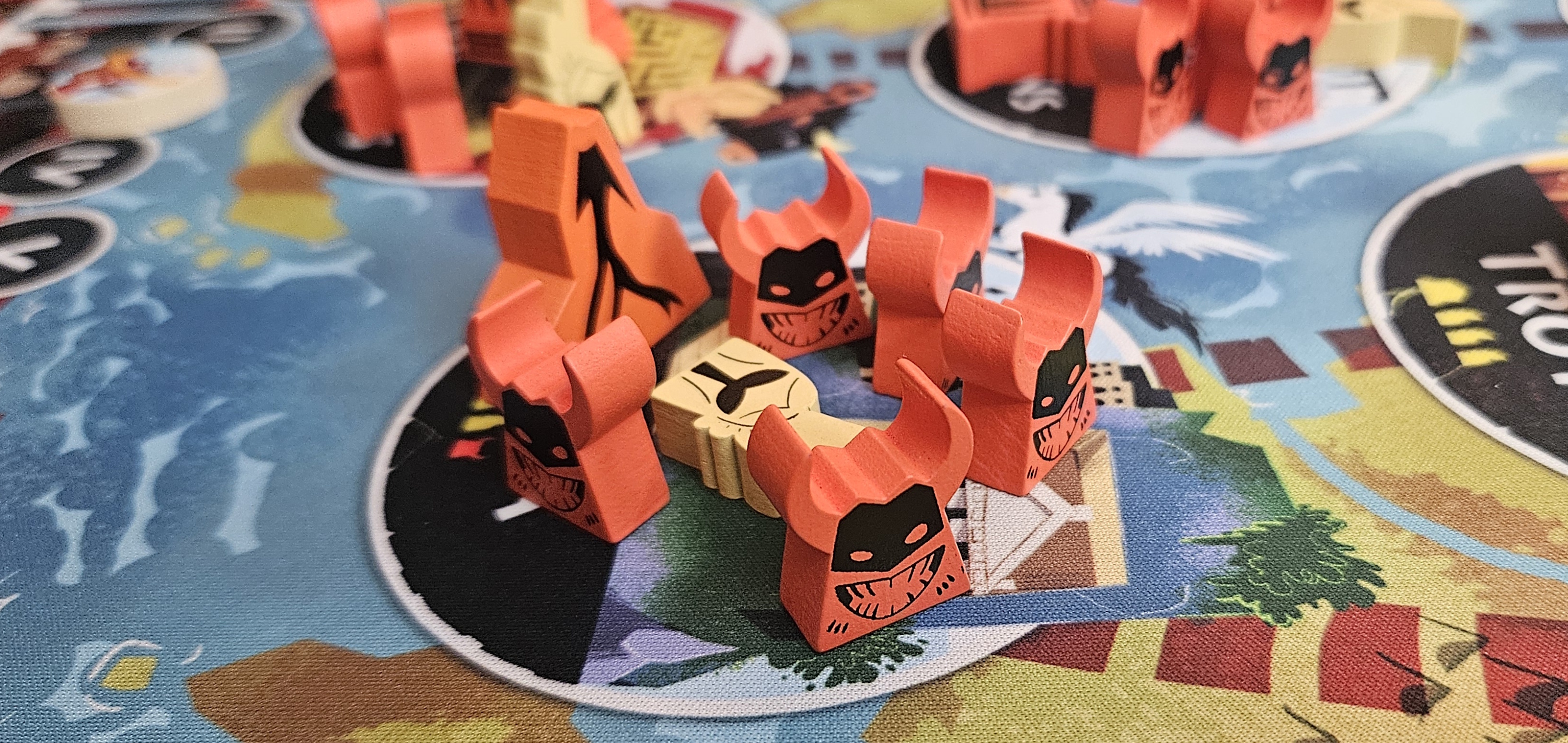
This trampoline game has gotten out of hand.
When Gods & Mortals opens, we receive a vision of the Aegean that’s half history and half myth. Humankind has split into four factions, each dominating roughly a quadrant of the known world. Proud Troy rules over one side of the sea, the Achaeans hold the opposite shore, the Minoans are doing the seafaring thing down south, and the northern land are ruled by the Amazons.
Don’t worry about keeping them straight. To you, an immortal, they’re yellow, blue, red, and green. You might as well distinguish between one species of beetle and another. The only reason you care that much is because the entire pantheon has gotten together and decided to wager some of their divine essence on the outcome of mortal affairs. Basically, you’re playing Age of Empires for money.
What follows is a freewheeling contest that plays out in two separate realms. On the table, mortal empires vie for control of territory, erect temples, and sometimes murder each other. Above it, the gods hoot and holler about their preferred sports team, trading wagers and nakedly calling for a rival’s star player to get benched. Betrayal is common. So is cooperation. Often those two go hand-in-hand, swapping places within seconds of the previous state of affairs.
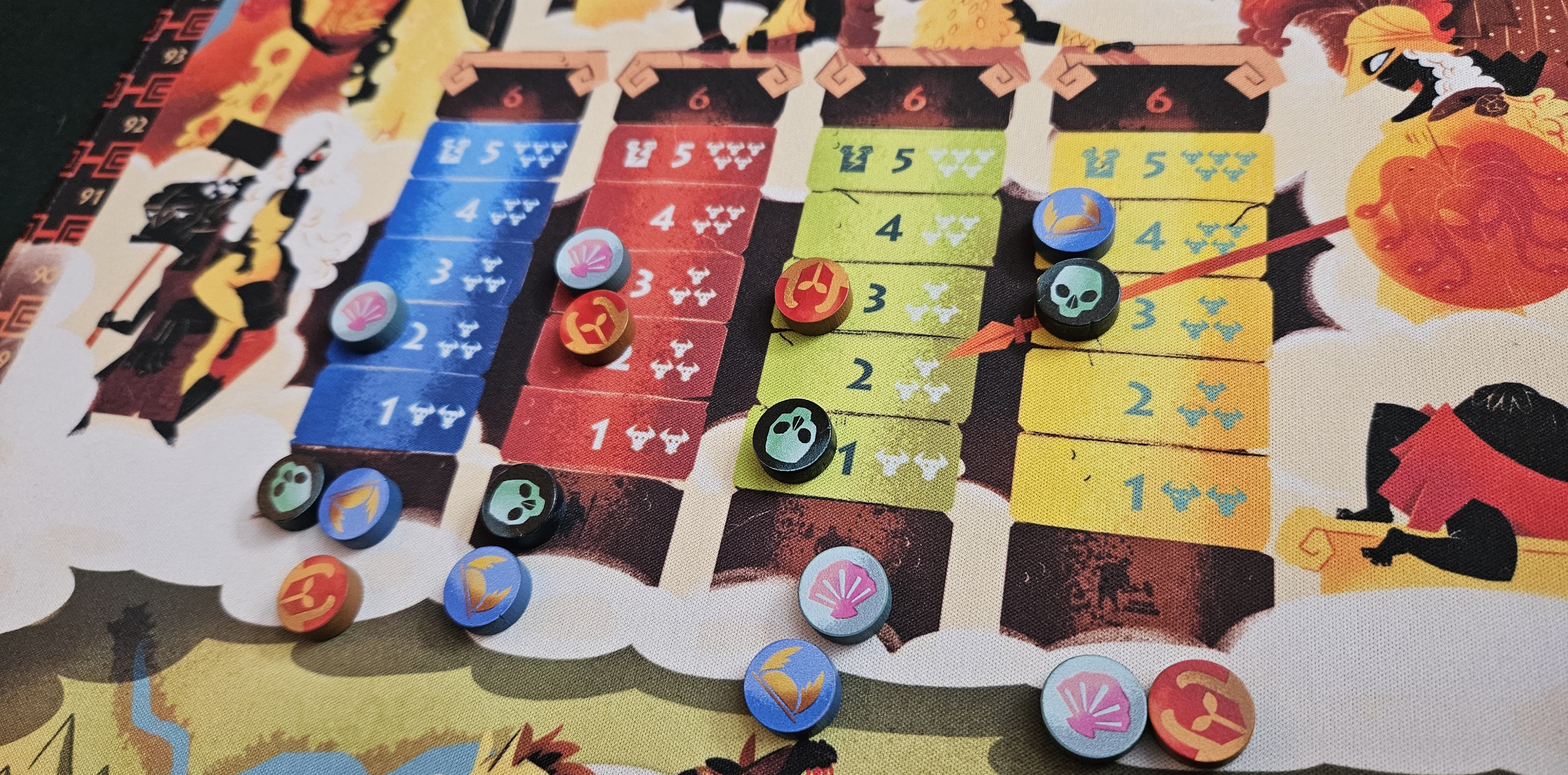
I like to believe the gods invest in my soul as well.
It works like this. When the round begins, every god is allowed to invest a portion of their divinity into the insect human dramas playing out below. The rules are strict. Only two kingdoms can hold your favor at a time. These increments are slow, only permitted one or two ticks at a time. Only one god can hold each level of favor within a kingdom, making it possible to block the interests of their fellows.
Perhaps most crucially, increasing your favor with a kingdom requires a proportionate investment of your divinity. If the Achaeans have been driven back to their city-state while the Amazons control a map-spanning empire, well, you’re presented with a conundrum: either buy Achaean favor at fire-sale prices, or cough up a premium for the Amazons.
Or betray them entirely. The strategy of Gods & Mortals is one of tactical investment and withdrawal. In essence, human factions are the joint-stock companies of your average cube rails title. Buying into a faction requires more divinity as they grow more prosperous. But so does your god’s potential buy-out. It’s tempting to bestow your godly light on a faction in ascent, but that could prove costly; on the flipside, spending too much time on a failed empire might prove catastrophic. We could render this as folksy wisdom. Buy low, sell high. The bigger they are, the harder they fall. Don’t date crazy.
And then, bets placed, the gods shift their attention to the mortal realm. You didn’t expect the gods, of all beings, to place a wager without leaning their thumbs and/or lightning bolts on the scales, did you? Even in the Book of Job, the foremost text on deities with compulsive gambling disorders, the spurned Creator sends a whole whirlwind to browbeat the poor guy into recanting his frustration.
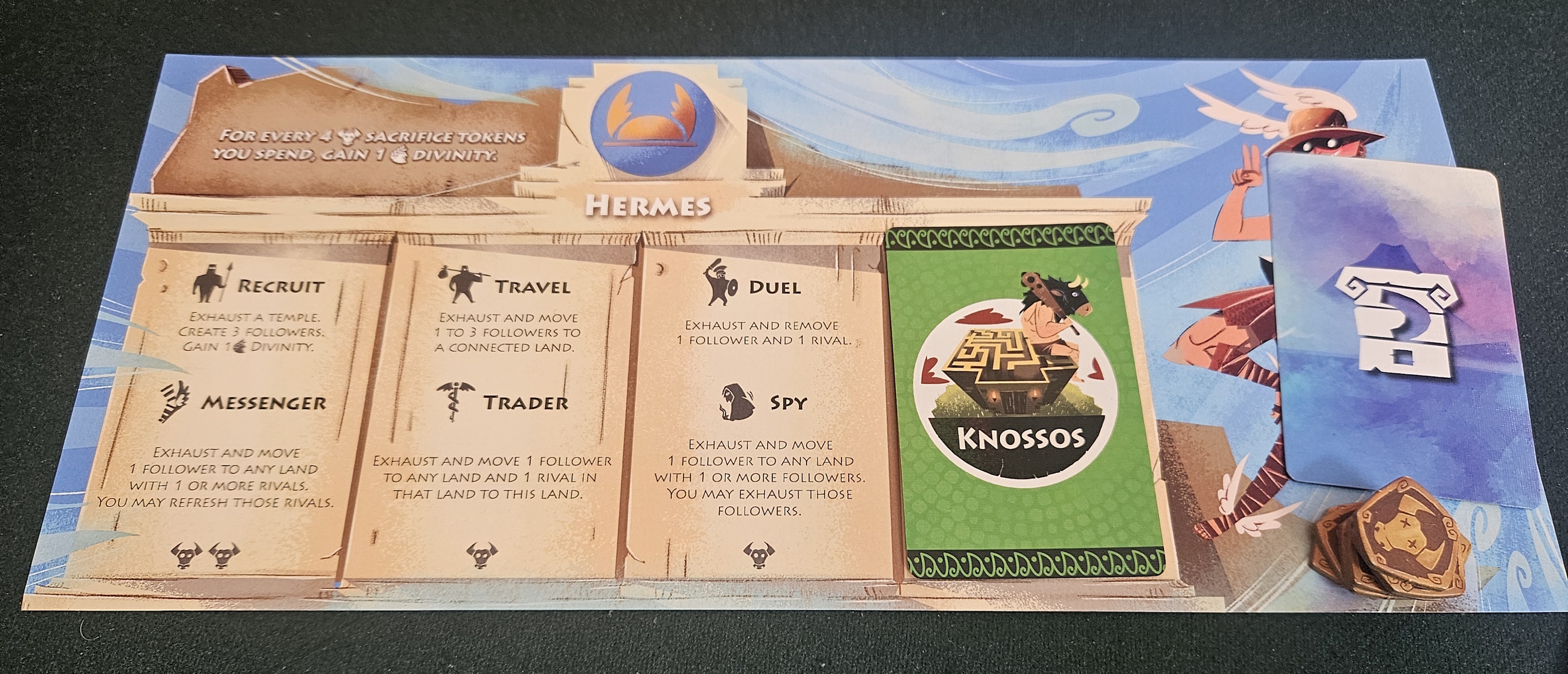
Each god brings their own strengths to bear.
This phase occupies the bulk of a round. Going around the table four times, each god takes turns manipulating the mortal wars, expansions, and offerings of the Aegean. As with the previous wagers, there are stark limitations. The short version is that you can manipulate mortal events quite broadly, but only provided you’re holding the right cards, the desired action is still available, and, if you’re going for one of the more powerful options, have enough sacrifices on-hand.
In practice, this strikes a tight balance. On the one hand, it’s exhilarating how transformative your powers can be. Some of this depends on your divine identity. Artemis can guide the bowstring of an anointed hunter to slay rivals in multiple foreign lands. Ares likes to sack rival temples, turning unprotected holy places into recruiting grounds for entire armies. Hades chews up souls and disgorges them as half-rotten Odysseuses. Most actions are smaller — troops marching from one space to another, a temple providing sacrifices to its patrons, a duel that kills both participants — but with the right timing and preparations, human affairs can prove surprisingly malleable.
But the other portion is social. Given the game’s stock-broker core, it shouldn’t come as a surprise that success often requires a deft touch with your immortal relatives. Control over the human factions is entirely shared, making it possible to meddle in surprising ways. I remember the white-hot fury that resulted when a carefully stocked military campaign entered a distant land only to, at the very beginning of the next round, turn around and march home before they could erect their intended temple.
More than that, it’s important to think about the long-term implications of each move. Will building that temple in Thebes lead to a long-term rivalry with Zeus? Is a volcano in Sparta a good way to ensure compliance with your plans, lest the little bondage-geared goofballs scream “This… is… ARGHHHH THE FIRE!!”? Or are there opportunities to trade favors? One session I won on the strength of collaboration, working with another player to reform the Achaeans from a measly two-territory kingdom into a sizeable empire. Theirs wasn’t the biggest faction on the board, in the end. But it had undergone the best growth, which meant the best total increase in our divinity. In my divinity.
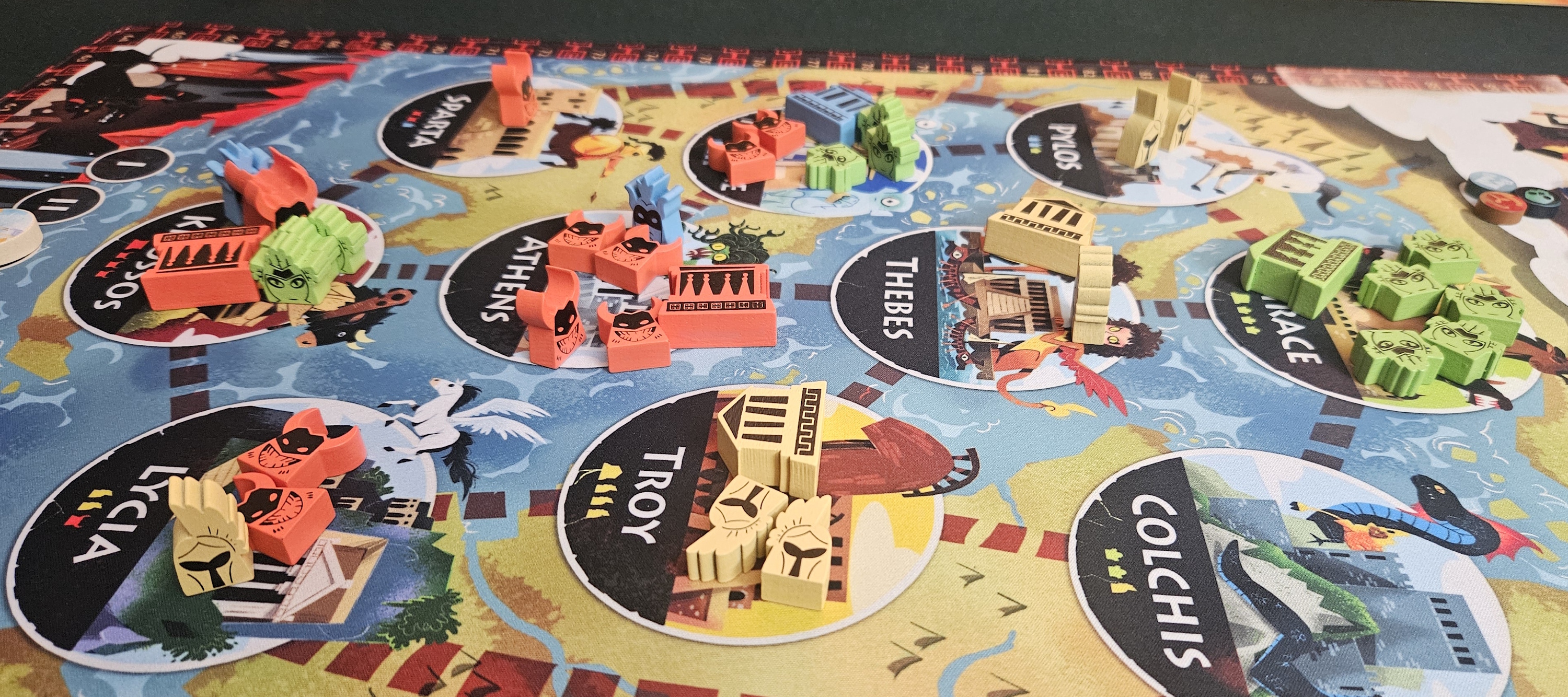
Historical Greece. No embellishment.
All told, Gods & Mortals is a hoot. It’s a stock game, there’s no disguising that, but it’s direct and combative in a way that, say, cube rails is not. It would be tempting to say that this blunts that genre’s subtleties, but the more accurate summary is that it moves the concept in a new direction. The result is flashy but still measured, every god bending the rules in their own manner, but only after careful preparation and in clear sight of everybody else at the table. While it’s distinct from Nichipurov’s previous designs, it carries a few strands of familiar code: the emphasis on human drama, the tightness of a few outlandish actions, the sheer exuberance that comes from discovering each god’s inner workings.
As a bonus, yeah, it’s got that train wreck theology going on. How do we respond when the gods throw our lives into turmoil? Not much, apparently. Maybe, at best, we can place some bets on the outcome.
Gods & Mortals is on Gamefound right now.
A prototype copy of Gods & Mortals was temporarily provided by the publisher.
(If what I’m doing at Space-Biff! is valuable to you in some way, please consider dropping by my Patreon campaign or Ko-fi. Right now, supporters can read about which films I watched in 2025, including some brief thoughts on each. That’s 44 movies! That’s a lot, unless you see, like, 45 or more movies in a year!)
Posted on March 31, 2026, in Board Game and tagged Board Games, Gods & Mortals, Wolff Designa. Bookmark the permalink. 19 Comments.

 SPACE-BIFF!
Dan, thanks as ever for the review – sounds like it could be fun indeed.
I wonder, does it compare to a game like Imperial (2030)? That’s also a game combining stocks and area control, which I liked more on paper than in cardboard in the end though.
Dan’s description made me think of Imperial / 7 Empires, too. Particularly the “The strategy of Gods & Mortals is one of tactical investment and withdrawal.”
Oh gosh, I haven’t played Imperial in ages. This is much more approachable, shorter, wackier… really, I hadn’t even thought to compare them, although I can see the high-level parallels now.
Thanks, that’s what I needed to hear to further my curiosity. I’ll give it a go when I get a chance!
Sounds super cool. And I know you hate the word ‘problematic,’ so I had to laugh at that part.
I wouldn’t say “hate”… but as a word, it’s problematic. (Eh? Eh?)
It sounds a bit like Dawn of Ulos. Any thoughts on how that compare?
There’s some overlap, but they wind up feeling pretty different. Dawn of Ulos is more… free-ranging, perhaps, especially since you can buy stocks in as many factions as you like. This one is a little more tightly controlled. It may depend on what sort of experience you’re looking for. Dawn of Ulos is probably closer to your average stock-managing game (in a good way, I mean).
Thoughts about G&M with 2 players? Would it be fun?
The two player game is rather chess-like! Lots of moves and counter-moves and trying to use certain pieces before your opponent exhausts them. I don’t like it as much as the three-player or four-player games, but it’s surprisingly solid.
Thanks Dan, another amazing write-up! But, Almighty is here as well and you gave praise to both, how do these align?
They’re almost entirely unrelated, it turns out! Apart from the religious setting, they aren’t all that similar. Almighty is a goofball game at heart; it features big swings and plenty of randomness in which cards you draw and/or which believers appear. I imagine Gods & Mortals will appeal more to those looking for a tighter experience, with less wiggle room for shenanigans. Just the distinction in whether you can see your rivals’ powers — in G&M, you always see what your opponents can do, even if the particulars of where are concealed, while in Almighty your opponents’ god powers are hidden — makes for a pretty significant difference.
Thanks, that’s what I thought but due to the timing I was just interested to hear your thoughts!
Hi Dan,
nice preview as always. Any thoughts on publishing it on bgg as well?
I’ll get on it.
Another great review Dan. I love the big swings that Wolffdesigna takes with their designs and will check this one out. It seems less like the “Acquire with card powers” nature of Dawn of Ulos and more of a… Cyclades with stocks instead of auctions? Though perhaps the theme is forcing that association for me.
Yeah, I’d put it at 40/60 stocks/action, where Dawn of Ulos is like… 70/30 stocks/action, maybe.
Coincidentally, I just got to play Cyclades for the first time last night, and while reading this review, it felt like this game had been VERY influenced by that older game. That may be recency bias but it certainly seems like Cyclades with a sense of humor on the surface.
It’s possible. I don’t know the degree of influence, but G&M does come across as an “inverted” Cyclades in some ways.