A Study in Personal Pickiness
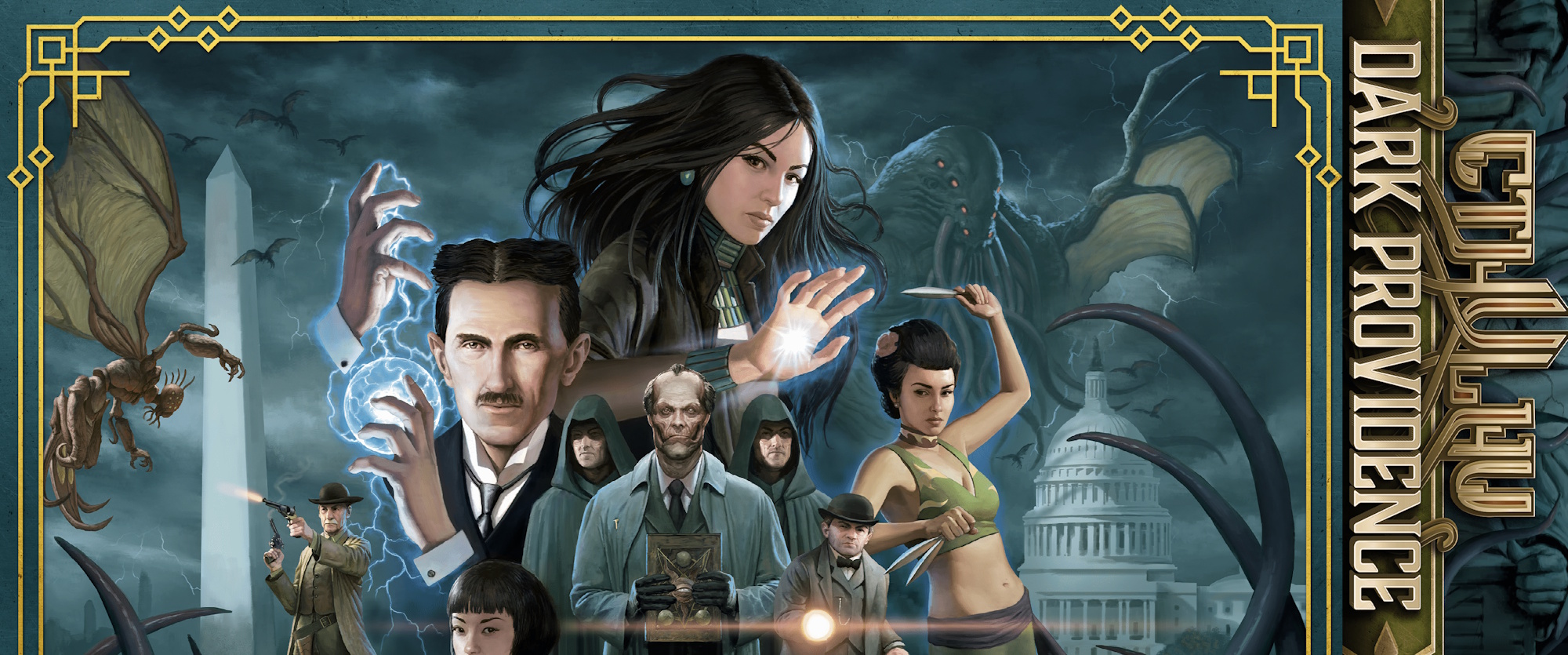
I adore Martin Wallace’s A Study in Emerald. The first edition most of all, although even the second edition, with its overly pruned foliage, will do in a pinch. I’ve talked about these games, and their spiritual sequel, multiple times. In some ways, the original Study was one of my first glimpses into the strength of board gaming as fable, as serious historical examination made easier to stomach thanks to its drapery. Like clothes over a mannequin; like speculative fiction describing theory of mind.
Cthulhu: Dark Providence, co-designed by Wallace and Travis R. Chance, is a remake of Study’s first edition. It’s a very good game. An excellent game. As a design artifact, it improves upon Study in fascinating and crucial ways. I’d be happy to introduce it to anyone who wants a glimpse into what board games can accomplish.
And yet, I can’t help but miss the original. There’s some rosy nostalgia at play. Of course there is. But I’m also longing for that original game’s fangs. And no, I’m not talking about how this edition swaps out the vampires for red-eyed knockoffs.
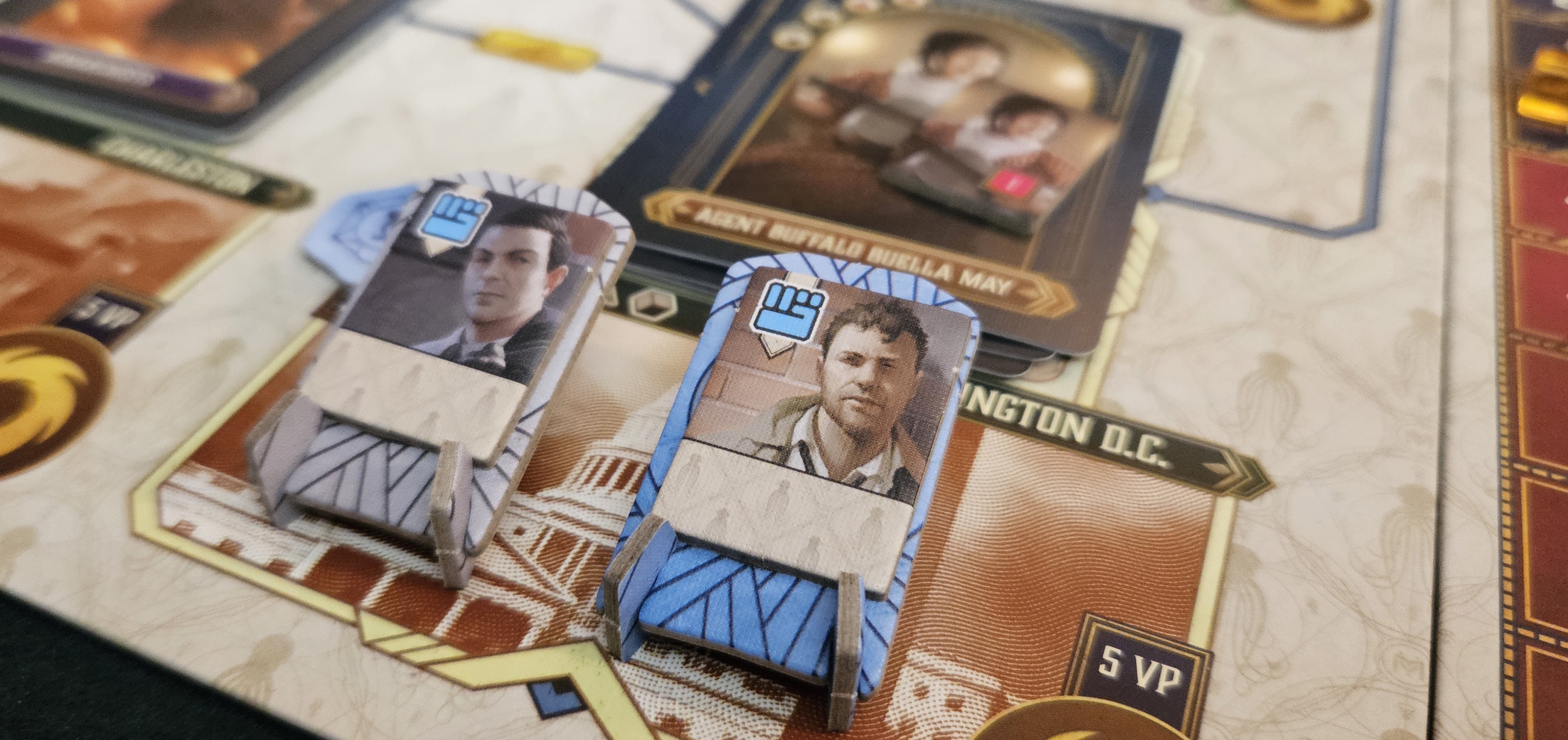
Greg from Succession and some alcoholic detective vie for the affections of a woman.
Let’s begin with the basics. Cthulhu: Dark Providence is set across the eastern portion of the United States during the Great Depression. People are hungry. Jobs are scarce. Ancient monsters rule the country. Literal monsters, not the nativist politicians who historically used people’s poverty and fear to drum up power. And those monsters are doing their best to pry open portals to otherworldly dimensions.
There’s a certain madness to American politics, always has been, so the idea that overly-tentacled beings that are simultaneously phallic and yonic would prey upon that unique American desperation to bring about an emerald-hued apocalypse is, if not exactly realistic, not the most far-fetched piece of horror fiction out there. This segmented reality informs the design itself. Put another way, Cthulhu: Dark Providence is hard to sum up. It’s a deck-builder. It’s an auction. It’s a social deduction game. It’s about revolution. It’s about trying to go insane on purpose. It’s about concealing yourself from the world. It’s about becoming your fullest self.
In gameplay terms, it’s about taking two actions per turn and clawing desperately at any sense of progress. When Dark Providence opens, everybody receives a role. Broadly speaking, there are two sides: the investigators, who hope to shut the monsters out of our world, and the cultists, who labor to bring humanity into their sticky embrace. These roles are hidden, but not quite as social-deduction-y as newcomers might expect. Concealment is a useful tool, but not a crucial one. There’s a good chance that everybody at the table will understand the broad strokes of everyone else’s objectives within the first half-hour. Still, that uncertainty is helpful. It staves off direct action. If nobody knows which side you support in the “Should we welcome the ancient god who promises to have us sprout penises from our eye sockets?” debate, nobody is likely to have you assassinated.
Much of the time, this produces a multi-act structure. In the game’s early stages, everybody’s motions are tentative, exploratory. Your agent — the avatar of yourself — travels from city to city, spreading influence and gradually picking up cards. Maybe you expand your network of agents. Maybe you tuck St. Louis into your back pocket. Maybe you join the Freemasons or conduct experiments with electricity or come into possession of a book with strange runes stamped into the leather binding. These are added to your deck, albeit slowly.
From there, little vignettes begin to form. Sometimes these are explicit, drawn via the game’s abundant actions. Somebody closes a portal for good, signaling their intention to rid the world of outside influence. Someone else starts appointing fish-people to local school boards, tipping their hand that they listen to dodgy podcasts. At other times, the developments are more subtle, such as when somebody’s network of spies and anarchists includes labor reformers and undead magicians. Other times, the changes are structural, the fabric of our reality coming unstitched as the cult moves up a shared track that will award points to everybody on their team.
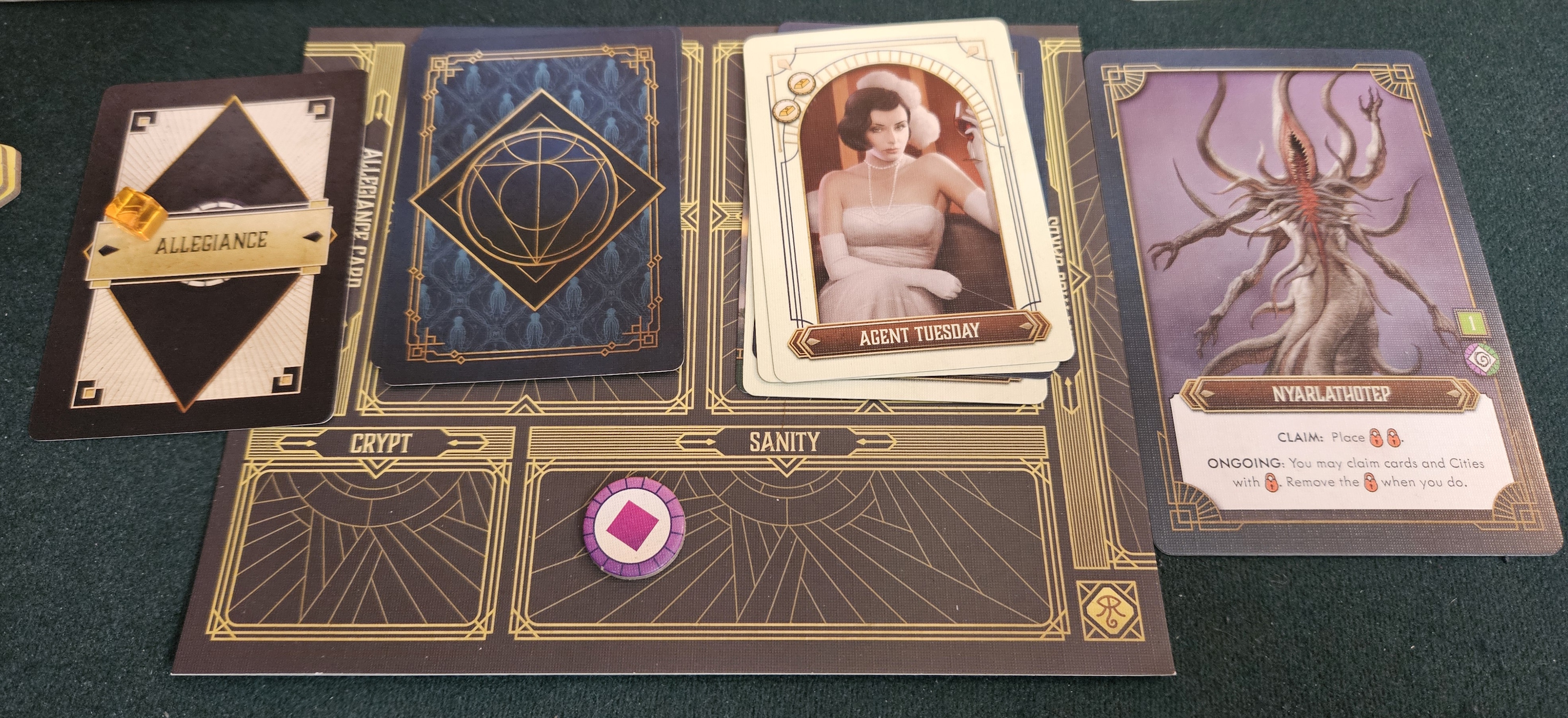
“Agent CHOOSE-Day, I presume?”
Team. That’s a funny word in Dark Providence. You’re on a team, always, but also not on a team. I mentioned investigators and cultists. It’s true that there are people who share your worldview and objectives, but this is an individualist’s paradise. Only one player will win in the end. That said, nobody can fully ignore the demands of their faction. Mechanically, the concept is simple enough. When the final tally is reached, the lowest-scoring player forces everybody on their team to lose, no matter how high their score. So while you’re always racing against your comrades, you’re also working to ensure they’re better-off than the peons of the opposing team. As in the original game, it’s deviously clever, forcing players to constantly evaluate their social standing in the absence of clear data.
But this rubric is even more tangled than it first seems. There are also dissidents out there, one of the game’s few additions to the original Study’s formula. Dissidents still occupy a team — they’re dissident investigators or dissident cultists, not true independents, sort of like how libertarians are conservatives who like to look at themselves in the mirror — but their scoring is slightly orthogonal to their faction. The main takeaway is that they lose or win on their own, ignoring the usual rah-rah teamwork portion of the game, but are also uniquely vulnerable to exposure.
These complicating factors make Dark Providence a bear to teach and an even grizzlier bear to learn. In that respect, it’s much like the original. Not that Dark Providence hasn’t undergone development. A few nips and tucks make it simpler, on the whole. For example, both games feature quite the cast of potential recruits, but where A Study in Emerald also included an entire pile of duplicates to fuel a double-cross system that was dramatic but also sometimes frustrating to trigger properly, Dark Providence just ditches the whole idea. Once you own an agent, they’re on your side. That is, unless somebody drafts the right card to switch an agent’s allegiance, but that’s a visible threat rather than the lingering face-down tokens of the original game.
On the whole, then, Dark Providence is more akin to a second edition than the actual second edition of A Study in Emerald ever was. Its cardplay is intact, with that trademark Wallace gumminess where cards stick around rather than cycling easily in and out of hand. Its social questions are intact, and indeed are even denser than before, requiring teamwork and competition and backstabbing all at once. The networks of agents and ruffians are back.
Even the original game’s surprising detours with zombies and vampires return, albeit with a fresh coat of paint. Still, the effect is the same. While you’re playing one game, merrily conquering cities and scrounging for points, suddenly the proceedings take on a dark turn as fish-folk begin conquering New York City or your best agents transform into red-eyed phantoms. Just as the original Study was playful and unexpected, so too is Dark Providence. You’re never sure how a session will shape up.
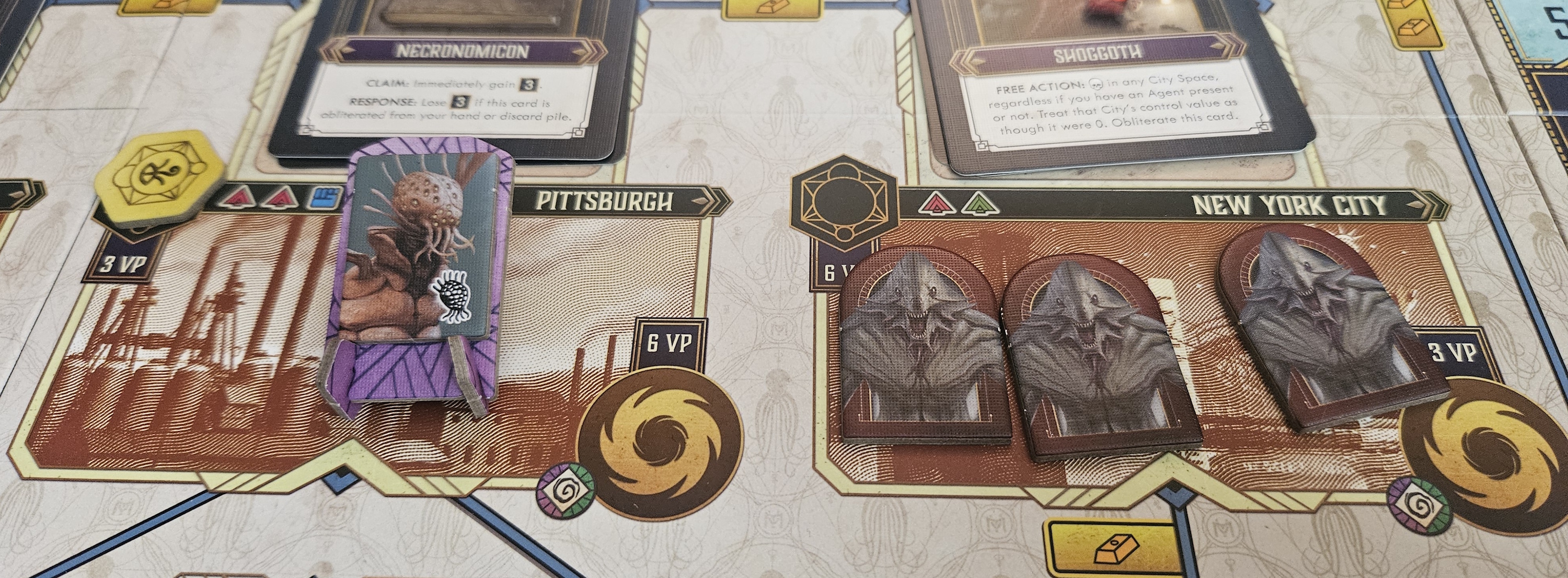
Their team rivalries are intense.
On its own, these strengths mark Dark Providence as a worthwhile successor to A Study in Emerald, especially given that game’s long absence from print, not to mention the, ah, squickier aspects of its provenance. While Neil Gaiman’s short story was an excellent companion piece to the original game, I doubt anyone is going to miss his name on the cover.
This isn’t to say it’s an entirely perfect production. The standees for holding the agent tokens are duller in color than they should have been, flimsy enough that I had to glue them together, and while their canted angle might be nice for a solitaire game, they’re hard to visualize from any direction but head-on.
As for the more structural changes to the factions… time will tell. The short version is that I’m eager to keep exploring what Dark Providence has to offer. Dissidents may well improve the game’s deduction, encouraging players to unmask one another more often. I have my doubts, as the penalty for being revealed as a dissident feels like a slap on the wrist, but with experienced players Study often featured rather slender scoring margins. Maybe it will prove enough of an incentive to shake up the original game’s dynamics. Either way, this is a (mostly) handsome and (largely) faithful recreation of the original.
Where it steps amiss for me — and maybe only for me, such is the pocket nature of this complaint — is in the game’s handling of its subject matter. A Study in Emerald arose from Wallace’s interest in anti-monarchical bomb-throwers, the anarchists and revolutionaries who took it upon themselves to punctuate the divine right of kings with sticks of dynamite. Smartly for the 2010s, Wallace reasoned that a game about blowing up the continent’s royalty might be considered in poor taste, hence the veneer of emerald paint. The game’s heroes weren’t trying to blow up Queen Victoria; their target was Gloriana, a god from beyond the stars. The pontiff of Rome was not the Pope, but Rhogog. Cairo had no shah, but rather, duh, the resurrected pharaoh Nyarlathotep.
Despite this veneer, A Study in Emerald played like a who’s who of 19th- to 20th-century social theory. One minute you’d recruit Emma Goldman and Élisée Reclus; the next you might watch as Leon Czolgosz assassinated an eldritch spider rather than President William McKinley; eventually, Peter Rachkovsky would lead the Okhrana in a crackdown against a revolutionary cell headed by Prince Kropotkin. That these historical figures rubbed shoulders with Sherlock Holmes and Professor Moriarty only deepened the sense of place, giving the game the hue of allegory.
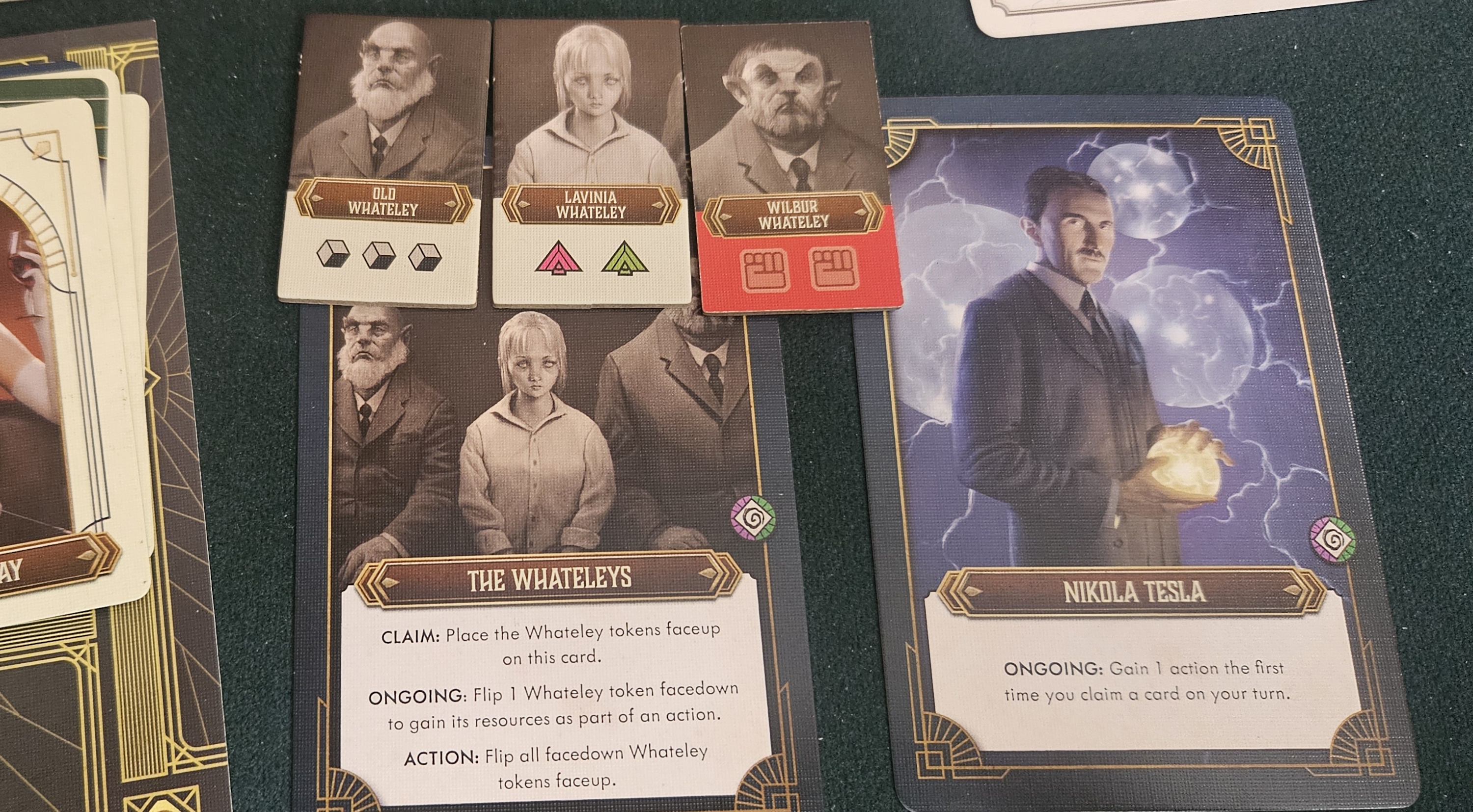
Historical figures rub shoulders with fictional characters.
By contrast, the Great Depression of Dark Providence is thinly drawn. What few historical touchstones it levies are mostly limited to gangsters (Arnold Rothstein, a misspelled Stephanie St. Clair), lawmen (J. Edgar Hoover, Eliot Ness, Wyatt Earp), or entertainers (Harry Houdini and Lillian La France, also misspelled), among a few scattered others. Unlike the historical figures of A Study in Emerald, which were united by the dueling social movements of the time, Dark Providence instead leans into the tropes that often accompany Lovecraftian fiction.
There are references, but most of them are confined to the Cthulhu Mythos. Every slouching shoggoth and brain-stealing mi-go is present, of course, but so are figures like Herbert West, Henry Armitage, and the Whateleys. When it comes to the Great Depression in the United States, even as a fictionalized depiction the game is sanitized of, well, everything. There are no labor movements. There are no suffrage movements. There are no Italian immigrants becoming enthusiastic Galleanisti. There is no Harlem Renaissance. There are no veterans’ organizations massing into the Bonus Army. There are no businessmen flirting with fascism by forming the Business Plot. Even the Prohibition stuff is thinly drawn, absent the original game’s clever inversions, putting figures like Eliot Ness on the side of resistance. (Yeah. Sure.)
The effect is to withdraw Dark Providence from the realm of historical fiction and slip it into the same category as most Lovecraftian board games, where figures like Nikola Tesla might wander into the frame, but not with any sense for their lived perspectives or accomplishments. It would feel right at home alongside any number of Fantasy Flight’s Arkham Horror titles or their many derivatives, full of tommy guns and long overcoats and men whose cigarettes dangle precipitously from their lips, but also sharing those same titles’ disinterest in what those characters or symbols stood for. It’s like setting Shakespeare in 1920s gangland Chicago. Fine for community theater, but disappointing as a sequel to a historical drama.
Again, it’s fine. No, really. Dark Providence is still a heck of a game. It’s just that, sans any broader context, the entire thing feels less grounded than its granddaddy. The irony is that, given how the hobby has advanced in the intervening thirteen years, it would be possible to design a game about anarchism without the veil of allegory Wallace draped over A Study in Emerald. Dark Providence flees the other direction, dulling its teeth for the sake of… I couldn’t tell you. To make the game less political, maybe. To lean into the Lovecraft thing. Unfortunately, the main side effect is that the setting feels generic.
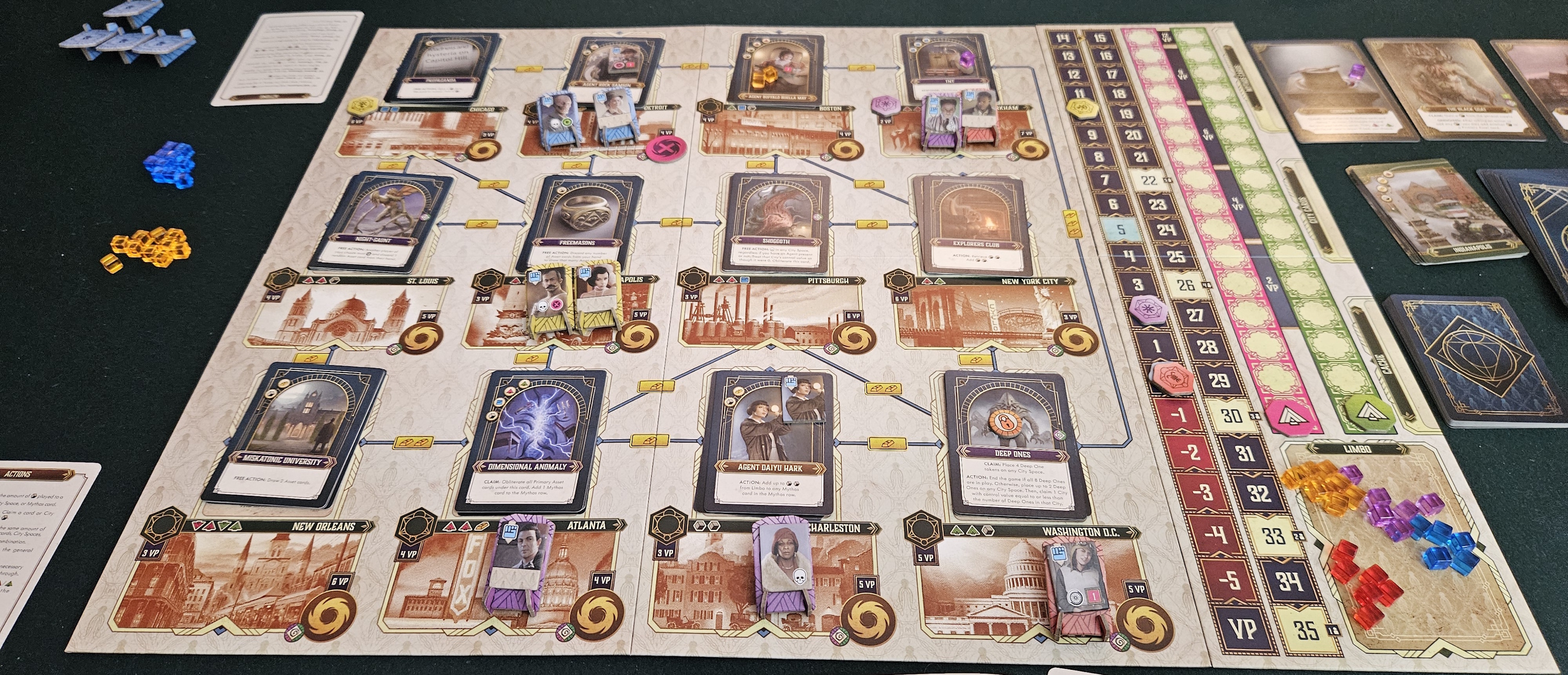
At times, it’s a sprawling game.
To be clear, however, even a blunted version of A Study in Emerald is sharper than any number of other Lovecraftian outings, and Cthulhu: Dark Providence is a formidable remake. It’s cleaner around the edges while still retaining the original game’s weirdness. In some ways I even consider it the better-rounded experience, especially where the deduction is concerned. The result is many things: a game out of time, a color out of space, an experience that still has yet to be emulated as widely as it deserves.
(If what I’m doing at Space-Biff! is valuable to you in some way, please consider dropping by my Patreon campaign or Ko-fi. Right now, supporters can read about which films I watched in 2025, including some brief thoughts on each. That’s 44 movies! That’s a lot, unless you see, like, 45 or more movies in a year!)
Posted on March 19, 2026, in Board Game and tagged Board Games, CMON, Cthulhu: Dark Providence. Bookmark the permalink. 13 Comments.

 SPACE-BIFF!
Great perspective, as usual. I agree with you that there’s something kind of… off about this production. I like that the rules are tighter than 1st edition and I like that some flavor has been breathed back into it in contrast to 2nd edition. But after three plays, I have to say that the Lovecraftian themes feel kind of pasted on. We encountered absolutely none of it in our first play, with the Mythos cards being confined to more mundane characters like Hoover and Tesla. Since then it’s gone a little better, but it still feels perhaps more mechanical than it should? Hard to tell. I’m willing to play a few more times before putting it on the trade list but just like with both editions of Study, there’s something not quite right here (appropriately.)
I suspect that the choice to gut the game of its original theme was made in order to increase its relevance to a new generation of Americans for whom all those magnificent references in the original mean almost nothing.
I will admit that I find it a little sad knowing that the number of those with whom I share a common culture and knowledge grows smaller each year. But that is the fate of all us whose lives are not unduly short.
It’s more likely the theme change was made to remove any association with the author of the short story that the original game was based on, Neil Gaiman, who has been accused by multiple people of some pretty horrific sexual crimes over the past few years.
According to the designer of this edition, the change of setting was done earlier to bring it in line with Death May Die, and it happened to be a bit of good luck that they also dodged association with the (living) problematic author.
Thank you for this piece! As someone who only played second edition and loved it, and now has played this and enjoyed it quite a bit, I went from being in a uniquely odd position to being in a possibly odder one. Up to a month or so ago, when I suggested playing that game I love, the most common response I encountered was “I heard that game you’re talking about sucks, and look at that BGG rating – let’s play something else.” Now that this is out, I’m making comparisons to Emerald Second Edition when it’s clearly designed as though second edition didn’t exist. For a few weeks now I’ve felt but could not articulate that Dark Providence’s thematic richness (compared to Emerald Second Edition) is weakened because of its comparatively much less rich theme. In other words, yes this gets more in depth about the characters and times than Emerald Second Edition did, but is that really an improvement when the characters and times are such a comparative letdown? Now that I have read this, I can articulate it. While I will still have trouble getting anyone at a convention to play Emerald Second Edition, I at least now have a similar game they likely will play (as long as that all-important BGG rating stays north of 7.0).
CMON say the theme change was made to set Dark Providence in the Death May Die universe. I don’t really see it, Houdini and Tesla are the only human characters from DMD to appear in DP (and Tesla isn’t even playable in DMD until the last crowdfunding campaign gets fulfilled). A bit of Elder One art work has been reused, but that’s really about as deep as the connections go.
Theme change aside, Dark Providence was the surprise game of 2025 for me. I ordered it with low expectations, mainly to get the DMD promo investigators, but ended up playing the game more than a dozen times already. The solo mode was a big enabler here, I’ve owned Study in Emerald in the past, but have never gotten it to the table because I could never get 2-3 other players on board to learn it. Solo mode isn’t perfect, it does away with hidden roles, and players can only play as investigators, but it retains the awesome card play and interesting scoring system.
Interestingly, the solo mode actually brings a bit of theme back into Dark Providence. The cultists work directly for an Elder One and change their play styles based on which Elder One is chosen. Rather than just try to push their scoring up and yours down, the cultists will work towards whichever win condition the Elder One has, it works well and also makes the game feel very fresh and different when the Elder One is swapped out
And yet all the Lovecraftian output continues, despite how clearly problematic *that* author was. I don’t get the enduring popularity.
Enjoying the creative legacy of someone who is dead and so can neither actively change nor be changed by the rest of society is different from supporting someone who can use their fame and licensing funds to hurt people now. If you don’t get the popularity because you don’t enjoy the work, I’m not sure what there is to get. If you don’t get the popularity because you think everyone should reject enjoyment of the work on ethical grounds, I think most people don’t feel like there is any benefit to that rejection.
No Italian immigrants and no Harlem Renaissance? Sounds like Lovecraft’s wet dream.
Hi,
Had an interest in this in it’s emerald cast with the number of people in groups I visit that thrive on social deduction. I hoped to pick up this new game when first mooted…but have a firm position on Lovecraft as one of the easiest lines I can hold in board gaming. I really enjoyed your account of the game play and do feel sad about the loss of the historical referencing and continue to track A Study in Emerald on eBay in case I win some money😎. Thanks
Hi Dan, If I were to pick up one, A study in Emerald second edition or Dark Providence?(Thematically I prefer Europe/England over America)
Ehh, that’s hard. ASiE 2 is pretty stripped-down. I’d look at both pretty closely before making that decision.
I’m very much with you on the theme. Stripping everything interesting and novel the original had for yet another round of the same tired set of Lovecraft creatures and shallow “detectives vs cultist” conflict kinda ruins it for me, even if gameplay is better.