Fickle Little Guys
Whenever a new fad mechanism comes around — deck-building, trick-taking, now it seems maybe dominoes might be having a moment — I’m disappointed to discover it isn’t mancala. Because mancala is great. Speaking of which, here’s your annual reminder that Nick Case’s Pilgrim was the most overlooked title of 2023.
Imps was Nick Brachmann’s offering at this past Indie Games Night Market. You’ll never guess where I’m going with this, but it’s mancala! Mancala with fickle little imps!
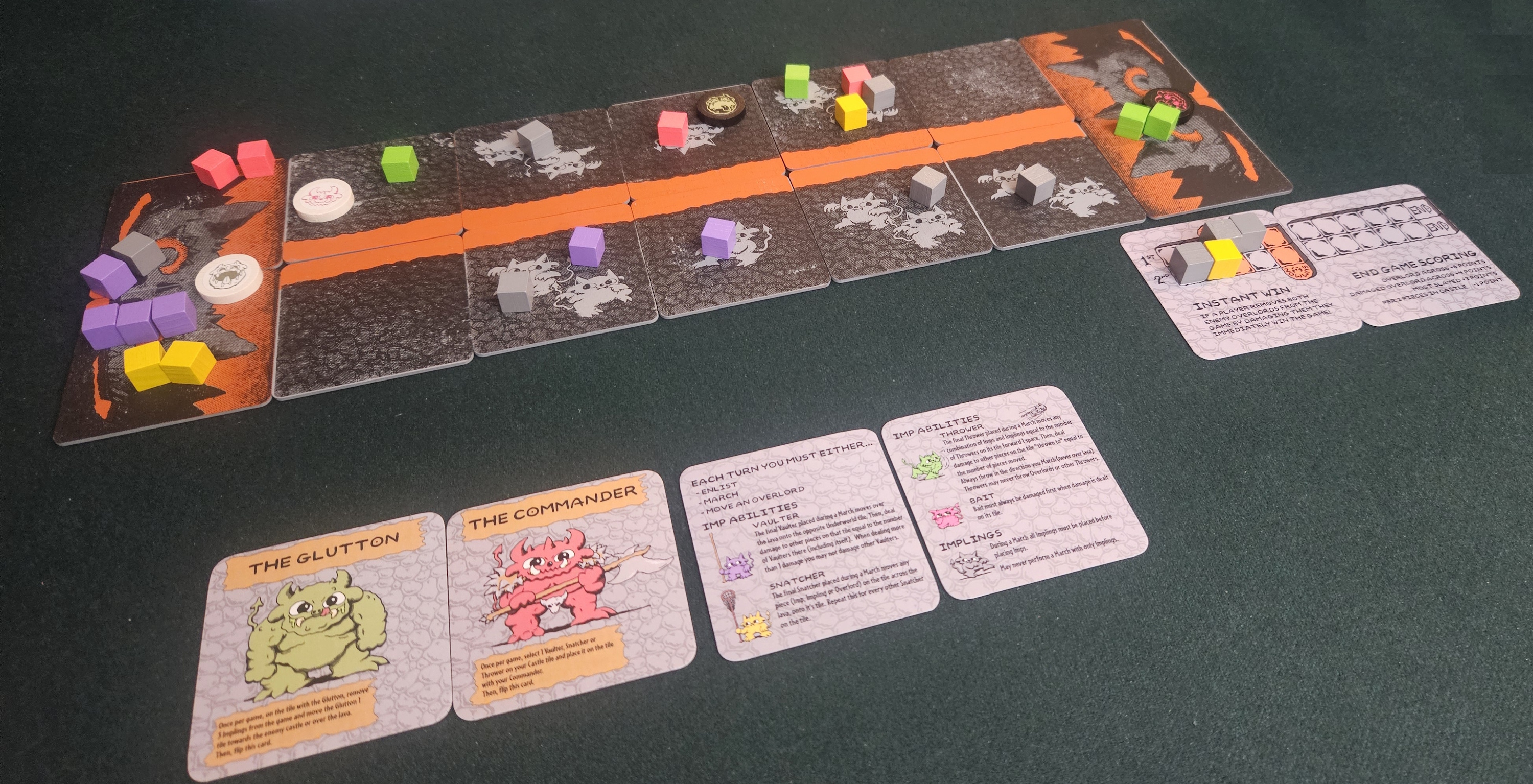
Everybody knows imps live along rivers of magma.
The fickleness of your imps is perhaps the game’s defining characteristic. Which makes sense, given mancala’s customary permissiveness. When the game begins, both sides are safely tucked into their own fortress, the game’s analog of a mancala board’s player stores. Your army consists of a few imps of varying colors — we’ll get to those — plus two chieftains represented by big chunky discs. Other than that, there are a few neutral implings milling around the no man’s land between fortresses.
Turns are simple. Most of the time, you march. This is familiar mancala fare: you pick up all imps of a color and sow them one box at a time until you reach the final space. If there were any gray implings in your starting space, you also pick them up for the march, potentially increasing your reach.
Crucially, depending on the imp that lands in that final space, something exciting happens. Each color represents a different… hobby, perhaps, or impish vocation. Purple imps are vaulters. They leap across the river of lava that separates the lanes. Of course, they soften the landing by flattening an imp on the opposite side. Yellow imps are snatchers; they do the inverse, dragging targets across the lava to their own space. Green imps are throwers. They throw other imps forward. Like vaulters’ vaulting, this kills an imp in the target location. Pink is bait. They absorb hits before their kin.
On its own, this produces quite the textured landscape. It’s possible to enlist imps from the spaces in front of your fortress, ensuring you’re never without a move of some form or another. But you can also command any gathering of imps anywhere on the board, apart, naturally, from those directly dwelling in your rival’s fortress. Like I said, they’re fickle little guys. It’s the perfect flair for mancala, a game that has always emphasized the management of risk and the turnabout of using an opponent’s moves against them.
Here, though, those contrasting colors generate little hills and valleys of danger and possibility. It’s tempting to open with a rush of vaulters, but that fills an entire lane with purple dudes that might fling themselves across the lava at a moment’s notice. Similarly, it’s easy to get caught in a back-and-forth war of throwers, both sides chucking bodies to smash other bodies, but this tends to go nowhere fast.
Indeed, Imps grows more interesting as its subtler possibilities unfold. That’s where those chieftains come in.
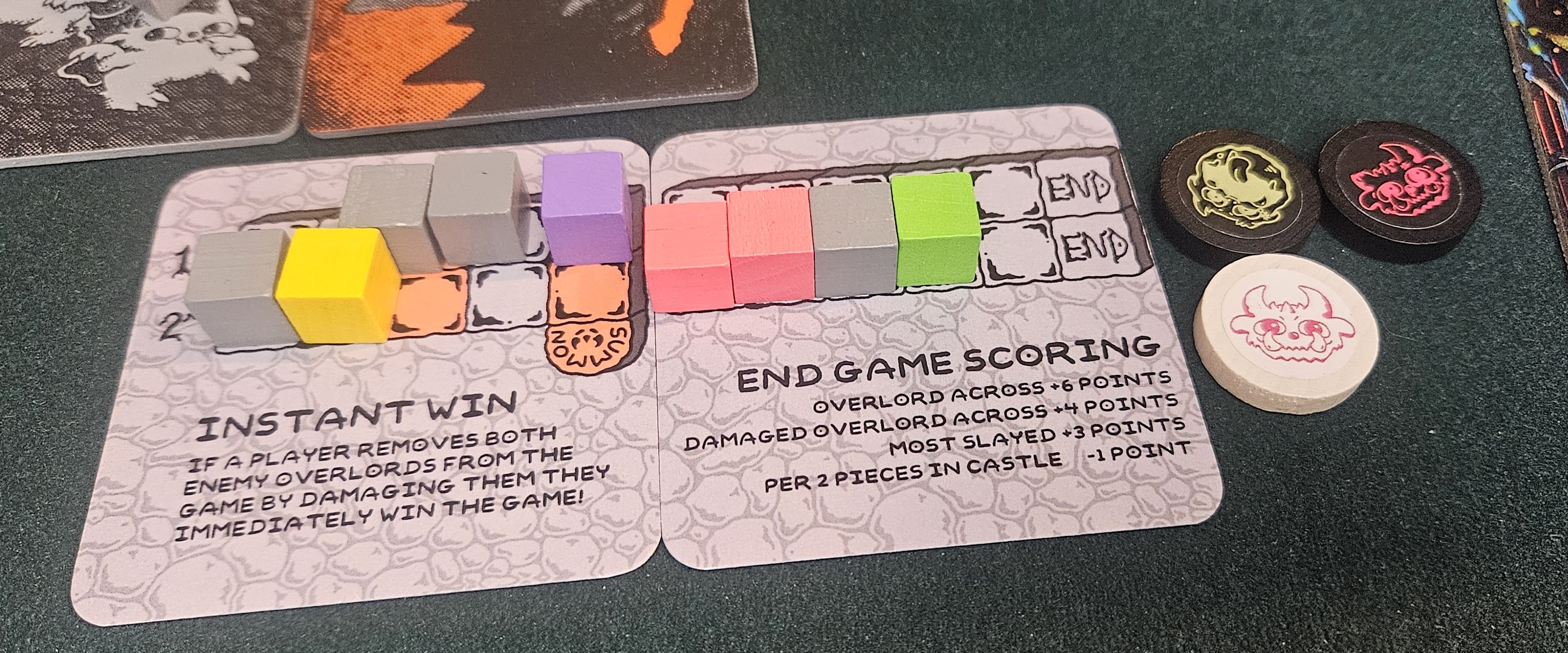
Tracking our respective kills.
At various points, your chieftains will leave the security of their fortress, whether by choice or after being lured out by casualties in the lower ranks. Unlike their smaller brethren, they’re always loyal. No switching sides for a chieftain. But they’re also slow. Rather than marching forward with stacks of imps and implings, they can only move a single space at a time, either trundling forward or hopping to the opposite side of the river.
They’re also vulnerable. Two hits and they’re dead. Oh, and losing both chieftains means you’re out of the game, so it behooves you to keep them safe at all times. This is no easy task in a game that two turns in resembles a tropical Skittles-themed minefield.
But chieftains also represent one of the game’s greatest opportunities. Because if you can enter the opponent’s fortress with a chieftain, you earn a heap of points. As in, more points than you can possibly earn through vaulting and throwing imps. The scoring is carefully done, encouraging risk but also penalizing it, rewarding murder but not so much that it becomes the default route to success.
Okay, scratch that. Played with novices, murder is absolutely the default route. It takes a few plays before Imps reveals the subtler game beneath the impish purge happening on the surface. Before it reaches that point, the whole thing feels like a slog of attrition. I hit an imp; you hit an imp; repeat until the game concludes.
It goes without saying that that’s not the best way to play Imps, either for the sake of enjoyment or strategy, but this is one of those games I can see someone dismissing after a poor initial impression. (Not that the game, with its hand-stamped pieces and low print count, is readily available, but that’s another matter, one someone will hopefully rectify.) Rather, the game is an onion. It has layers. Yes, I’m pretty sure that simile popped into my head because of Shrek. Ogres, imps, it’s all a matter of height. That probably makes me a fantasy racist.
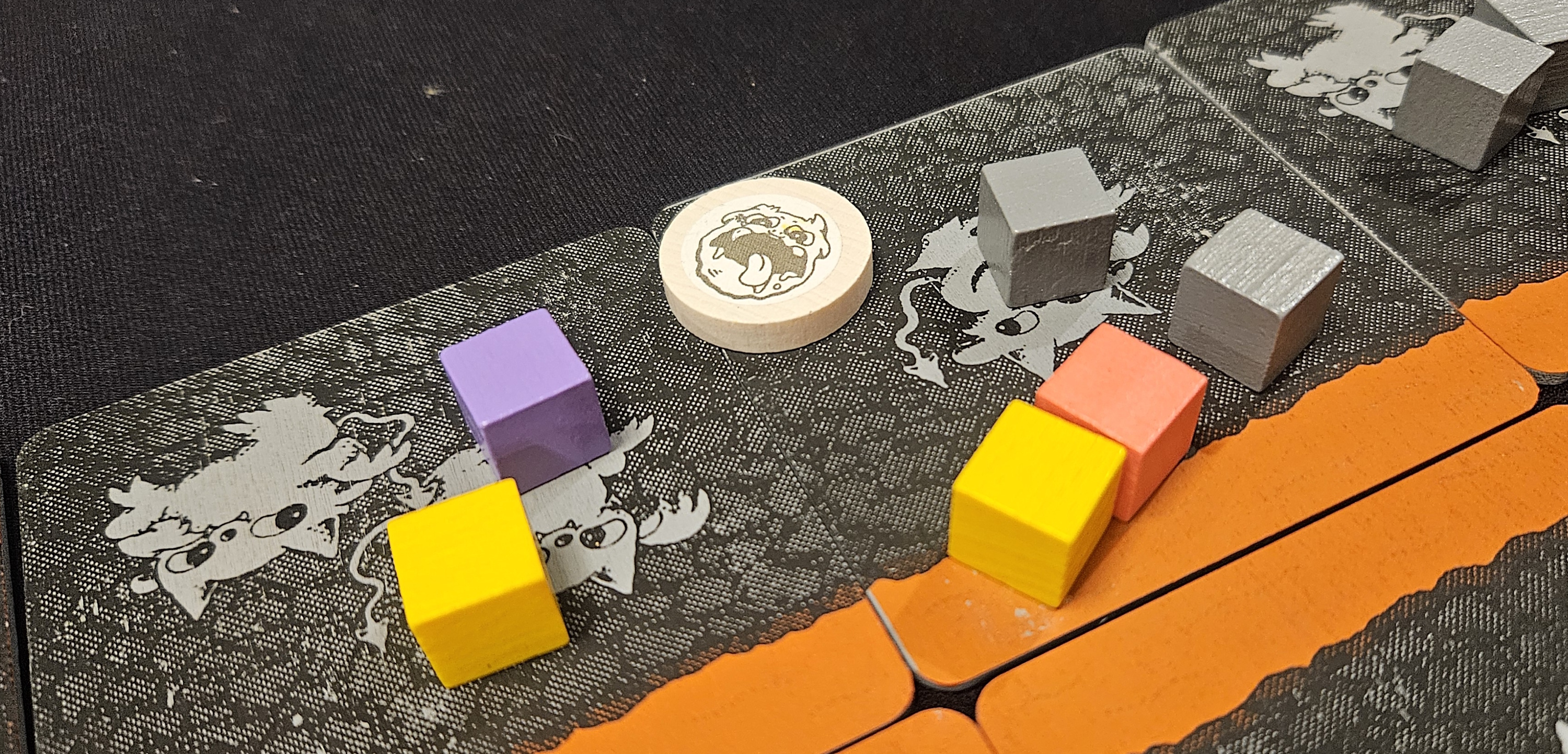
Attacking a chieftain.
Played the right way — with consideration for every move, yielding only the barest advantages and striking mercilessly — Brachmann has done something remarkable. Imps takes the simple rules and interplay of mancala and tweaks the formula with the gentlest of touches. The result is something that feels timeless and new at the same time. I genuinely hope this becomes one of the titles to break the confines of its indie market origins; these fickle little guys deserve to be traded between as many chieftains as possible.
A complimentary copy of Imps was provided by the designer.
(If what I’m doing at Space-Biff! is valuable to you in some way, please consider dropping by my Patreon campaign or Ko-fi. Right now, supporters can read about which films I watched in 2025, including some brief thoughts on each. That’s 44 movies! That’s a lot, unless you see, like, 45 or more movies in a year!)
Posted on February 18, 2026, in Board Game and tagged Board Games, Imps, Indie Games Night Market. Bookmark the permalink. 12 Comments.

 SPACE-BIFF!
ugh, why do you have to remind me of Pilgrim, which I shall never have 😦
hopefully Imps gets some kind of public release. That mancala mechanic sounds nifty.
Your mention of mancala made me go check whether you ever reviewed Theseus: The Dark Orbit, and you did! 12 years ago! What even is time?
Time is a river…of magma.
I grew up playing Sungka, a Filipino form of the Asian ‘mancala’ family (which may have been invented independently of the African family).
So far, the only novel takes I’ve seen that caught my interest were firstly one from the old 3M line (the title of which I forget) that combined it with moves on an inner board shaped by the mancala style track around the edges.
The second is a newer design called The Glass Bead Game (title presumably inspired by Hermann Hesse’s novel), which like this one involves pieces of different colors.
Thanks for the continued support for Pilgrim Dan. Unfortunately, despite no little effort, I can find no publisher willing to take it on for a second edition. (sad face emoji!)
Bummer! That makes me sad.
I don’t imagine you’d consider print-on-demand (e.g. TGC)?
To be honest it’s not something I’d considered. However the sheer quantity of hex tiles that need to be cut out make this a tedious and painful task. For my prototypes I used a Stanley knife to cut tiles and lost the feeling in my index finger for three days after. For proto #2 I paid for laser cut hexagons so I just had to cut and stick paper but it was expensive to do.
Factor in the Monk meeples, resources and pocketed boards and I’m not sure if TGC could turn a copy out at a price anyone would be prepared to pay. There isn’t much room for air in the box.
Pilgrim is one of my grail games. I’m not sure how steep you’re expecting it might hypothetically run, but I’d probably pay it. Looks like used copies are going for $120ish. I’d probably be willing to pay that if they were domestic listings and not overseas.
Just to set a price point, I recently paid $90 on The Game Crafter for a relatively small box full of cards (a lot of cards, but still just cards) and wooden pieces. I don’t know for sure that $120 for Pilgrim on TGC is unachievable, but I have my suspicions.
TGC charge $0.45 for a blank hexagonal tile and there are 114 printed hexes in the game. Factor in the $15 charge for a square quad board (Pilgrim has an octogon) and you are over $60 with all the other player boards, tracks, duty tiles and 64 screen printed acolytes and 62 other wooden bitys still to go.
Pingback: Triple-Triple Omelette Burger w/o Cheese | SPACE-BIFF!