Best Week 2025! Beatrixmania!

I don’t believe I’ve ever seen a publisher have more of a bottle rocket year than DVC Games. Home to the design collective Jasper Beatrix — which thankfully avoids the pitfalls of the now-defunct Prospero Hall by offering actual attribution — DVC Games has established itself as a cradle of innovation. Even when their individual titles riff on the familiar, they’re undoubtedly riffs, jazzy little grace notes that bring their own interpretation to the genre.
Which is to say, this is the tightest focus ever featured in Best Week. These folks deserve the plaudits. Just take a look.

#6. Karnak
Designed by Jasper Beatrix. Published by DVC Games.
Like a lot of the titles on today’s list, Karnak is sorta many things. Sorta a stacking game. Sorta an area control game. Sorta a cutthroat contract game. It’s all of those things and none of those things. It’s what you get when a child-pharaoh demands a cool plinth with a rockin’ statue, then changes his mind and instead wants a bunch of sideways pillars over a river. Why? Because the brat is nine years old, that’s why.
In practice, Karnak is a little uneven, although its unevenness is also no small part of its charm. What, you expected the god-king to be consistent? Pshaw. Stacking together strange monuments, only to repurpose some of them into new edifices while others are ossified thanks to obnoxious priests, that’s just how it goes when you’re an ancient architect. No aliens required.
Review: Most Select of Board Games

#5. Medusa’s Garden
Designed by Phil Gross and Jono Naito-Tetro. Self-published.
The only title on this list not strictly published by DVC, Medusa’s Garden was nevertheless crafted and developed by the Jasper Beatrix crew. I suspect the form factor — a deck of cards and a hand mirror — prevented its inclusion as a boxed release. Picture this: a social deduction game, but with none of the pressures that accompany most social deduction games. Instead, it’s presented as a duel between two players: Perseus, who wants to deliver a swift chop to Medusa’s neck, and the famous gorgon herself, lurking among a garden of stone statues, determined to crumble them before Perseus can ruin the party.
A perfect convention game, then, one that sits halfway between performance art and logic puzzle while never once failing to be hilarious. And all that when over half of its participants have the simplest goal of all: stay very, very still.
Review: Nebulae, Medusae… Crownae?

#4. Scream Park
Designed by Jasper Beatrix. Published by DVC Games.
I’m a bit of a snob when it comes to tableau builders, but I contend that ninety percent of the things have no idea why players want to build these spaces in the first place. It isn’t only the brain-tickling pleasure of arranging icons in proximity; it’s the possibility of exploring that space.
Scream Park is a love letter to seasonal haunted houses, and what it understands is that we don’t only want to build the things — we want to get scared silly along with their visitors. That’s why each round concludes with a VIP guest, somebody we as curators must fear in our own right: a fire marshal, a gang of birthday brats, an internet influencer looking to dunk on our subpar effects. We build the space for maximal fright, rejiggering the components from last year’s leftovers, and try to sell this season’s guests on the illusion. It’s silly and satisfying as only a perfect tableau-builder can be.
#3. Pacts
Designed by Ben Brin. Published by DVC Games.
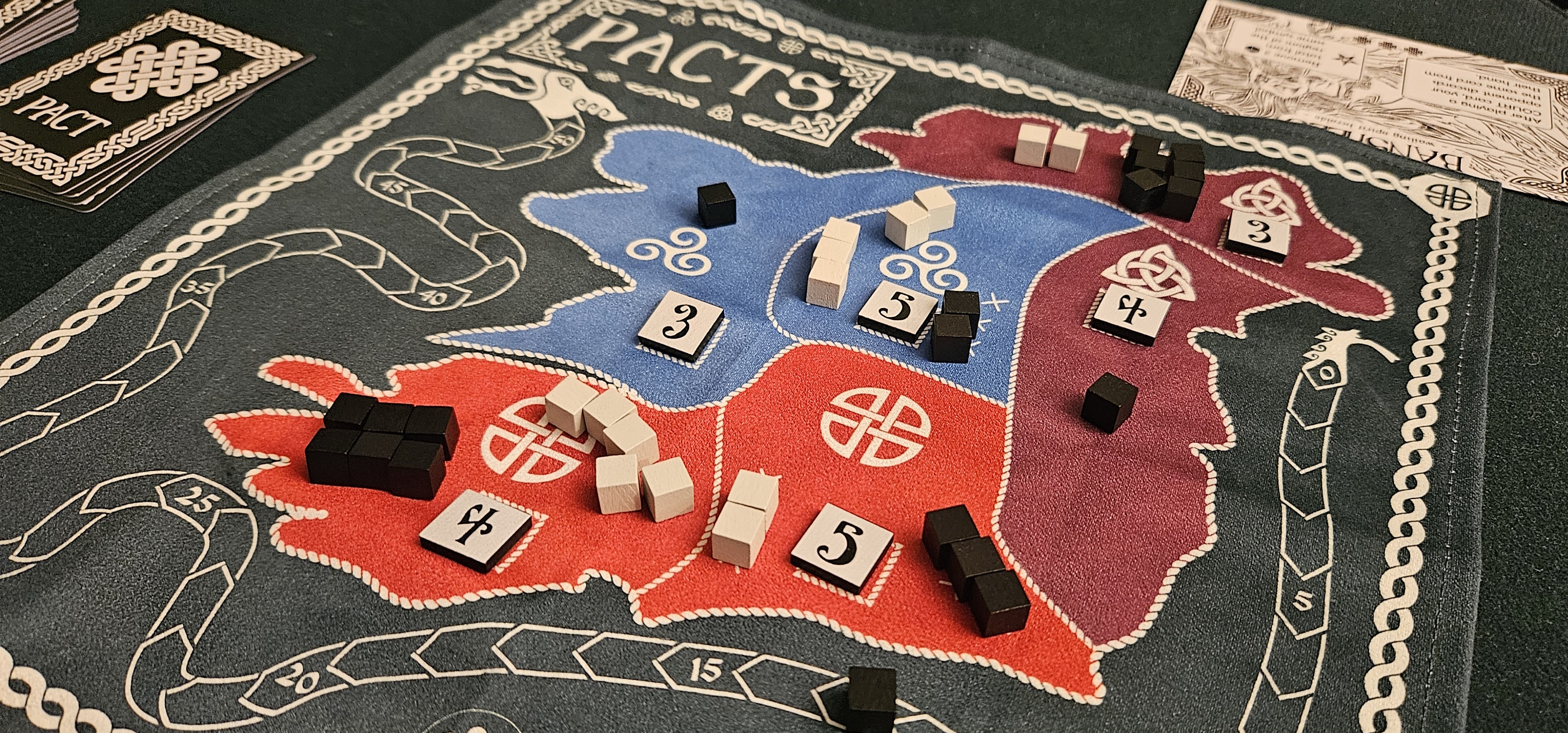
Pacts is emblematic of this publisher’s whole deal. Designer Ben Brin takes a concept, in this case “I divide, you choose,” jettisons what makes the mechanism tired in every other setting, and gives it new life. There’s nothing here we haven’t seen before, strictly speaking, but every edge has been polished to its finest shine. Or sharpened into a stake, perfect for driving through your opponent’s skull.
Set in Ireland of legend, Pacts has it all. Strange creatures, devil’s bargains, and a surprising number of ways to get ahead. With all the cruft subtracted from the design, what remains is a pared-down but rich experience, a fantastical conflict that occupies less than half an hour but contains enough drama for a game five times its size and duration.
Review: Cutting the Cottage Pie

#2. Signal
Designed by Jasper Beatrix. Published by DVC Games.
If you’d asked me back in March, I would have insisted that Signal would be one of Best Week’s #1 games. Based on first contact fiction — squint a little and you can see the grainy target-cam footage of Arrival — Signal is a cooperative effort between one alien and a crew of translators. Between those two groups and a whole lot of failed experiments, the rules of the alien’s language emerge one line at a time. It’s translatorpunk, to fall back on the trope of slapping -punk onto the back end of an otherwise ill-suited descriptor.
What makes Signal work so well, though, is the sheer variety on display. There are dozens of aliens in the game, each with their own rules. Some want pieces placed in relation to one another; others stack pieces, or use pieces that shove other pieces, or deploy pieces that transmogrify into different colors. The rules are myriad and ever-changing. And it’s up to you to deduce their meaning.
Review: A Desire for More Cows
#1. Here Lies
Designed by Jasper Beatrix, Jakob Maier, and Bobby West. Published by DVC Games.
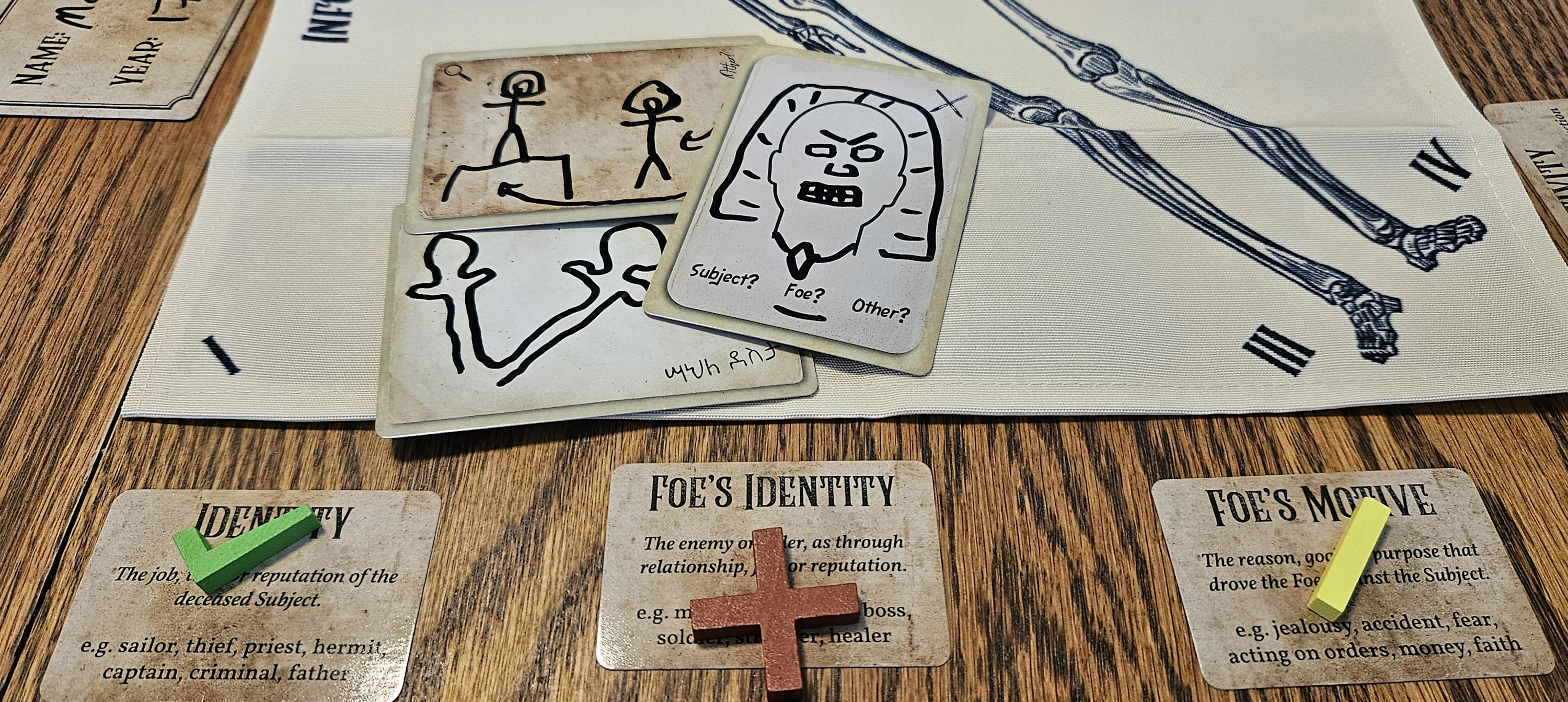
At a glance, Here Lies is perilously close to Signal. One player takes the role of an aging detective recounting decades-old cold cases. (In one scenario, a millennia-old cold case!) Everybody else gathers round to try and figure out the solution. It’s a blend of locked room mystery, Encyclopedia Brown short stories, and Sherlock Holmes serials.
But what sets it apart from every other detective game is that Here Lies refuses to present one more logic puzzle. Instead, it’s a chance to get creative. You’ll play hangman, draw a picture, summon a snippet of dialogue, or test your vocabulary with some word association. As new evidence trickles onto the table, you’ll draw unexpected conclusions that bring the group inexorably closer to the truth. It’s perhaps the most striking of the Beatrix collective’s titles, a brilliant summation of a design ethos that evokes the game’s literary inspirations while sidestepping the tropes of every board game that came before it. When I first sat down to dig into the box’s contents, I had no idea I was holding a quiet revolution in my hands.
Review: Here Lies Every Other Detective Game
Okay, so there’s a real problem on our hands, because I want you, the reader, to give me your own recommendations. But this is the narrowest topic ever featured in Best Week. So perhaps share your own top publisher of the year, complete with examples? Who opened your eyes to new possibilities over the past twelve months? Go wild.
(If what I’m doing at Space-Biff! is valuable to you in some way, please consider dropping by my Patreon campaign or Ko-fi.)
Posted on December 28, 2025, in Board Game, Lists and tagged Best Week!, Board Games, Space-Biff!. Bookmark the permalink. 20 Comments.

 SPACE-BIFF!
I have bought 4 Jasper Beatrix games (Signal, Here Lies, Corvids and Scream Park), plus Rosetta the Lost Language in pnp and I’m planning to add Pacts to my collection. Another publisher that I appreciated this year is South-Korean Playte, with their ingenious L-board packaging and re-editions of old glories.
Whoa, I’m looking at the Playte page. Seems like they’re doing some cool stuff. I’ll have to check them out.
I spent some time at the playte booth at SPIEL, trying -and failing – to get my hands on their Asian lime rock face Can‘t Stop editions. NEXT YEAR THOUGH.
Oh, and Rita Orlov is doing great niche games with PostCurious.
I’ve wanted to try Orlov’s games. I reached out to PostCurious this year to see if we could set something up, but I never heard back. I’ll circle back around.
Orlov’s best games so far are Adrift, The Light in the Mist and Emerald Flame. The first one is my favourite, it’s made using poems and artifacts, it’s the most “consistent” of them, Light in the Mist is a deck of tarot cards entirely illustrated with puzzles, while Emerald Flame is the most “sumptuous” of the bunch, in every meaning.
I’ve been consistently impressed with the quality of work that Restoration Games has displayed in the UnMatched series. Each expansion has been a delight to explore, and it has really captured that spark that Netrunner held for me: organizing a community and running tournaments, engaging new players and discovering strategic depths with established players. The back-and-forth of play and counter play….
It is amazing how much art assets and thematic underpinnings they manage to cram into the limited real estate of 30 cards and 3 actions. Even the debates on relative power levels of specific characters are instructive, as I tend to favour games that allow me to tinker with the balancing of a particular match (teaching new players, showcasing an interesting play style or mechanism, etc). Any game that can put my son on even terms with me is a plus, not a source of contention!
Good call! I haven’t covered as many Restoration titles this year, although I was very impressed with their Witcher Unmatched sets. I think I like it best in cooperative mode… and I didn’t get around to requesting this year’s TMNT set. My loss.
Yes! The Adventures expansions have been fantastic story generators for our cooperative ventures: the T-Rex and Muldoon putting an end to the Alien Invasion (the UFO fits nicely in Rex’s jaws for that triumphant end scene), or Moon Knight and Hamlet thwarting Mothman’s destruction.
The sheer versatility of the system is also impressive. I really appreciate how some characters shine in 1v1, or 2v2, or of course synergise especially well in co-op. A real treasure trove.
Unfortunately, Dvc Games does not ship to Europe. I would have really liked to try some of their games. Hopefully they will expand their print-and-play catalog with Scream Park or Signal.
All in all, this article felt to me like being a child looking at a candy store through the window without being able to go in and taste anything.
Sigh
Hi Martino, actually I live in Italy and we have a store selling DVC games. I think they can ship to Europe too, if you’re not Italian.
Hi Elena. Could you tell me the store’s name? I’m Italian by the way. I recognised you from La Tana 🙂
I don’t think I can write a link to a seller here, anyway if you google “Here Lies gioco” it’s one of the first entries. A store from Pomezia.
Thanks, found it. Unfortunately they don’t have Scream Park. I’ll keep watching hoping they’ll restock
Yeah, sorry. Links sometimes get held in moderation, in which case I can eventually approve them, but at other times they get blocked by the system and I never see them. Too many spammers.
It’s fun to see such innovation in board games.
Especially at a time where everything is online, taking time to sit with friends, even as adults playing games is really nice.
I’ve never been much for superlatives, so I’m having a hard time saying Button Shy was the best publisher of the year for me. But having mostly discovered Button Shy in 2025, and playing a number of their new games this year, I am just always amazed at the quality of their games.
Specifically this year, Hyperstar Run was great; and Shallow Regrets was a neat wallet-sized take on a bigger game from this year. And Downtown Las Palmas is so delightfully novel and makes just about anyone that you play around in public ask “what on Earth are you doing?” So that’s always fun.
Very cool. I have a lot of respect for Button Shy, even if I don’t cover as many of their releases as I’d like. But I have a trio on my table right now, including Downtown Las Palmas!
Pingback: Best Week 2025! The Index! | SPACE-BIFF!
Pingback: PAX UNPLUGGED 2025 Recap (Part 2) – HERE LIES Review by The NameFather – Board Game Gumbo