Cutting the Cottage Pie
At this point, I don’t believe the fine folks at DVC Games have it in them to publish a bad game. Pacts, for example, is not only a fantastic divide-and-choose game, it’s probably the best example of its ilk.
Maybe that isn’t a tall order. Certainly it would sound more impressive if we were talking about deck-builders or trick-takers. Divide-and-choose is one of those mechanisms everybody understands at an instinctual level. We use it whenever we split a slice of pie. We contemplate it whenever the check comes due at a group dinner. But for all that, it’s never quite found its footing. Open a teach with, “Okay, this is one of those I-divide, you-choose things,” and my mind doesn’t exactly spark with excitement.
Until now. Because Ben Brin has cracked the code. Even though it isn’t quite as offbeat as other DVC titles, Pacts is one of their sharpest offerings yet.
Conquering Ireland. Again.
Not that it opens with a bang. Oh, we’re in Ireland again. Oh, the Emerald Isle is in need of a good conquering. Oh, some mystical creatures are willing to lend their aid. We’ve done this before. All that’s left is a Blood Rage sequel with big gray miniatures hogging up the board’s real estate.
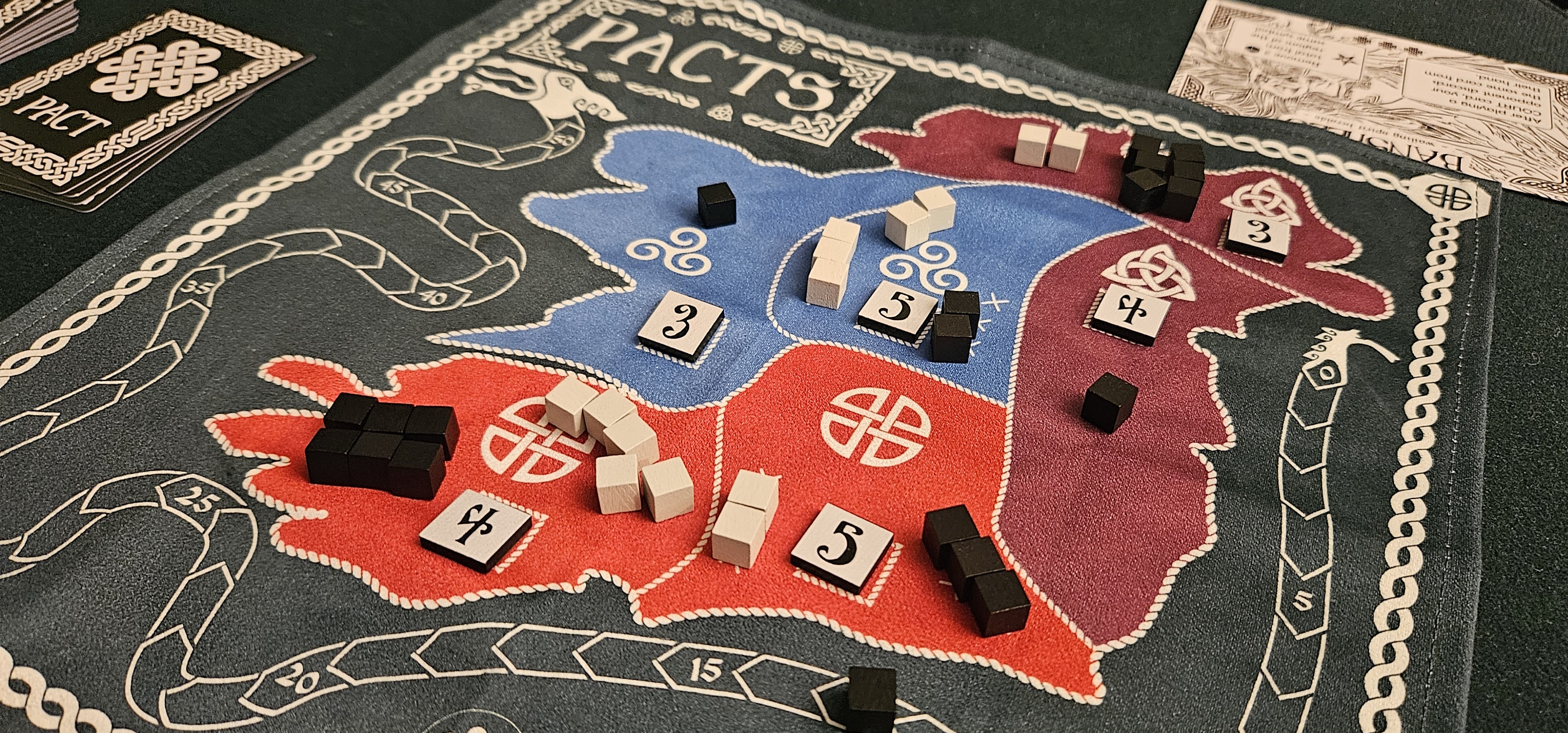
Fortunately, the minimal aesthetic does Pacts plenty of favors. There are only six regions in all, divvied across three color-coded zones for reasons that will soon become apparent. The only track is for scoring. The mat, much like those in Signal, Here Lies, and Karnak, is clear and legible, without any of the little details that fuzz into obscurity on fabric.
And then the game takes all of two minutes to explain. That helps too.
You want to control those six regions. Some of them, anyway. Each region is worth some number of points, some lower and others higher, which quickly gives the island an essential topography. To accomplish this, you play cards to place cubes — either one or two at a time, and either into purple, blue, or red regions — or move them around, or maybe trigger a special ability. That’s it. Three actions. Okay, four actions. One of the cards awards a few points outright. But that one is so simple I nearly forgot about it.
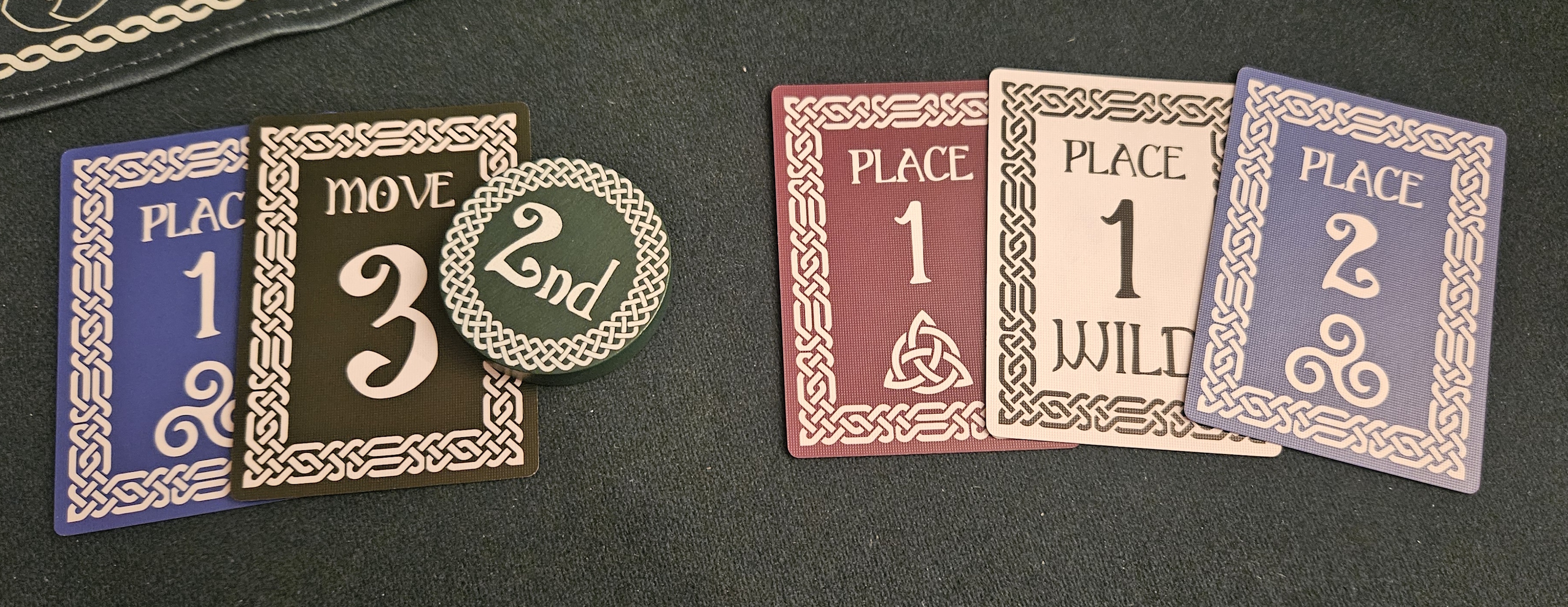
Selecting your cards is another matter, and while it might be simple rules-wise, it’s devious in calculation. At the start of each round, somebody draws and divides a handful of cards into two piles. As before, there’s a topography to this decision. Four cards are revealed from the basic pile. These are the wimpy ones, small placements and small moves. Another card is added from the rare pile. That’s five cards in total, one of them better than the others. Not enough to divide into two clean piles.
Divvying up the actions.
And then the dividing player adds one more piece: the second-player token. Going second in Pacts is an enormous boon, letting you play reactively. Now you can dump a bunch of new cubes into areas your rival assumed were secure. Or march cubes out of a low-yield area and into two neighboring scoring zones. Or trigger your special ability at the last moment. It’s a superpower in its own right, and it’s up for grabs every turn.
Adding to this decision is the fact that both players also began the round by choosing a single clan card. This holdout adds another small action to your arsenal. Small but mighty. In a game that keeps its cards on the table at all times, having even a single secret can turn the tide in your favor. The limitation is that your clan cards thin out as the game progresses, giving an attentive opponent an idea of where you might next focus your efforts.
There’s also your faction. When the game starts, both sides select which mythological creature they’ll call upon for assistance. Last session, I was helped by the Selkies. They gave me a one-time ability to drop four cubes into any spot on the board… but only when I played my points card, effectively sacrificing three points for four cubes. But get this. They also offered a special ability, triggered by those star-shaped cards on offer, that let me duplicate two of my other cards. When paired with my points card, suddenly I was allowed to drop eight cubes onto the board, and shift some of them around as a bonus.
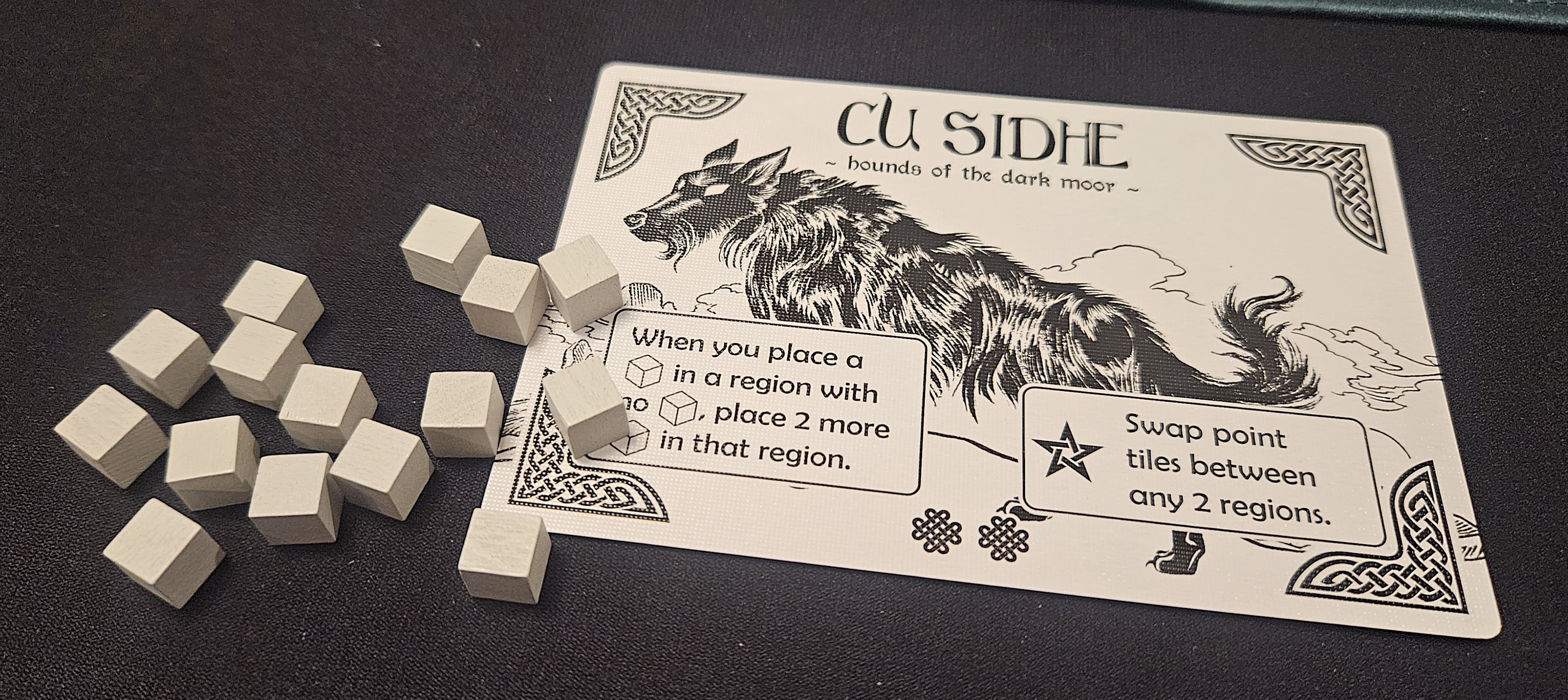
The other creatures are just as powerful, but also just as conditional. The Banshees can wreck your opponent’s hand of court cards. But they do this by using their own court selection to remove the corresponding card from their opponent’s pool. This transforms a match against the Banshees into its own mind game, always trying to guess which card you should play right now, rather than holding onto your best options for some more opportune future moment. Or there’s the Cu Sidhe, the hounds of the dark moor, who can swap the values of any two scoring regions. Or the Dragons, who scorch regions of all cubes completely before moving into all those now-empty slots. Or the ever-migrating Fir Bolg, who freely populate regions without their cubes — thus encouraging them to populate, migrate into neighboring territories, and then repopulate all over again. Even though I’ve seen many of these creatures before, they’ve never been quite this alive, quite this relevant to the holistic game-state. In Pacts, every creature has the potential to be both a trickster and a terror.
Ah, the cheating dogs of Pacts.
And then, almost belatedly, we arrive at the “choose” portion of “divide-and-choose.” Whichever player didn’t divvy the cards gets to select which set they’ll take. Both players then take their turns, playing both the cards they claimed from the table and their holdout court card. After three rounds, scores are tallied. Then the scoring chips are flipped over, tweaking the value of each region. Another three rounds and they’re scored once more.
That’s the game.
It’s a beautifully simple thing, Pacts. It’s also beautifully tangled. Apart from those little shudders of uncertainty, the stakes are always clear. That only serves to make the dividing and the choosing all the more agonizing. It isn’t uncommon for the divvying to take a minute or two. Far from grinding the proceedings to a halt, this amplifies the game’s tempo, like an inhale before a collision. But it also generates a certain social frisson. When you spend ninety seconds tinkering with the cards, fretting over whether the second-player token should go in one or the other, and if over here then shouldn’t this card shift over to the other pile… and then, when you lay out the options and your opponent darts out a hand to claim one of them, as if the decision is obvious, as if thought needn’t enter into the equation at all, as if you might go back to tinkering if they offer even the slightest hesitation… well, that’s also an essential component of the game. That’s when the dread really kicks in. That’s when you begin to second-guess every decision you laid out on the table.
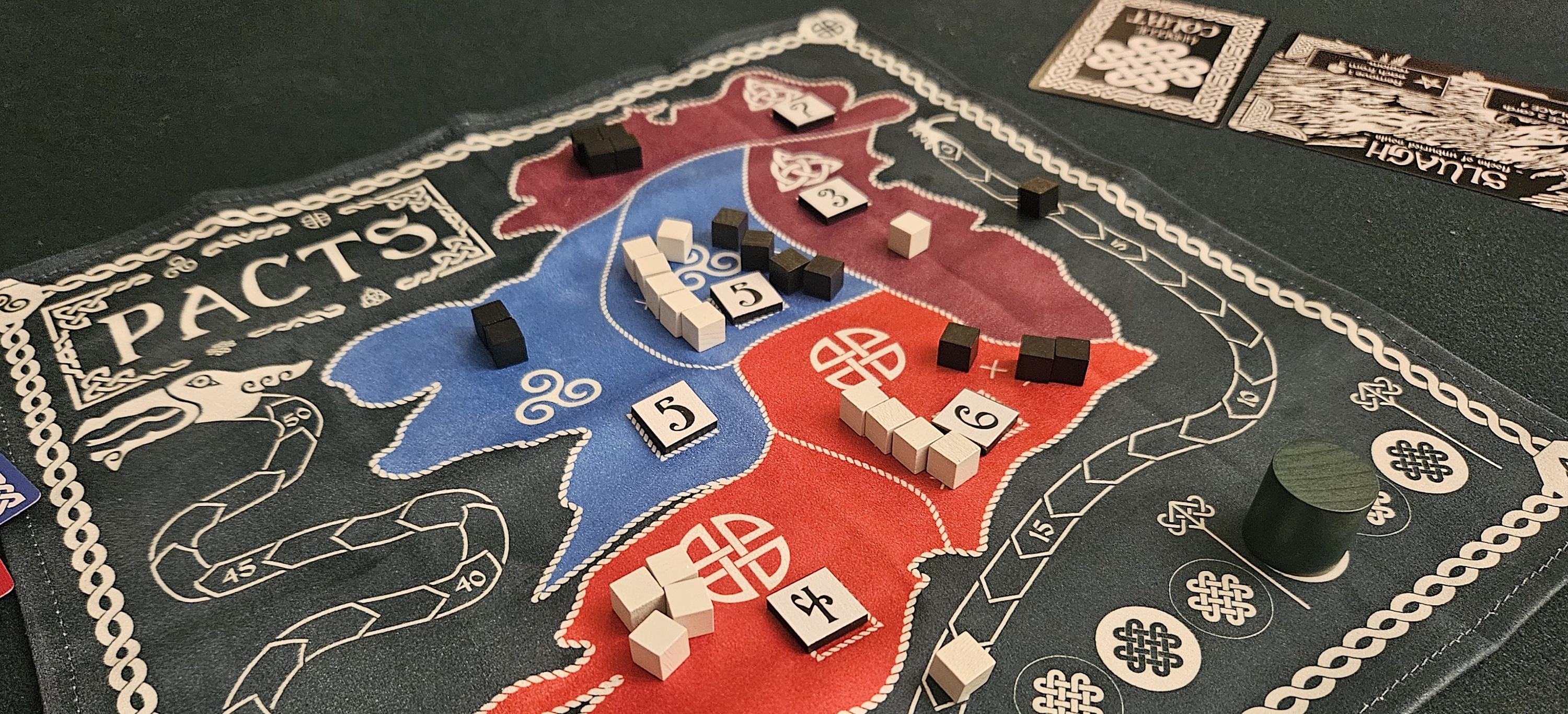
There’s nothing like it.
None of this would work in a more complicated context. Pacts works because it hits that sweet spot between simple and open. There’s room to maneuver, but not enough land to get lost in. Every creature has its own tricks, but none of them are too unconventional. Instead, everything occupies that goldilocks zone.
Which is to say, this is as close to perfect as I’ve seen this type of game get. Decisions matter. The dividing, of course, but also the choosing. But also the way you leverage your cards once the dividing and choosing is done. But also the court cards you pick, and their order, and whether you sacrifice what you need right now so you can go second right before a scoring round. Everything matters. What’s so impressive is that everything matters, and matters so much, in a game this short, this punchy, this clever. It’s enough to make me want to befriend some Kelpies and conquer Ireland all over again. I think I’ll do just that.
A complimentary copy of Pacts was provided by the publisher.
(If what I’m doing at Space-Biff! is valuable to you in some way, please consider dropping by my Patreon campaign or Ko-fi. Right now, you can read my third-quarter update on all things Biff!)
Posted on December 8, 2025, in Board Game and tagged Board Games, DVC Games, Pacts. Bookmark the permalink. 15 Comments.

 SPACE-BIFF!
I kind of want some sort of hashtag to trend around the removal of cloth boards from board games. Between “Night Soil”, “Gazebo / Gingham”, “Steam Power”, and now this, I for one am getting mighty sick of them.
Would that too be petty?
I don’t think it’s petty, but it is just preference. I like cloth mats!
How does this compare to Marabunta, if you’ve played that? They sound similar on the surface: 2 player are control with divide-and-choose mechanics.
I’m similarly interested in hearing how Dan compares this to The King is Dead!
Oh, they are quite different, despite some aesthetic similarities. The King Is Dead is very “tight” — tight action economy, tight headspace. Pacts is a little looser.
I haven’t played Marabunta, although I’d be happy to give it a try sometime.
I mean, it’s based on personal preference. I go to gaming conventions and there’s a lot of relief over cloth boards, because people are more sick of bulky games that are hard to travel with. 🧳
If anything, it’s often the deciding factor for a person whether they get 3 small games or 1 big game.
A lot of these developers with cloth mats are also usually considering sustainability in some way. Just my thoughts.
I know they’re different types of games but how would you personally rate this vs Moytura and would they both be worth having in a collection? They seem to fit a similar spot – short, small, 2 players, vying for control of Ireland – which checks most of boxes. Any thoughts?
As you note, they’re very different sorts of games, but it’s natural to compare the two. I liked Moytura quite a bit… but I ADORE Pacts.
Haha I just had a thought and it’s terribly reductionist to be sure. But this feels like Cribbage: Legends of Ancient Ireland.
The beginning of this review resonated with me; I too am generally unexcited by split-and-choose mechanics. In fact, on the list of game mechanics that usually turn me off immediately, it’s right after trick-takers. So, glad to hear I’m not the only one, but for once, Dan, you didn’t convince me to spend my money. $25 saved, for once! Nice try though. 😉
I’ll get you yet!
Pingback: Best Week 2025! Beatrixmania! | SPACE-BIFF!
Pingback: No More Mr. Mice Guy | SPACE-BIFF!
Pingback: Silver & Gold & Cinnabar & Verdigris | SPACE-BIFF!