This Is Not a Review of a Pipe
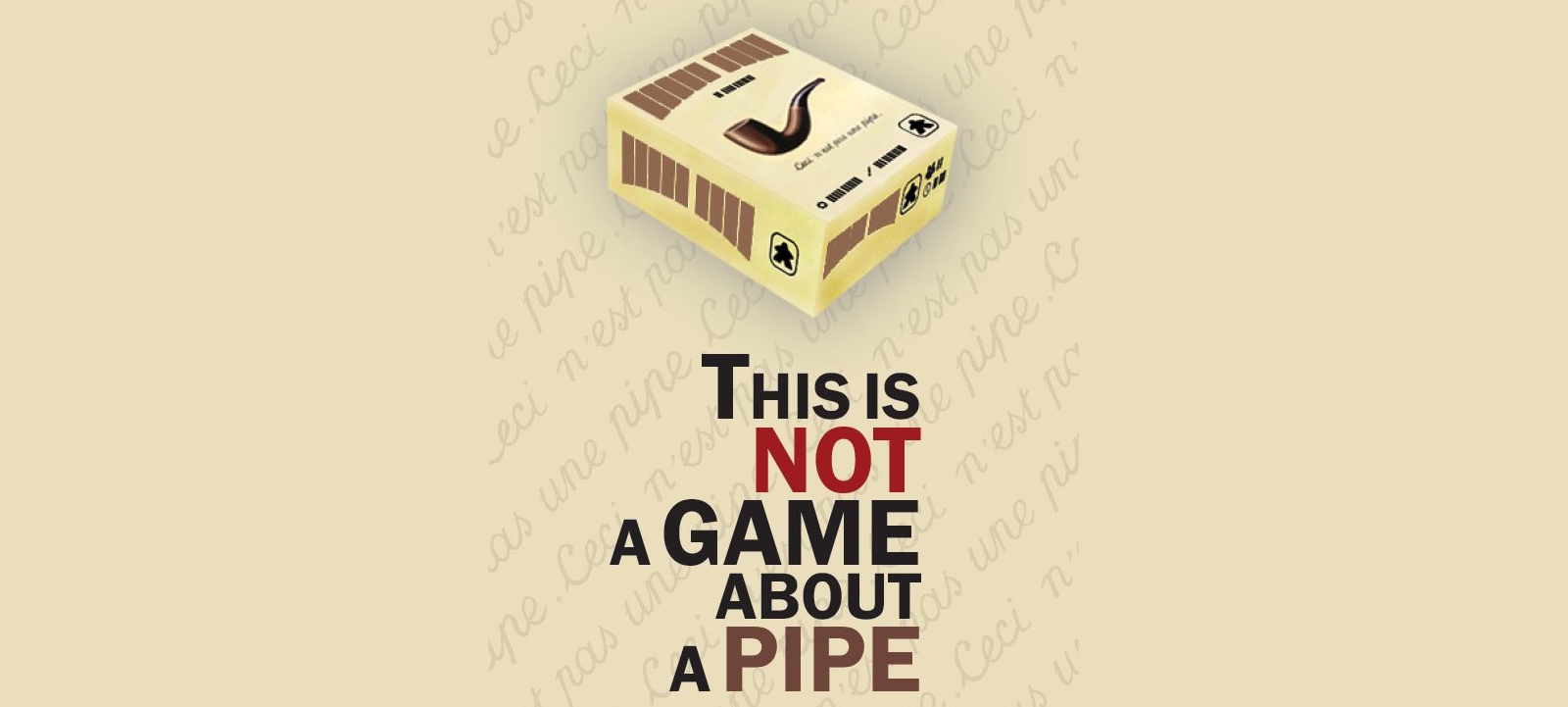
All I play anymore is trick-takers. And while some of them are challenging, others risk disappearing down their own pipe-hole in a semantic puff of tobacco smoke.
That isn’t a bad thing. This Is Not a Game About a Pipe, designed by Mac McAnally, may have started as a riff on René Magritte’s The Treachery of Images, but it’s a respectable little ditty in its own right, in no small part thanks to the way it forces players to construct studiously sensical statements about their cards.
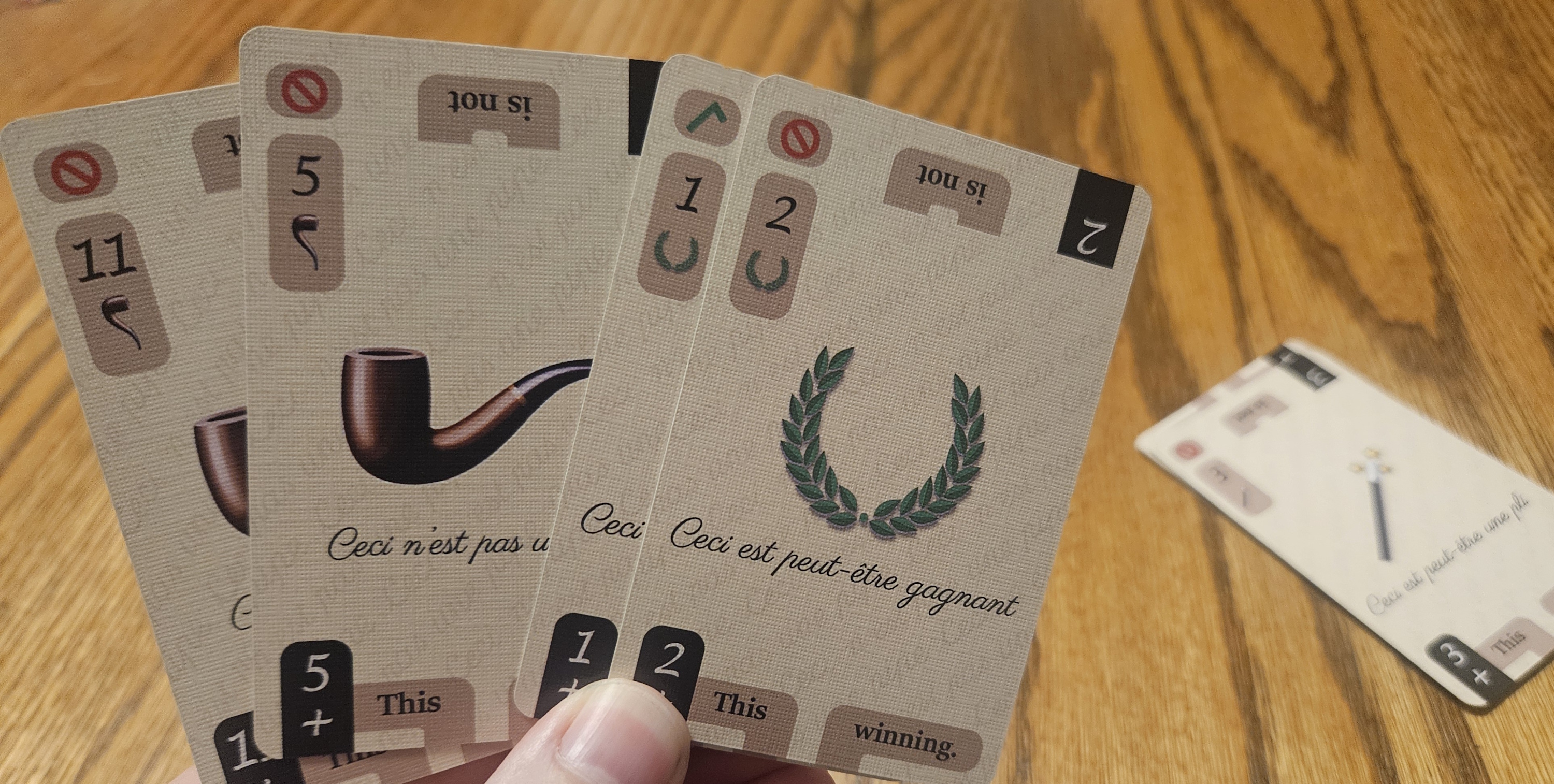
This is a hand of cards… wait, no, it’s an image of a hand of cards.
Okay, let’s back up. Like most trick-takers, This Is Not a Game About a Pipe is all about playing cards of various suits in an attempt to win as many tricks as possible. What sets it apart, at least upon a cursory examination, is that its suits are self-referential in the extreme. One of them is a Card. Yes, a Card. Another is a Trick. Another is Winning. Lastly we get the Pipe, just in case one forgets that this game is jokes all the way down.
But every card is also the bookends of a semantic phrase. “This ____ a pipe,” the Pipe card reads. “This ____ winning,” says every card in the Winning suit. The remainder of that phrase, whether “is” or “is not,” can be found on every card’s header and its reverse, and now we’re really going nowhere.
Backing up even further, tricks work like this. You always play two cards as a pair, and the sum of their numbers becomes your rank in the trick. Whew! We’ve seen this before! The hiccup in the game’s throat is that cards can only be paired if they make phrases that are strictly true. “This is a card” is always true, because you are in fact playing a card. “This is a pipe” is always untrue, thus you must instead play “This is not a pipe.” The other suits, those for Winning and Tricks, are more conditional. Unless your current card is winning, it must be phrased as not winning. That sort of thing.
This accomplishes two things for McAnally’s trick-taker. The first and most relevant to the game’s meta-plot is that every card is also a semantic beat in a larger conversation. It’s funny, is what I mean to say. Very funny. Especially when inevitable mistakes creep in. Because while the game’s rubric isn’t overly complex, and there’s a handy reference card that clarifies which is/is-not statement must be played at any given time, the degree of precision is so exacting that it can’t help but result in the occasional fumble.
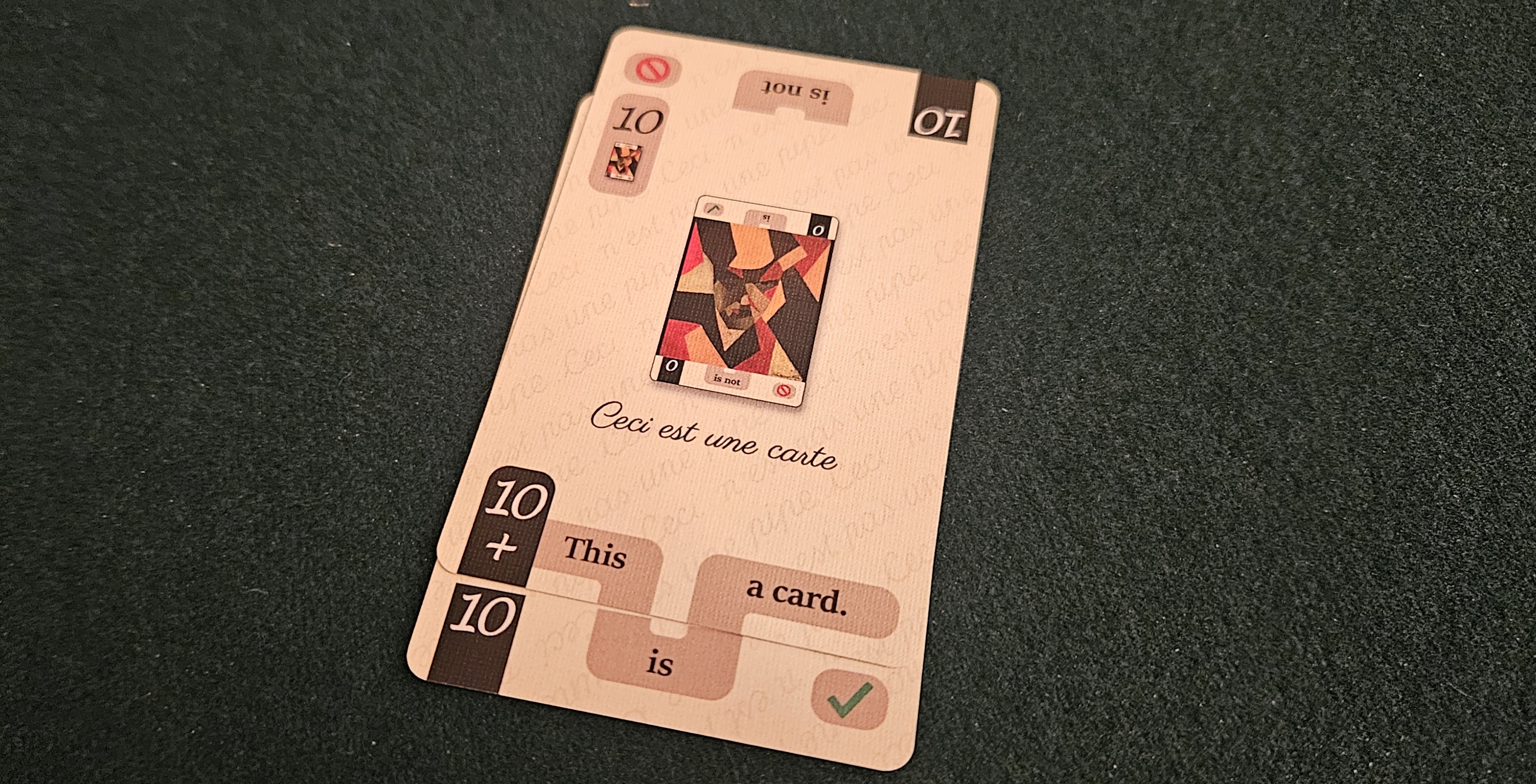
This is an image of how you pair cards.
But the second accomplishment is that all these if-then considerations make for a really darn good trick-taking game.
Consider this. Every card only has one modifier on its face. When you go to pair two cards, finding the right match isn’t necessarily easy. The suit is Cards, so you need to play a statement that reads “This is a card.” But what if you don’t have any is’s left over? To make the statement true, you’ll have to flip a card face-down. This transforms every card into an all-purpose filler, but there are downsides. For one thing, face-down cards don’t add to your pair’s rank, making it harder to win the trick. For another, face-down cards are worth extra points to their scorer when the hand concludes.
Which brings us to scoring. In fitting fashion, the scoring in This Is Not a Game About a Pipe is semantically precise and wholly obnoxious. Tricks are worth points. Face-down cards are worth points. But so too are all those Winning cards you’ve been accumulating — albeit only if you have the highest cumulative rank in that suit. The opposite goes for Pipes. Philosophers may love to smoke, but the cancer takes them in the end.
I appreciate your forbearance. This isn’t the easiest game to describe, and by extension it can’t be the easiest game to read about. This is a pedant’s trick-taker, a grammar cop’s speed trap, a rules lawyer’s preferred Sunday night pastime. It’s a bit mind-bendy, but not too much. When we introduced it to my mother-in-law, thinking it might provide some amusement after Chasing Shadows proved too much for her to grok, she made the occasional syntactical error, but also nearly won the whole dang game on her first try. It’s more reflexive than some experiments in trick-taking, closer to the expected template. It’s just that it’s also a gigantic goof on the whole format.
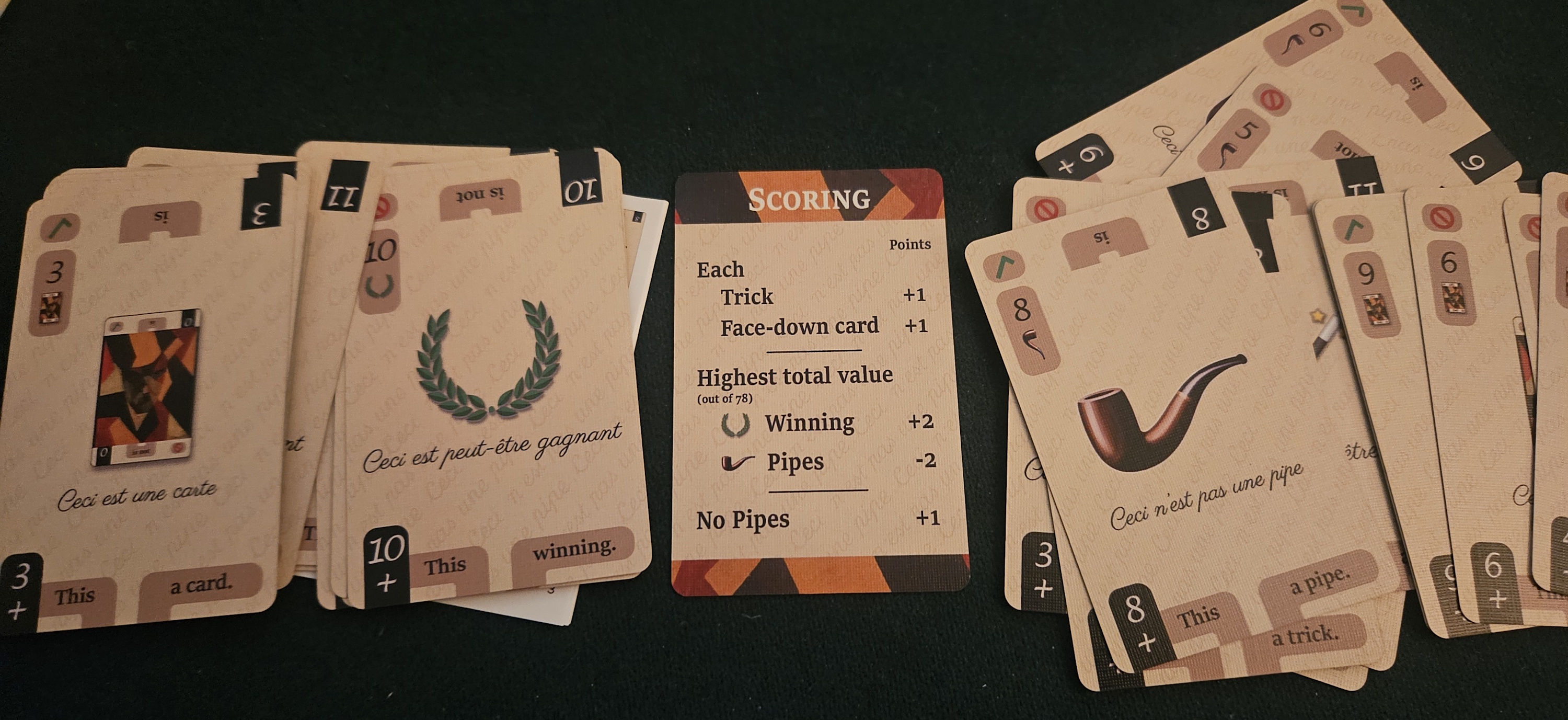
This is an image I snapped because I needed one more image.
Is it thought-provoking? Eh. Maybe if you’re the sort of person who keeps Baudrillard on your bedside table. But it is thinky as a plaything, deeply funny, and more of a keeper than ninety percent of its peers. We’re quickly reaching peak trick-taker. This Is Not a Game About a Pipe is a reminder that there are still depths yet to explore.
A complimentary copy of This Is Not a Game About a Pipe was provided by the publisher.
(If what I’m doing at Space-Biff! is valuable to you in some way, please consider dropping by my Patreon campaign or Ko-fi. Right now, you can read my third-quarter update on all things Biff!)
Posted on November 25, 2025, in Board Game and tagged Board Games, Indie Games Night Market, This Is Not a Game About a Pipe. Bookmark the permalink. 9 Comments.

 SPACE-BIFF!
This is not a comment about your review.
I love this game and it embodies the kind of stuff I was hoping to see at the Indie Games Night Market.
Me too, on both counts!
The novelty of this design amuses me. It seems a clever addition to the seemingly never ending list of reimagined trick takers which are introduced nowadays with such surprising regularity. The well of ideas for new trick takers truly is not running dry any time soon.
Agreed. Which only makes it all the more frustrating that it’s now suspended thanks to a DMCA takedown.
so there’s no way to get this? I don’t even see a BGG entry 😦
The BGG entry was taken down. Currently there’s no way to acquire the game.
Apparently the first documented U.S. exhibition of the work was in 1932, so in 2028 it should be incontrovertibly in the public domain in this country. Let’s hope McAnally re-publishes the game then.
I got that history slightly wrong. 1932 was the first public display of the painting anywhere, not in the U.S. And we’ll need to wait until 2029. However, it seems the first exhibition of the painting in the U.S. wasn’t until 1954, so depending on how litigious the estate wants to be, we might have a longer wait.
Pingback: A Prickle of Trickers | SPACE-BIFF!