Robots Punching Robots

space-biff: noun (informal) A sudden, sharp blow or punch or lasering, as delivered from a robot or spaceship to another robot or spaceship
I believe it goes without saying that any game about gigantic mechs will receive default coverage here on the site that is their namesake. CogDrive Neon isn’t John Clowdus’s first game about gigantic mechs slugging other gigantic mechs. But is it his… most recent? Yep. It’s definitely that.
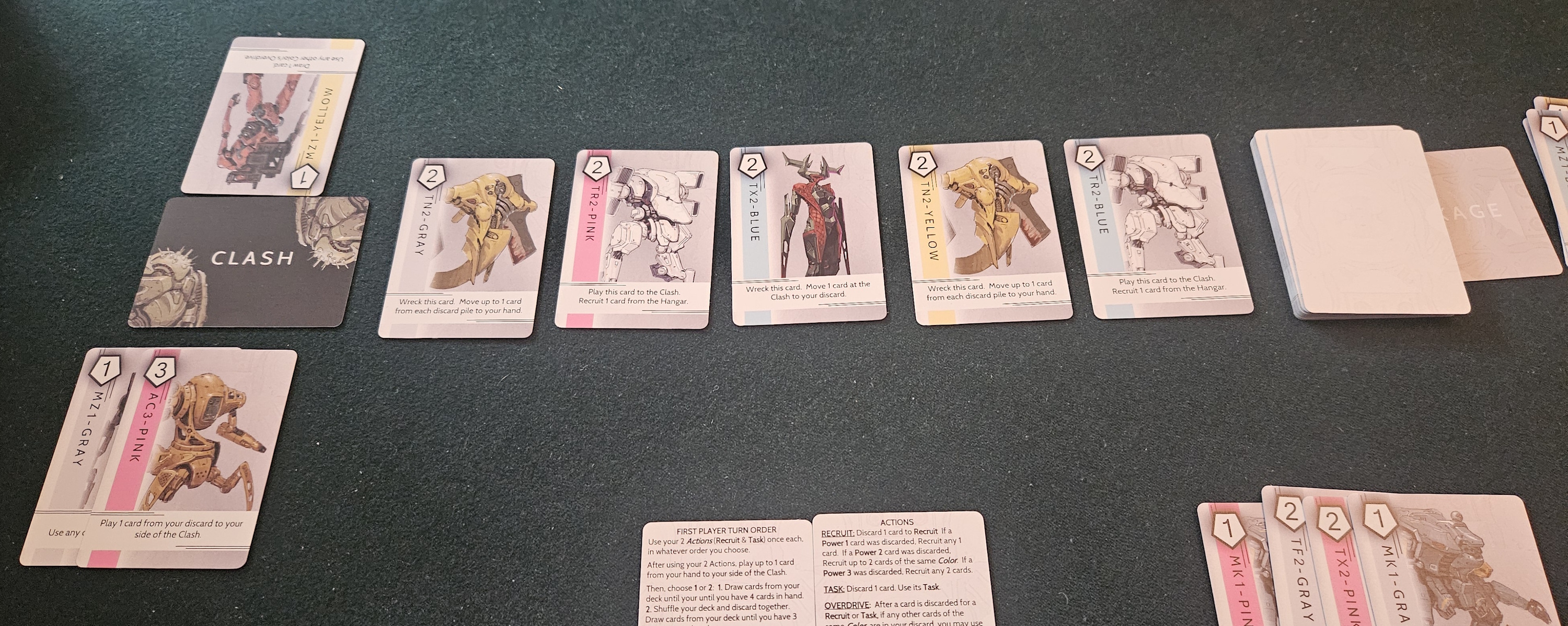
Ah, which mech to build today?
Like most of Clowdus’s games since the beginning of time, CogDrive Neon defies easy description. The shorthands simply don’t apply in the usual fashion. Is it a deck-building game? Yes, but one where cards are added at speed, your deck can only be reshuffled by choice, and at least one mech is winnowed into an ongoing battle at the end of every turn. Is it a lane battler? Sure, although there’s only one lane, every pip in that lane is worth points, and the lane never “resolves.” Is it a set collection game? That too. Somehow.
So far so Clowdus. That’s fine by me. The hobby would be poorer without designers who craft games that march to their own drumbeat.
It takes a few plays to come together, though, is what I’m really saying. In recent years, Clowdus has slimmed his format from biggish small boxes to smaller small boxes to single decks with QR-code rulebooks. CogDrive Neon finds us at the steepest point on that incline, with some of the essentials offloaded to the reference cards. Amid the text, it’s easy to overlook the particulars. And, by extension, to fumble through those inaugural plays.
Once clarified, the rhythm bangs out like tree-trunk hydraulics carrying mounted ordnance. Turns are divvied into discrete phases. First, a pair of cards must be played. One to recruit more robots, the other to trigger its ability. In both cases, these cards are checked against your discard pile. Should they match colors with one of the cards there, they activate an “overdrive” ability, minor perks in the singular, but formidable when attained turn after turn. Once that’s done, a card can be added to the clash. Then it’s time to draw up.
Even here, Clowdus adds in his signature flashpoints, decisions in miniature that seem unimportant at first, but quickly reveal themselves as core to the entire experience. In this case, the decision is whether to draw until you have four cards — but doing so without the benefit of a shuffle, even should your deck be empty. Or you can shuffle your discard into your deck and draw three. This erases your discard pile and its ongoing overdrive abilities, but puts your used mechs back into circulation.
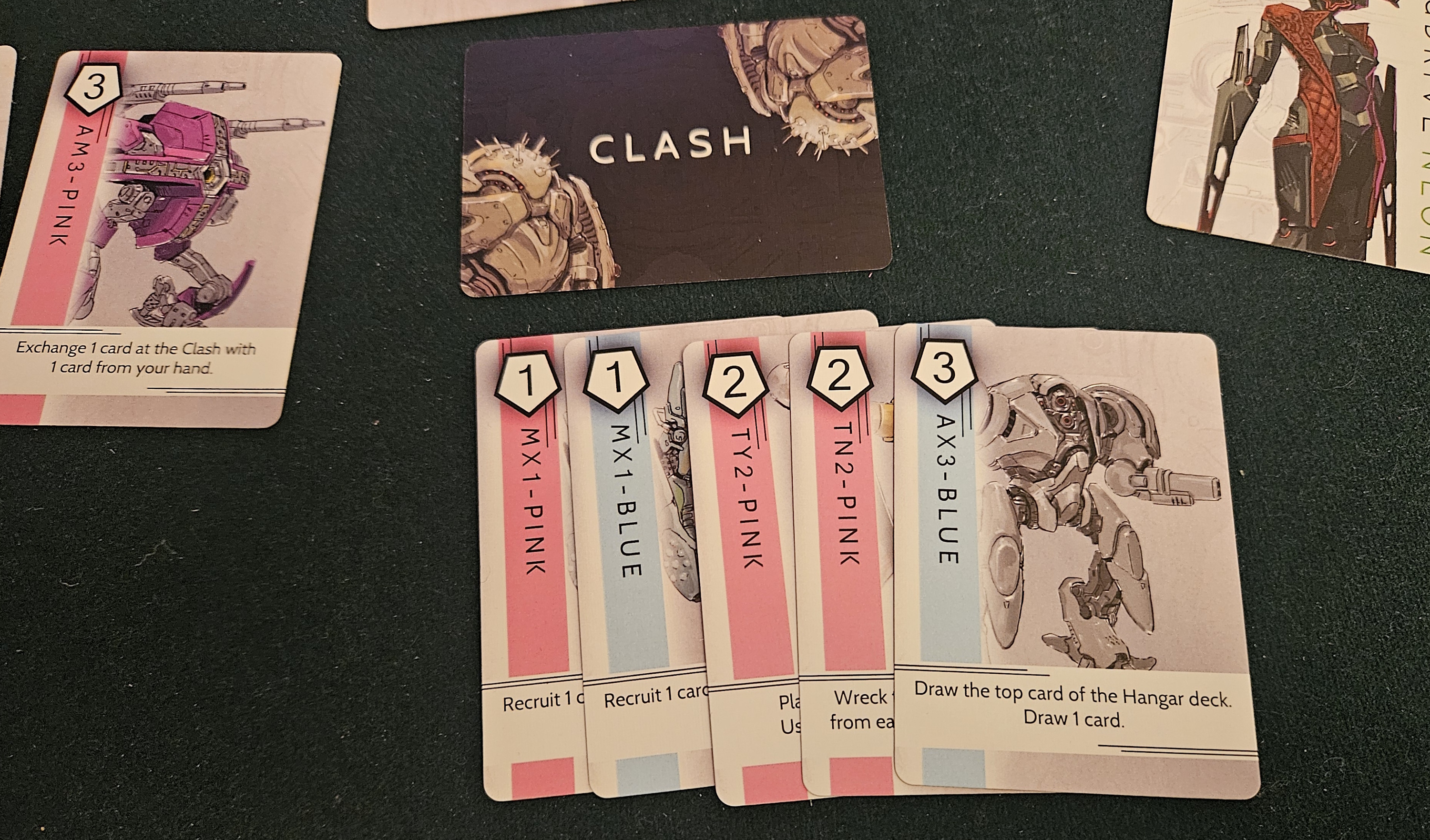
The clash is where robots go to die… actually, to become victory points.
These little decisions are important even when they don’t seem like it. Shuffling in CogDrive Neon always feels like a minor defeat. Recruiting only one mech when most cards will let you recruit two also feels like a minor defeat. Adding only wimpy troops to the clash, even though it’s the surest way to get them out of your deck — that’s right, a defeat, if only a small one, like not paying somebody a compliment at the grocery store or forgetting to block that one insufferable scold on social media so they get in one last jab.
But that’s the point. No single move or decision feels large. CogDrive Neon is too immaculately balanced for that. Instead, in the game’s sole ludic nod to its setting, it feels like managing one of these lumbering robot’s heatsinks. One misstep won’t cause trouble. Crud, absorbing a barrage of missiles is just another Tuesday. But little by little, those dips aggregate. Your armor starts to crumple. Your engines start to whine.
Consider the game’s scoring. The clash, that makes sense. Every pip of strength in there is worth a point. Also, the stronger player wins the battle, earning a bonus five points. That’s a lot. So much that it might be a little too much, to be honest.
But the rest of your points come from your deck. You fan out all those mechs according to suit. Then you pick one. That suit’s strength is added to your score. It’s like an inverse of the traditional Knizia scoring, one where you’re encouraged to double down on a single color rather than build outward. That’s even more potential for little losses, by the way. If you’re recruiting every yellow mech in sight, it’s inevitable you’ll reach a point where the only things you can deploy to the clash are yellow cards. As in, you’re swapping points in one sphere for points in another. And the exchange rate isn’t great.
CogDrive is bristling with good ideas, although that doesn’t prevent it from feeling like a minor Clowdus. Literally minor, as in it’s too small for its own good, with decisions that evaporate because of the game’s format. Those shuffle-or-nots, for example, often don’t factor in at all. I’ll go an entire game without shuffling once, instead merrily bouncing cards around between relevant destinations and using overdrives to reclaim them. Why would I ever empty my discard? The same goes for the clash, which feels like a pruned-down version of Clowdus’s other lane battlers. Shifting a card into there is pretty much always worthwhile. There’s a reason most of these games have multiple lanes.
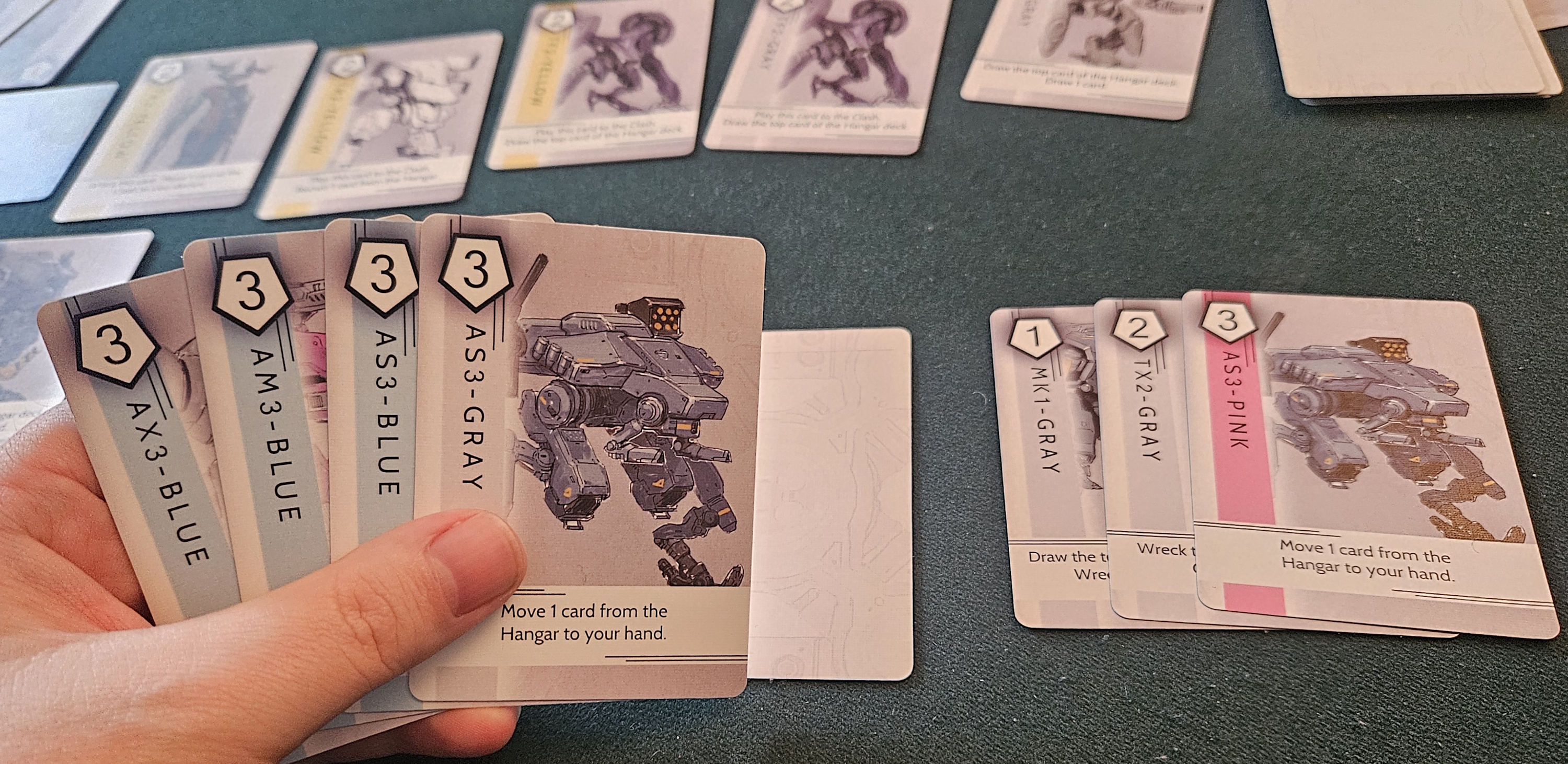
Overdriving your mech is a good idea.
But, look, even a minor Clowdus is worth a look, at least for fans. Because examining this game from outside is fascinating. It speaks to a range of possibilities most designers overlook because they don’t stray from conventional wisdom. The game’s deck-building, the way its cards flow from one location to the next, the counterintuitive scoring that encourages both deck construction and deck destruction… it’s all worthwhile.
As an exercise, at least. When it comes to gameplay, this particular mech doesn’t always quite meet its specs. So, instead, how about tomorrow we look at one of the strongest John Clowdus designs in years? Yeah. Let’s do that. Meet back tomorrow. See you here.
A complimentary copy of CogDrive Neon was provided by the designer.
(If what I’m doing at Space-Biff! is valuable to you in some way, please consider dropping by my Patreon campaign or Ko-fi. Right now, you can read my third-quarter update on all things Biff!)
Posted on November 4, 2025, in Board Game and tagged Board Games, CogDrive Neon, John Clowdus, Small Box Games. Bookmark the permalink. 2 Comments.

 SPACE-BIFF!
Thank you for playing (and writing about) CogDrive Neon!
Nah, thank you for designing it!