Syphilitics
Moving to Paris to embrace my inner bum/artist has always been one of my life goals, so Jasper de Lange’s Bohemians was a safe bet. Set in the drowsy days and smoky nights of Paris-That-Was, this is a love letter to the wanderers who set out to thumb their noses at society and create timeless works of art, and sometimes even did, but spent more of their time sleeping in, strolling the streets, and spreading syphilis.
Did I mention that Bohemians is also a deeply funny game? Top comedy, this.
Wait, this isn’t Bohemia. Where are my medieval traders?
Bohemians is such an overt comedy, in fact, that it encourages players to describe their daily routine for the edification and amusement of everybody at the table. This morsel of role-playing isn’t strictly necessary to the experience, and if given too much breadth can sap it of some vigor. But in the right quantity, it’s worth noting how you spent the day working up the energy to paint — or compose, or write poetry, or whatever else — only to collapse into a love affair that seemed more pressing at the time.
Oh well. There’s always tomorrow.
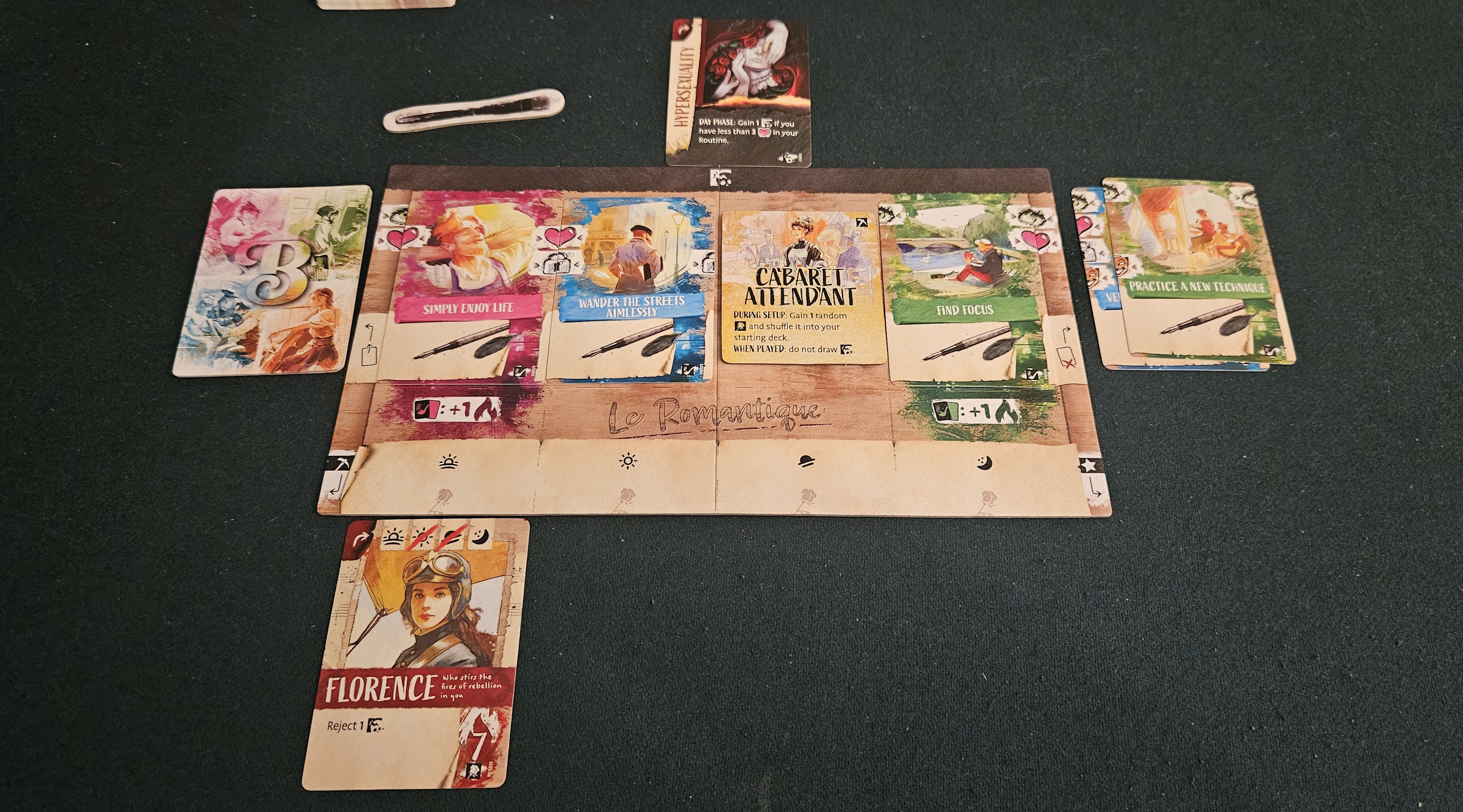
At root, this is a game about scheduling things as much as it is a game about building a deck or making new acquaintances or twittering about your existential ennui. Your daily goal is to plan your day, filling up to four slots with routines that might, with practice and determination, redefine art itself.
If only you weren’t so prone to distraction. The goal of Bohemians is to create a certain amount of art, earning accolades from your peers or attention from respected mentors or grudging respect from the family that has all but disowned you. But, again, there’s always tomorrow. Why work into the night when you could instead pursue a new lover? Lest you assume this is mere window dressing, this air of distractability penetrates beyond the layer of setting. Honing your craft is how you win. But that’s not how you live, as one of your scruffy vagabonds might put it. Winning is a bourgeoisie construct, man.

Bow wow.
The decks in Bohemians are constructed from three building blocks. The aforementioned routines are the first and most load-bearing of these bricks. By arranging them side-by-side to match icons, they produce inspiration, the game’s currency for pretty much everything. Naturally, your starting routines soon give way to more efficacious fare, letting your artist develop their chops or attend political rallies, but they never stray far from the game’s insouciant core. It’s a good thing that “making love with abandon” also happens to be so inspirational, because you’d like to do as much of that as possible.
It isn’t long before you’ll want to amplify your routines with muses. These cards attach below your usual schedule while still being beholden to its procession from morn to midday to evening to night. Many muses offer the customary advantages: Francis doubles the value of your eyeball icons, Ophélie provides a discount on routine cards, that sort of thing. But others are such a perfect fit for the game’s van-life aesthetic that it’s hard to avoid making their acquaintance even when they don’t fit your current engine. Why not declare that absinthe is your muse? Consume enough of the emerald spirit and your other troubles will momentarily dissipate. Or how about the moon? There’s no need to fret over homelessness when you can stare into her face all night.
Ah, yes, homelessness, one of many troubles that might worm its way into your deck. The life of a bohemian is nothing without its struggle. You begin with a job — a cabaret attendant, a journalist, a beggar — and can sacrifice one of your day’s four slots to its drudgery. Of the game’s distractions, however, this is the one most grudgingly swallowed. When you’d rather focus on your art, you can always forego your employment, but this guarantees a new trouble card at the end of the round.
There are other ways trouble might find you, but the effect is much the same. Troubles cycle through your deck like everything else, but instead of opportunities they present problems in miniature that must be overcome lest they snowball into a real mess.

Apart from the syphilis, this is me in high school.
You might, for instance, develop a fixation. On its own, this isn’t a big deal. The fixation doesn’t prohibit you from buying cards like some of the other troubles, or devalue your tableau, or anything like that. But if you complete a turn without three completed eyeballs in your routine, you draw a new trouble. And this time, it’s… narcissism! Which means you will produce art or you will gain another trouble. But making art is hard, you don’t generate quite enough inspiration, so it’s time to spin the wheel once more to produce… a drinking habit! Then a rival artist drops some syphilis into your discard, making your deck (and your lymph nodes) rather swollen.
There are solutions, of course. The right muses, some time reconstituting your health, pleading with your syphilitic peers to stop having sex with you. But it isn’t uncommon for the mid-game to hit a plateau where everybody’s dedication to the life of an impoverished artiste means they can’t produce the great works they went into poverty for in the first place. There’s an arc to this game, is what I’m saying. A decline and then a triumphant return. Like watching a musician’s biopic, but less dour and less formulaic, and sometimes you can keep the addictions and still weasel your way into artistic infamy.
It’s kinda great. I mean that. Bohemians doesn’t look like much from the outside. To some, it doesn’t look like much on the inside. Some of the illustrations, which are lovely on the whole — especially the troubles, wowza — have drawn heat for appearing a little too artificial, if you catch my drift. The game’s publisher, Ignacy Trzewiczek, has denied these claims, but there’s some speculation that one of the artists may have used generated images without his knowledge.
We’ve reached the point where there might be no telling, but I hope that isn’t the case. Not only because Bohemians is far better than anyone expected, a masterclass in how a game’s setting can elevate a design in every respect, but also because, well, it would suck for somebody to cut corners in a game about an artistic movement that was so dedicated to their craft that they elected to live in squalor. Affected squalor, to be sure! But games about art should be the first to think long and hard about the value of the things we create.

The solo mode is pretty good — and can transform Bohemians into a respectable cooperative game.
Here’s the good news: Bohemians did make me think about the value of my own creations. Its value, and its impermanence, and the very real possibility that I’ll distract myself from ever creating anything of worth. These thoughts were satirical, gentle, always produced with a chuckle, but never far from mind.
Which is to say that this game is so good that its problems are easily overlooked. The way muses can run out in a four-player game; the duration of that mid-game slump. Honestly, I don’t care. In much the same way Santa Monica blew me away with its sense of place, Bohemians impresses me with its sense of time, the vividness of its cast, the bleak humor of its troubles. Playing this thing, whether with friends or the excellent solitaire bots, I see myself goofing off with some video game or doomscrolling or pretending I’m answering emails. The art is on my fingertips, ready to be tapped into existence.
Oh well. There’s always tomorrow.
A complimentary copy of Bohemians was provided by the publisher.
(If what I’m doing at Space-Biff! is valuable to you in some way, please consider dropping by my Patreon campaign or Ko-fi. Right now, you can read my third-quarter update on all things Biff!)
Posted on October 30, 2025, in Board Game and tagged Alone Time, Board Games, Bohemians, Portal Games. Bookmark the permalink. 5 Comments.

 SPACE-BIFF!
As an actual Bohemian, I must let you know that your expectations of medieval markets are grossly misinformed.
On the contrary, musing on alcohol, working our backs off for alms and spending most of our lives in illness are absolutely accurate to our jolly mitteleuropean lives.
On a serious note, how would you compare Syph… I mean Bohemians to other verily thematic games like Obsession and Molly House in its delivery? Say, is it more gamey like the former? Or more immersive like the latter?
Good question. I would probably put it more on par with Obsession than Molly House, which really rides on its immersion. Definitely more on the “gamey” than “role-play” side of the spectrum.
This game ended up being my surprise hit at Essen. An excellent deck builder with great theme. Plus you could engage with that theme as much or as little as you wanted. Two of us playing were telling ongoing stories every time we played our cards out, while another friend was content just to read his cards and move along. And both felt fine.
I’d never come across a spillover resource before either, and that felt amazing, as even subpar turns banked your paltry inspiration for later actions.
Yes! The spillover is such a clever way to make workable hands even when you draw four troubles. I should have mentioned that in the review. The game is filled with little touches like that to help it move along.
Pingback: Respond or Re;ACT | SPACE-BIFF!