Repentants

Gosh, it’s been a while since I thought about March of the Ants. Tim Eisner and Ryan Swisher’s eusocial civilization game is now ten years old, which in board game years represents the better part of a century. As befits the game’s diminutive nature, this has always been the smaller, faster, and scuttlier cousin to fare like Eclipse: New Dawn for the Galaxy, Clash of Cultures, and Twilight Imperium. With the recent release of the Evolved Edition, it seemed like a good time to take a second look.
I’m glad I did. Not only is this new edition an improvement on the original in pretty much every regard, it has swiftly become a jumping-off point for my eleven-year-old into the expansive world of 4X games. And the ants! There’s nothing quite like slapping a big old butt onto your custom subspecies.

What a visual upgrade!
From a foot-high perspective, March of the Ants is the same game it always was. Sharing humble origins in the cramped Great Tunnel, everyone is given command of their own army of soon-to-scuffle Formicidae. Beyond this space’s relative security, the lawn is a teeming jungle, with grass that towers like redwoods, wormholes that function as tram stations, and centipedes looking for a quick bite. But there are opportunities out there, too. Food, mostly, but also fresh storage room for eggs and larvae, a few tweaks to your rapidly-mutating genetic code, and maybe some abstract victory points for good measure.
In some ways, March of the Ants is such a throwback. In this incarnation at least, there’s none of the modularity that pockmarks today’s designs, and certainly there are no gaps in this thing’s thorax where an essential portion has been carved out for an expansion pack. Frankly, it’s refreshing. After that first learning session, my time with March of the Ants has emphasized foreknowledge: which spaces are liable to contain danger, how to ward off competitors, which cards to be on the lookout for. The whole package is so slick, so easy to come to terms with, that there are very few barriers between the player and the play.
There have been alterations, of course, all of which are thoughtful in their own right, and some of which mitigate my hangups with the original. Perhaps the biggest is the “nasty combat” problem, where battles were so punitive that the original game’s swarms tended to be a little too socialized. Combat, I’m happy to report, is still vicious enough that thoughtless battles are best avoided, but the game’s worst sputterings of hemolymph have been staunched. You’ll bleed, but you won’t be knocked out of the running thanks to a single massacre.
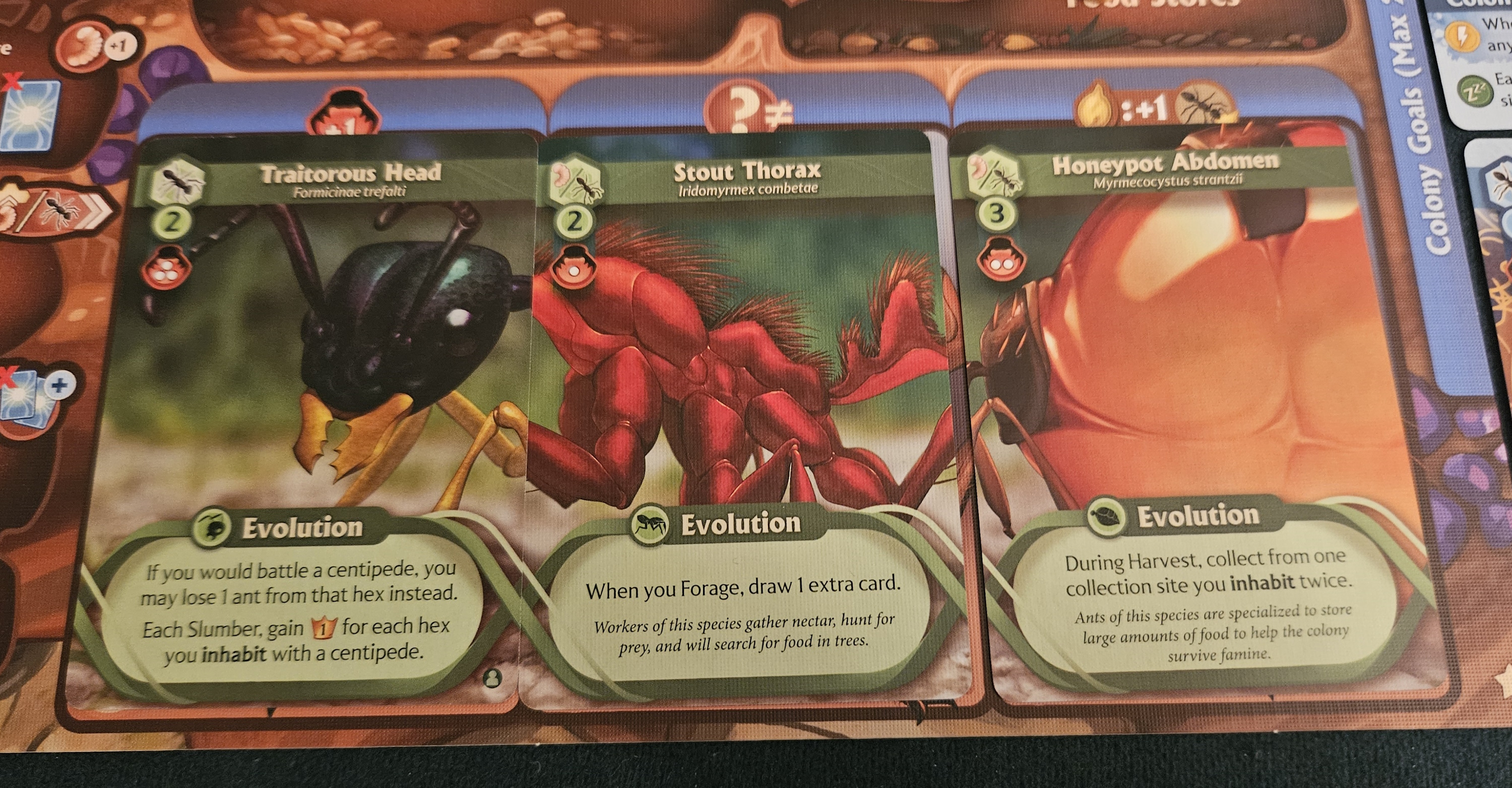
Check out my honeypot abdomen.
Meanwhile, everything else has been touched up. The illustrations are better, which does wonders for an entomology-obsessed preteen. But at a more mechanistic level, the game has been overhauled right down to its smallest bonuses. Perhaps the most significant are those of your ants’ bodies themselves. As before, March of the Ants allows players to tailor their species, adding heads, thoraces, and abdomens for a wide array of special abilities. Sprouting wings lets you travel between hexes with ease, developing specialized pincers makes it possible to steal larvae from rival hives, and growing a big ole dump-truck ass permits additional harvesting.
Beneath the macro-evolution, however, the sub-bonuses your species earns from developing multiple body parts have been overhauled. Heads are good for combat, adding to your ants’ overall potency in battle. Thoraces let you take bonus actions, moving a single tide-turning ant into battle or gaining a larva after the main action phase. And abdomens increase the calories you dredge from each grain, making it easier to feed the swarm. The whole thing is more balanced, but also easier to comprehend.
Naturally, the higher-level stuff survives intact. This was always where March of the Ants shone brightest. The gist is that every action permits your neighbors to take a corresponding bonus, forcing players to consider the ramifications of sustained activity. For example, if I explore into new territory, the players to my left and right are allowed to move an ant from their larvae chamber to the board. If my neighbor then forages for additional cards, I gain a larva, increasing my population cap. It’s a smart system, if also an attention-heavy one. To my thinking, the need to constantly pay attention is worth the benefits. To play March of the Ants is to inhabit, if only in the slightest, most cardboard-mediated sense, the eusocial sensitivities of these creatures. You’re never far removed from the activities of the other bugs around you.
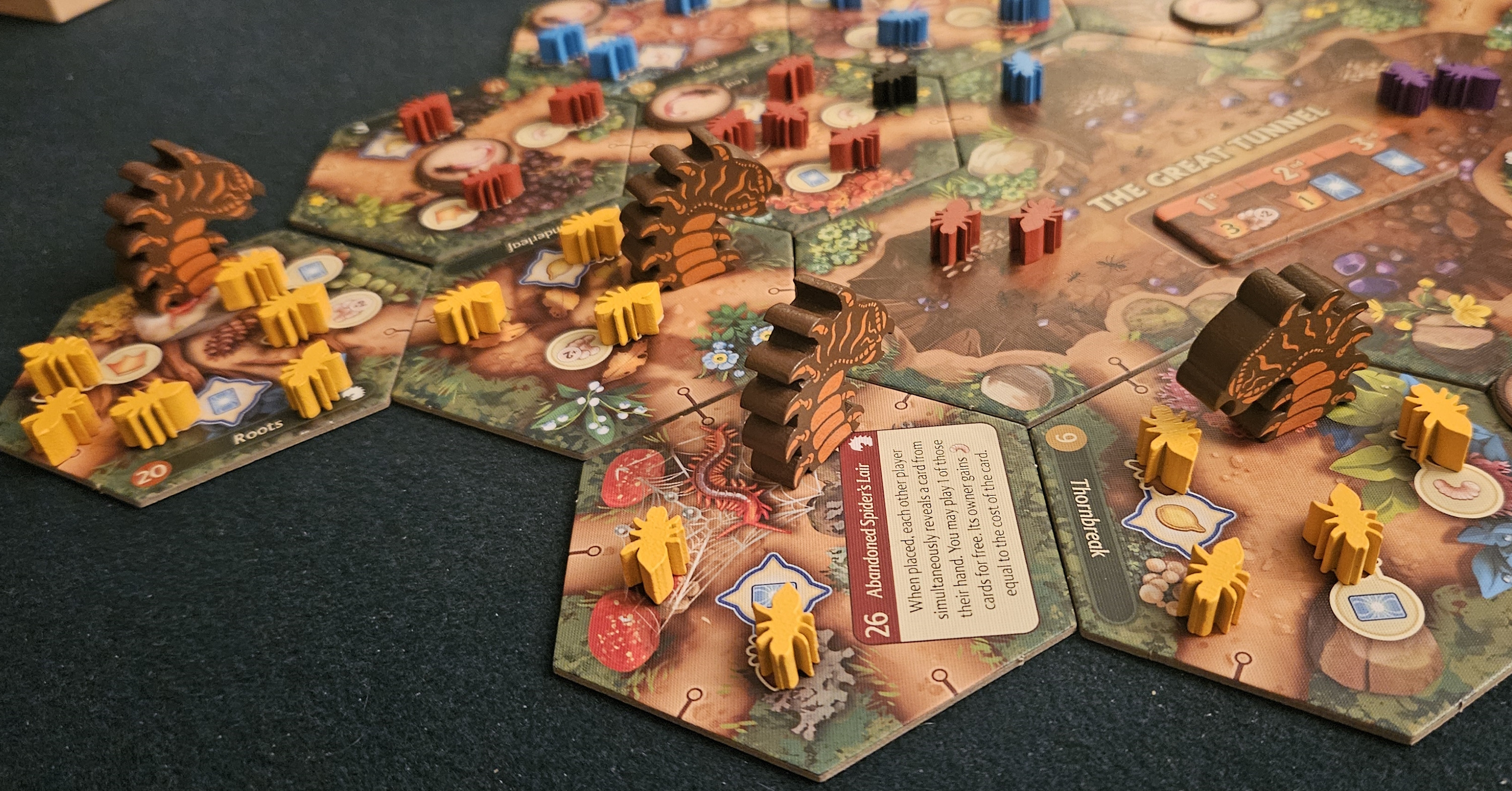
Centipedes are nasty… unless you learn to live with them.
This breeds an intertwined social space, one where the fate of your hive is never far removed from those of your fellow insects. Multiple species can inhabit the same space, provided there are enough foraging spots for everyone. It’s only once the local population spills over that the ensuing Malthusian catastrophe forces a conflict. Similarly, the cards that govern how your hive operates — not only their changing bodies, but also the events that befall the meadow and the goals you eventually set for yourself — tend to bite both ways. March of the Ants is a competitive game, but it’s a particular brand of competition, one that slips over the edge into outright hostility only after careful consideration.
It’s a delight. Even when it requires an unusual amount of moment-to-moment attention thanks to those neighboring bonus actions. Even when plumbing the deck because you haven’t seen a workable objective card in two full rounds. The small scale befits these pebble-sized problems. Unlike those bulkier peers I mentioned earlier, March of the Ants is so quick to play that it never gets around to amplifying its issues. Especially now that the game’s irritants have been polished down for the new edition, what remains is so smooth that it doesn’t stick in the sock like a burr. Not anymore.
What remains is a pleasant little 4X that offers just enough room for self-expression. Once, my ants carved out a portion of the frontier for themselves by hiding among centipedes, their traitor heads letting them sacrifice a single drone but earning points in return. We spent the back half of that session shielded from our rivals by many-limbed killers. In another, my kiddo developed a species of flyers that could redeploy into occupied hexes at will thanks to their many thoraces, then sting their foes and steal their harvesting slots. Crafting the perfect ant has never felt better.
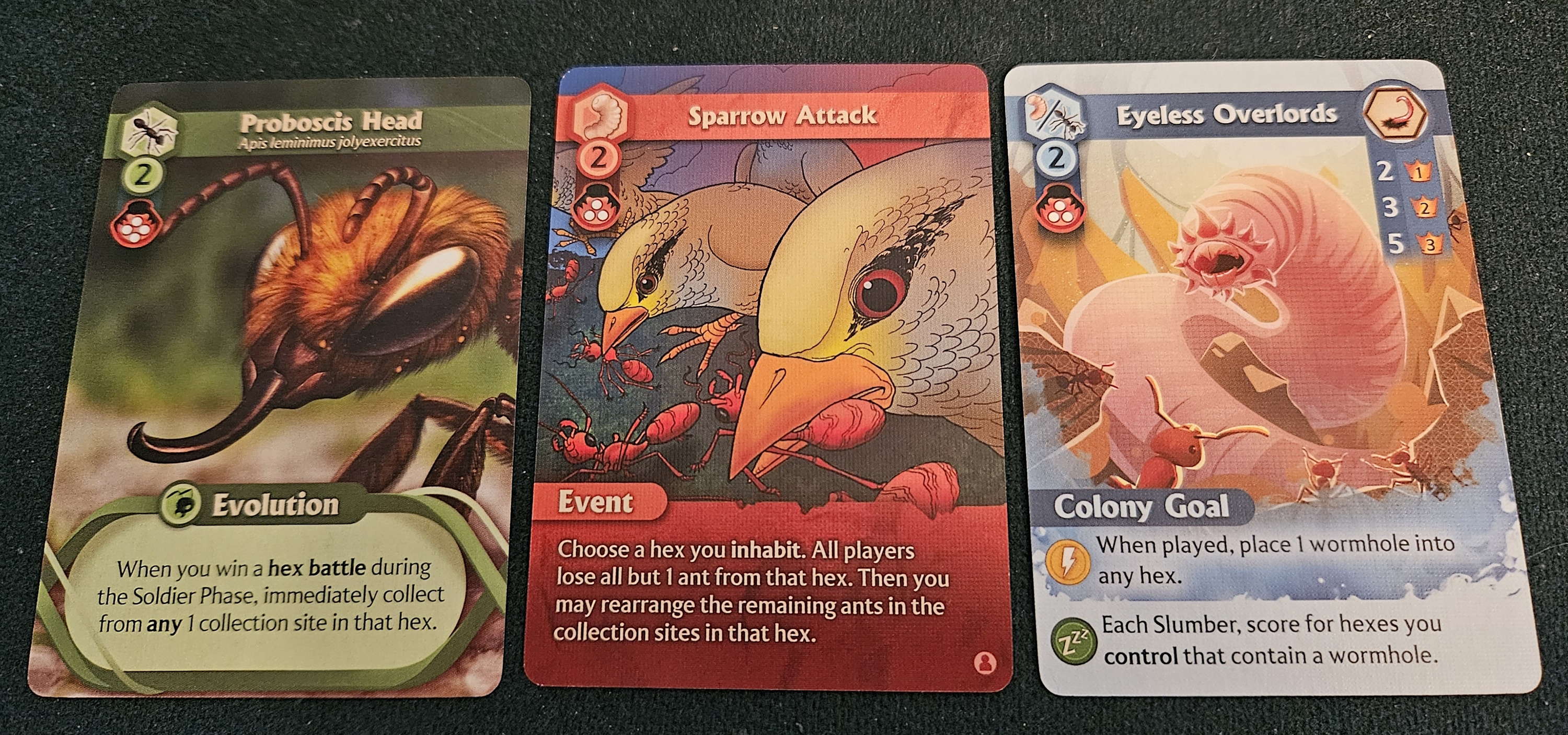
Trying to draw the right cards.
At times the game gets cutesy; nowhere does it flaunt its space-faring inspirations more than with the “wormholes” that bridge far-off hexes. But it’s come a long way from its original incarnation. Eisner and Swisher have evolved their design sensibilities across the intervening years. The result is a game that still captures that mid-weight feel, that allows for two-hour sessions rather than consuming an entire evening, but also no longer trips over its own feet. Heaven knows there are enough of the little things.
Which is to say, March of the Ants has grown into the creature I wanted it to be ten years ago. It’s lighter, but not too light; considered, but not too tangled. This is the joy of bugs. The enormity of their world encompassed within a few square meters, the strangeness of them, the variety. I’m so glad to have found myself once again kneeling in the grass, magnifying glass in hand and sketchbook folded open, only this time it’s the eleven-year-old next to me who can’t stop sharing facts about the creatures scuttling beneath us.
A complimentary copy of March of the Ants: Evolved Edition was provided by the publisher.
(If what I’m doing at Space-Biff! is valuable to you in some way, please consider dropping by my Patreon campaign or Ko-fi. Right now, supporters can read my next essay, on the competing strands of history and criticism that are present in my work. That’s right, it’s the Death of the Author, bay-bee!)
Posted on October 22, 2025, in Board Game and tagged Board Games, March of the Ants, Weird City Games. Bookmark the permalink. 12 Comments.

 SPACE-BIFF!
Reading this makes me glad I decided to take the risk and back the crowdfunding campaign for this new edition of the game, despite the high extra costs of shipping and VAT as a customer in the EU.
As a big fan of area-control games, it had been on my wishlist for many years, and I’m also very much into the theme. I hope my copy arrives soon!
Thanks for the review!
Thanks for reading!
The slow narration over many articles of your and your daughter’s shared love of board games is precious.
Thanks!
I had pondered this one back when it was crowd funding but the battle system seemed overly complicated. Reading back over the rules now it still seems more complicated than necessary but mayhaps I will check it out still
There are a number of steps, but it becomes second nature after one or two fights.
Sounds really nifty
I dunno, it makes me antsy.
Being in Brazil that is one of the games that was very hard to get and always wanted it. With this new edition and a publisher bringing it I will try to snatch it, seems a nice lighter 4x before I pull the big guns for my normies ants.
And of course, great review as ever. Was it “fun”?
I think so! Sometimes it’s a bit tiring, especially when I’m running the game and have to keep reminding everybody to take their actions. Ironically, I find it more tiring than some of its weightier brethren. But, yeah, I think it’s fun.
Have you played with any of the expansion content? I really enjoyed the strategic considerations of the major workers, but I’m kind of split on the “tactics” cards that offer special bonuses in combat, but don’t have a cost. They feel a good deal swingier than the rest of the cards, and getting something like an ant Evolution or a Colony Goal for free can be a pretty big deal.
I’m excited to try my next game using the Predators as well, as the game-warping effects and potential scoring bonuses all feel very cool.
Sorry, I haven’t tried any of the expansion stuff. They sent me the base game. Which is quite enough game for me!