Auto Dominion

I believe Gricha German and Corentin Lebrat have cracked the code. Ever since the auto-battler was popularized way back in 2019, the format has seemed ripe for cardboardification. I mean, its alternate title is auto-chess, for heaven’s sake. But while plenty of titles have attempted to bring the genre to our tabletop, none of them have really captured the spirit of the thing.
Until now.
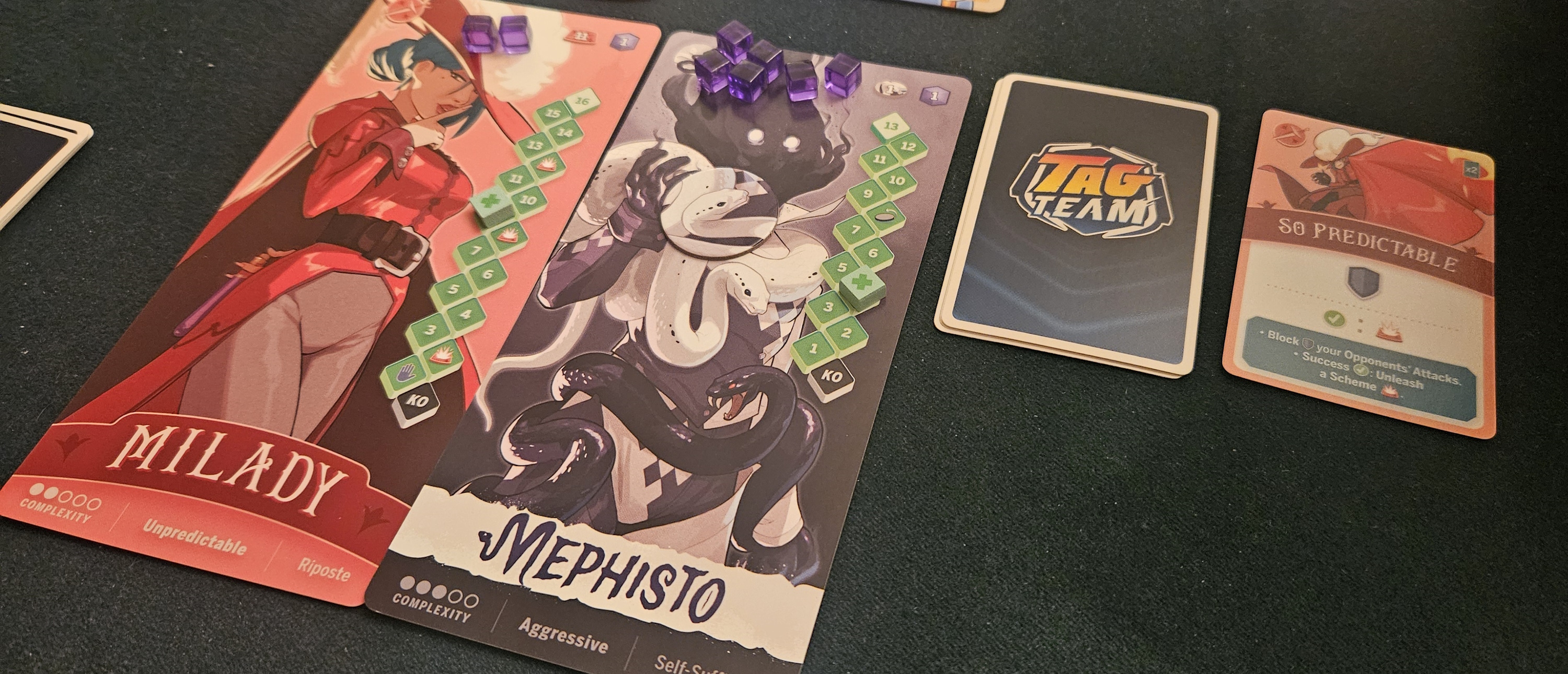
Shhh.
Tag Team is… how to put this delicately… it’s Smash Up merged with War. But good.
The first portion of that equation is simple enough. As in Paul Peterson’s zany lane-battler, there’s no competing in Tag Team without smooshing two fighters together. Each character, of which there are twelve, has their own deck of cards, and in some cases unique components for unleashing special effects. Both players pick two, shuffle their decks together, and there you have it. Smashed. Up.
But the second portion needs more explanation. As in War — also known as Battle across the pond — the gameplay largely consists of both players peeling a single card off the top of their deck to see what happens.
Not that it’s so simple as all that. Every character provides a single starting card. When the bout begins, you place one on top of the other. This is your combat deck, a slender two-card stack that resolves in all of ten seconds.
Every time you reach the bottom of that stack, the decision-making portion of Tag Team unfurls. You draw three cards from your pool, choose one, and then slot it into your actual combat deck. That deck’s order must be preserved; no reshuffling or rearranging allowed. But the new card can be added anywhere. On top. On bottom. In between two other cards.
Then you flip the whole combat deck face-down and go again.
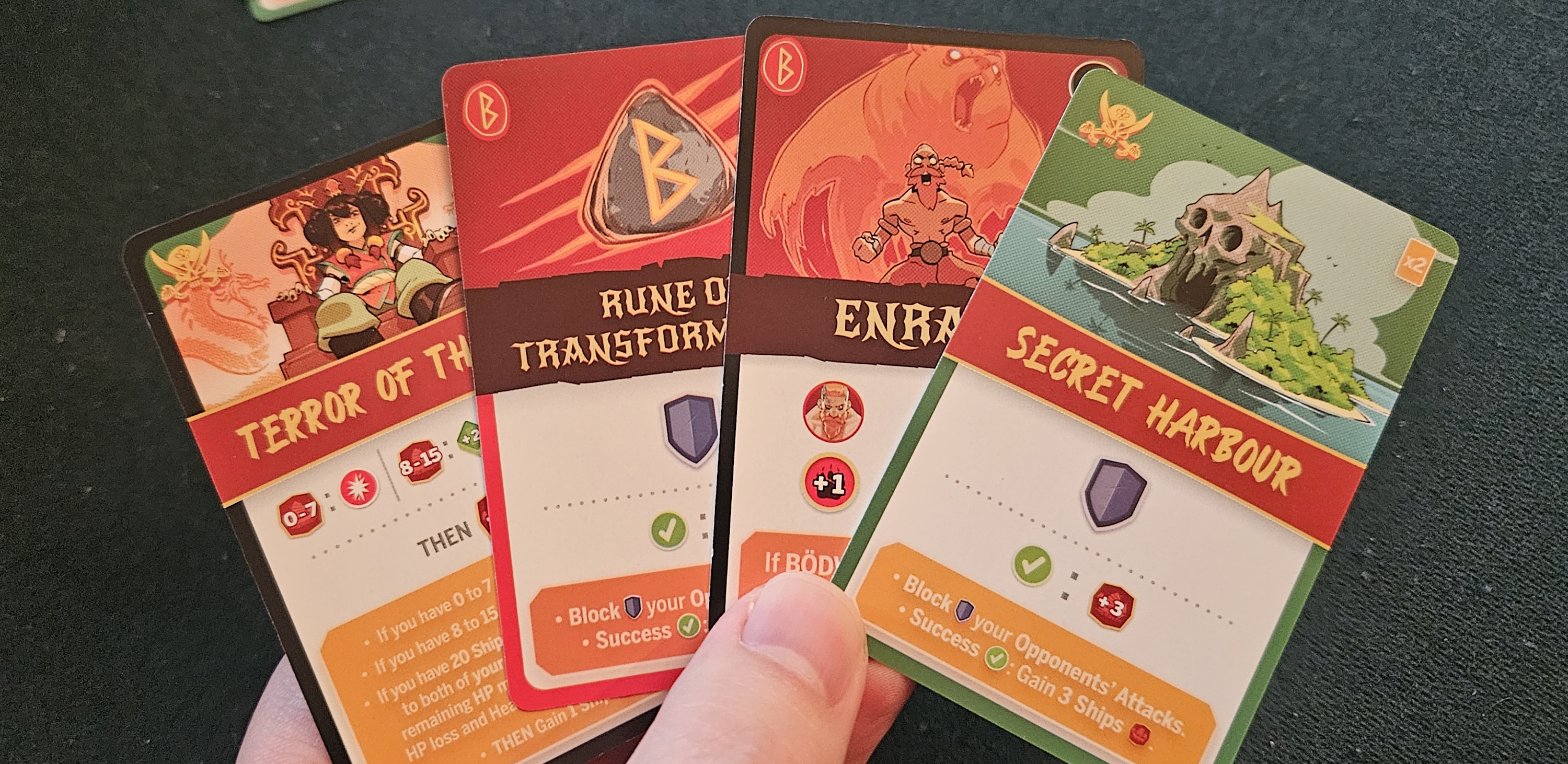
Ordering your cards is a big deal.
As battle systems go, it’s beautifully simple, even making other gateway duelers like Unmatched look encyclopedic by comparison. The first time you run through it, the whole thing perhaps even comes across as too simple, not enough steps removed from War to make the game worthy of more than a passing glance.
Of course, there’s plenty going on under the hood. Those watershed moments when you add a card to your combat deck are anything but straightforward. For one thing, these decks are so shallow that anybody can remember the basic sequence. Two cards? Even my aging brain can handle that. Four cards? Breezy. Seven? It’s getting tougher, except we’ve run through that sequence six times by now. And I don’t need to remember every step. I just need to take note of the most important beats.
For example, let’s say one of your fighters is Shango, the Polynesian warrior whose goal is to deposit five fire tokens on one of my characters so they incinerate to death. Over the last three rounds, you’ve faithfully stacked those tokens on just one of my guys. But if I alter the order at the right moment, now they’ll be safely tucked onto my other character, nullifying your progress toward that auto-win.
Or perhaps you’re playing as Mephisto, whose snake token keeps flipping between buildup mode and murder-everything mode. If I insert a block card at the precise moment you would normally deliver a huge blow, I deflect the attack in its entirety. And, in most cases, earn some additional perk at the same time.
It’s a sheer embodiment of the concept of yomi, that idea of getting in your opponent’s head so fully that you appear to read their mind. Or David Sirlin’s fighting game Yomi, sans all those stances. Huh. Weird that those two things share a name. Serendipity, that.
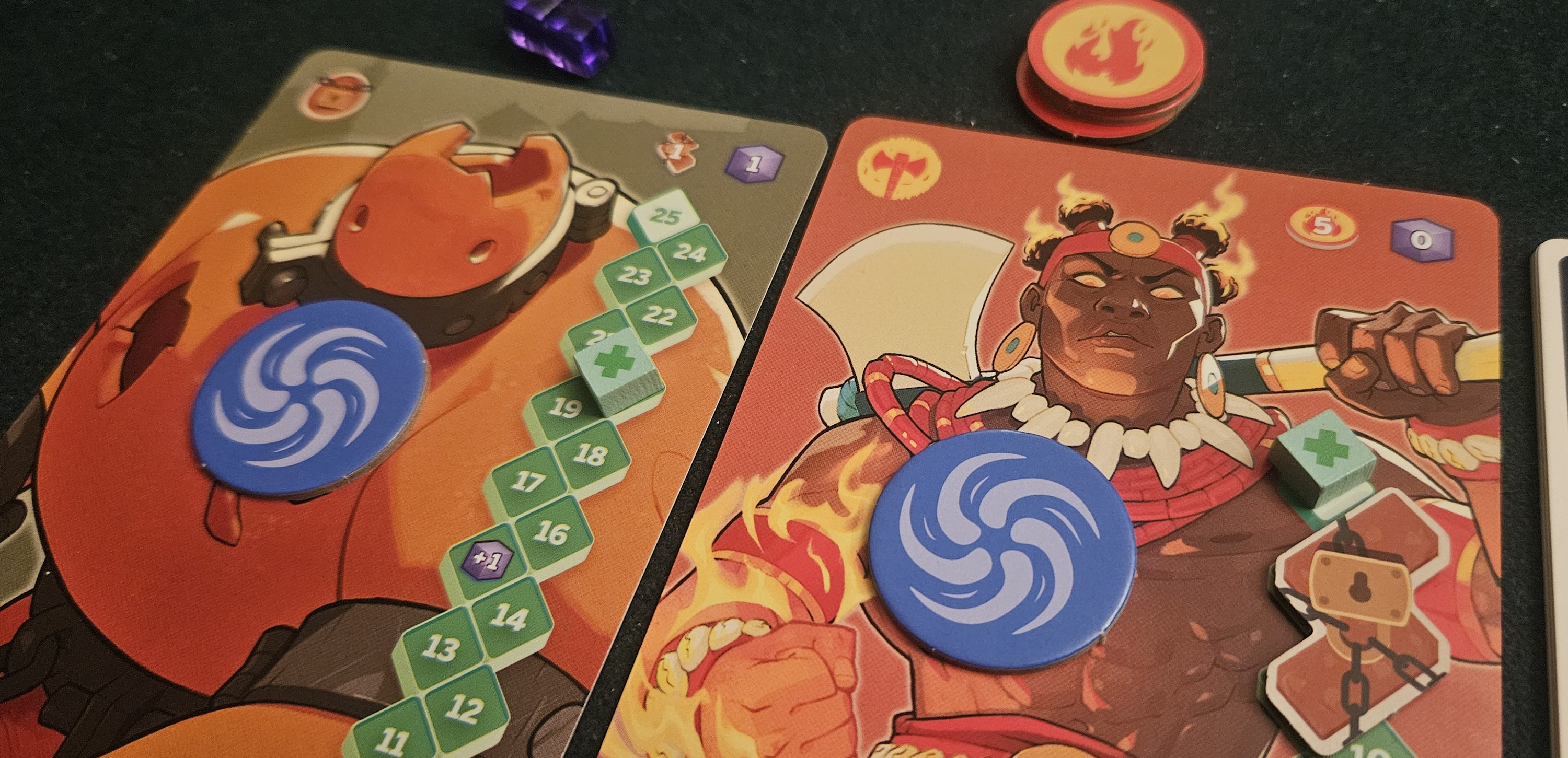
My two brawny boys.
As you might expect, much of the game’s strategy emerges as you craft new duos. Every fighter brings their own style to bear. Playing with Golem, you’ll block entire chunks of damage, only for your ceramic hero to gradually drain his life — a great trade when facing a bruiser, but a poor exchange when suffering chip damage. The hidden schemes of Milady play well with a finisher, but pair as well as orange juice and toothpaste with someone like the Wild Bunch, who only have five hit points, can only suffer one hit at a time, and might find themselves overwhelmed by the former’s occasional “hit everybody at the table” tiles.
Mixing those styles together is a joy, provided you don’t care much for internal consistency. As a set, Tag Team is doing the Unmatched: Battle of Legends thing, not so much the Unmatched: Cobble & Fog thing. Which is to say, there’s no sense that these stooges might actually mix it up together.
And, look, it really doesn’t matter. But there have been moments where I’ve wondered how a character from Shrek wound up tussling with Joan of Arc. According to my eleven-year-old, who absolutely loves the game, these pairings are totally natural. Then again, she has no idea about any of the cultural touchstones being referenced, so let’s maybe leave her opinion of thematic consistency on the sidelines.
But like I say, it doesn’t matter. To offer a more relevant dispute, Tag Team sometimes concludes a little too quickly, especially when one player’s deck has their rival’s number. Like the previous quibble, this isn’t especially substantive. If anything, it’s a mercy when the game wraps up after five minutes rather than dragging out the shellacking. Just be aware that Tag Team is shockingly light. Shockingly good, too. But I have yet to introduce it to somebody — an adult somebody — who wasn’t surprised at how high it rides in the water.

I like to blend complexity levels.
As an introductory set, though, Tag Team is excellent. It showcases perhaps the cleanest expression of the auto-battler format ever put to cardstock, and does so with inventiveness and a clear-eyed perspective on the system’s limitations and potential. My kiddo has announced that we’re not allowed to donate it. Good thing I wasn’t planning to.
A complimentary copy of Tag Team was provided by the publisher.
(If what I’m doing at Space-Biff! is valuable to you in some way, please consider dropping by my Patreon campaign or Ko-fi. Right now, supporters can read my next essay, on the competing strands of history and criticism that are present in my work. That’s right, it’s the Death of the Author, bay-bee!)
Posted on October 16, 2025, in Board Game and tagged Board Games, Scorpion Masqué, Tag Team. Bookmark the permalink. 4 Comments.

 SPACE-BIFF!
What a pleasant surprise to see my latest obsession show up on here. Rules-light games are often praised for punching above their weight class. I find it fascinating that feels like the wrong conclusion here. Yet the game still has a surprising amount of addictive depth, even within a single repeated matchup.
From a fighting game fan perspective, the odd pairings here don’t feel out of place. From a genre still built on Fighters deriving their entire personality and playstyle from what Japan thinks is a nation related trope, yeah the oddballs seeking to punch each other feels like it fits the root inspiration.
While I believe everything you said here, and looking forward to trying Tag Team at the SPIEL this week, I can’t help but feel that Challengers deserves mentioning. In my opinion, it has been one of the few games from the last ten or so years that perfectly executed what it set out to do. The auto battler was wonderfully simple, the challenges in deck creation were tricky with just the right dose of luck, and most importantly, it managed to squeeze a 24-hour tournament atmosphere into precisely 45 minutes. And to my knowledge, it opened the door to tabletop auto battlers like Dominion did to deckbuilding.
Pingback: One-Hit Wonder | SPACE-BIFF!
Pingback: Flippin’ Mickey | SPACE-BIFF!