Afterlives

Sometimes I think about the afterlife. Not the actual afterlife. I’m suspicious about the probability of any such thing. But the afterlife as it appears across faiths and cultures, as reflections of our lived values and fears.
Take Club Spooky and That’s the Spirit!, the forthcoming duo by Connor Wake, whose Out of Sorts was one of last year’s unanticipated (and overlooked) hits. These small-box titles present contrasting soteriological outcomes for our disembodied souls, one an endless celebration and the other an endless process of self-doubt. To my Manichaean mind, one of these afterlives must be paradise and the other purgatory. The only problem is that I can’t tell which is which.

Welcome to the club.
Club Spooky
According to Club Spooky, the afterlife is one big party. Or at least it’s waiting in line for one.
Picture a gigantic nightclub, brimming with dancing bodies and the hottest beats. Unfortunately, the nightclubs of the afterlife have turned out to be much like the nightclubs of the beforelife. Long queues, burly bouncers, pushy strangers. It’s a relief we no longer have a sense of smell.
As a spirit with a silver tongue, you’re hoping to assemble the best clique at the table, spending persuasion points to talk the club’s various line-waiters into hanging out with you. I believe the kids would label such behavior a big red flag, but whatever, let’s run with it. Your would-be pals come in a variety of shapes and sizes, illustrated perfectly by Wake, and boast such traits as “cosmic,” “magic,” “nature,” and “science,” which astute readers will identify, of course, as the four ghostly genders.
For the most part, securing the loyalties of your new pals requires some straightforward auctioneering. You go around the table and spend “talking points” to bring ghosts around to your way of thinking. The process is smooth, very nearly Knizian in the way talking points are gradually spent only to rebound back into your hand when another player out-persuades you. Unpersuaded ghosts eventually ditch the queue for the dance floor, where one might pass on their remaining talking points to secure their allegiance, although honestly this portion of the game feels somewhat underdeveloped. It’s pretty rare for a worthwhile ghost to sneak into the club, if it happens at all. More often, the queue is where the real action takes place.
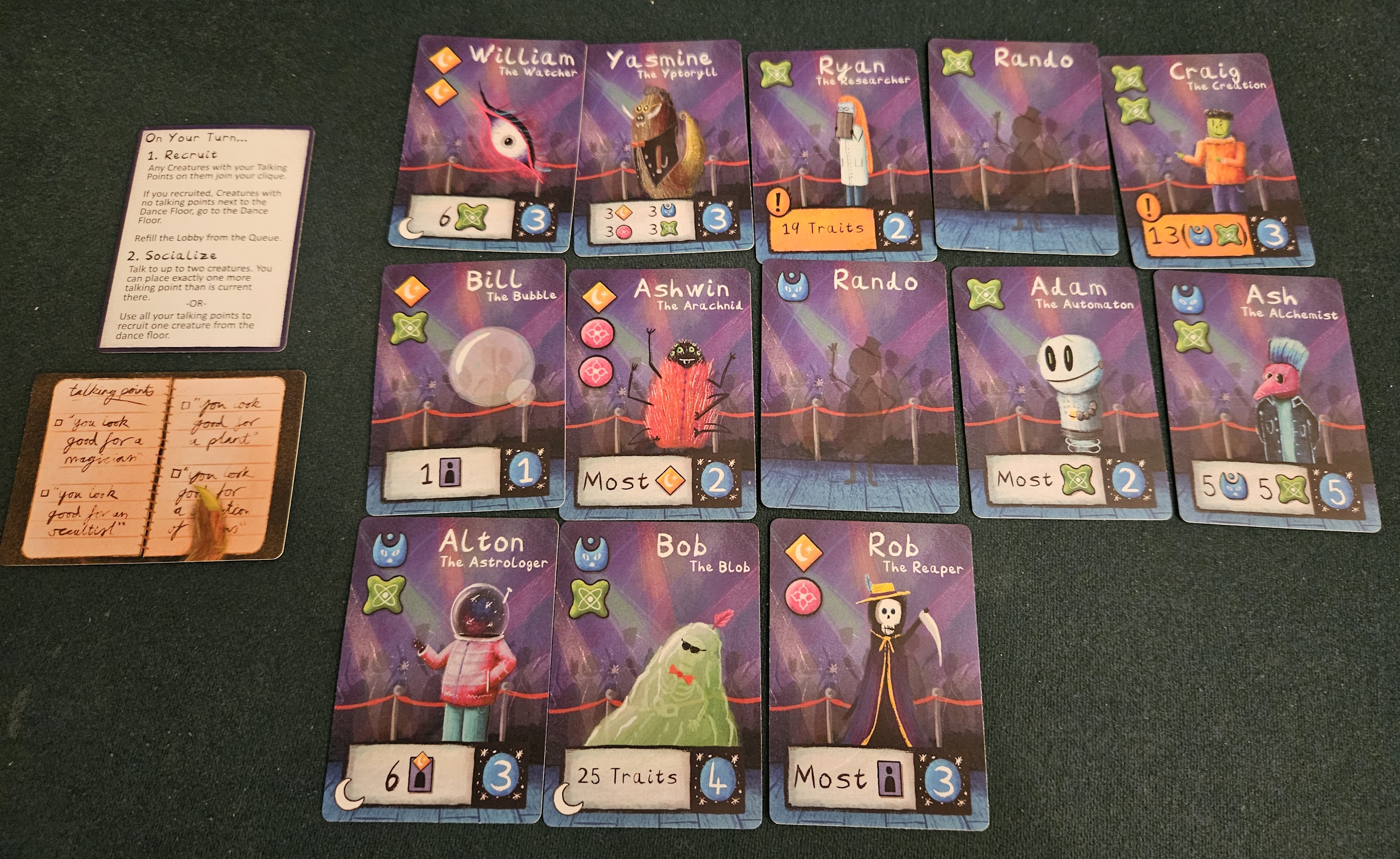
My clique has come together.
But wait, that’s not all. Most ghostly pals also have needs of their own. Meeting these needs is how you score points. For example, Ash the Alchemist scores five points if your clique has five magic and five science icons, while Shilo the Shocker wants to hobnob with at least three science-type ghosts. Some needs are more involved or interesting than others, like how V the Void scores a point for every unmet goal, or Charles the Chatterer awards points for big alphabetical strings of ghost names.
Making this process even more treacherous is the fact that some ghosts are picky about the company they keep. These ghosts, marked by big orange exclamation marks — which, again, maybe ought to have been big red flags — will ditch your entourage if their goals aren’t met. This can spark cascading failures in the scoring phase, your group melting away one by one as Craig the Creation disappears because there aren’t enough magic icons in the group, only for Ryan the Researcher to beg off to the washroom because Craig’s disappearance now means your group isn’t large enough for his tastes, and so forth. For anyone who’s been roped into attending a high school dance with the popular kids, these end-game abandonments can feel doubly triggering, depriving you of big chunks of your final score and a hefty portion of self-esteem.
Fortunately for Club Spooky, these tangled considerations are where it shines. There’s a pleasant asymmetry to the ghosts on offer. Most cards are VIPs, which means multiple icons and usually a scoring objective. A few others are randos — literally, they’re called “randos” — wallflowers who offer an icon and not much else.

Persuading people to be my friend.
But even among VIPs, there are big swings between unassuming kings who only want to hang out at the club with some like-minded spirits and picky jerks who award big points but might disappear on you. And depending on which cards come out over the game’s three rounds, it’s entirely possible you’ll meet someone like Beatrice the Brain or Isabella the Invisible who transforms even those low-value randos into point generators.
Of course, this means we’re in the Bad Place. I can’t think of anything I would rather do less than spend the afterlife trying to persuade people to hang out with me. Then again, there are worse ways to spend time than performing micro-auctions. Club Spooky isn’t a perfect game. I mentioned the dance floor, which doesn’t quite work as intended, and little details like the strict turn order can cause consternation as well. But on the whole, I appreciate what Wake is doing here. Especially when it comes to the ghosts themselves, with their peccadilloes and competing interests, this one offers plenty to chew over.
Sort of like your own death. If we’ve learned anything from supernatural thrillers, it’s that every spirit is haunted by their last moments. Which brings us to…
Now for something weird…
That’s the Spirit!
So you’ve died. Don’t worry, it happens to the best of us. The hitch is that you might be the one responsible. Not only for your own death, but the deaths of your entire group of friends. Oh, and you aren’t sure how it happened. You’ve narrowed it down to a few possibilities. Maybe fire. Or poisoning. A tornado would be cool. Please let it be a tornado.
In That’s the Spirit!, everybody at the table has died in a shared accident, which is already one heck of a proposition. From there, Wake presses the idea until it threatens to burst out of containment. This is a deduction game sorta, and a lying game sorta, and a logic puzzle sorta. All of those things. None of those things.
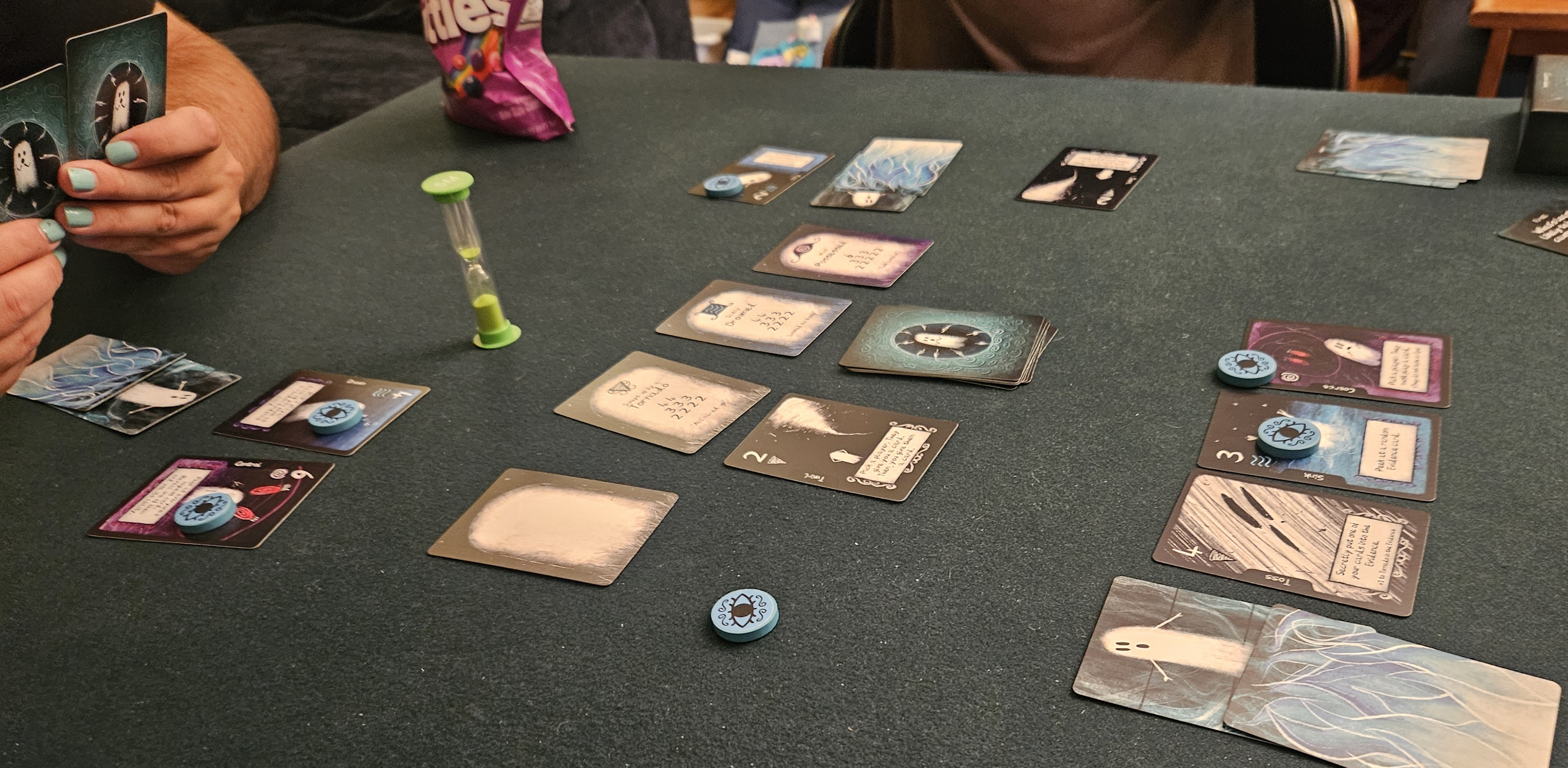
It works like this. At the start of each round, you shuffle three suits into a deck and deal a few cards to each player. The leftover cards are placed to the side. Call this the evidence pile. Those three suits represent your group’s possible causes of death. Whichever suit has the highest sum in the evidence pile is what killed you all. And whichever player has the highest sum of that suit in their hand is the one responsible for your accident.
Conceptually, the whole thing is certainly grimmer than a spiritual nightclub. But it’s darkly humorous as well, especially once the table begins earnestly discussing whether they died of boredom or possession. These modes complement one another, the grimness and the black humor merging into something of an absurd singularity.

Each cause of death has its own flavor. And in the game!
Like Out of Sorts, Wake’s previous game that saw players pressed into service in an alien library, That’s the Spirit! is played on a timer. This particular purgatory requires you to deduce your cause of death and figure out the one responsible — or, if you happen to be the dolt who got everyone killed, to point the finger at somebody else. Like I said, it’s a deduction game, but only in the vaguest sense.
A round lasts five minutes, and every one of them is unusually freewheeling. That first round will likely be discomfiting with how open-ended and undirected it is. Much of the game is about discussion. Players are free to ask anything they like, but just as free to lie. The only things resembling “actions” are when you play a card, revealing some tidbit of information about yourself but also making use of that card’s ability.
For instance, I might reveal that I have “enflame” in my hand. This is a rather high-value card, which makes me a likely culprit if it turns out we died in a fire. But revealing this card lets me ask the table a yes/no question. Crucially, because this comes from a card rather than ordinary conversation, everyone must answer truthfully. All at once, I’ve made myself more vulnerable, but possibly revealed other vulnerabilities that I can leverage to ensure I’m not the one taking the fall when the round ends.
Ultimately, it comes down to impressions. Some cards let you peek in the evidence pile. Others swap cards, or force players to reveal information, or transform the safe cards somebody played in front of them into sudden detonations. Despite all this, there’s never quite enough time or enough cards to actually hone your suspicions. Accusing somebody of killing you is a long shot. But it’s also necessary in order to prevent your spirit from being consumed by fire. Because that’s the outcome. Losing the round causes hellfire to rise up and engulf a portion of your spirit. Better get talking.

The first hand can be a little directionless. That’s part of the charm.
Compared to Club Spooky, That’s the Spirit! is more interesting. It’s also more experimental. Which is to say it suffers from a degree of fragility. One time, two players decided to approach it as a cooperative event. They were even dropping such obvious hints as, “Hey everyone, I think it was my fault this time.” This broke the game clean in two. Similarly, there’s nothing stopping a particular inquest from going nowhere. Maybe this combination of cards won’t provide a glimpse at the evidence pile. Maybe everyone will sit and eye each other warily.
More often, though, That’s the Spirit! calls to mind another excellent social deduction title, Jon Perry’s Scape Goat. As in that game, Wake has tapped into an uncommon brand of deduction, one suffused in paranoia and doubt. And not any old paranoia and doubt, but those that see you questioning your own role at the table. Because you’re never quite sure. Maybe it’s you everyone is hunting. Maybe that card you revealed will be the linchpin clue on their conspiracy board, all those red strings pointing straight at you. It isn’t long before you’re checking yourself. Should you play a card or will it reveal too much? Can you even ask a question or will that raise everyone’s suspicions?
Ultimately, that’s what sets this one apart. Club Spooky is good, but That’s the Spirit! is the rightful successor to Out of Sorts, one more breadcrumb that points to Wake as an up-and-coming creator of wonderfully offbeat tabletop designs.
Club Spooky and That’s the Spirit! are on Kickstarter RIGHT NOW.
Prototype copies of both Club Spooky and That’s the Spirit! were provided by the designer.
(If what I’m doing at Space-Biff! is valuable to you in some way, please consider dropping by my Patreon campaign or Ko-fi. Right now, supporters can read my next essay, on the competing strands of history and criticism that are present in my work. That’s right, it’s the Death of the Author, bay-bee!)
Posted on October 15, 2025, in Board Game and tagged Always Awake Games, Board Games, Club Spooky, That's the Spirit!. Bookmark the permalink. 5 Comments.

 SPACE-BIFF!
So what you’re saying is that it would be premature to plan a wake for Wake as a game designer?
Nice!
I think this is the first time I read a preview you’ve written. I’ve read reviews more often because most previewed games won’t reaaaally be available for me outside of the US.
I read on a previous article that you try to not be as negative on previews as you can maybe be on full reviews.
Other than that, what do you consider to be the difference between writing previews and reviews? If any.
That’s a… big question. Maybe more for the first part than the second.
To answer the back half, the main difference between a review and a preview, to me, is that reviews are for finished games that have been released into the wild and previews are for games that haven’t been released. Simple as that. Some outlets use an in-house distinction that reviews are impartial and honest, while previews are paid advertising. I don’t accept payment for previews here, so I don’t draw that distinction.
Okay, back to the first half. I try to limit previews here, usually to around one a month at most, although I think I do even fewer than that. And I try to focus on games that might not otherwise come into being without the nudge.
Do I “go easy” on previews? Sooorrrrta, although that can be misleading. I try to represent the game as honestly as possible, while also keeping in mind that the game might still be in development, its art assets won’t be finished, that sort of thing. Now, this is a sliding scale. If the game feels like it’s broken, usually I’ll decline to cover it at all. But if the game feels like it’s headed in the right direction, or just needs a bit of polish, that’s a different question.
Here’s a recent-ish example. Over the past few years, I’ve covered two different titles by the same designer. One of those was Arcs by Cole Wehrle, the other was Molly House by Wehrle and Jo Kelly. For Arcs, I was open about the game’s problems as I perceived them. Because my preview didn’t pull punches, it caused a bit of a stir and some frustration from the game’s development team. But I stand by my criticisms of the game as it existed at the time. When Arcs finally released, those problems had been fixed, which was reflected in my final review.
Meanwhile, I was open about the in-process nature of Molly House, but I could see it was moving in the right direction. When the game finally released, certain underlying mechanisms were almost unrecognizable. But the game’s message, the way turns felt, the gist of the card system, were all preserved in sensation if not in direct mechanisms. So I was pleased to have previewed it positively, of course, but also I believe I previewed it ACCURATELY, because the game, despite having transformed quite a bit, evoked more or less the same “feel.”
Now, these two games by Connor Wake, I pretty much just “reviewed.” I think there might be some minor changes, but I expect they’ll be superficial. The box for That’s the Spirit! will be bigger. The auction tokens for Club Spooky might not be 3D printed. But I believe these games are finished, they function as intended, and so forth. So I wrote my thoughts on them as if they were done.
Pingback: Best Week 2025! The D.T.R.! | SPACE-BIFF!