The Hero We Became
Every time a pearl necklace is scattered across a rain-soaked alleyway behind a theater, a superhero is born. Sorry, them’s the rules. While endless reboots have turned origin stories into a topic of much lampooning, there’s no denying the appeal of watching an everyman transform bit by bit into a reluctant defender of justice. Or maybe a relatable villain. Or, perhaps, hear me out, both.
Origin Story, designed by Jamey Stegmaier and Pete Wissinger, tills the well-trod ground of superhero origin stories to craft a hybrid trick-taker and… wait for it… engine-builder. It’s a combination I haven’t seen yet, at least not in such a compact format, and it certainly seems like it was built to appeal to my preference for hybrid designs.
But I’ll say it right now: this is a weird one.
Which trait would you pick?
As is the case with every origin story, this power fantasy begins with an inciting event. Or more accurately, five inciting events, one per round.
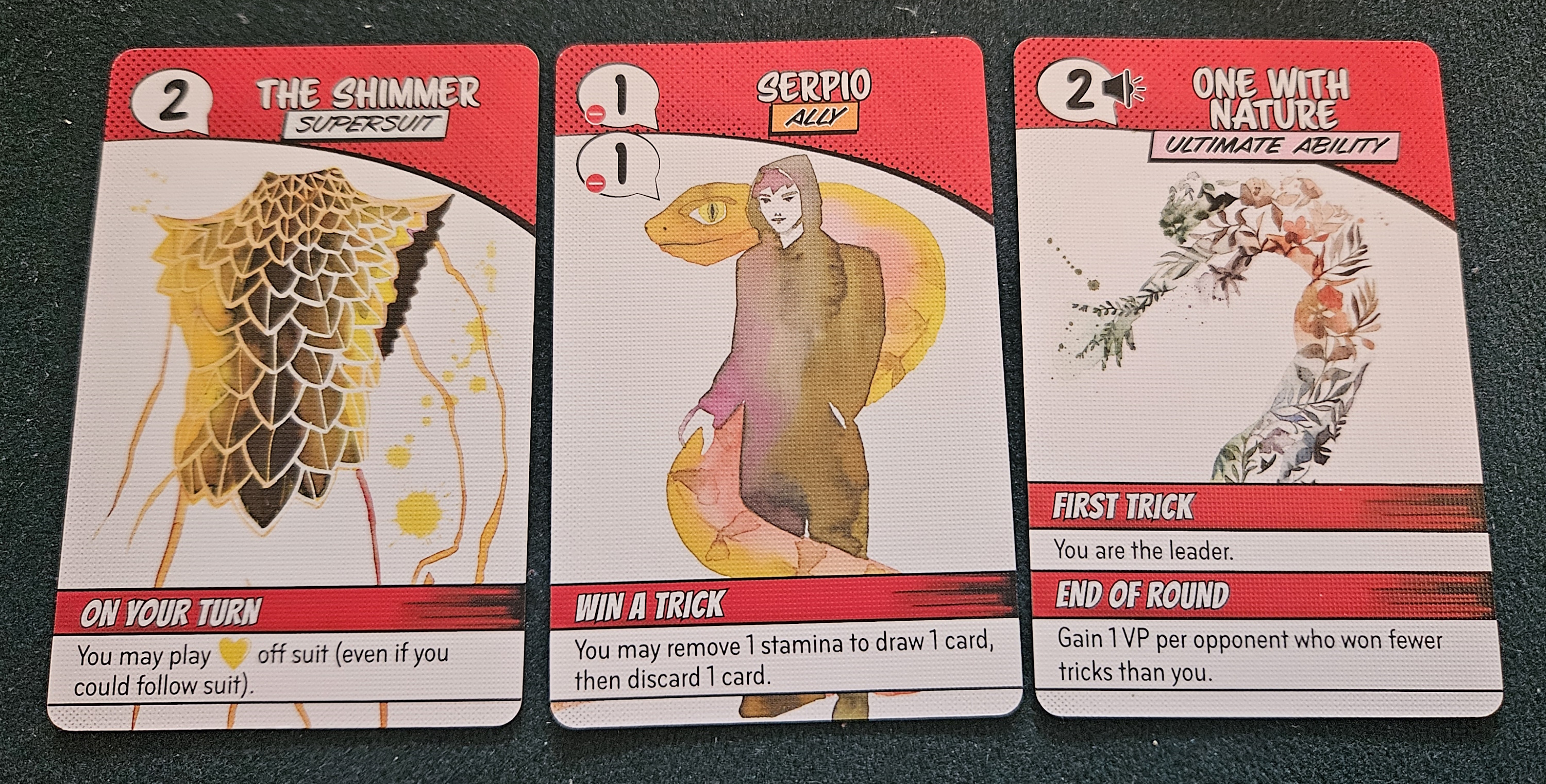
At the outset of each of those rounds, your would-be hero is offered a choice of three cards. These are the various accoutrements that cling to a superhero like body odor to a convention-goer. Perhaps you’ll be faced with the sudden manifestation of telekinesis, a backstory as an undercover operative, or a jaunt back in time.
Of course, these traits don’t merely exist as narrative beats. Telekinesis, for example, offers a twice-per-hand ability to swap out the card you played into the trick with one from your hand. Going undercover lets you peek into an opponent’s hand, hopefully to preempt their defenses. And time travel lets you rewind a trick entirely, this time taking the lead and maybe revisiting the whole thing with a fresh perspective.
In some cases, these traits might present little barbs. My favorite is monologuing. This forces you to play with your hand revealed, but earns you an extra point for each trick you win. Amnesia lets you draw extra cards, but you have to discard some first. Gaining a particular archenemy requires you to name a suit. When the hand is done, if you’ve won every card of that suit, you earn a bunch of extra points. Gulp.
Over the course of five rounds, you add these traits to your up-and-comer. Sometimes they’ll complement. Other times they’ll clash. That’s the engine-building portion of Origin Story, and unsurprisingly it’s also the most interesting portion of the entire game. Ways to manipulate the deck’s suits, extra scoring opportunities, impediments to your rivals’ success… everything is in there. With some forethought and a whole lot of chance, you can cobble together a mighty hero indeed.
Good versus evil.
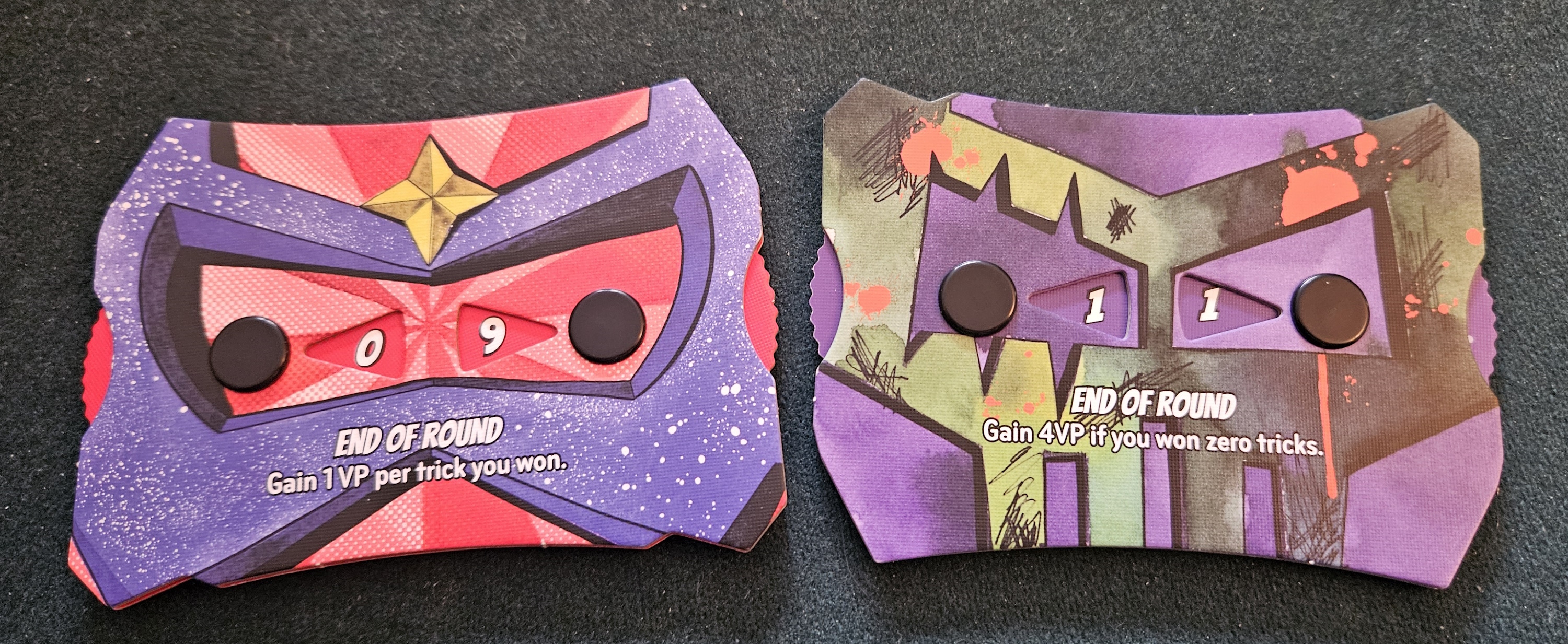
Somewhat by necessity, the trick-taking itself is straightforward. There are four suits, themed around speed, strength, brains, and love, with the latter suit functioning as the triumph. Tricks are must-follow, and each hand requires players to place a contract bid, although Origin Story goes easy here: either you label yourself a hero, which means you’ll earn a point for each trick you take, or a villain, who only scores if you avoid taking any tricks at all.
It’s breezy stuff, in other words, and, given how zany the proceedings can get in later rounds, it was a smart decision to keep the wrinkles largely confined to player abilities. For instance, there’s a trait card, the ally Aegis, who lets you predict exactly how many tricks you’ll take, more closely imitating other contract-heavy trick-takers. But, again, that’s a card that will only present itself to one player, if that, and can be declined if you happen to get anxious whenever a trick-taker asks you to place such a specific bid.
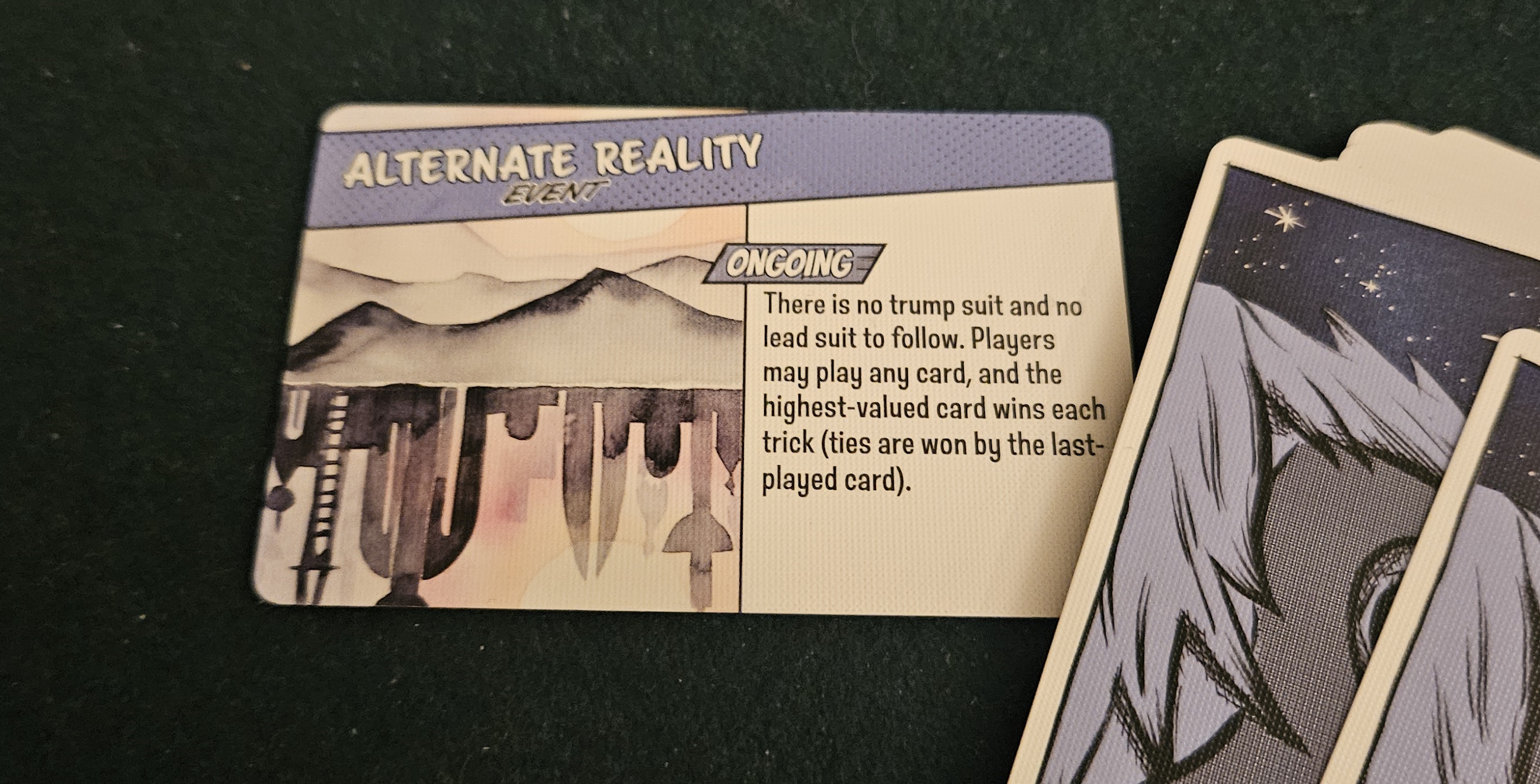
The one exception arrives in the third round, when an event card throws the game off the rails, for better or for worse. Events alter the parameters of the entire hand, throwing your heroes into an alternate reality where suits don’t matter, or mass surveillance forces everyone to play their cards face-down, or all the hands at the table get passed clockwise. The result is nearly always chaotic.
More chaotic. Origin Story has plenty of turmoil to begin with. This is the defining characteristic of the game as a whole, with its gradual buildup of special powers and trick-altering effects. In the first round, when there are only a few powers to negotiate, the atmosphere already grows choppy. By the third, fourth, and especially fifth round, when your fully developed alter ego is finally revealed, there’s a good chance any sense of control will have been flung clear of the stratosphere.
Once per game, something wacky happens!
Of course, this turbulence is much of the appeal, and I expect Origin Story will work best for those who are willing to engage not only with their own engine, but those developed by their peers. This isn’t to say that the trick-taking doesn’t matter, only that it’s slowly eclipsed by the powers built up around it. More than once, I’ve watched winning hands, sometimes even specific winning tricks, evaporate under the weight of all those abilities and allies and archenemies triggering at once.
I say “more than once,” but the reality is that there might be even more havoc than that in the cards. More than once per game, more than once per hand, sometimes more than once per trick, various powers can spark against one another. I recall one hand in particular where one player’s ally prevented anybody from playing a higher card than the one they’d led, only so-and-so used a lower card that was altered to a higher digit, and then someone else was allowed to play off-suit to deploy a triumph card, but then someone used their invincibility to win the trick, and then someone else rewound the whole thing with time-travel shenanigans. Seeing that many powers trigger at once is atypical, but hardly rare. Maybe I’m misremembering the exact details. With so much happening at once, everything was a blur.
While these moments are often humorous, and certainly fit the setting, they also sometimes succumb to a certain degree of ludic noise. Imagine that one fight sequence where the one team of superheroes battled the other team of superheroes, except you walked into the flick halfway through and you’re not sure what anyone is fighting about, where the lines are drawn, or which lasers and rockets belong to which heroes. Who’s this girl with the horns? What is this supporting character from the other movie doing on the wrong side? Why are the punching heroes not getting smeared to paste by the flying laser heroes? People sometimes complain about the many rule-altering powers in games like Arcs. Now take those powers and shift them from a three-hour game — maybe even a multi-session game! — to a compact forty-minute experience that isn’t otherwise all that hefty. That’s Origin Story.

At the end of five rounds, your origin story is complete!
Or, well, that’s Origin Story to a degree. There are other problems as well. Like the possibility that you won’t draw a point-scoring card in the early rounds, which can put you behind by an unwinnable degree. Or the final forms your heroes eventually adopt, which are limited in number and feel wildly imbalanced in terms of how much effort they require to produce points. Or the way larger-count games often burn through so many cards that players are left flipping through the same dregs.
Put all that together and you get a very strange game indeed. There are many things I appreciate about Origin Story. The stories it tells, the engines it permits, the way a utility belt can be the most useful item in your entire arsenal. But for every advantage, it produces a commensurate mess. This is trick-taking sans the genre’s sense of control. And while this brand of trick-taker has its own appeal, one that’s wild and silly rather than controlled and measured, I think I’ll wait for the reboot.
A complimentary copy of Origin Story was provided by the publisher.
(If what I’m doing at Space-Biff! is valuable to you in some way, please consider dropping by my Patreon campaign or Ko-fi. Right now, supporters can read my next essay, on the competing strands of history and criticism that are present in my work. That’s right, it’s the Death of the Author, bay-bee!)
Posted on October 13, 2025, in Board Game and tagged Board Games, Origin Story, Stonemaier Games. Bookmark the permalink. 5 Comments.

 SPACE-BIFF!
Sounds cool
yeah it’s nifty
You only ever play trick taking games
Sorry, “All you play anymore is trick taking games”
true