Trick-Taker or Treat
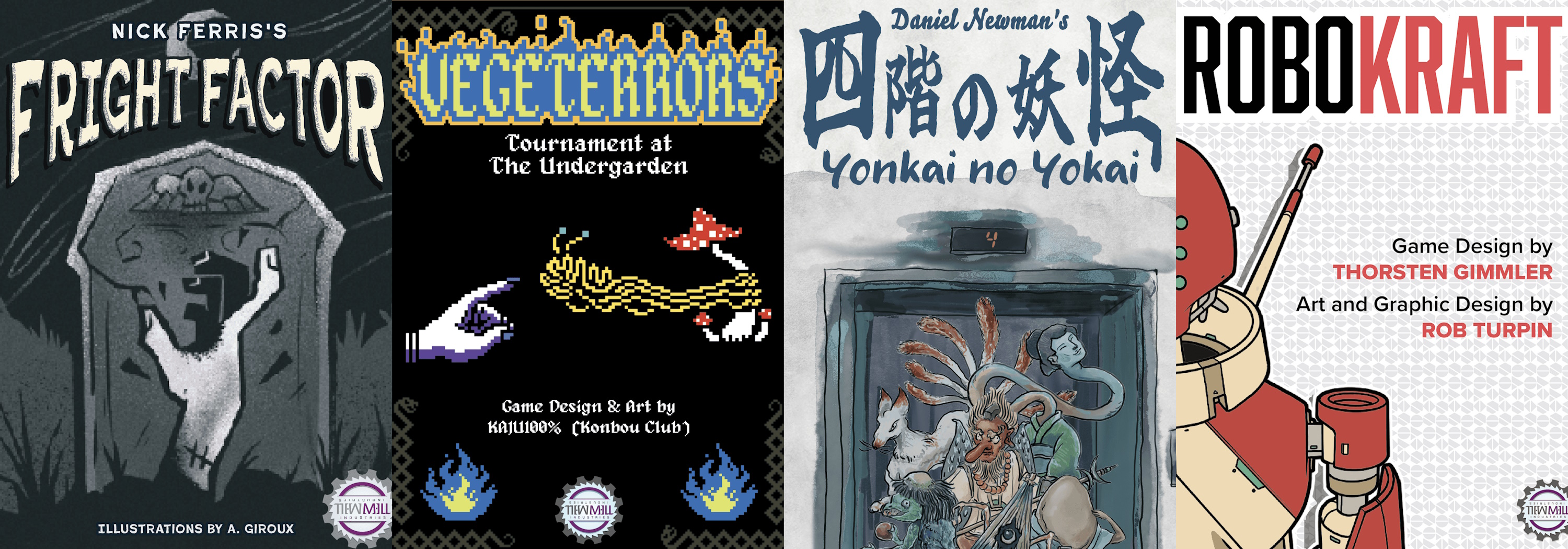
All I play anymore is trick-taking games.
But when they’re this good, that isn’t exactly a burden. The latest four sets from New Mill Industries are here in time for spooky season, and I can safely say this is the first time there isn’t a tarantula in the bunch. Let’s blitz through the whole hand.
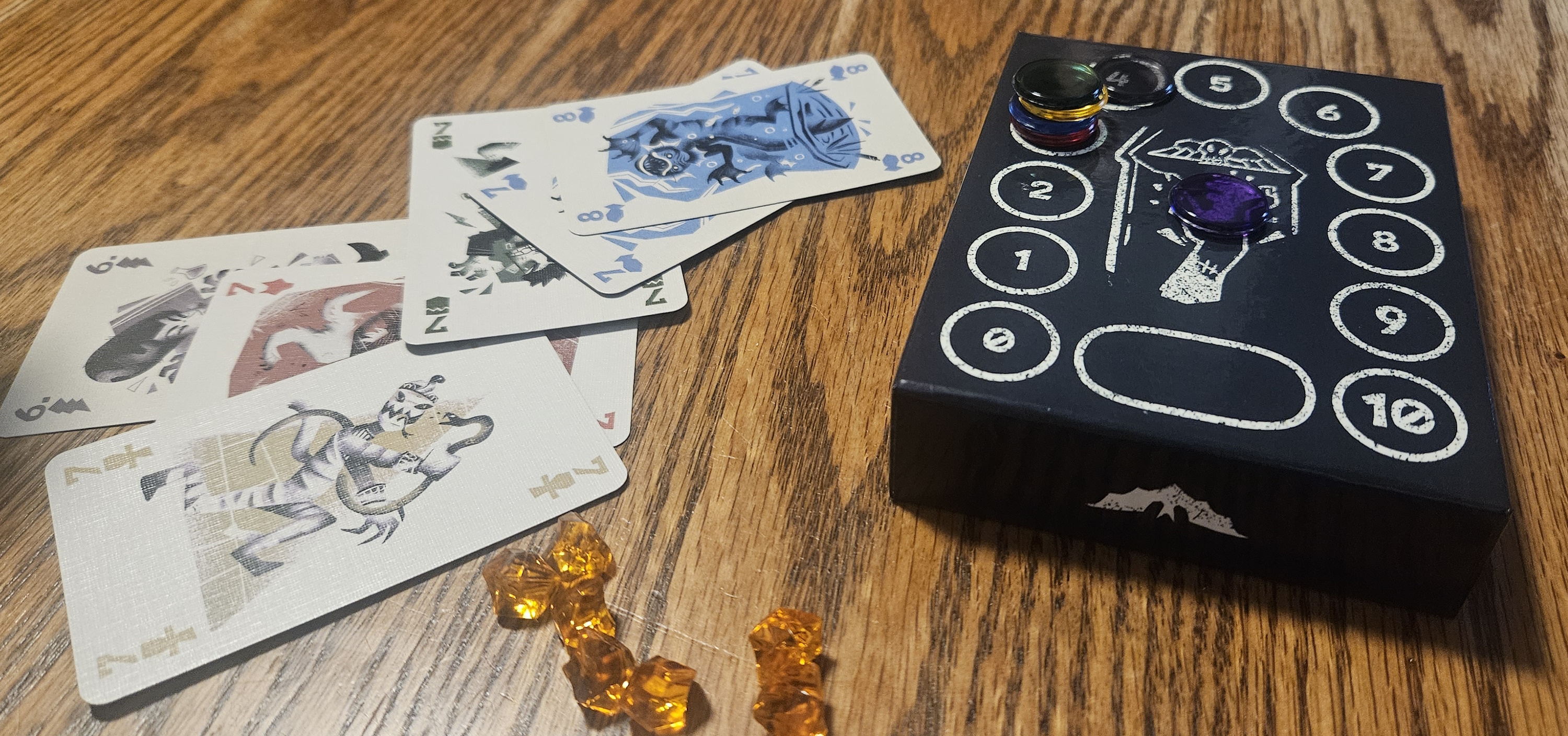
How scary are your monsters?
Fright Factor
It’s a truism of horror movies — one that more directors could stand to observe — that the less you see of the monster, the scarier it is. That’s the basic idea behind Nick Ferris’s Fright Factor. Your hand is populated with monsters of the classic variety, mummies and vampires and frankensteins. The more any given monster appears, the more humdrum it becomes. Eventually, it might drop from circulation altogether. Not unlike the entire stable of Universal Monsters, come to think of it. Buuuurn.
In game terms, this functions via a sliding track. When the hand opens, everybody tosses out a card; this sacrifice becomes the baseline scariness of the corresponding monster. The scariest of them all becomes trump. Frightful indeed. As more cards are played, their monsters’ fright factor continues to dip. Eventually, those that zero out are prevented from leading entirely. By extension, if any lead player isn’t holding an eligible monster, the whole round concludes prematurely.
That’s a big deal, as Fright Factor also happens to be a bidding game. There’s some flexibility there. Going over your bid will still score points, while hitting your bid precisely earns points depending on how many monsters are still scary. This turns the game into a bit of a race, one where going out early will net more points, but only if you’ve hit your bid.
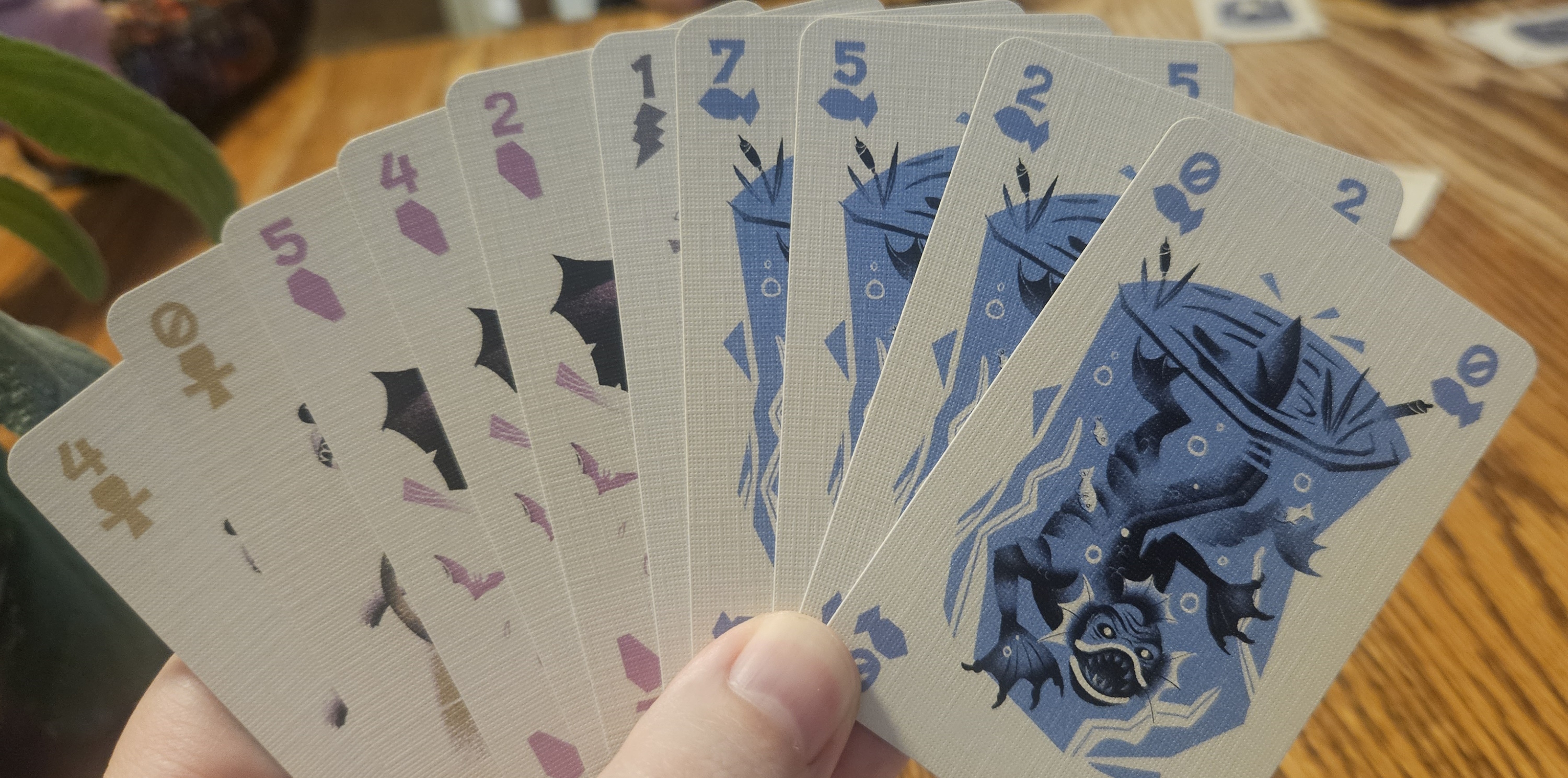
Glug glub.
This makes for a fine time, even if a few elements are looser than they might have been. The fright track, for example, seems to land on the least satisfying way to handle monsters tied for scariest. In other spots, its grab-bag sensibilities leave players unsure whether they’ll come up with a Twix or a toothbrush. There’s an entire optional set of bonuses for the zero-ranked cards, although these are concealed in the rulebook rather than printed onto the cards themselves, making the variant feel like a memory exercise.
On the whole, though, Fright Factor is the clear hindquarters of this particular centipede. It’s also the most straightforward, which might say something about my patience for trick-takers that only slightly manipulate the formula. Still, this one isn’t bad, just somewhat flat, the haunted house equivalent of a middle school fundraiser.
Kissing with tongue.
Vegeterrors
Vegeterrors is Pokemon but with haunted vegetables rather than sentient beings, which is one way of clearing up the whole animal cruelty issue. As a vegan necromancer, your cohort has gathered under the full moon to wager on the outcome of a battle royale.
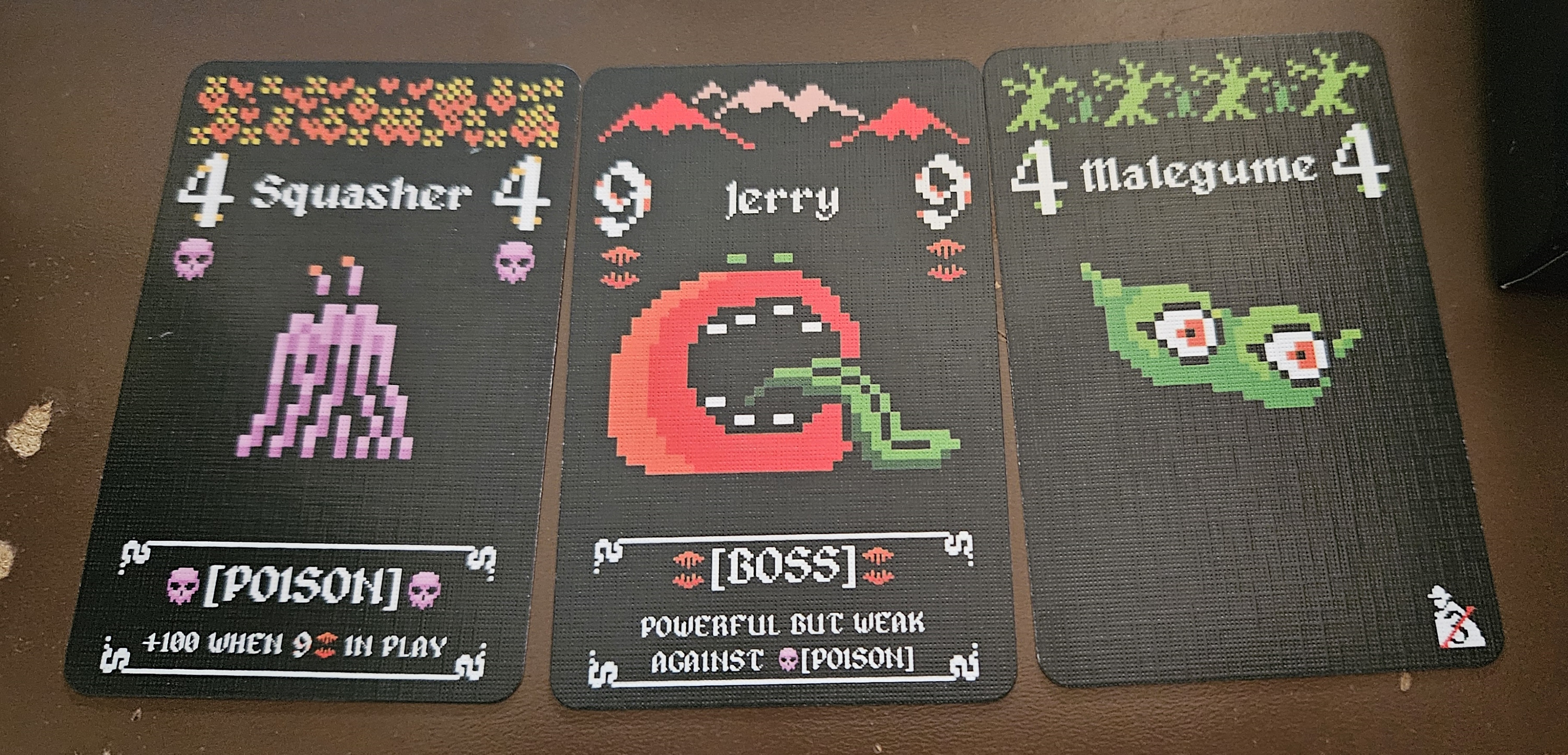
These battles are played out as sequences of must-not-follow tricks. I play a Squasher, you up the ante with a Fungalord, then a Jerry sweeps in to smear tomato paste across the octagon. High value wins — a loaded proposition when the suits are this unequal.
Along the way, there are enough little wrinkles that prevent the whole thing from running too smoothly. For example, if somebody isn’t holding a non-matching suit when their go comes round, they can play anything. This naturally results in duplicated suits. Only that’s a good thing, because duplicates sum together, letting smaller numbers prevail over their zestier brethren. Meanwhile, certain cards are given special powers. Magic adds to the value of any card you like. And while Jerry is the chunkiest suit of them all, its digits can be overcome by the timely appearance of a poison card.
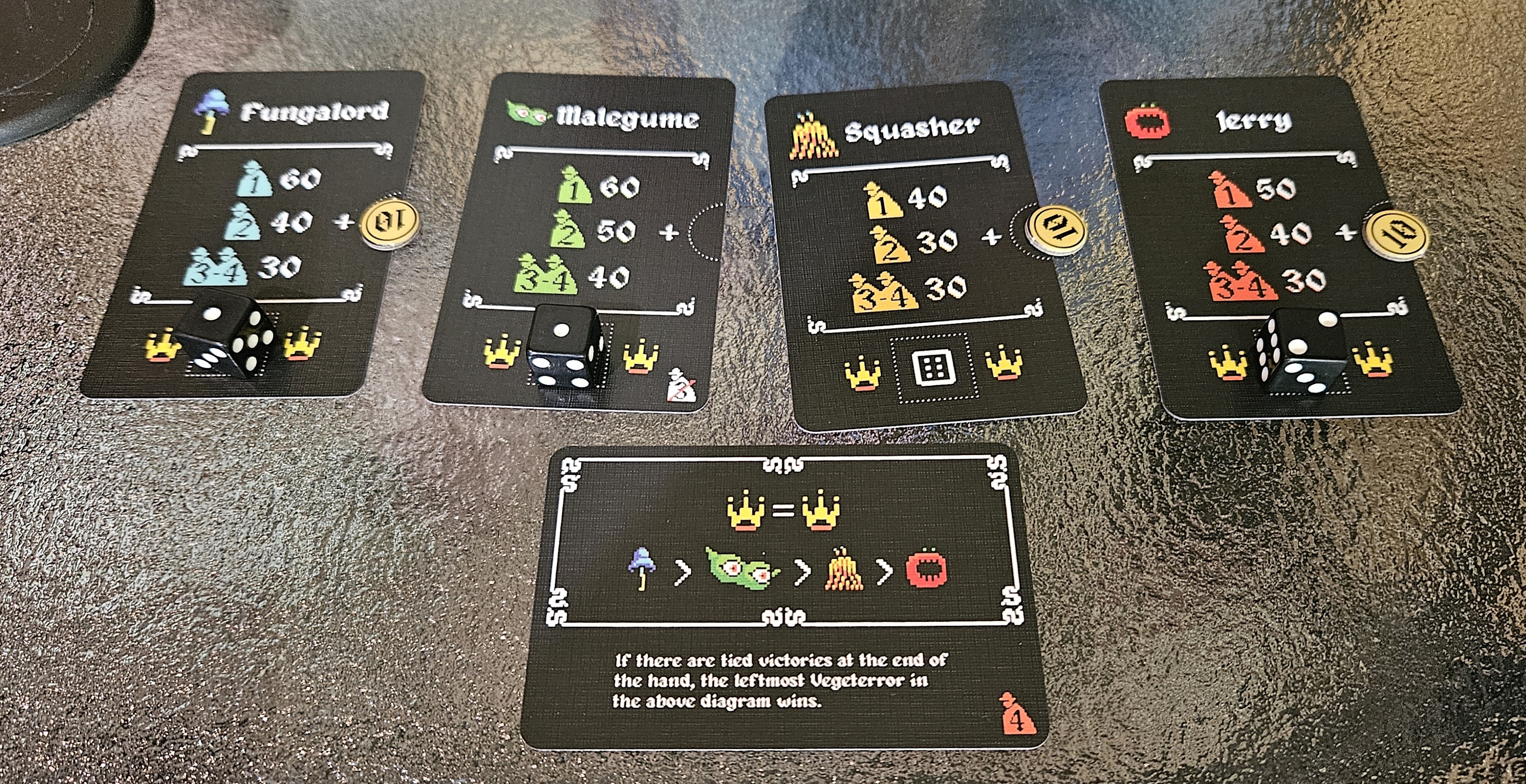
Gauging the standing of your vegeterrors.
Of course, the entire thing is wrapped in the shroud of a betting game, and that’s where the real calories can be found. Rounds start with an opening wager. The card you lay face-down in front of you is the veggie you believe will win the current bout. Even here, there are little thorns to avoid. To keep your better cards in circulation, it’s tempting to wager your lowest rank. But if you win, that rank transforms into coins, thus bringing you closer to ultimate victory. So there’s a strong incentive to noodle with your luck by wagering your best card. Choices, choices.
If I had to call out a weakness with Vegeterrors, it’s that there are only so many special cards, which means there’s quite a bit of variance between a strong and a weak hand. Or, well, not a weak hand, precisely, since your success isn’t tied directly to what you’re dealt. But an uninteresting hand? A hand with a meager measure of control? Sure.
Still, Vegeterrors sets a high bar. It’s clever without relying too much on particular rules, and winds up feeling wholly distinct from anything else out there even though it largely sticks to the format. The 8-bit art doesn’t hurt, either. This is a good one.
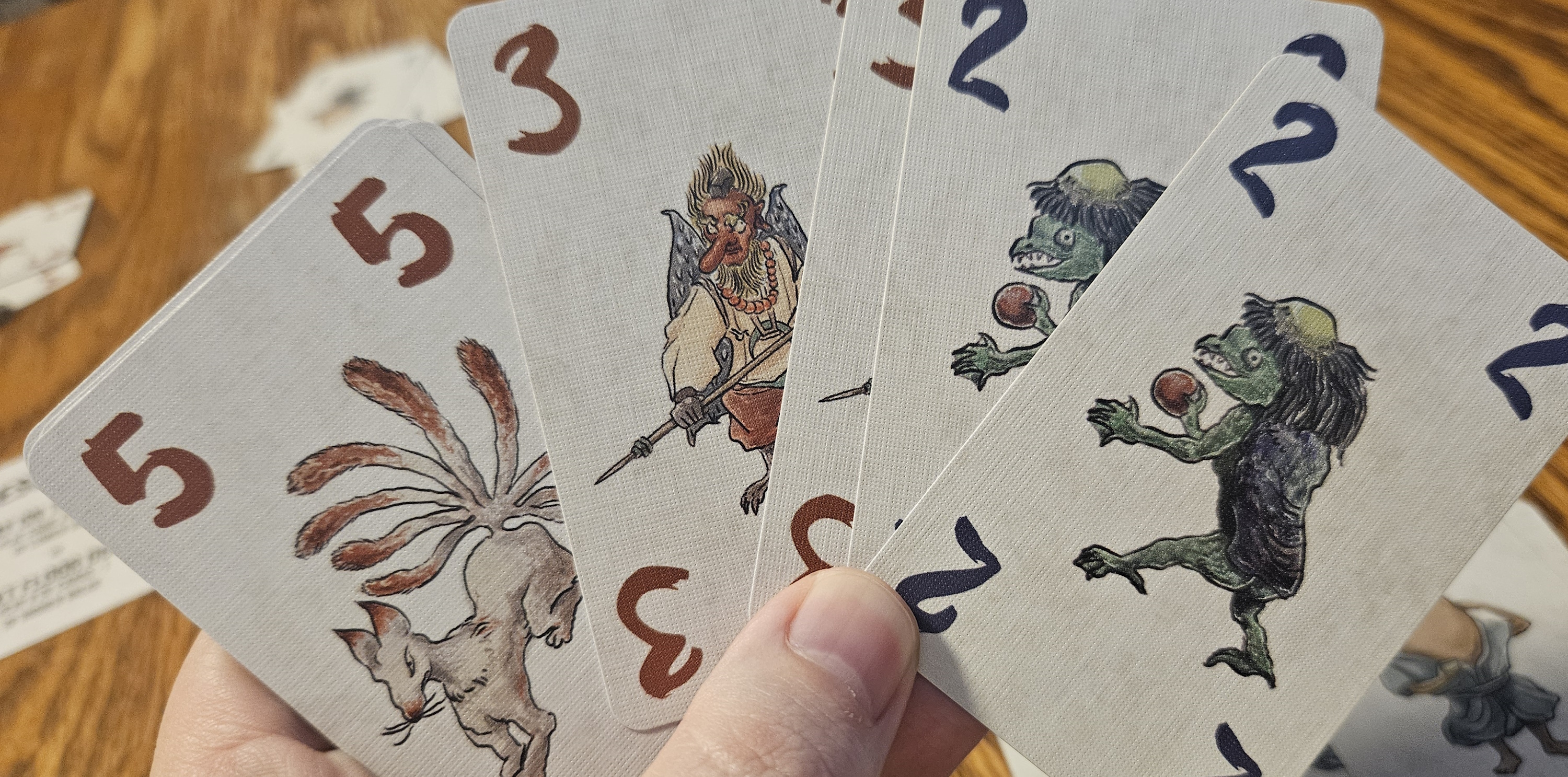
I love all my children the same.
Yonkai no Yokai
So you’ve gotten yourself trapped in an elevator with a bunch of Japanese demons. We’ve been on that date, right fellas? Anyway, in this climber/shedder by Daniel Newman, your goal is to exorcise your entire hand of demons before anybody else. The only hitch is, again, that you’re stuck in an elevator.
And the elevator is an actual thing, a slider that shows which cards can legally be played. When somebody plays a meld — say, three 1s — you physically slide the elevator card upward, belch out a sickly “ding!”, and present the next player with their new range of legal options.
This is so dang smart. As someone who always struggles to recall which melds are legal in any given climber/shedder, having the game merge its card reference with an ever-changing menu of options goes a long way toward easing the process. There’s a rubric to the whole thing. Technically, you’re always playing the same meld with higher ranks or adding one more card with lower ranks. But, look, that’s a mouthful. Newman puts the whole thing right there in front of you, no mental calculations necessary.
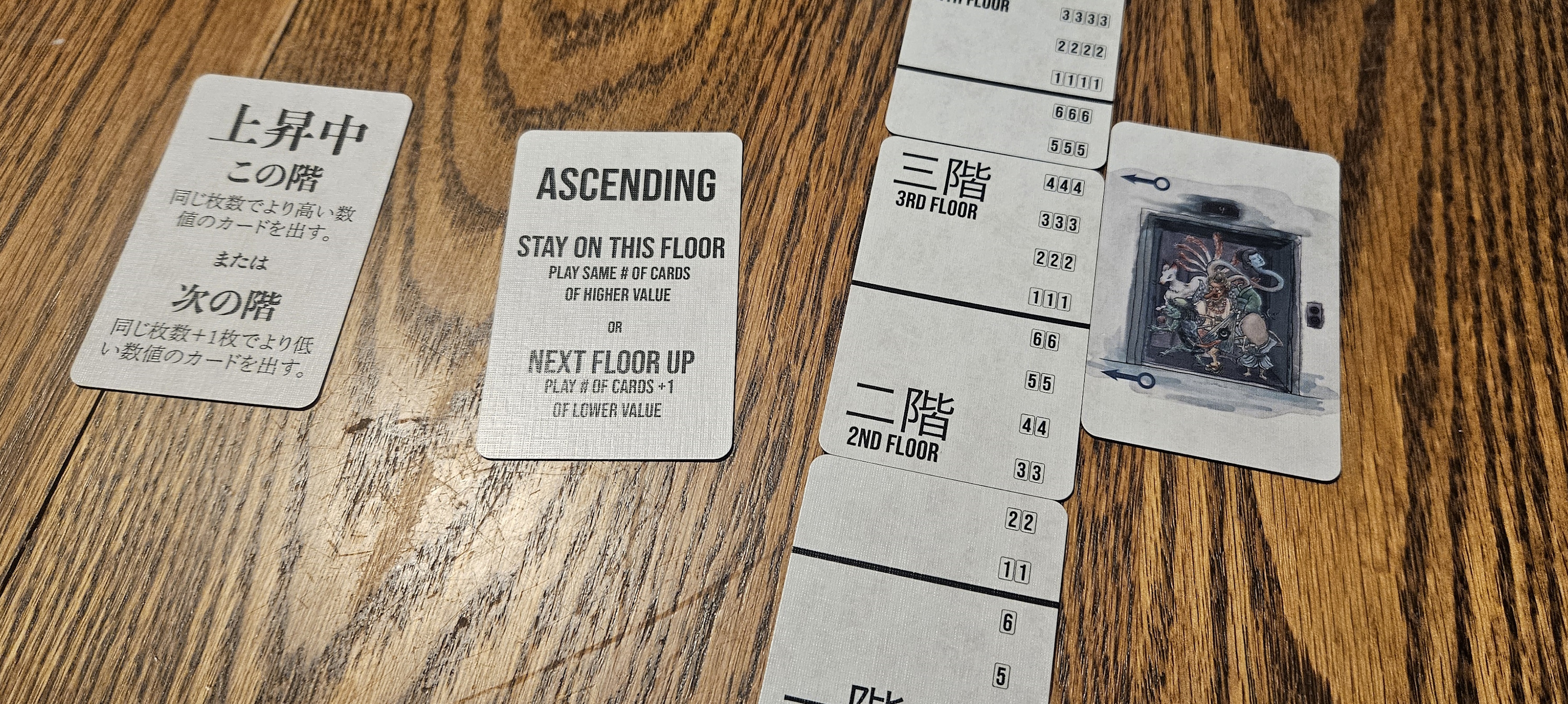
Who tooted?
The real strategy of any given hand comes down to manipulating the elevator itself. When the hand opens, you’re headed upward. Upon either reaching the top floor or when somebody presses their elevator button, the direction inverts. Now instead of crafting better melds, you’re deliberately decreasing their quality. This lets you plan your moves in advance, holding onto that set of four 6s so you can dominate the top floor, but also allows other players to dink with your turn when they smash their button prematurely.
It plays fast, too. So fast that a full game will take three to five hands, just enough time for everybody to get a little bit haunted. When somebody’s hand runs out, they’ve escaped the hotel alive. Holding any cards at all means you lose one life point, while the poor sucker with the most cards loses two. Bottom out your hit points and the game ends for everybody, with the most resilient player returning to an ordinary life with absolutely zero bad dreams.
And that’s it. Yonkai no Yokai is so stinking elegant. There are no special abilities or any of that clutter, just a range of cards from 1 to 6, a bleeding-smart method for visualizing what can be played next, and just enough control that every hand is chock-full of reversals both literal and play-wise. If the next title weren’t so good, this would be the best of the bunch. As it stands, it’s probably a dead tie.
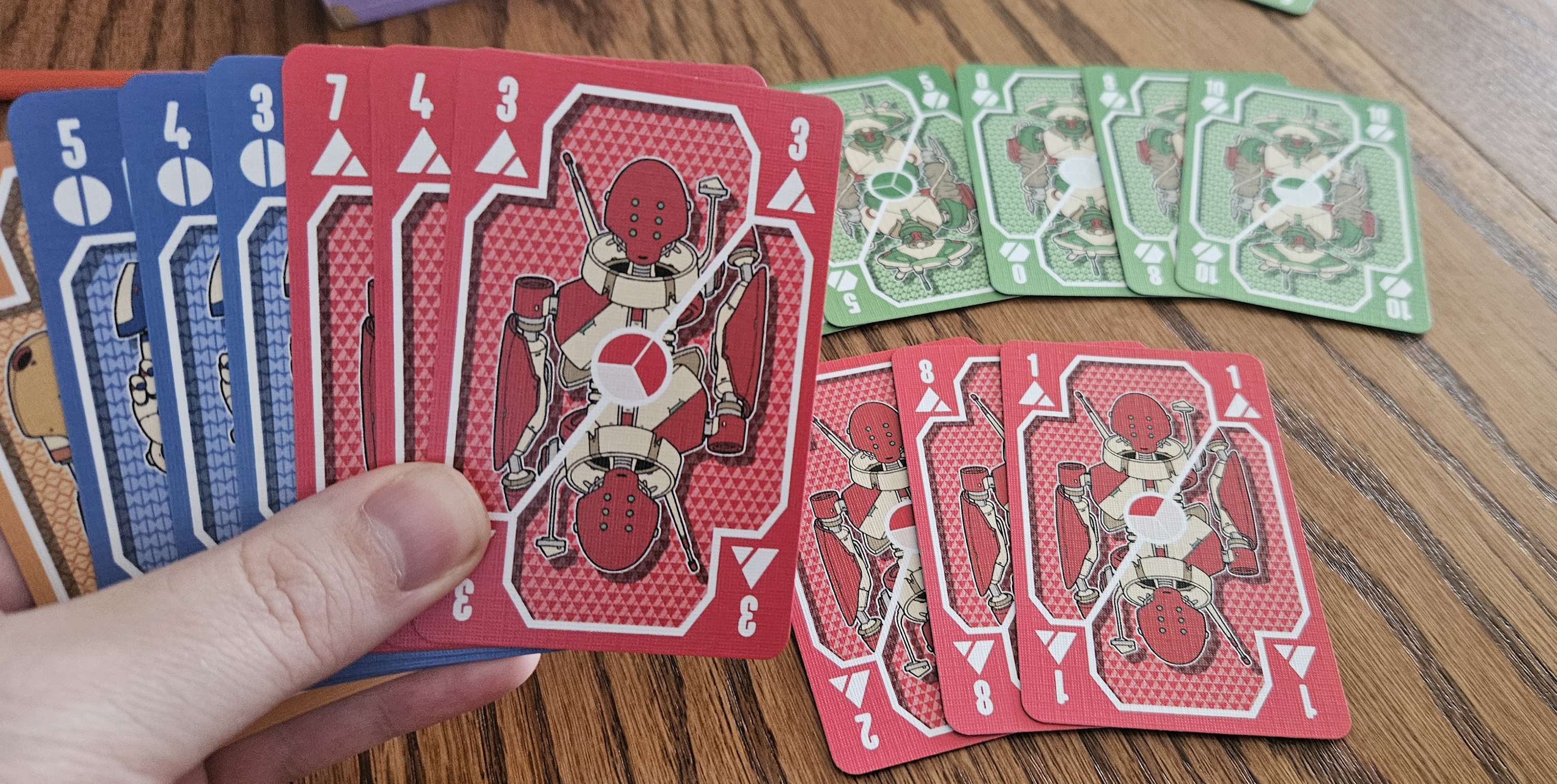
I am robot.
RoboKraft
I know what you’re thinking. “What do robots have to do with spooky month?” Well, I’ll tell you right now: Thorsten Gimmler’s RoboKraft is the most terrifying game of the bunch. Only rather than classic film monsters, necromantic greens, or haunted elevators, it deals with hostile corporations, suspended customer relations calls, and electric outlet adapters. It’s the trick-taking equivalent of finding the right toner for your printer. And Canon is pushing through an update that invalidates your pirate ink. Brrr.
It goes like this. You want to buy some of those newfangled domestic helper robots. Fine! You can buy a bunch at once. It’s as easy as winning a trick and taking all the cards played into it. You also want the right batteries to power your robots. Except, oops, it turns out that the batteries don’t come included. Those will be awarded to someone else. The player with the lowest-ranked card, actually. But rather than selecting a battery of their choice, they get one that matches the winning suit’s color.
That’s right. The batteries must match the robots. Just as there are four different brands of domestic helpers to collect, there are four brands of batteries. Matching batteries to robots results in a multiplicative score. Two red batteries and robots with a pip value of six? That’s twelve points, bay-bee. But every non-matching battery and robot becomes a negative point. All that clutter just sits there, filling your closets and hallways. See, the real horror is commercialism, see.
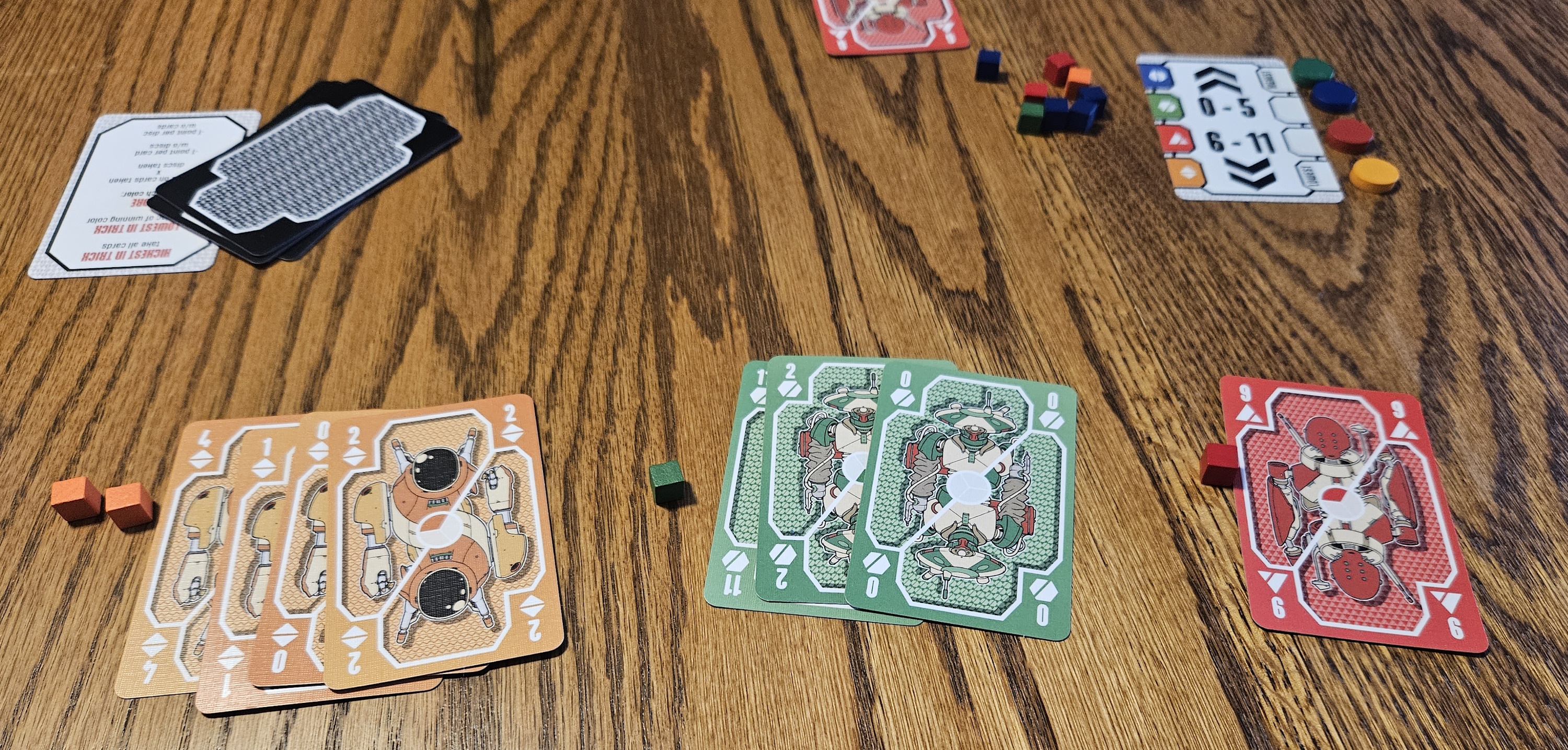
Pairing batteries and bots.
The other wrinkle is that the suits alter their rankings as you play. Depending on the led card’s rank, the corresponding company either inflates or deflates its value. This alters the relative standings of those robo-brands, not to mention transforms every hand into one of those automated call menus where you can’t remember if you’re supposed to press one followed by the pound sign or enter your account number. Or was it your social security number? Man. We are cooked.
It’s downright hostile, is what I’m saying. Matching the right robots to the right batteries is pain enough, but to do so when these four megacorps can’t stop with their bullshit for one dang minute? That’s nasty. The result is a trick-taker that refuses to cooperate. It’s necessary to win sometimes and lose sometimes, even, in many cases, to do the middle-ground thing just to avoid both robots and batteries that would otherwise subtract from your score. As trick-takers go, this one is unusually thoughtful, requiring a heaping of gray matter and speaking to a rumbling horror we can never escape. Because while monsters are one thing, enshittified corporations with one hand in our back pocket is a terror we know all too well.
And just in time for Halloween. Merry Scares, for those who celebrate.
A complimentary copy of Fright Factor, Vegeterrors, Yonkai no Yokai, and RoboKraft was provided by the publisher.
(If what I’m doing at Space-Biff! is valuable to you in some way, please consider dropping by my Patreon campaign or Ko-fi. Right now, supporters can read my next essay, on the competing strands of history and criticism that are present in my work. That’s right, it’s the Death of the Author, bay-bee!)
Posted on October 1, 2025, in Board Game and tagged Board Games, New Mill Industries. Bookmark the permalink. 2 Comments.

 SPACE-BIFF!
Thanks for this! I pre-ordered Yonkai no Yokai immediately after reading.
I hope you love it as much as I have!