Chariots of Frickin’ Fire

It is wild to me, utterly wild, that in 2025 CMYK has released not one but two racing games. Even wilder that the second, slipstreaming in the wake of Jon Perry’s Hot Streak, should be a remake of Takashi Ishida’s Magical Athlete, tuned up by Richard Garfield of all folks, and that it’s as close to perfection as any board game has ever managed.
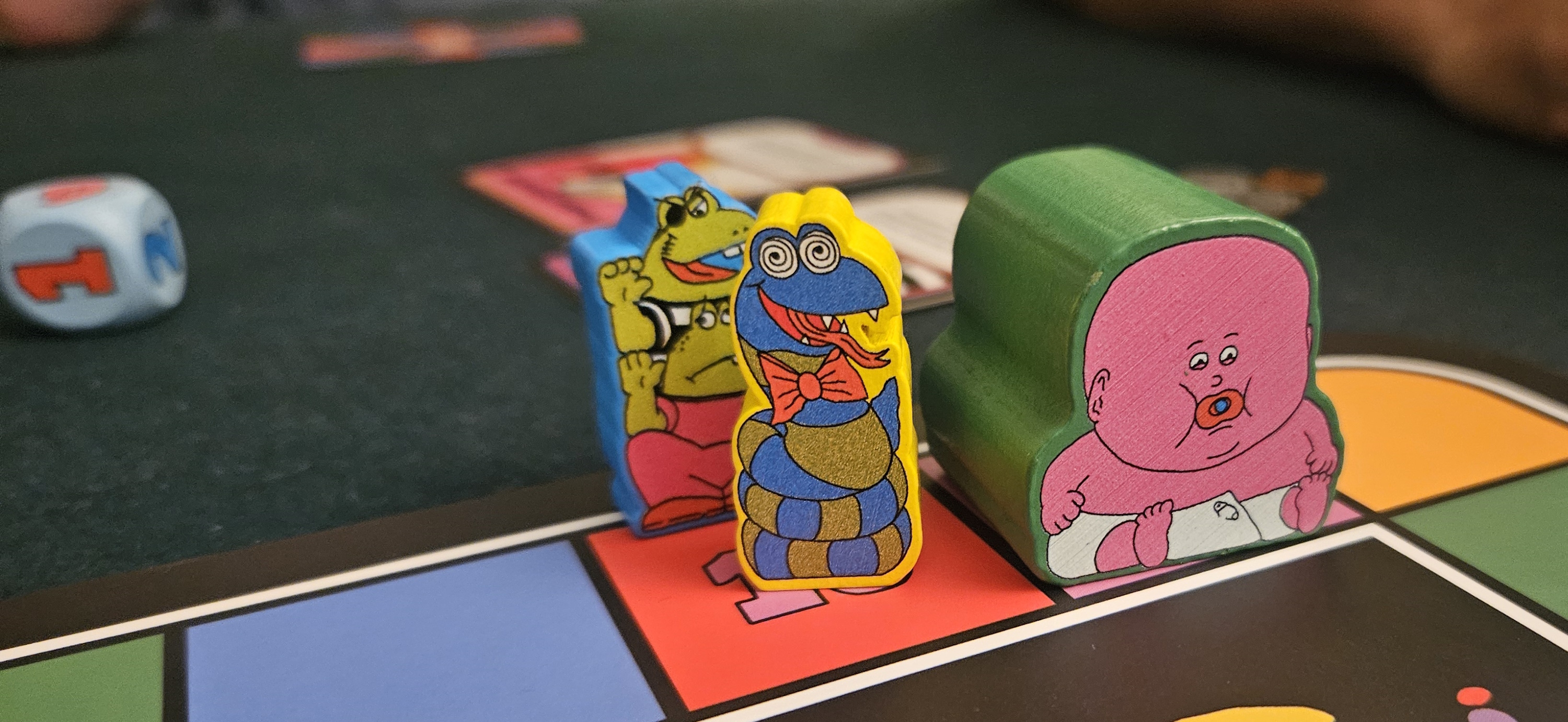
Nobody gets by baby.
Originally released in 2003, Magical Athlete was always an odd duck. In many ways it was a design dislocated in time: its roll-and-move racetrack, its chintzy clipart, the unadorned purity of it all. It was about throwing wacky racers onto a track and letting them break the rules each in their own way.
This new edition preserves and even doubles down on the game’s best elements. The sublime new art by Angela Kirkwood is still outlandish, even garish, but has a tonal consistency the original characters lacked. There are two tracks now instead of only one, and the second, with its danger zones and point-scoring stops and loop-de-loop corner, is something to behold.
In what will perhaps be the remake’s most contentious update, characters are selected via a snake draft rather than Ishida’s original auction. A full session of Magical Athlete takes place over four races, each staffed by one character avatar per player, with any individual match lasting anywhere from two minutes to twenty, depending on how often your racers fall on their faces and/or your volume of laughter. The new edition’s snake draft speaks to its superiority as a remake, operating more rapidly and with less strategy than before. Lest you think I’m sneaking a ding in there, that latter description is an advantage. There’s still an element of strategy to the game, but it’s decidedly secondary to the main course. You want to pick the best racers, of course you do, but while some are superior to others and there’s an art to selecting the character that will bypass or obliterate your rivals’ advantages, the real draw is found in the play itself, the sheer joy of rolling a die and watching everybody flop over one another.
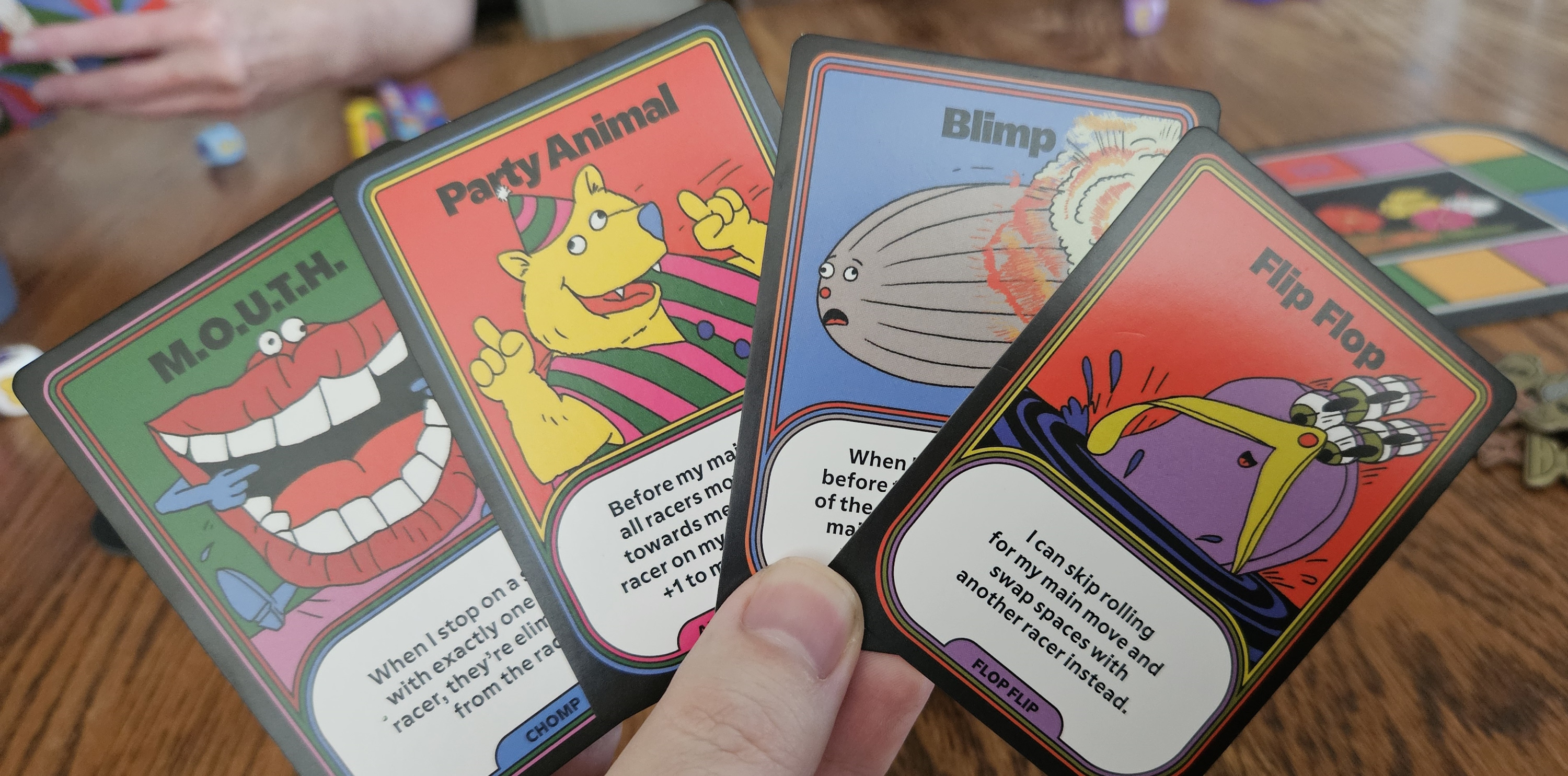
Selecting your racer, both in the draft and before each race, is lightly strategic.
Magical Athlete is impossible to describe without delving into its roster. There are thirty-six racers in all, a half-score improvement over the original, and the only stinkers in the squad are conditional, based on failings that may well present as strengths in other lineups.
There’s the Banana, a slippery peel of a racer who “trips” anyone that races past him — “tripping” being the game’s term for what amounts to a skipped turn, a no-no in any other game but which is wholly suitable in the context of Magical Athlete.
Or there’s Sisyphus, who we must imagine happy with his four free victory points, and very unhappy indeed whenever he rolls a 6. This forces him to shed one of those points and return to the start of the track.
Or what about the Hare? He gets +2 to his rolls. Unless he’s in the lead. Then he skips his turn. Another no-no, except here it’s bitterly appropriate for the chump whose sole claim to fame is that he once lost to a tortoise.
Or there’s the Hypnotist, who warps another racer to its space. Or the Suckerfish, who attaches itself to another racer. Or the Lovable Loser, who earns points for sitting in dead last. Or Scoocher, who scooches forward a single space whenever another player’s power happens — perfect for those matches when powers are triggering left and right, not so great when paired with occasional contenders like Heckler (moves a couple spaces when somebody barely moves) or Skipper (goes next in turn order when somebody rolls a 1) or Twin (steals the ability of a previous winner).

Sucker fish riding this train to victory.
The beauty of this beast is what happens when these screwballs are put in collision. In one session, we watched in awe as the M.O.U.T.H., a very large mouth, ate every other contender. Just gobbled them up. And then waddled to the finish line one sad roll after another when everybody spitefully insisted that “winning by default” wasn’t permitted in the rules.
In another, my family doubled over with laughter when the Coach kept the entire group moving at a steady clip, leaving the Stickler far in the rear-view — only for the Stickler’s insistence that everybody must cross the finish line via an exact roll resulted in a situation where only she could win because everybody else was now stuck on the penultimate space but kept adding +1 to their roll. She won on a technicality. The best kind of win.
Or there was the time the Party Animal kept pulling everybody into his space, where Baba Yaga was merrily tripping everyone with its spindly chicken-legs, producing a literal pileup of toppled bodies. Or the session where the Romantic and the Third Wheel kept out-awkwarding one another. Or the time my nephew kept correctly guessing his rolls as the Genius, giving him a cycle of endless turns, made only slightly easier by the Dicemonger’s free reroll. When the dust settled, the Genius and Dicemonger had claimed first and second place, with everybody else crowded somewhere before the first turn.
There’s one theory of play that states that play must be a competition, that art or narrative are unessential, that games can say nothing but to speak to the primal contest that exists in this War of All Upon All that is our turgid existence. Magical Athlete represents that theory in its own way, but somehow also stands in for every one of that dour outlook’s opponents as well. Because in addition to offering one of the finest competitions ever put to the cardboard, Magical Athlete is also play as discovery, our yearning to see what lies around the next corner. And it’s play as shared experience, too, as memories in the making. And play as laughter and warmth. And play as rules in a bubble, enforced but not so serious that when a die is thrown amiss and sends the pieces sprawling, they cannot be reset without exacting care for their precise recreation of their previous state.
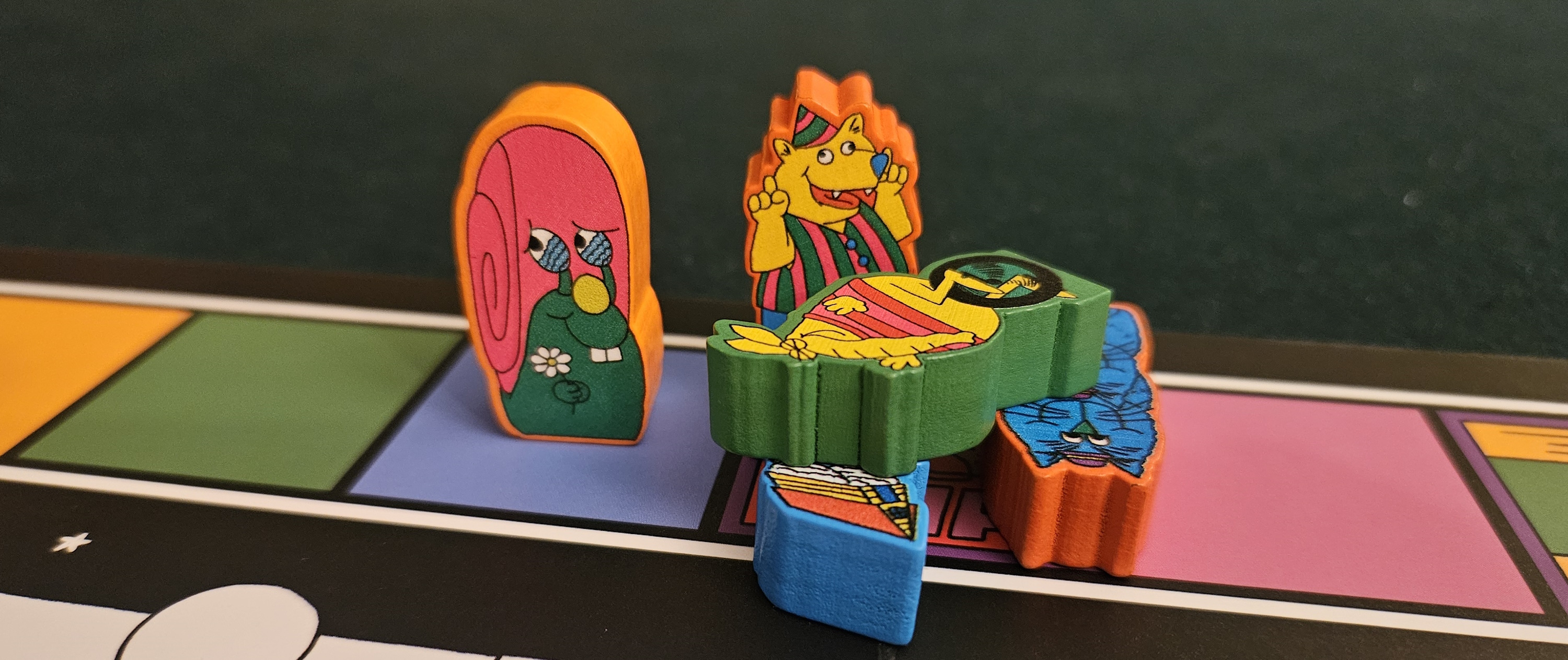
When you party with the party animal, he beats you with experience.
Magical Athlete is magical for a host of reasons. It is unbridled in its joyousness, loud of laughter, sweet in the stomach, keenly competitive but simultaneously insouciant. This remake is better than the original, but that’s almost beside the point. I hope everybody gets to spend some time in its company.
A complimentary copy of Magical Athlete was provided by the publisher.
(If what I’m doing at Space-Biff! is valuable to you in some way, please consider dropping by my Patreon campaign or Ko-fi. Right now, supporters can read my second-quarter update!)
Posted on September 16, 2025, in Board Game and tagged Board Games, CMYK, Magical Athlete. Bookmark the permalink. 14 Comments.

 SPACE-BIFF!
Great. My finger poised excitedly over the pre-order button for Hot Streak. Tendons sweating (I don’t think tendons sweat, shut up) with excitement at the absurd competition which it promised… and now I find myself like a hobbled racehorse scratching my head at the meta-absurdity that CMYK appear to have created two equally absurd race games to race against each other.
Rather amusing, isn’t it?
Our kids are still quite young. I’m imagining raucous future family game nights with this one.
I can confirm that it works great with my 11yo and 6yo, as well as a nephew or two of various ages.
I have never instantly bought something so quickly. What a ridiculous game and huge credit to CMYK for having the nose to sniff out this non-classic from 2003 and fully realising its potential. It’s Cosmic Encounter Goes Running or a lost tape from an episode of Space Dandy and I am all aboard…
The recent CMYK catalog is incredible. Just one hit after another.
Is it worth having both this and Hot Streak? As I kind-of want both.
I can’t assess value for anyone but myself. But, speaking for myself, I’m very happy to have both.
Your sales mojo is ginormous.
Dunno about that. I once worked a door-to-door sales job for an entire summer and never made a single sale.
Just wanted to drop a note of thanks – I didn’t get to play as many games as I would’ve liked this year, but this review made me add this to my Christmas wish list.
We played twice at 5 and 6 players yesterday and had a blast – it was a perfect low strategy game for the end of a long few days. One highlight was a good-natured argument about whether M.O.U.T.H.’s ability triggered, only for the spared character to be undeniably eaten one turn later anyway, making the entire debate moot.
Thanks again for all your reviews, and I expect to see this in the Best Of series soon!
This is so great to hear! Thanks for sharing. At Christmas, my parents asked if we had brought Magical Athlete. That’s a success in its own right.
Pingback: Best Week 2025! All My Children! | SPACE-BIFF!
Pingback: Wagering Everything on Bronto | SPACE-BIFF!