Brass: New Delhi

Is there an aphorism about how satire is often indistinguishable from reality? If not, there ought to be. Tycoon: India 1981 takes notes from Martin Wallace’s Brass, not only in terms of its interlocking economy and rich-get-richer gameplay, but also by turning choking smog into a whole aesthetic. It’s the inverse of colorful Lakshadweep, the last title we covered by Sidhant Chand, swapping the sustainable fisheries for sky-blotting smokestacks.
In spite of that shift — in spite of a few problems, really, nearly all of them inherited from the Eurogame tradition Tycoon is imitating — I can’t help but be compelled. Can you taste the carbon? That’s the flavor of money.

Let’s industrialize India!
As an inheritor of that Eurogame tradition, Tycoon fashions itself as a series of interlocking systems, of which any one’s subtraction would bring the entire machine grinding to a halt. The board presents itself as a triptych. There’s the map of India in 1981, underdeveloped after decades of colonialism and protectionism, begging for a new generation of development. To one side, tracks dictate the growth of six distinct industries across three sectors, marking players’ relative standings. On the other side, there’s a grid for managing and spending promoters, the first and perhaps most important of Tycoon’s many resources.
To Chand’s credit, Tycoon is not nearly as complex as it could have been, despite the inclusion of two different brands of auction, plenty of steps and sub-steps, and a construction action that isn’t quite as intuitive as it could have been. The broad view consists of bidding on cards — mostly industries, although policy cards also serve to add special perks and scoring bonuses — and then using those cards to tick upward on the game’s various tracks.
Construction functions as a microcosm of the entire process. Once an industry has been secured, whether via an auction or by spending promoters, it must be built somewhere on the map before it yields its income and asset valuation to your company. This process is… not complicated, exactly, as nothing in Tycoon is exactly complicated, but loaded with little steps that require constant reminders. Depending on the industry’s cost, some amount must be paid either to the bank or to rival industrialists. That exact amount depends on the current industry leader, their rank, and whether the price is being paid for fixed goods (minerals, oil, agriculture) or must be counted from an urban center (power or transportation). At that point, the card spills its benefits onto the table. You move up a track, gain some influence, and maybe take home an additional bonus depending on which portion of the country your project was completed in.
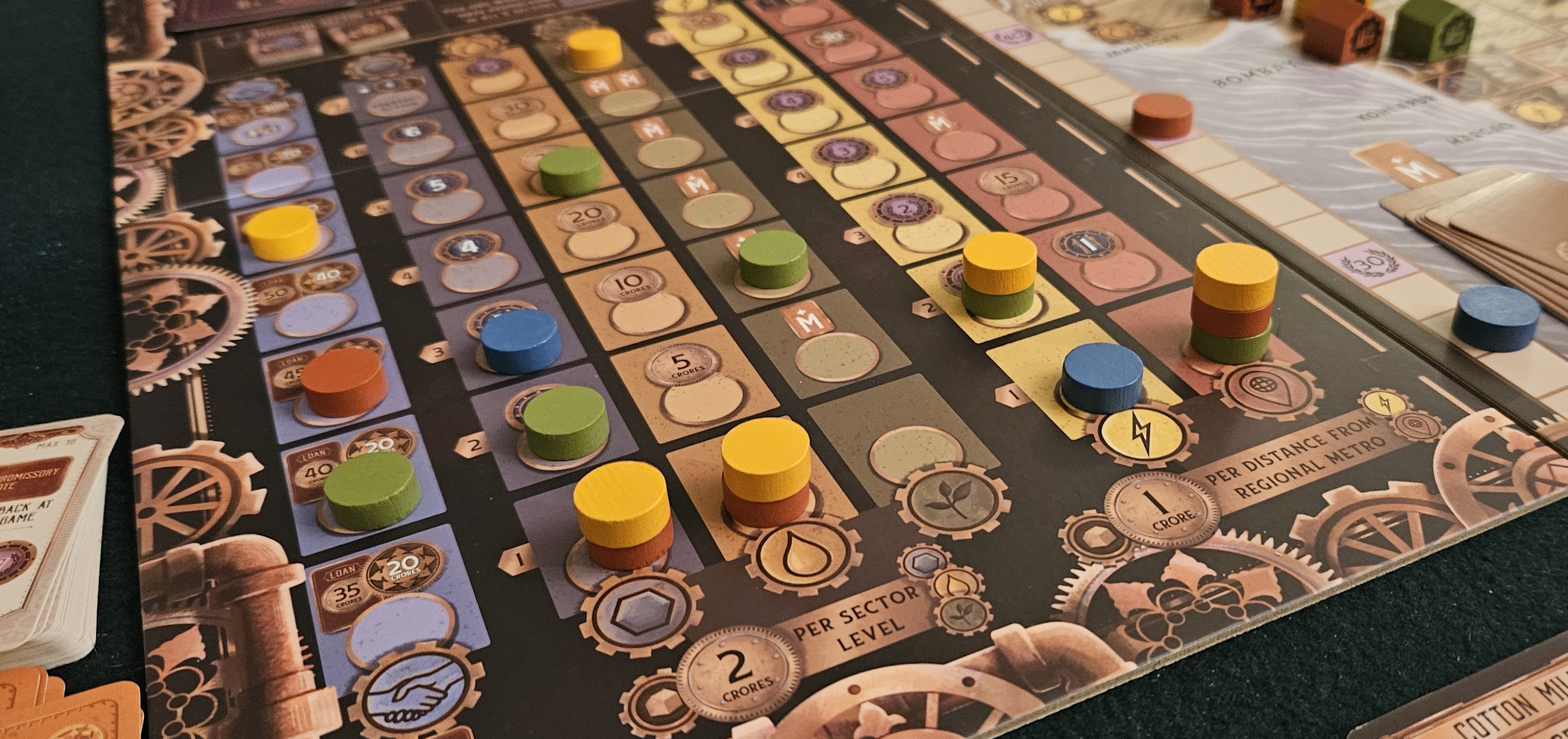
Ensuring your position as a captain of industry.
Again, this isn’t especially onerous. Chand’s rulebook is tidy and crisp, explaining not only the rules in the raw, but also their individual import. For a densely tangled economic game, there aren’t too many lingering questions.
Where it perhaps flounders is in the big picture stuff. Tycoon isn’t only about modernizing India, it’s also about shaping the country’s future through dint of your economic specialization. Financiers will take out bigger and bigger loans and eventually come to own the bank. Titans of industry will collect windfalls whenever anybody else uses their roads or farms. Stockbrokers can buy shares in rival companies for huge endgame payouts. Media-savvy players will leverage their surplus promoters to bypass auctions or the stock minigame altogether, instead currying favor with the government for lucrative contracts. In certain spots, this landscape is wide open.
In certain spots. In others, various bottlenecks force players to reckon with the game’s shortcomings. Perhaps the most notable of these are the auctions. Only two industries are awarded per turn, and it isn’t long before they step up in cost, making their acquisition through lobbying cost-prohibitive. Over the course of that first half-hour, the identity of the session’s contenders usually becomes apparent. Of course, Tycoon doesn’t end there. The following ninety minutes must still be played out, the rich getting richer while smaller fish seem ever tinier by comparison.
Is this ever-expanding wealth gap suitable? Frustrating? Satirical? Celebratory? Everything at once? It’s hard to tell. Encouraging tourism and founding cooperatives may produce warm feelings, but these initiatives are quickly dwarfed by smoggier industries. Looking over one’s holdings upon the game’s conclusion, all those stocks and industry tracks and big industries, the little people seem so much farther away than before.
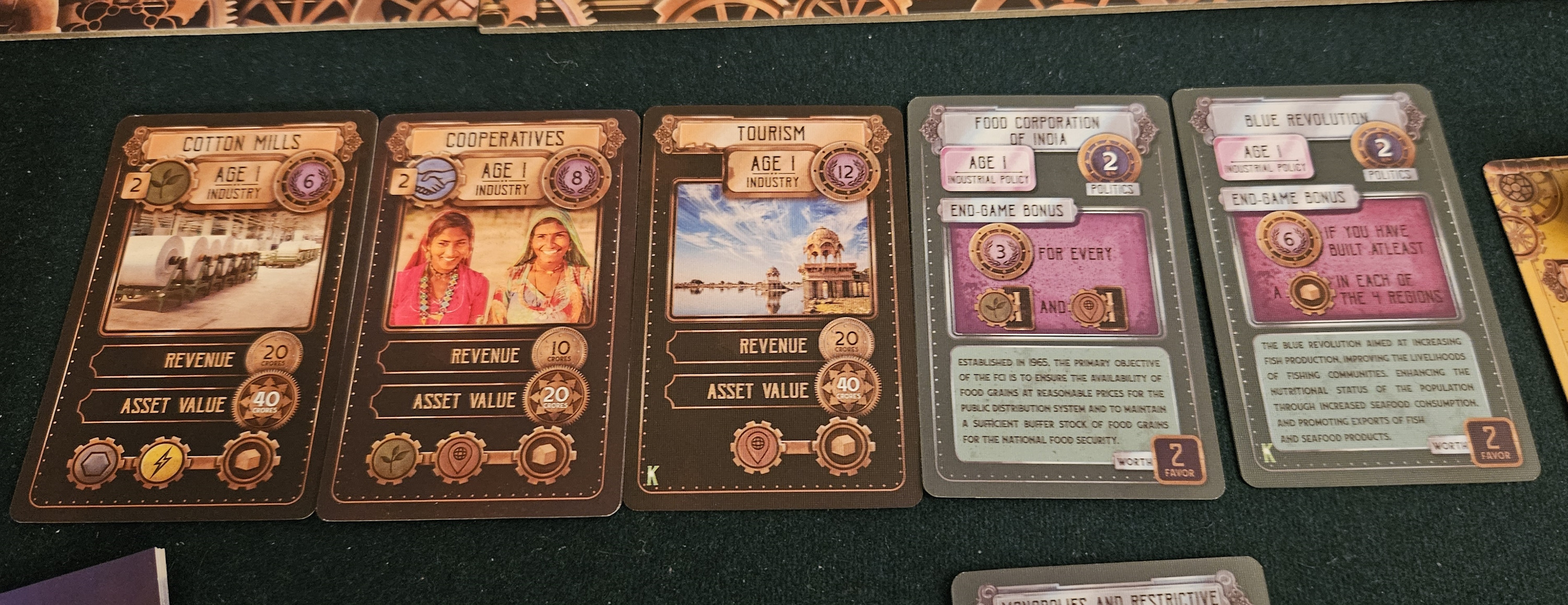
Just a few of the industries and policies one can utilize.
Not content with “victory points,” Tycoon provides three separate tallies in what is perhaps the game’s most interesting idea, but which suffers from the same fate as some of its Eurogame peers.
The first, and the one that most resembles a traditional victory point, is influence, counted via a rectangular track around the map. Almost every action can produce influence in some quantity: building, advertising, buying stocks, playing politics… yeah, pretty much everything. Next to influence is your asset value, a blend of tangible assets (your company’s holdings) and the intangible (stocks). To win outright, you must hold first place in both.
Barring that, the game’s third tally comes into play. Called “favors,” these break the tie between influence and assets, and are largely accumulated in secret, both by undertaking actions in the game, accruing policies, and by fulfilling a corporate agenda drawn at the outset of the game. It’s a glorified tiebreaker, but it’s easy to appreciate that it’s a whole process, not the usual flippant “whomever has the most industry cards wins” nonsense.
As victory conditions go, this three-part division informs nearly everything about Tycoon, both for better and for worse. The good part is that Tycoon allows players to feel conniving and clever. In our most recent session, I only built industries that would significantly improve my asset value. While everything provides little bumps to influence, mine were minor compared to my main rival’s. When the game ended, I had almost double his asset value while he had edged me out in the influence contest. But because I had spent more time on accruing favors, the session went to me. So much for my opponent’s robust public relations department!
At the same time, Tycoon falls into the trap of offering too many sources for each type of point. Your asset value is derived from your industries and your position on the finance and transportation tracks and certain leftover merit cards and your stock shares (with the requisite valuation of everybody’s company!). Influence is tallied from the track and meeting the country’s target policies and placating the planning commission. Favor comes from… you get the point. Like many modern Euros, Tycoon verges into a parody of what non-players hear when they eavesdrop on our specialized jargon. Far worse — because who cares about non-players? — it’s so overstuffed with sources of points that no one of them feels important or distinct.

Stocks can be sold… or better yet, turned into bonuses.
The short version, then, is that Tycoon is restrained in some corners but not all of them, and would have benefited from some pruning. The actual economic system, with its various auctions and promoters and tracks, locks into place like clockwork, only to award so many little spills of victory points that none of them feel significant. A high-asset card will also award influence, even if it doesn’t necessarily make sense to do so, while more philanthropic projects flip the script but still goose your asset value. Given the game’s tendency to produce runaway titans of industry, this leaves one or two players out in the cold.
Which isn’t to say that Tycoon is a bad game. Not by any stretch. I would even call it a very good game, just one that’s subjected some departments to careful laser-tooling while overlooking others. Foremost among the game’s successes, it’s such a delight to play a game that’s willing to touch upon all of these topics — stocks! industries! worker co-ops! regulations and benchmarks! — without having any of them draw the short straw. From what I’ve seen, success depends on mastering multiple arenas and observing your competitors’ progress. There is no room here for heads-down play.
Further, so many of Tycoon’s actions are individually rewarding. Losing an auction grants some benefit — promoters, again, to circle back — making it easier to lobby the government for various benefits. It’s still necessary to pay attention. Despite these occasional boons, there are no major rubber bands in place to prevent somebody from falling behind. But it’s possible to leverage even weaker outcomes into advantageous positions. Chand walks a tightrope between letting players fail and giving them too much rope, and for the most part he measures out the cord in exactly the right proportion. Tycoon’s straitjacket is surprisingly roomy.
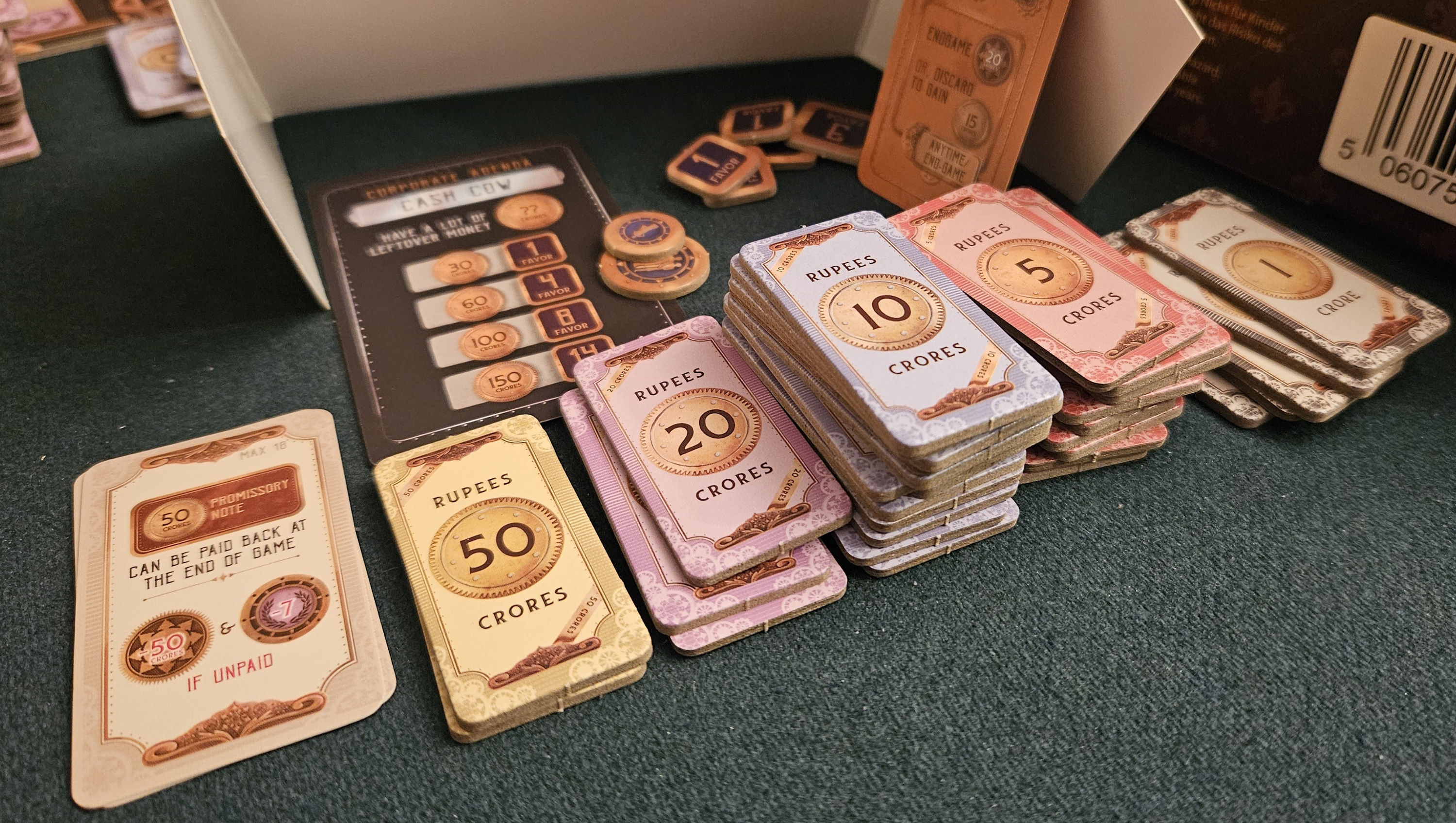
I’m feeling pretty good about all that smog.
All in all, Tycoon: India 1981 is another fascinating title by Sidhant Chand, a riff on the Eurogame formula that pulls some of its own tricks while repeating others, both to great success and its own peril. For a dense economic system, it’s eminently learnable. For a point salad, it’s… rather fibrous. Once more, I’ll be following Chand’s development as a designer with great interest.
A complimentary copy of Tycoon: India 1981 was provided by a reader.
(If what I’m doing at Space-Biff! is valuable to you in some way, please consider dropping by my Patreon campaign or Ko-fi. Right now, supporters can read my second-quarter update!)
Posted on August 5, 2025, in Board Game and tagged Board Games, Tycoon: India 1981, Zenwood Games. Bookmark the permalink. 2 Comments.

 SPACE-BIFF!
Thanks a lot Dan for the review, as always it is a treat to read what you write 🙂 I’m glad you enjoyed it overall!
Cheers, Sidhant
Thanks for designing such an intriguing game, Sidhant!