Christ and His Saints Were Asleep

Hot take: any time period dubbed “THE ANARCHY” was probably a bummer. The specific Anarchy referred to in The Anarchy, the latest flip-and-write game by Bobby Hill, was a fifteen-year war of succession fought between the Empress Matilda and King Stephen across Normandy and southern England during the twelfth century. Which, in case you missed the memo on the merits of every century, was itself something of a bummer.
Here’s the good news. While The Anarchy might have been a big ole stink-pickle for everyone involved, Hill’s version offers the exact opposite. Building on the systems he established in Hadrian’s Wall, this is a complex but thrilling portrayal of Medieval warfare, tower defense, and brewing, with a heady dose of modern combo-building for good effect.
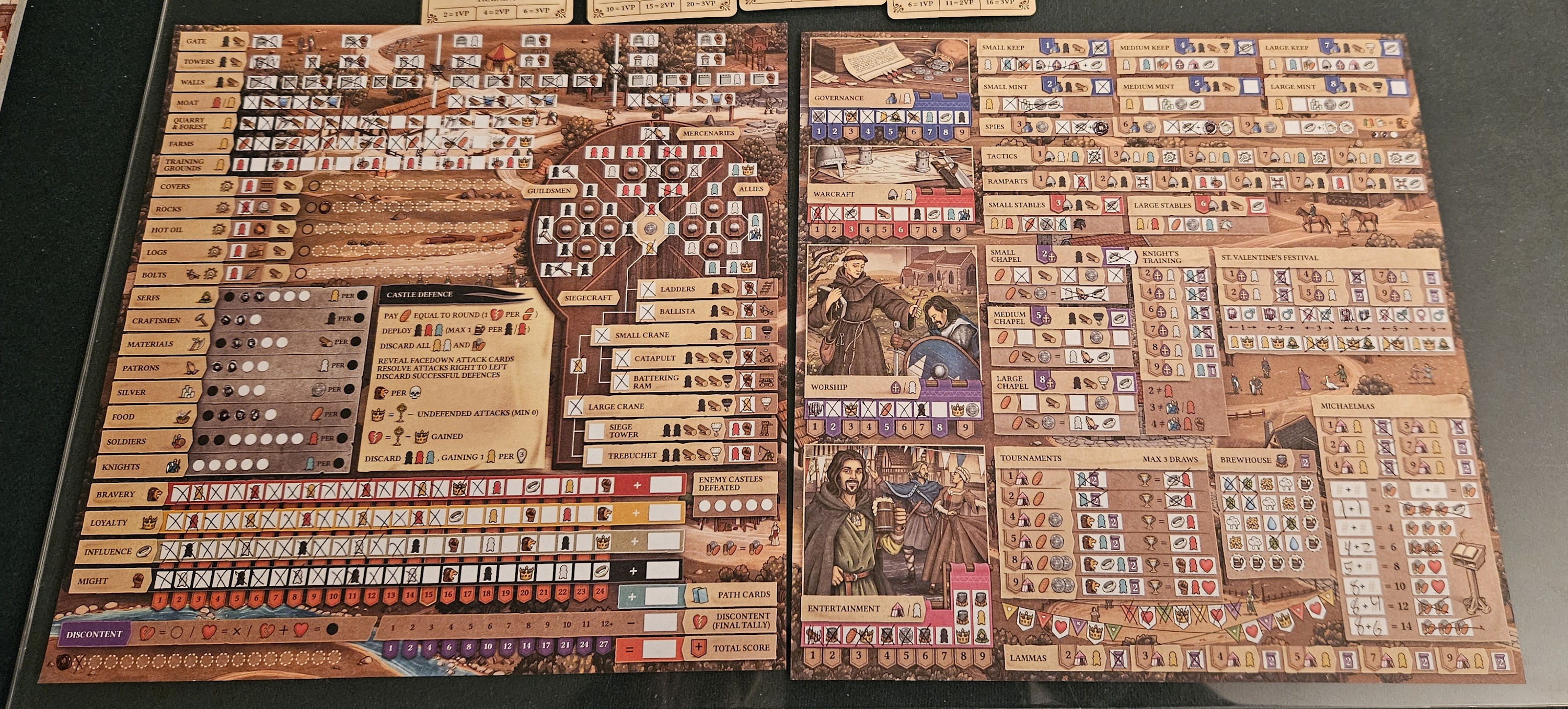
Info bomb!
Provided you can learn the thing, that is.
If the above image proves anything, it’s that I hope to never teach The Anarchy again as long as I live. The problem isn’t so much that the game is complicated — although for this genre, it’s jousting with Twilight Inscription — so much as that flip-and-writes are, at core, all about filling in spreadsheets. Just look at all those boxes in need of ticking. Why’d I have to go and uninstall Excel?
The basic idea, shorn of all its wool, is that you’re handed a bunch of resources, spend them to tick boxes, and then those boxes grant you some diminishing quantity of other resources to spend on ticking other boxes, until such time as you’re too short on resources to tick any further boxes.
For anyone who’s played Hadrian’s Wall, that formula will prove familiar. Even the resource categories return more or less intact. Your tools fall into two main camps. First, there are your material goods, the silver, stone, and food necessary to keep any feudal society limping along. Next are workers. There are serfs who labor in the fields and forests, craftsmen who build your walls and towers and siege engines, soldiers and knights who stand in the way of oncoming armies, and patrons who do pretty much everything else, from praying to hosting pre-renaissance faires.
Very quickly, Hill entrenches his reputation as somebody who cares more for his history than as mere window dressing. This division of responsibility calls to mind King Alfred’s Estates of the Realm, divided between those who work, those who fight, and those who pray. But it’s a cluttered portrayal, not only because there are more roles under examination, but also because there’s some degree of flexibility between spheres. Rigid flexibility, if we can call it such a thing, but there it is, the current crisis allowing a serf to become a soldier, patrons and priests titling new knights, craftsmen unambiguously ranked below nobles but still somehow seeming like the luckiest sots in the land. Anarchy is always a bummer. But it can also be a time of transformation.

Incoming invaders, scoring rubrics, and a wee castle.
While the basics remain digestible, Hill adds enough to The Anarchy to make it distinctly more fibrous than Hadrian’s Wall. Where that game’s raiding Picts spurred your Roman governor to balance the needs of three segments of ditches and walls, occasionally spying on your foes to know where the next incursion would appear, The Anarchy coughs up an entire castle-building and -defending minigame that encompasses intelligence-gathering, fixed and moveable defenses, tactical repositioning, the military potential of a stiff drink, and more.
There are a few ways to discuss these additions. The least interesting approach is also perhaps the most far-reaching, in that The Anarchy departs even further from the flip-and-write template than its predecessor. Rather than presenting everybody at the table with an identical invasion, here your defenses, including the rampaging army on your doorstep, are wholly your own. This is presented as a line of incoming attacks, some visible but others concealed face-down to only provide clues about the composition of the enemy force. It’s entirely possible that the army marching on your doorstep will be tougher than those approaching your neighbor, or show up with trebuchets after you’ve invested in a moat, or focus wave after wave where your castle is most crumbly. This upends the identical inputs that are the genre’s usual template, and even, at times, feels — gasp — unfair.
Your objective, naturally, is to preempt these invaders. Your most effective tool is your castle, with its permanent walls, towers, gatehouse, and moat. But you have other options as well. The obvious one is to position defenders, sacrificing soldiers, knights, and in a pinch some craftsmen. Or there’s engineering, piling up rocks and logs to toss onto attackers, preparing ballistae to hurl bolts at a distance, or utilizing that stickiest of medieval myths, boiling oil, to ignite over the top of a battering ram.
The trick lies in identifying when to use each tool. Walls are formidable, but can lend a false sense of security — not to mention, attackers might approach from a direction you haven’t finished piling up. With the right upgrades, troops can be repositioned on the fly or given ale to rouse their courage, but are comparatively squishy and have the pesky tendency to die. And all those stones and logs might provide the extra boost you need to weather this attack, but are limited to as many shots as you’ve invested in them.

Your castle are belong to us.
It’s a lot to learn, especially in the game’s first session. Deciphering an incoming attack is a skill in its own right. Face-down cards in particular require some deduction, showing which tool the enemy will deploy, but not which direction they intend to approach from. You can spy on these cards, although doing so requires its own investments. More often, some guesswork and redundant defenses are your best bet.
Meanwhile, you’re also attending to your own military campaign. This is less burdensome rules-wise, asking you to spend some resources and troops to capture an opposing castle. But it’s one more thing to worry about in a game full of worries. No wonder some first-timers forget about it for a round or two before recognizing the benefits of sacking those enemy storehouses.
Here’s the thing: while The Anarchy’s tower defense minigame is unexpectedly complicated, sometimes frustrating, and often imbalanced, it rewards each of those traits many times over. Your personal castle, with its polyhedral walls and cylindrical towers, pops the pleasures of the game’s printed sheets into the third dimension, rewarding careful planning, forward thinking, and more than a few combos with a tangible artifact. It’s a toy, and a handsome one at that, but it also serves as a visual shorthand for everything you’ve accomplished and still have yet to check off. The cards are theoretical, like any invading force, but your castle’s topography reveals where your soft underbelly ought to be armored, which sections can be left to their own devices, and lets you array your defenders where you suspect the hammer will strike the anvil. I’ve even begun piling food tokens inside my castle walls as a reminder of how much I need to earmark for feeding my people.
The castle is the game’s most tangible component, a useful centerpiece for the sieges that are its organizing events. As I noted earlier, though, Hill is tinkering with the formula in subtler but more profound ways.
Just as attacks can vary in strength from player to player, so too can the outcomes of your actions vary. As in Hadrian’s Wall, every round begins with everybody drafting a path card. This offers a selection of resources and a goal for the end of the game. Unlike in Hadrian’s Wall, however, where everybody had an identical deck to select from, here that deck is shared between players. This encourages everybody to think on their feet, maybe even altering their approach mid-game. Since you won’t have access to every card, it isn’t possible to bank on any particular avenue awarding the highest number of points. In turn, this eliminates the build orders that eventually dominated Hadrian’s Wall. It isn’t enough to go in with a strategy. You also need to think tactically.

Domain cards help resolve a wide range of activities.
Nowhere is that more apparent than in the domain deck. Each player gets their own deck, and it governs… well, a bunch of stuff. Investing patrons unlocks four separate tracks, each of which offers its own benefits. Governance and warcraft, for example, are the demesnes of keeps, spies, and ramparts. King stuff, in other words. Worship and entertainment, on the other hand, let you appoint new knights, hold tournaments, and throw festivals.
Sometimes these activities produce obvious outcomes. Stables are for horses. Ramparts give you time to reposition your troops. Spies go a-spying. Easy.
Others are less certain. This is where your domain deck comes in, producing a bunch of mini-minigames — card flips, really — that blur the game’s arithmetic just enough to prevent the game’s proceedings from growing too foreordained. Sometimes these manifest as diminutive press-your-luck sessions, such as hosting St. Valentine’s Festival and hoping your serfs pair off to create baby serfs, or banking the potluck numbers of Michaelmas to hopefully produce a surplus. Some of these flips border on false decisions. Brewing ale is surprisingly testy, jousts don’t ask you to actually choose anything, and almost everybody forgets about Lammas Festival.
But the advantage of this system isn’t that it asks you to make decisions while flipping your domain cards. It’s that you’re forced to adapt to changing circumstances, take actions whose outcome can’t be relied on, and structure your turn around differing approaches to siege warfare and medieval society-building. Along the way, sure, it can feel unfair! Sometimes your peasants don’t get horny no matter how much bread you stuff in their mouths, sometimes your ale foam won’t fizz in the next batch, sometimes Empress Matilda sends a bigger army to your castle than to your buddy’s manor next door. The Anarchy is aptly named, producing a chaos not only of setting, but in the very actions you rely upon to weather its societal collapse.
That said, Hill offers so many ways to get ahead that this remains a game that can be played, and played well. Hosting a festival isn’t certain to succeed, but you can game the probabilities. Besieging armies might pull an unexpected trick, but you’re offered counterstrokes of your own. You might be left with a path card that doesn’t have enough craftsmen. Okay. Can you hire some more? Where do you stand on the influence track? Do you really need to build another chapel this turn anyway? Every question posed by The Anarchy has an answer. Multiple answers. The result is a very different sort of test from Hadrian’s Wall.

Awww!
The Anarchy — the historical one — doesn’t sound like a very good time. As recorded of the period in the chronicle at Peterborough Abbey, “Men said openly in that day that Christ and his saints were asleep.”
As a board game, though, this is pure kino. Pure, uh, ludo. For a game that’s all spreadsheets and icons, Bobby Hill has produced another wonder, a game that thrills at the prospect of striking an X through another box. More anarchy, please.
(If what I’m doing at Space-Biff! is valuable to you in some way, please consider dropping by my Patreon campaign or Ko-fi. Right now, supporters can read the first part in my series on fun, games, art, and play!)
Posted on June 25, 2025, in Board Game and tagged Board Games, Garphill Games, The Anarchy. Bookmark the permalink. 7 Comments.

 SPACE-BIFF!
I am loving this game, it is a worthy successor to Hadrian’s Wall. I have only played the game solo, but the 20 missions solo campaign keeps you on your toes and forces you to try different strategies. Added to that the added complexities and more varied strategies compared to Hadrian’s Wall, and this one is a real keeper.
And don’t forget those Lammas festivals, they have saved my bacon more than once 🙂
Lammas is super useful!
Yet another Garphill game relying and focusing on a specific country and culture, made solely by half a dozen white men, with no cultural consultant.
You won’t see me disagreeing that Garphill has a few titles that would have benefited from better research, but this one doesn’t strike me as a big offender. Was there something about The Anarchy that rubbed you the wrong way?
I have and enjoy Hadrian’s Wall, and again the historical premise (which I had considered treating myself) is part of the appeal. It will probably be a few years before I delve into this game, though; different premises implemented with similar mechanisms seem to engage me more with the old-school approaches typified by historical simulation classics from Avalon Hill, SPI, et al.
A game for 1-4 players is not in the “killer app” territory for this kind of mechanism (regarding which see below), so the question of why to choose the paradigm has a different answer than in that use case. I think an obvious one is how it can simplify operation of a system so inherently complex that it’s bound to end up looking like a spreadsheet.
The roll-and-write/flip-and-place paradigm has as its “killer app” games that can accommodate an arbitrarily large number of players without unfeasibly long playing times. The usual context of separate player boards (instead of move interactions in a shared space) works in synergy with the usual generation of a single identical piece for all to place, the “multiplayer solitaire” dynamics facilitating a massively multiplayer game without getting too complicated to manage.
When the boards are just identical sheets of paper, and the ‘pieces’ just pencil marks, those materials are also less costly to provide. (This is also the case with interactive games such as Battleship, which was a paper and pencil game in the public domain before Milton Bradley produced its plastic rendition).
Bruce: The principles in this historical situation were about as ‘white’ as can be, mostly male (for what little that matters), and about as alien to modernity wherever on the globe one’s modern perspective was formed. Moreover, culture is a phenomenon in the mind, not the meat!
Expertise in these fields is hence a matter in which one can’t “judge the book by looking at the cover.” Also, the degree of immersion in a subject adequate for a game design (or even a book) *about* it is less than the active participation *in* a tradition needed for masterful practice of an art (e.g., dance) as a performer of it.
An expert on a given historical milieu may design one or several outstanding game treatments of it, but we are the richer for folks who are in that respect more eclectic — but skilled in *game design* — also producing treatments (including ones that bring a more foreign perspective, which may notice things that wouldn’t occur to someone who was not to that degree an outsider).
The interactive element of the shared deck would seem to detract a bit from the time-saving feature of simultaneous selection from independent decks; however, the time needed for sequential deals or draws is in prospect trivial with only four players.
Pingback: Fry n’ Write | SPACE-BIFF!