She’s a Grisly Monster, I Assure You

You know the story. Buncha monsters storm Mount Olympus. The pantheon is in a scramble. Who’s this coming to save the day — Hercules? More like Hunk-ules.
Reiner Knizia’s Ichor isn’t Disney’s Hercules, and thank the gods for that, although Tyler Miles Lockett’s illustrations do somewhat resemble the Gerald Scarfe amphorae look of the animated feature. When I previewed the thing a year back, I liked it somewhat less than its sibling title Iliad. Now that they’re both finished and on my table, though, I’ve been giving Ichor a second look. And while it’s still the zanier and less measured of the pair, there’s so much to appreciate about Knizia’s portrayal of this divine brawl that I can’t help but be charmed.

Control those lanes!
Like Iliad, and indeed like many of Knizia’s several hundred published titles, the basic concept for Ichor is wonderfully straightforward. Playing as either gods or monsters, your objective is to deposit a certain number of tokens across the board. This number depends on the size of the map. There are two sizes, a six-by-six grid and a seven-by-seven grid, requiring fourteen or nineteen tokens respectively.
The hiccup is that placing those tokens requires movement. Any unit, whether god or monstrosity, is permitted a rook-like slide, shifting as far as they like until stopped dead in their tracks by an opposing piece. For every space they exit, that’s a token.
Along the way, though, every opposing token they touch is also removed. This produces a seesaw effect, gods and monsters nearly brushing fingers (or talons) with victory as they hoover up rival tokens and scatter their own in their wake. This gives Ichor’s situation a dire sensation, your foe’s remaining pile of tokens always seeming one or two moves away from securing victory, only for your own move to put them in a panic, back and forth until somebody actually plops their final token on the board like siren guano.
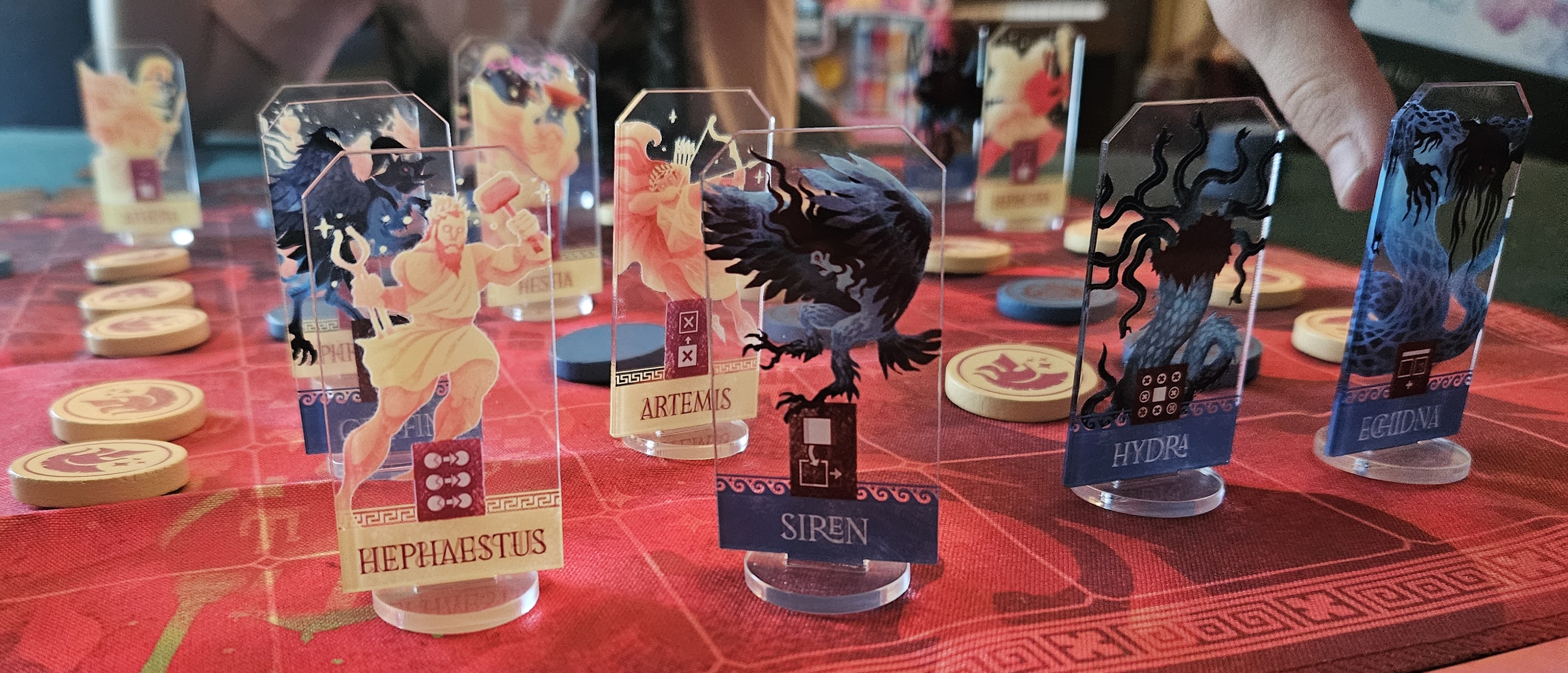
Blocking is important, but many units can wriggle out of a corner.
Unlike Iliad, which was an all-original Knizia in Bitewing’s lineup, Ichor has pedigree. This is something like the fourth iteration on the concept, and it’s the most robust of the set. It’s been fine-tuned into its current state, and it shows.
The most obvious example is found in the god and monster abilities. Rather than moving a unit, you can instead flip one of your cards face-down to activate that unit’s special ability. Some units are clinchers who excel at swinging the board state. On the divine side there’s Hephaestus, capable of moving over your own tokens, creating a double-dipped line that any opponent would be wise to eliminate as soon as possible, while the monsters get creatures like the Centaur, who can move diagonally, upsetting the usual orthogonal headspace that dominates the match.
Other creatures excel at escaping traps. Trapping plays a large role in Ichor, with players routinely blocking off access to precious lanes or even surrounding enemy units. This gives real punch to units like Heracles, who can shove a monster forward until they run into an obstruction, or the Griffin’s ability to hop over the first god in its path. And then there are more utility-based troops, like Poseidon, who can sweep his entire row or column of tokens altogether, or Cerberus, who replaces any three god tokens on the board and replaces them with their monster kin.
As mentioned above, though, using these abilities requires sacrifice. Once flipped down, that unit is depleted of its power forevermore. Some units even depart the board entirely. Barring, of course, other powers, some of which recharge their peers’ depleted powers or, when using some of the variant units, bring new pieces into play. This forces players to approach their units cautiously, reserving their strength for a conclusive punch. Or at least a bell-ringing haymaker that forces your opponent to scramble to recover some board position.
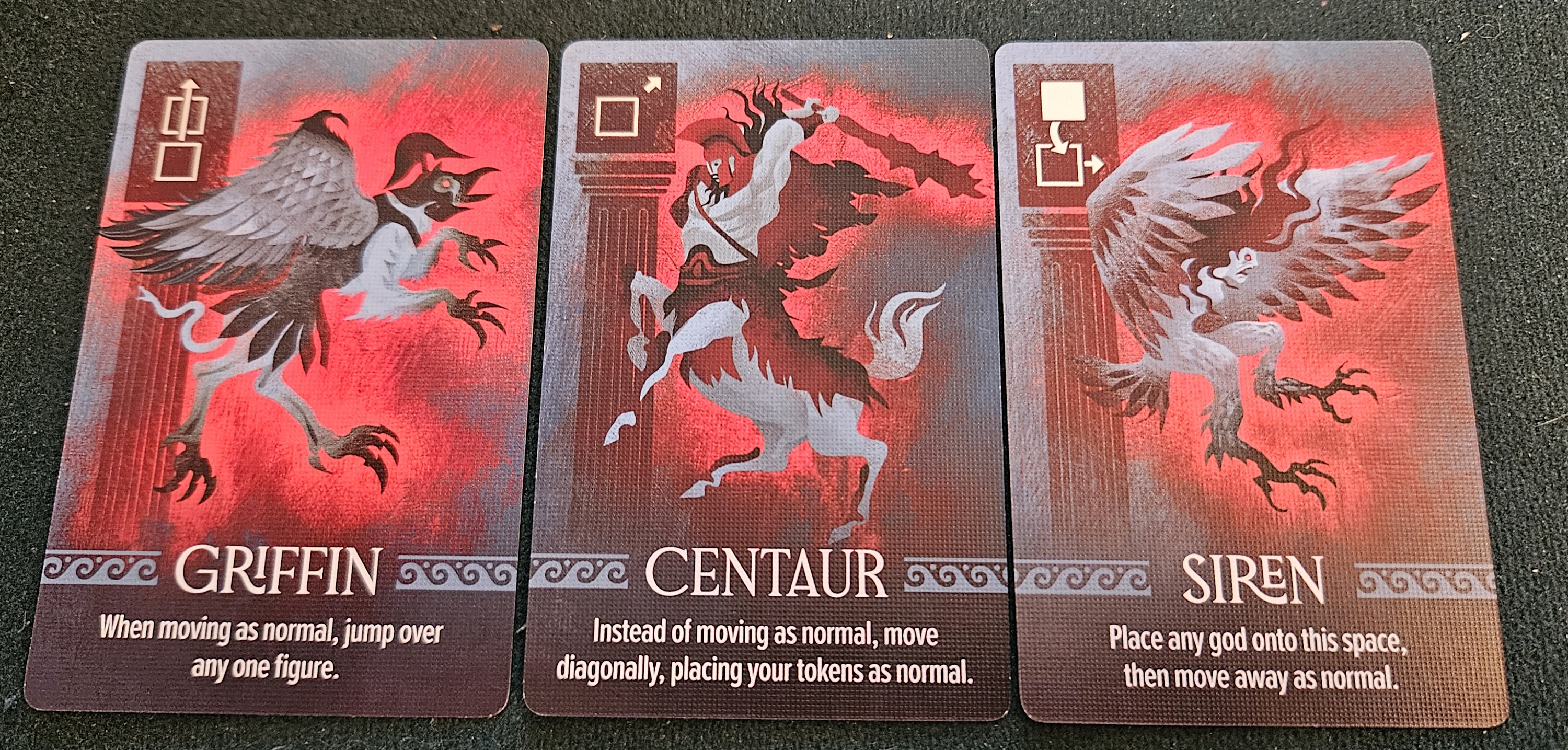
Creature abilities keep the game unpredictable despite its open information.
Truth be told, I’m somewhat mixed on the variants. Some of the additional units are appreciated, adding unexpected twists to those starting lineups. Others, like the Calydonian Boar and Hera, add new victory conditions, which is amusing for one or two sessions but detracts from the game’s purity. The same goes for gates, special tiles that can be placed on the board. These prevent easy movement — you can hop over them, depositing tokens as usual, but never leave any unit on the gate itself. This creates more chokepoints in a game that’s already rather chokepointy. Gates also afford unique powers to the players who cross them lengthwise, adding yet another dimension to a game that really does not need any more clutter.
Because the beautiful thing about Ichor is the way it merges simple rules with those outlandish, sometimes even game-busting abilities. The core experience is slender enough that it takes all of thirty seconds to explain. My eleven-year-old, for instance, can play it with zero issue.
But there’s depth to this sea, too. Playing well is a matter of keeping track of those competing god and monster abilities. If I teleport Hermes here, then that will block your Minotaur from looping to the opposite side of the board there, except that will still be vulnerable to your Siren kidnapping Athena in the neighboring space, so maybe instead if I put Zeus in the middle of the board, you’ll have to shift your Hydra to remove his tokens, but then, but then…

Certain additions, like gates, are fine.
It runs the risk of becoming too zero-sum, and I suppose an endless exchange is theoretically possible. Honestly, though, I haven’t noticed it being the problem I expected. More often, the board becomes saturated with tokens after a half-dozen moves. This isn’t enough to win, but it will put someone within reach of moving within reach of victory. That double-stretch is where Ichor thrives, both players just one or two tokens shy of claiming victory. There’s nothing quite like the midgame, when both players have hemmed in their rival’s most potent units, only for somebody to stumble into some state-altering eureka that brings the game to a sudden conclusion. That’s the good stuff.
On the whole, I’m even more impressed with Ichor than I was a year ago. This is supernal Knizia, full of fine reversals and nasty corners. For a game with perfect information, it has that admirable capacity to surprise and delight with unexpected moves. Cate has declared it vastly superior to Iliad. I don’t know about that, but I’m still impressed with all it accomplishes with a few rules, tokens, and a pantheon’s worth of big jerks.
A complimentary copy of Ichor was provided by the publisher.
(If what I’m doing at Space-Biff! is valuable to you in some way, please consider dropping by my Patreon campaign or Ko-fi. Right now, supporters can read the first part in my series on fun, games, art, and play!)
Posted on June 18, 2025, in Board Game and tagged Bitewing Games, Board Games, Ichor, Reiner Knizia. Bookmark the permalink. 4 Comments.

 SPACE-BIFF!
This seems a very action-packed game! It’s probably far from the first such in his prodigious ouvre, but the mode is not what he’s famous for.
Might it be having a bit of a renaissance? I’m thinking for instance of Cosmic Frog, Escape from New York, Stationfall, Thunder Road: Vendetta and Tournament at Avalon.
The astonishingly prodigious ouvre of Team Knizia (really, I think his playtesters are a key part of the endeavor) manages to produce what would be for other designers several lifetimes’ worth of brilliant works that attain classic status by releasing several lifetimes’ worth of experiments that don’t quite get over that bar. (Only time will tell which is which.)
Pingback: I’m Not Azure About This One | SPACE-BIFF!
Pingback: Real Moytura, Guys | SPACE-BIFF!
Pingback: Best Week 2025! All My Children! | SPACE-BIFF!