Casus Ludi

I know this isn’t a functional rubric for anyone whose output has been as prolific as Martin Wallace’s, but I mentally sort his games into two broad categories. There’s the tight, elegant stuff, full of careful point-generating races between players, logistic considerations, and probably a loan system, and then there’s the big messy sandbox stuff.
Casus Belli inhabits the latter category. More than inhabits; it embraces the role whole-heartedly. It isn’t even a little bit ashamed to be rolling around in the sandbox. What’s that sand-encrusted lump over there? Oh, don’t mind that. It’s just another potential building block. Stick it in the back of the dump truck and call it a pun.
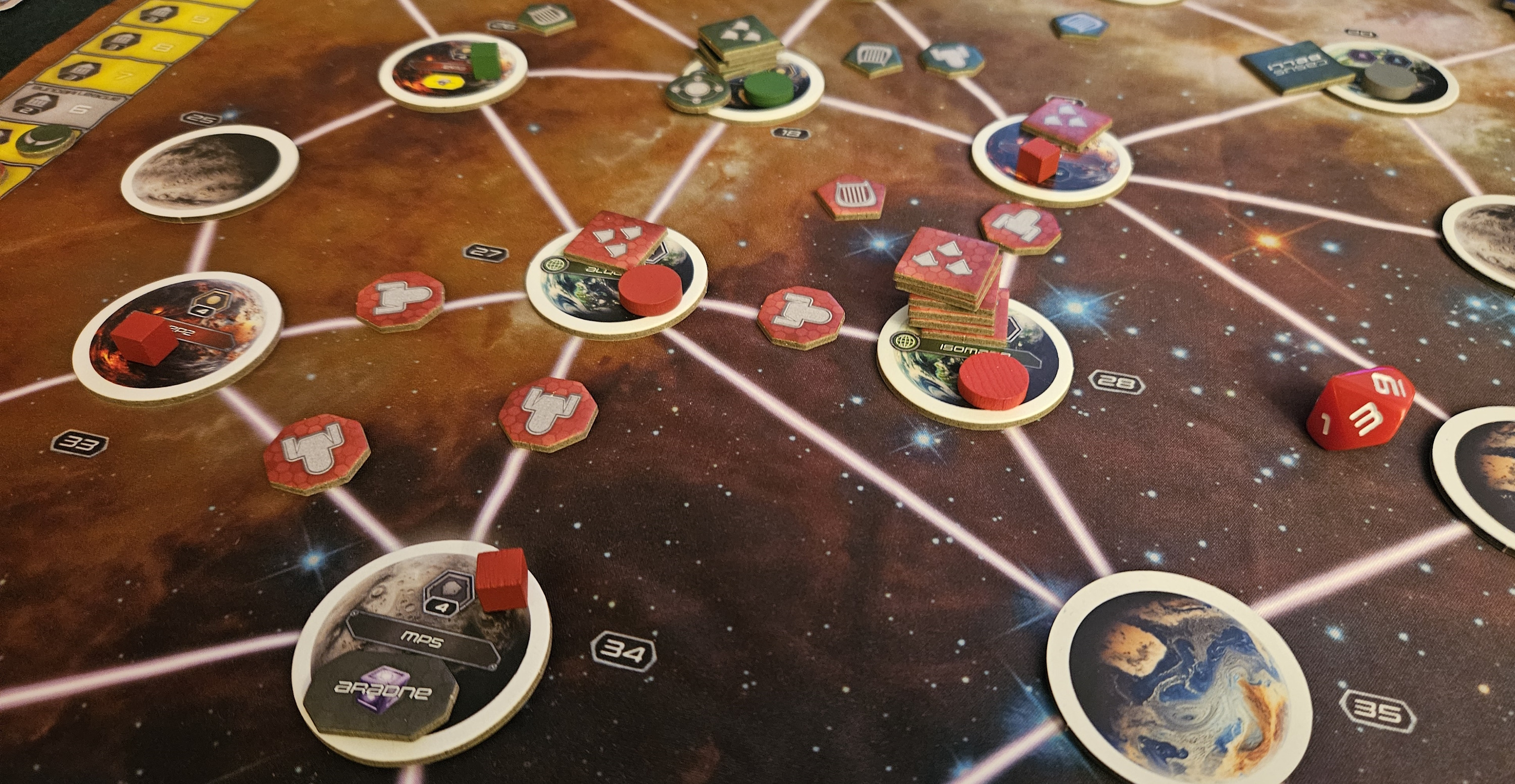
Stars must be connected via star-lanes. ‘Tis the rules.
There’s a line wending its way from A Few Acres of Snow to Casus Belli, its ink charting both classic titles like A Study in Emerald and flawed gems like Mythotopia and A Handful of Stars. Like those games, this is a Martin Wallace deck-builder, fully literate in what makes the format tick, but also pushing the genre outward to cross new frontiers. Wallace is the granddaddy of the hybrid deck-builder. It’s invigorating to see the ways he’s still adding new solvents to the formula.
If you’ve played A Handful of Stars — there are dozens of us — then the basic getup of Casus Belli will be familiar. Stellar empires are in fashion, prompting your aspiring sidereal polities to blast off into the void. Like that older game, the map is a patchwork of planets connected via lanes. Scout ships reveal planets, fleets conquer them. Easy. Right?
Would that it t’were so simple.
There are subtleties aplenty in Casus Belli, and we’ll get to those, but the biggest ripple in this game’s gravity-distorting lens is found in its name. Casus Belli. The occasion for war. It isn’t enough to smash your frigates into an opponent’s frigates and see who still has frigates left over when the frigates have finished doing their thing. Casus Belli opens on the verge of galactic war rather than in the midst of one, and as your stellar empire spreads across the sector, it must also chart a diplomatic course.
In simpler terms, you can only fight when you have a reason to fight. Or can fabricate one.
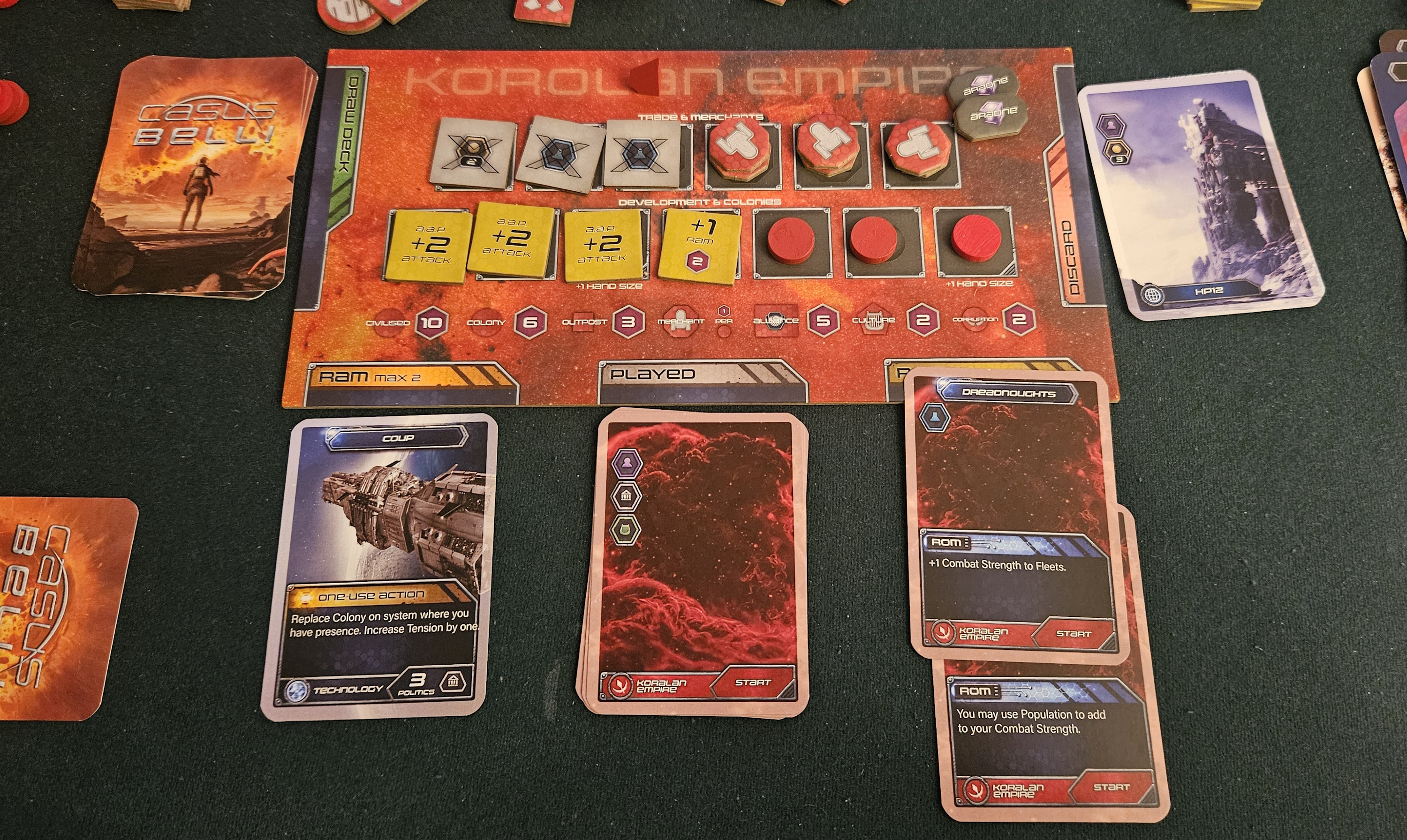
When there is no yellow team, I default to the mean guys.
In Dune, Frank Herbert wrote that the tripod is the most unstable of all political structures. Duff, obviously. A four-sided conflict is way less stable, presenting the illusion that everybody will have an ally when the sand-pup hits the fan.
To wit, Casus Belli offers four competing factions, and it’s no surprise that the game functions best when they’re all present and accounted for.
The reliable deck-bolts of the group are the Stellar Alliance, do-gooders whose whole ethos is making buds with all those neutral planets speckling the sky rather than shoving them into a locker. Standing somewhere to their left is the Elenic Union, a relative lightweight with fewer ships at their disposal, but tremendous broadcasting power and plenty of hits on satellite radio. These initial factions establish the game’s basics: while the Alliance flies around doing alliance-y stuff, the Union expands strategically in terms of actual colonial outposts, but fills the airwaves with their culture-dominating bops. Two totally distinct routes to scoring.
Here’s a third path: the Bundari League. Rather than allying with or enculturating their foes, the League sells them tchotchkes, populating the sky’s star-lanes with merchant vessels that bypass regular control altogether.
If that sounds too complicated, you could always control the Korolan Empire. True to their name, the Empire is here to push everybody around. They earn points for conquest, with a side platter of conquest in case their entree isn’t enough.
But the Korolan Empire also produces the game’s template. These are the most belligerent of the four factions, but it soon becomes apparent that hostilities are strictly regulated. Gobbling up individual planets is one thing, but as soon as two player-controlled factions butt into each other, expansion grinds to a halt. To seize another player’s territory, the Empire will first have to manufacture a casus belli. Tied to an individual card, this places a token on their intended target. Now the Empire can rush in and claim their prize.
Except declaring a casus belli accomplishes a few essential things for Casus Belli. The first is that it signals to your target that you intend to invade, giving them a crucial turn or two to buzz up their defenses, whether by repositioning fleets, planting an embassy in your crosshairs, or even, in the game’s middle stages, declaring a casus belli of their own. This last point is crucial, because while a casus belli paves the way for your fleets, it’s also severely limited. Unlike the steamrolling mega-fleets of A Handful of Stars, here your expansion is focused into a narrow beam.
At first, that is. Because that’s the other thing about generating too many little wars. As tensions rise — accounted for via an actual tension track — the sector spirals closer toward galactic war. And when the cold war goes hot, Casus Belli’s sandbox begins to divide into coalitions.
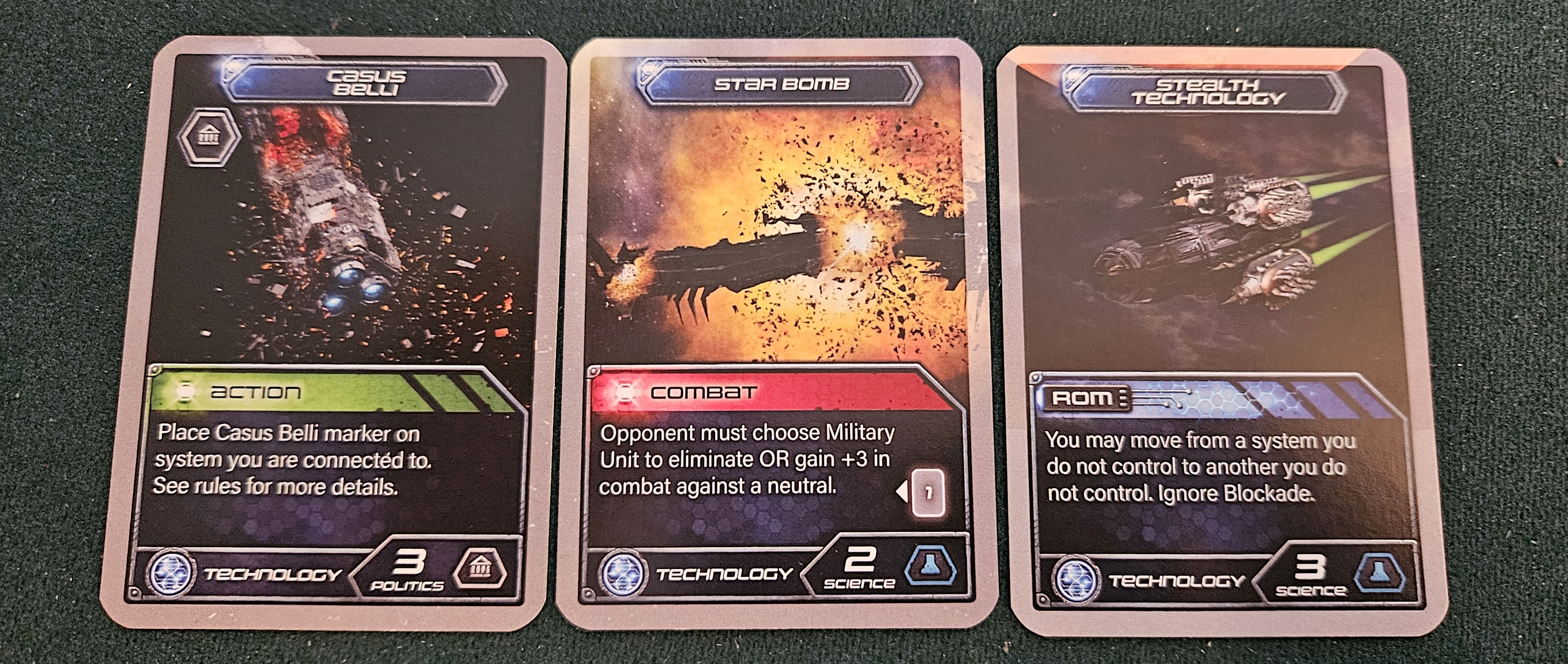
Aha! There’s the phrase!
These coalitions, it turns out, are not wholly player-determined. If it really comes to open warfare — which isn’t guaranteed, I should note — the Stellar Alliance and Elenic Union will always hop into bed. Depending on their current standing, this could be a boon, letting them turn the tide against the Korolan Empire, or a total dumpster fire. Bound together at the leg, they either sink or swim as a pair. Their scores are averaged, which often stinks for whichever half of this freshly minted pact was previously in the lead… although this also gives a trailing player a good reason to tweak galactic tensions upward. If your score is anemic, why not goose your ranking by tying yourself to the current winner?
When it comes to the Bundari League, matters are more complicated. Rather than siding with the Alliance-Union or Empire outright, the merchants prove as vacillating as a big-box store’s rainbow brands. Depending on their standing on another track, this one charting the everybody’s “corruption,” the League will either throw in its lot with one side or the other. Sometimes its position can spin on a dime, abandoning one set of friends for another before sprinting back into the first group’s forgiving embrace.
As I noted earlier, Casus Belli doesn’t always come to blows. Sometimes it stays in that earlier act, its factions dancing around one another, vying for position and cultural dominance, occasionally declaring tactical incursions, but not allowing the tension to detonate into actual war.
Sometimes. More often, conditions in the sector — the messiness of the sandbox — nudge players into tighter proximity and greater uncertainty. When that happens, war stops being a terrible eventuality best avoided, and instead becomes, dare I say it, the surest course forward. And not only for the wolfish Korolan Empire. If the Empire is getting too big for its britches, or if another faction is succeeding too thoroughly at making friends (or selling space-kitsch, or being space-Hollywood), then it may well be in your best interests to set off a bomb. Even as the good guys! That way, at least you’ll have somebody on your side. Or towing your score upward. Same difference. We’re equal partners in this, I swear.
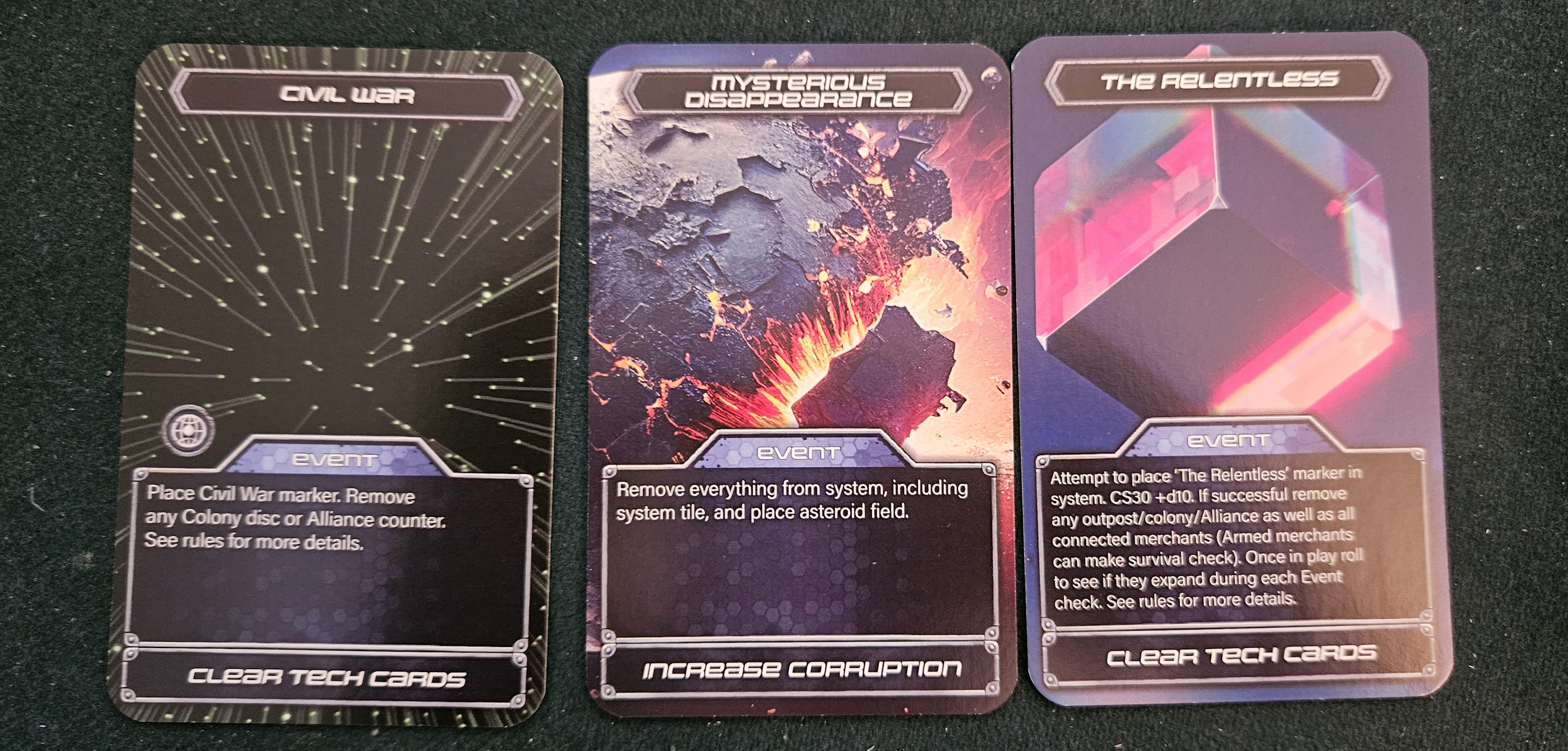
Events emphasize the sandbox nature of Casus Belli.
Essential to this process of widening the gyre is Wallace’s event system. At first glance, it’s wholly random and entirely unfair. That’s because it’s wholly random and entirely unfair.
Those traits, however, are precisely the point. When a civil war breaks out on your most important planet, that stinks. When a nine-dimensional entity exits non-space, consumes a colony, and threatens to expand to its neighboring stars, that’s a worrisome development. Once, an entire system, including every single fleet and outpost, disappeared completely from a fellow player’s empire. They had been amassing to fend off a Korolan incursion at the time. Now their entire fleet, cobbled together one card-resource at a time, was gone.
Far from being ancillary intrusions into the game, though, such developments are necessary to Casus Belli’s actual gameplay — not merely the card-play, but to its diplomatic aspirations. At its baseline, Casus Belli functions like a much-improved version of A Handful of Stars. There’s factional asymmetry, some cooler card effects and technology to research, but by and large it’s a similar experience.
But the game becomes so much more when considered from the diplomatic angle. This is no boilerplate 4X controlled via deck-building. It’s about building coalitions, about willing galactic peace off its pedestal so you have a chance at winning, about manipulating a faction’s internal politics so they swap sides. When my friend’s entire fleet was erased from the map, she went all-in on manipulating galactic tensions. Through sheer willpower she sparked war and put herself on the winning side. Her position had gone from modest to victorious because of a terrible setback.
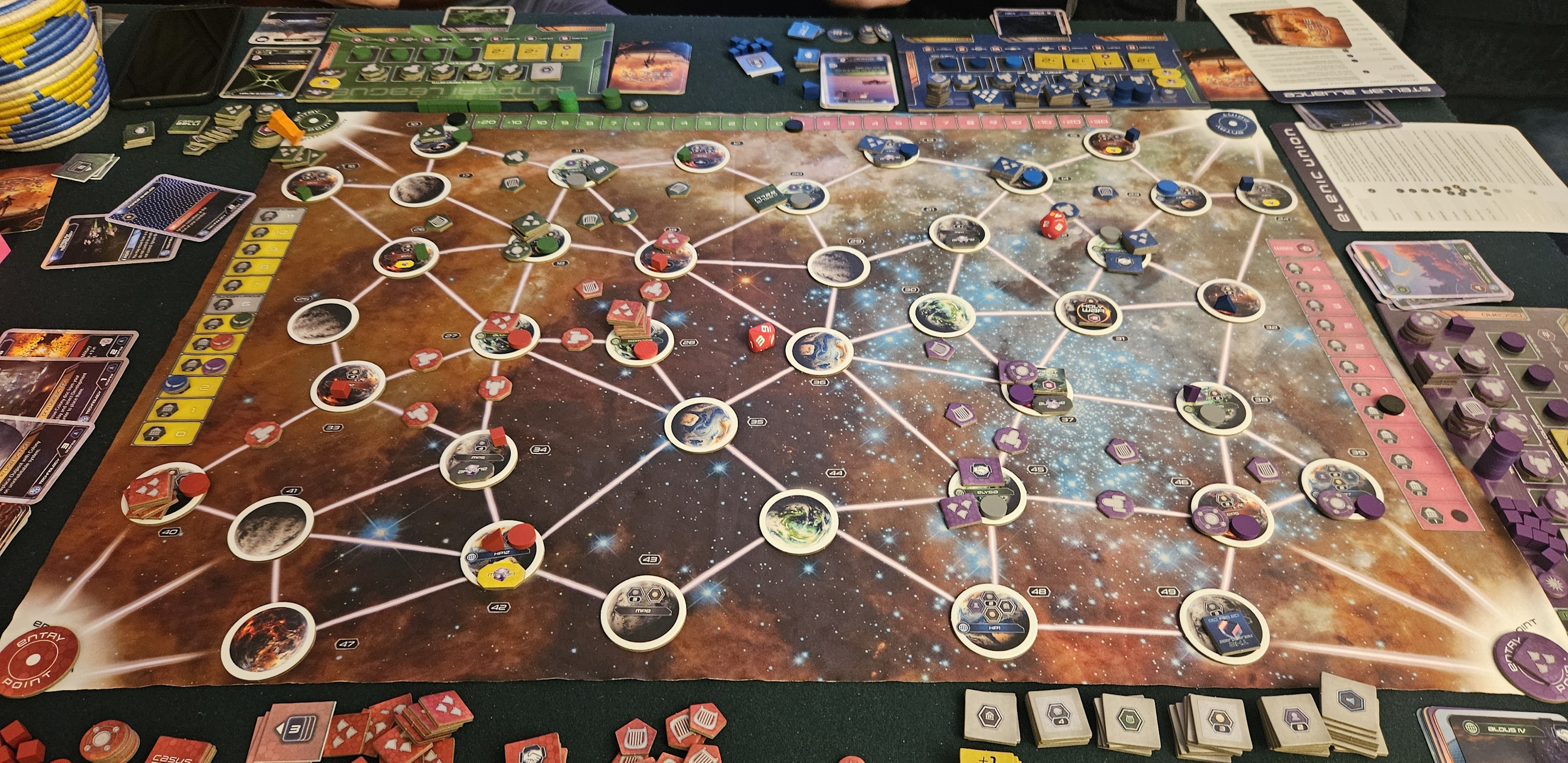
With all those factions, Casus Belli is a big boy.
Along the way, there’s some of Wallace’s trademark clunkiness — different planetary types, combat tokens and cards that can be used in distinct ways, factional interactions that aren’t always intuitive. This is the inheritor of A Few Acres of Snow’s bloodline in more ways than one.
Still, it’s wonderful to see the creator of hybrid deck-building back at it once again, and with one of his finest creations in the format. Casus Belli is big, bombastic, subtle, strange, and wild. In the tradition of A Study in Emerald, it grows more intriguing as players adjust to its finer points, focusing more on the interplay between factions rather than on the particulars of the rules. I hope to keep exploring these far-flung frontiers.
Casus Belli is on GameFound right this instant.
A prototype copy of Casus Belli was provided by the designer.
(If what I’m doing at Space-Biff! is valuable to you in some way, please consider dropping by my Patreon campaign or Ko-fi. Right now, supporters can read the first part in my series on fun, games, art, and play!)
Posted on May 12, 2025, in Board Game and tagged Board Games, Casus Belli, Martin Wallace, Wallace Designs. Bookmark the permalink. 9 Comments.

 SPACE-BIFF!
As is usual, you’ve helped me clearly see without cost to myself, save for a little time, whether my group will likely gel with or else bounce off a design. In this case, bounce, bounce, bounce.
But, in truth, my real reason to reach out to you is to say: I got that reference, and I love that movie! 🙂
Underrated!
More on topic, I’m always happy to help somebody realize that a game ISN’T for them.
Hi, I’m on a quest to discover Martin Wallace games? Can I ask you some advices? What are your favorites? Even not so famous one.
I really liked Tinners Trails. And Auztralia.
Yeah, I like AuZtralia too. But A Study in Emerald is not only my favorite Wallace, but one of my five favorite games of all time, full stop.
I guess Brass? Most people like Brass.
Besides A few acres of snow, I think Byzantium is my favourite Wallace. Very clean design.
I am very surprised you don’t compare and contrast to Arcs.
From your review it seems they are concerned with much the same type of overall experience (Grand Space Opera), and the same kind of altitude for player consideration (Diplomacy and Strategy), and embrace similar attitudes towards perfect control and unexpected setbacks (amused condescension and an expectation of making lemonade respectively).
Only perhaps Wallace is less inclined to conflate frustration with the frission of adaptive agility?
The thing is, Casus Belli and Arcs just don’t have much in common. Arcs is very open-ended; Casus Belli isn’t so much. The alliances are “set” in Wallace’s game, for one thing. There’s really no negotiating. It’s a more strategic game, given Arcs’s tendency toward the tactical. Apart from both being set in outer space, they’re a galaxy apart.
Interesting review. It made me both eager to play a game I had initially crossed off… and convinced I should not back it indeed.
Hey, that sort of nuanced takeaway is exactly what I hope a review like this will implant in readers!