Gingham Takes a Roadside Picnic
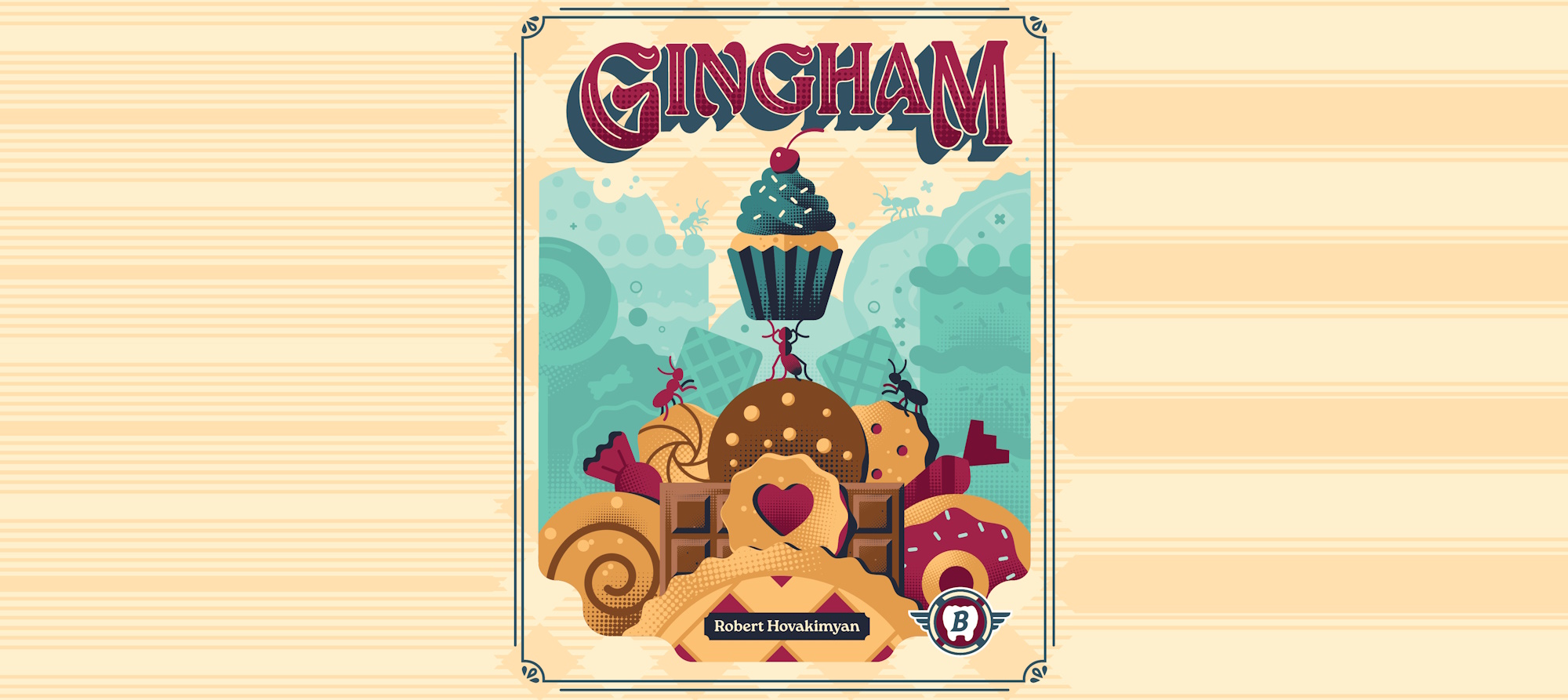
Yesterday I previewed Gazebo, a forthcoming remake of Reiner Knizia’s Qin. In the usual Bitewing tradition, Gazebo has been partnered with another game, one it broadly shares a setting and aesthetic with. That game is Gingham. Created by Robert Hovakimyan, whose titles Bebop and Shuffle and Swing I covered around this time last year, Gingham also takes us to the park. In a few ways, though, it’s less of a spiritual partner to Gazebo than its spiritual opposite.

I’ve been to that picnic.
Right away, Gingham outs itself as distinct from Gazebo through its handling of its appointed setting. Where Gazebo was abstract — achingly so, its cozy vibe divorced from its ruthless sniping for position — Gingham carries itself with a marked concreteness. Someone has left a picnic blanket on the grass, scattered with cookie crumbs and half-eaten cherries. Perhaps it was abandoned amid one of Gazebo’s tumultuous pavilion turnovers. Either way, the local anthills have emptied onto the scene. Now each queen is commanding her workers to pile up the goods, chow down on any errant sugar cubes, and absorb all those sweet, sweet calories.
What follows is nasty, transactional, and may leave some bruised egos in its wake. Then again, that’s more or less what one expects from competing colonies of ants.
The other big contrast with Gazebo is that Gingham is, for lack of a better descriptor, a big old weirdo. It took me three sessions before I came to terms with the particulars of its placements and scoring enough to reliably eke out a strategy. That isn’t because it’s complicated. But it lacks the intuitiveness that marks a Knizia design, producing a tangled and entangling play-space that’s certainly clever, but also sometimes requires a bit of squinting to clarify everyone’s relative position.
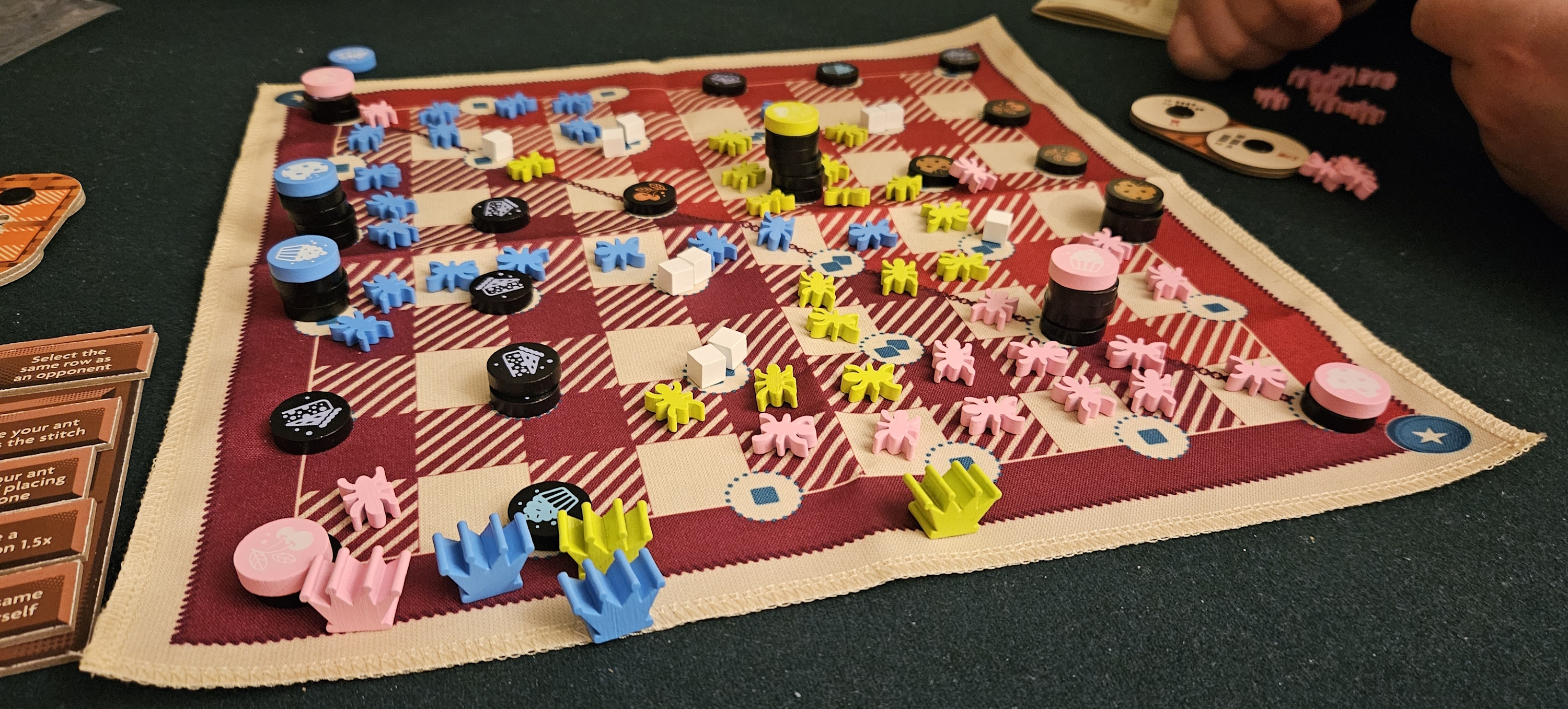
Lining up queens to take actions.
Let’s begin with your objectives. There are three main ways to score points in Gingham. None of them are straightforward.
First, moving food. When the game begins, the blanket is scattered with discarded foodstuffs, one per intersection, spread between four or five types depending on player count. Whenever you string ants between similar crumbs, those tiles are shifted into a single pile. Along the way, you score one point for each ant in the chain between points A and B.
This is easier said than done. For one thing, you’ve probably already deduced that there’s some tension between crafting direct chains of ants, which will score early, and arranging circuitous, winding trails that will score greater amounts. Yes indeed, and when rival ants can bump yours off their fabric squares, that makes circuitous, winding trails a risky proposition indeed.
More than that, placing ants is a stickier proposition than you might imagine. The entire turn structure of Gingham is an odd duck. Players place their queens along one edge of the blanket to determine where their ants can go, which later becomes the turn order for the next round of placements. It’s easiest to think of this as a dual bid. Each queen determines potential placements, and placing your queen farther from the “seam” of the blanket affords greater latitude in where your ants can be deployed. But being located closer to the seam of the blanket means you’ll go earlier in turn order next time, potentially even choosing which side of the blanket will get priority. Like everything else in Gingham, it’s an intriguing but knotty headspace, offering both short- and long-term anxieties.
Meanwhile, your placements can be contested by rival ants. Bumping an ant is never an easy decision, since the bumped ant then gets placed on any empty space by its owner. But that space must be empty — there’s no chaining bumps here — and it’s often worthwhile to disrupt a chain of ants. That goes double once ants begin clustering around one of those heaped-up piles of food. The second way to score is by surrounding such a pile, which allows you to place a token over the top of it, earning points both now and at the end of the game. Provided it hasn’t been stolen away, that is. Piles on the corner or edges of the blanket are easier to claim, but also easier to steal. Another tension to consider.
Finally, there are sugar cubes. These appear on the blanket whenever food is moved, left in the departed token’s wake. From that point onward, they can be nabbed by any ant placed next to them. These are worth points when the game ends, but can also be spent to activate various bonuses from a shifting menu of options.

I wish my body used sugar this way.
At this point, I wish I could release a long-held exhale of relief, but there’s more to say.
That bonus menu, for instance. It’s important. Maybe even crucial. By spending sugar, you can break the usual rules. Maybe your queen will plop herself onto the same row as an opponent, doubling how many ants will be placed on their column. Maybe you’ll let an ant cross the blanket’s stitch, venturing beyond their usual boundary. In the game’s flimsiest offering, you can multiply the points earned by chaining ants by 1.5, a surprisingly inelegant product for a game like this. When a bonus is used, it shifts on the menu, landing itself in the most expensive slot and only shifting down as others are purchased. This often prices a bonus out of consideration, what with the relative rarity of sugar cubes, adding yet another layer of bids to a game that is rapidly cluttering itself with things to think about.
Now I can permit myself that breath. Whew.
As you’ve probably already deduced, Gingham is sometimes too stringy for its own good. Each individual slice of the pie is a mouthful on its own. The entangled placements and turn-order bids presented by the queens. The conflicting chains and claims of everybody’s ants. The shifting bonuses from sugar cubes. Any one of these might have produced an elegant title on its own. Side by side, you get a razzleberry pecan rhubarb ham tart.
A taste of its own, perhaps, one gradually acquired, but complementing all the same. As I noted up front, it took me three plays to come to terms with Gingham, but terms were arrived upon nonetheless. At its best, Gingham is gripping. In practice, it plays almost like a series of heists. Early on, your ants are tentative, laying down stakes and making a few short chains. As piles come together, that’s when the potential for theft becomes clear. In our sternest session, a particular cookie pile was stolen from one player, jostled between its stealer and a third party, then finally absconded back by its original owner, who strove to claim its juicy points but ultimately failed to chow down on all those crumbs before the game ended.
The winner of that session, it should be said, was not involved in any of those heists and counter-heists. They spent the entire session working around the edges, heaping up modest piles of pie, cupcakes, and cherries, scoring small in three categories rather than going all-in on cookies. It was a tense and exciting play, all four players in contention to win, filled with reversals and incursions. It’s just that it took some learning before we knew what we were doing.
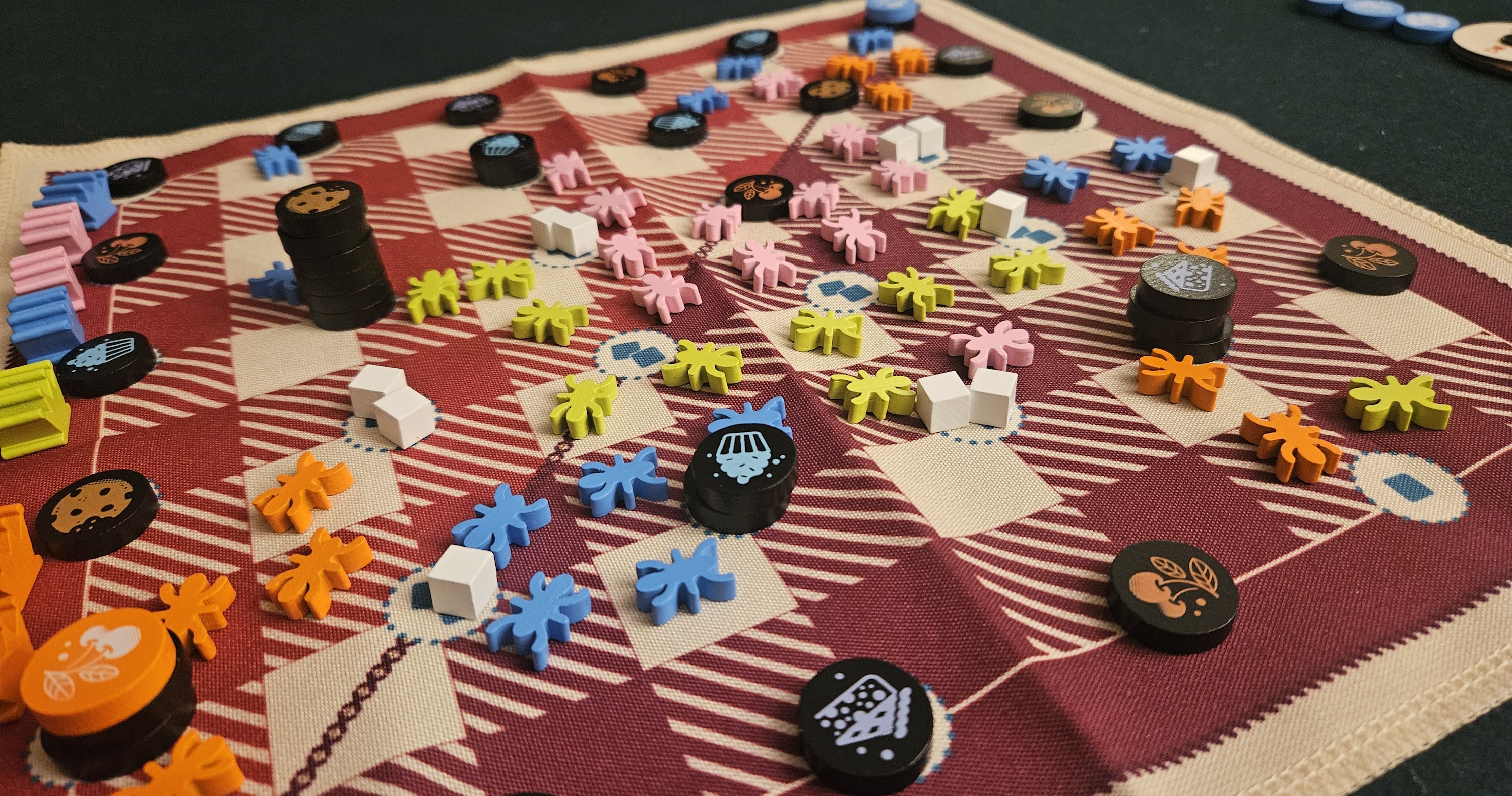
The Great Cookie Heist.
Again, Gingham offers a counterpoint to Gazebo. It lacks Knizia’s elegance, his keen eye for reducing a game to its essential core, instead heaping together a pile of crumbs from various sources — any one of which might have produced plenty of game on its own.
But those crumbs are enough for a modest feast. Once again, Hovakimyan reveals himself as a designer with big ideas on his mind. Where I love Gazebo for its directness, I appreciate Gingham for its circuitous, winding trails, its dense visual language, and the ability to steal a teetering pile of cookies from my friends. I might even appreciate that it lets me multiply a scoring value by one-point-five.
All right, let’s not go nuts. Gingham’s edges show the occasional fray. The good news is that I’m excited to continue pulling on its errant threads.
(If what I’m doing at Space-Biff! is valuable to you in some way, please consider dropping by my Patreon campaign or Ko-fi. Right now, supporters can read my quarterly report on all things board games!)
A temporary prototype of Gingham was provided by the publisher.
Posted on April 22, 2025, in Board Game and tagged Bitewing Games, Board Games, Gingham. Bookmark the permalink. 5 Comments.

 SPACE-BIFF!
Came in really expecting something inspired by the classic science fiction novel. This is interesting too though.
The ants get superpowers from the sugar, so it’s more or less the same thing! (Sorta.)
So it’s kinda “Hansa Teutonica meets Passtally”? Never thought I’d see an intersection of those two, but it does make a certain sense the more I think about it.
This seems to be a recurring theme with Robert Hovakimyan’s work – riffing on Knizia, but adding a layer (or two) of unintuitive complexity not seen in the Good Doctor’s designs.
I’m wondering how much of the negative impression stems from Gingham being compared side by side to Gazebo. The latter seems like a hugely successful redesign of the original. Perhaps Dan would’ve seen the former in a better light if it wasn’t being compared to a seminal achievement in refinement of released titles, out of all people Knizia’s to boot.
It seems evident to me that Hovakimyan, judging from his designer diary articles, wasn’t aiming to riff on Knizia at all with Gingham. I feel that the fingerprint is much closer to Hovakimyan’s authentic sensibilities. If you compare it to Shuffle & Swing, his other major Bitewing title, you might notice a commonality of wiring together disparate mechanical engines to produce at first puzzling, but eventually intuitive game cycles. Even if streamlined, something along the lines of nu-euro that Dan announced he doesn’t fancy. Gingham is indeed fundamentally different and I find it a disservice being compared to a super-streamlined abstract strategy Knizia is revered for. (Not that this is Dan’s fault, what other option was there left from Bitewing?)