Gazebo Takes It on the Qin

Right when I’d sworn off writing about any more Bitewing Knizias, they went and got the rights to Qin.
Long out of print, Qin — pronounced “chin,” for those among us who keep stumbling over that Q — is another Reiner Knizia tile-layer, one that effortlessly showcases the Good Doctor’s ability to generate hard stares over a handful of non-matching colors. Now redubbed Gazebo, the original game was about unifying the warring polities of pre-imperial China. In my mind it’s still about that, because merging garden plots doesn’t quite communicate just how ruthless this thing can be.

The fabric map and dominoes are pleasant on the fingers.
Welcome to Warring States Period China a tranquil garden. See? Not the same thing. I guess today isn’t the day that we beat the “Knizia is themeless” allegations.
But I’ll go ahead and say it: winning this game is easier if you think of yourself as a warlord. Your goal has a simplicity only reserved for the vicious. Everybody begins with a certain number of gazebos. In my case, these were wooden discs. In the finished game, they’ll apparently be plastic pavilions. Either way, your objective is to place all of your pieces on the board before anyone else. Barring that, to have the most gazebos on the table when there’s no more room to place anything else.
To accomplish this goal, you place dominoes to make solid blocks of color. These are called “nooks,” all cozy-like, but really they are bands of territory patched together through blood and shrewdness. Making a nook lets you place a gazebo on it, but of course there’s a catch. Dominoes can only be placed next to dominoes that are already on the board, starkly limiting your options. Once there are five or more squares in a nook, it becomes, get this, a “big nook,” capable of holding two gazebos. Much like the swaths of color in Tigris & Euphrates, competing nooks can be bridged, letting one player swallow up the other, but big nooks are immune to these takeovers. Thus one of Gazebo’s core tensions. Either you expand rapidly, establishing as many vulnerable nooks as possible and hoping not to lose too many, or you take measured strides across the map, protecting your flanks with big nooks.
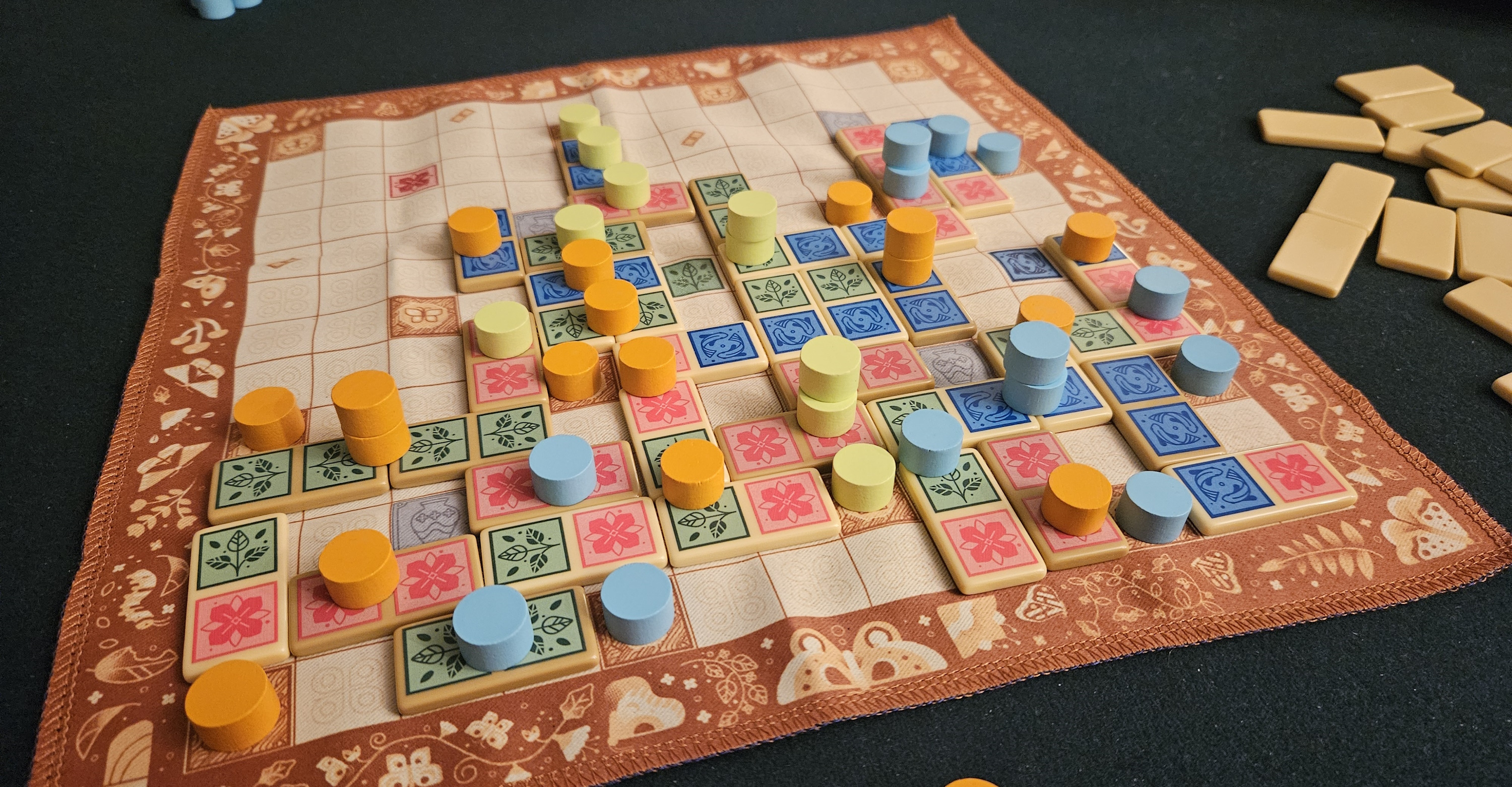
Gazebo uses elevation and density to communicate player strength.
Big nooks. My goodness. I cannot talk about this game in these terms.
To explain why, I want to talk about the maps. There are four in total, two in the main box and two as an expansion, and each has its own features. Every map features what this reprint calls “patios,” spots where gardeners compete to place bonus gazebos. By controlling nooks next to these patios, you gain control over them, potentially letting you place an extra gazebo that turn.
In practice, though, these patios are not anything like patios. They are like besieged cities, ripe with plunder and political import. Controlling patios is crucial to your success, and different maps emphasize their relative value. The first map, for example, has special “fancy patios,” which are large enough to hold two gazebos. Others have “elevated patios,” which can only be conquered when you control at least two gazebos next to them. Regardless of the particulars, patios represent instant flashpoints in the Garden Wars. Rival players can strip you of ownership by establishing their own adjacent gazebos. This produces huge swings, your pieces flying off the board and being replaced by foes.
It’s brutal, in other words. It feels like war, all careful posturing and sudden reversals. There are feints in Gazebo, moments when a single domino can intrude on an opponent’s territory and force them to respond with a blocking maneuver. There are invasions, when a single placement annexes a neighboring nook and thus seizes a patio. It’s opportunistic and nasty. It’s Knizia at his best, not only as a creator of mechanisms, but as an abstractionist.
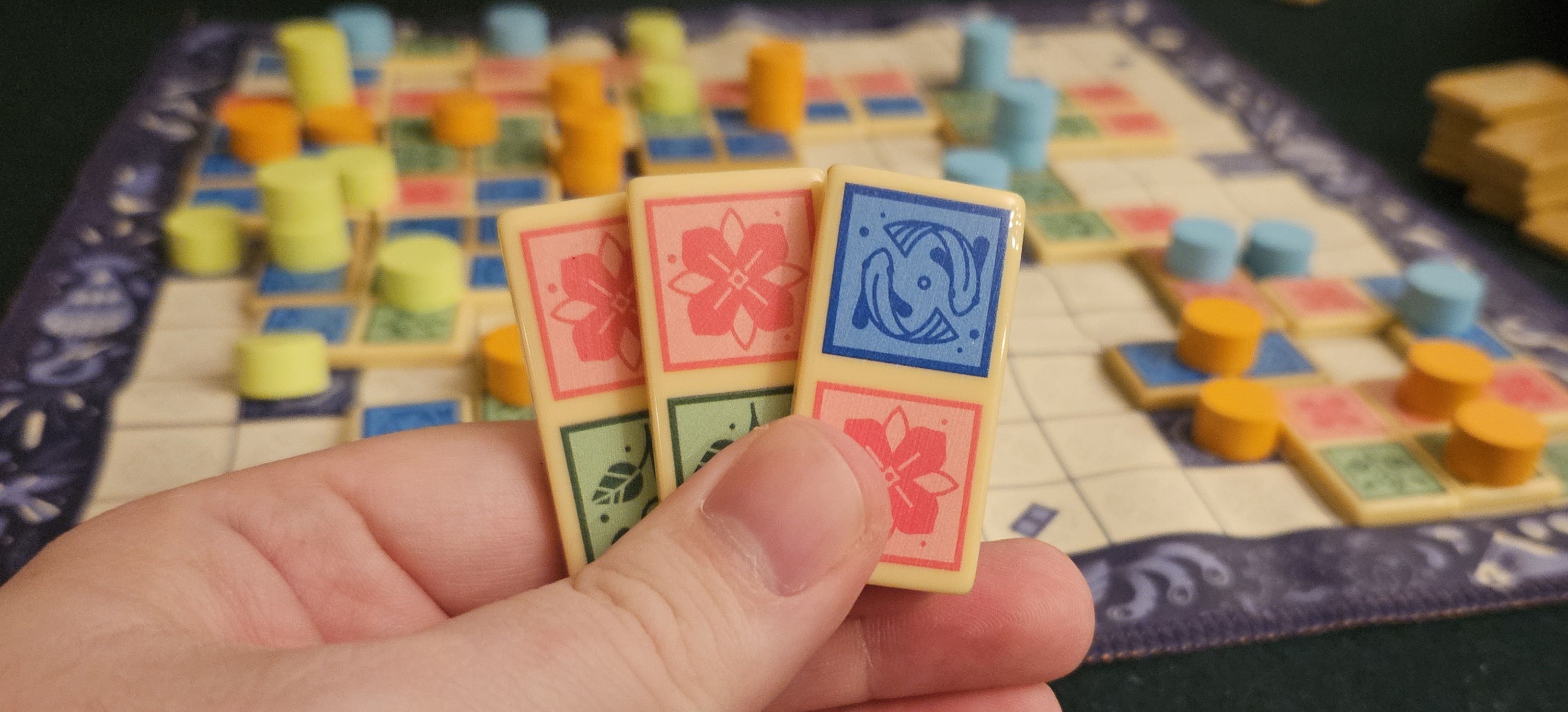
Click. Clack. Like I’m a villain in a Bond movie.
The beautiful thing about Gazebo is… well, there are many beautiful things about it. But the one that leaps off the table, to me, is the way it resembles one of those time-lapse maps of an empire’s expanding and shifting borders. There’s an elegance here, true, but there’s a hunger to it as well. I’m poking fun at Gazebo when I talk about its wacky new setting, but I’m also a little bit serious. This game demands a certain headspace. Don’t be fooled by its fine Easter dress. That’s armor, baby.
Within that proper headspace, Gazebo is hallmark Knizia. The rules are dead simple, but the strategies that arise from them are anything but straightforward. Some of that depends on its particulars. Which map you’re playing. How many players you’ve gathered. At two, the game is a cutthroat duel. With three or four, there’s some politicking to be done.
Either way, there’s a cutting sharpness to each placement. I’m often impressed by designs that allow players to feel smart. Knizia often does one better. Gazebo, like Qin before it, lets players feel smart because it lets players be smart. It compresses its landscape to a discrete number of decisions. There are only three colors. Only so many spots to place those dominoes. Only one edge case when it comes to disallowed placements. But within that slender ruleset, there’s an ocean of possibility. A battlefield of possibility. It feels good to play. Even better to win.

Each map has its own essential texture.
So, yes, taking the warring states of Qin and transforming them into rival botanical landscapers is somewhat akin to adapting Moby Dick into a killer whale playing with a basketball. Still. Gazebo is Knizia firing on all cylinders, offering a tile-placer that’s simpler than T&E but no less shrewd.
Now if you’ll excuse me, my neighbor has a gazebo I intend to burn to the ground.
(If what I’m doing at Space-Biff! is valuable to you in some way, please consider dropping by my Patreon campaign or Ko-fi. Right now, supporters can read my quarterly report on all things board games!)
A temporary prototype of Gazebo was provided by the publisher.
Posted on April 21, 2025, in Board Game and tagged Bitewing Games, Board Games, Gazebo. Bookmark the permalink. 12 Comments.

 SPACE-BIFF!
I had already seen this and be amazed about how bad the new theme fits the game and how much less interesting it is compared to Qin. I mean, I understand wanting to do a cozy game about tranquil stuff, but this? It really turned me off the KS (apart from all the myriad other considerations that can turn one off KSs)
Yeah. It’s a really weird setting for the game. Cutthroat gameplay, cozy vibes.
You kind of got me interested! Have you played the old version? Would you prefer it? Considering it’s available second hand for ~20€ here in Germany
Despite preferring the original setting, I really like Nick’s sense for production. The cloth maps and dominoes feel great. As for ancient China… I can squint. =)
That’s what I thought… The new material looks neat. I once bought the original printing of modern art, but I just couldn’t convince myself to bring it to the table more than once
Except in this case Qin is already quite pretty as well. The pagodas are very nice. Granted, the box is size-ably bigger, to fit the board, but I prefer that to a cloth board which can wrinkle easily.
Overall, I am glad that game is getting a new lease of life despite the retheme. I think casual folks will gravitate toward the new title vs. a hard to pronounce title like Qin. I still own the original and curious how the new format plays out.
I guess they were adverse to using a brutal, warring theme. On the other hand, one can easily imagine it as warring states, only abstractly depicted. And the production looks really sweet! I feel there’s a lack of good small, no-card up to 4-player games on the market, so I’m really looking forward to Gazebo, despite not having played or known Qin. Thanks for the review!
I for one am thrilled by the re-theme as there was no way in hell to get my wife to play an intimidating game like T&E with me. However, a ‘charming’ game of dominoes might just do the trick!
Important to note that this is not just a retheme and a new print run, but the game has been quite substantially reworked.
In the original, mono-colored tiles were stronger and drawing them was just better than drawing dual-tiles. Now mono-tiles are limited to their own draw pile so luck-factor is much smaller.
So even if one doesn’t like the new theme, the new game is (hopefully/probably) better and worth a look.
Indeed, it looks like Knizia’s extensive collaboration with Bitewing produced a T&E for everyone.
I hope Gazebo eventually gets to have a wider release. It might become a gateway staple for the kind of people who would enjoy the abstract euro classics of old, but get put off by their drab presentation, apparent complexity and out-of-print-ness.
Pingback: Gingham Takes a Roadside Picnic | SPACE-BIFF!