Sharkboy vs. Octoboss

Carl Robinson is onto something with Kelp: Shark vs. Octopus. Hidden movement games have always been asymmetrical; there’s no hide-and-seek without both hiders and seekers. But in Kelp, that asymmetry is pushed in exciting new directions.
The concept will make sense to anybody who’s so much as glimpsed a nature documentary. One player becomes the Shark, a sleek killing machine running on pure reflex. The other is the Octopus, doing its darnedest to rustle up some snacks without becoming one. It’s a battle of muscle versus wits, one evolutionary path pitted against another to determine which is the more viable.
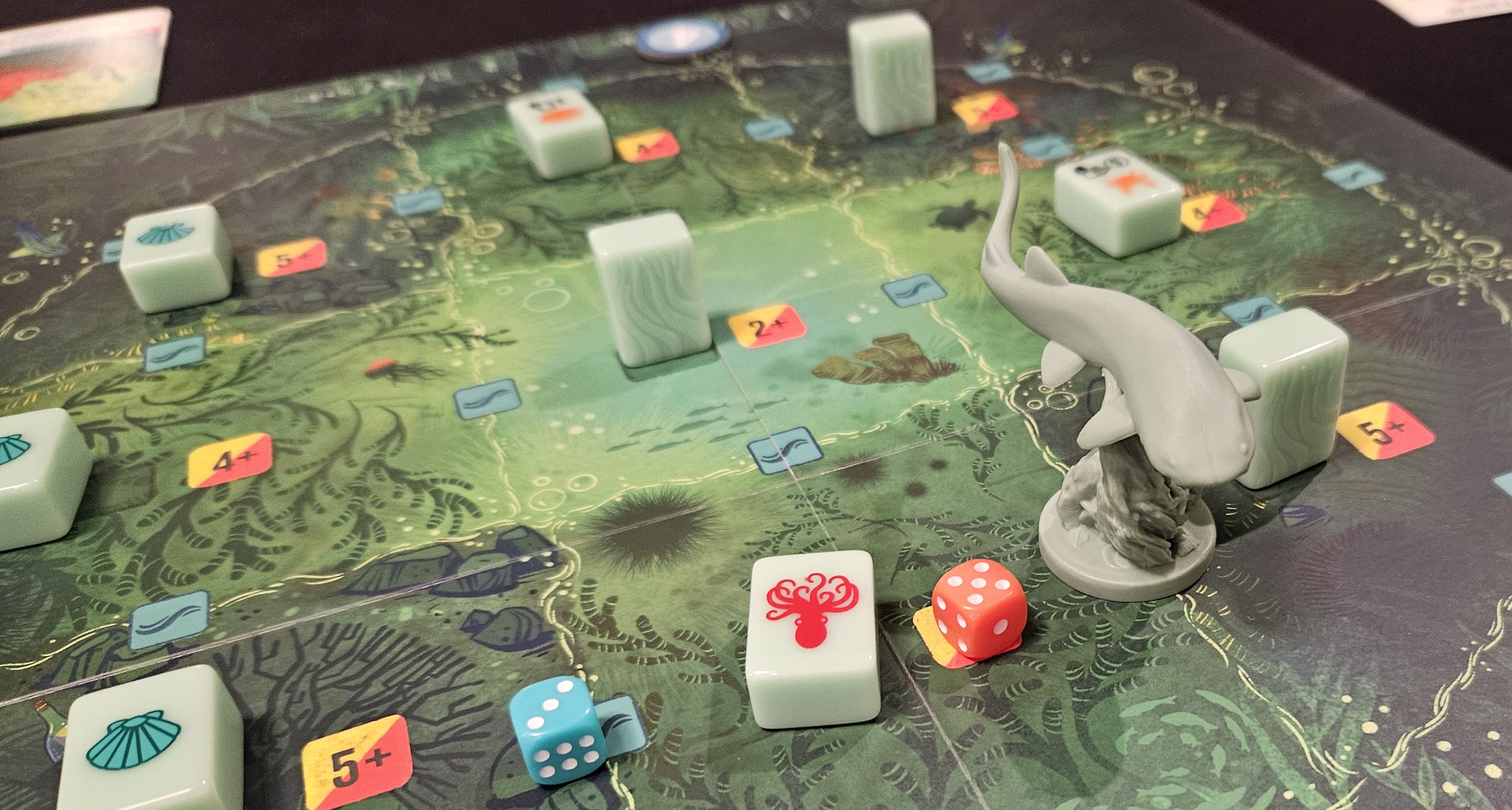
Cue the theme music. You know the one.
Right away, the trappings of the genre are put on full display. This is a lean, mean hidden-movement game, not only in terms of mechanisms, which are actually rather robust, but in terms of geography and wiggle room. Where some exemplars of the genre offer wide-open playgrounds, this kelp forest is unusually cramped. The board is limited to nine spaces, a mere three-by-three grid. Worse — if you’re the Octopus, anyway — the Shark doesn’t inhabit those spaces but rather borders them, placing it within chomping distance of two regions at once. Sorry, little Octopus. Get used to that sinking feeling.
When it comes to things like movement and attacks, the gist is easy enough to sum up. As the Octopus, you’re playing a deck-builder and shell game, shifting hidden blocks between those nine spaces while also learning new skills to better slink, camouflage, and hunt smaller prey. As the Shark, you’re playing a bag-building and dice-rolling game, riding the currents and prodding your nose into places it is almost certainly unwelcome. Simple.
But the real appeal of Kelp lies in the details. Take the Octopus, for example. Rather than inhabiting the board as a standee, the Octopus is one block among many. It blends into the backdrop, rubbing tentacles with shells, crustaceans, maybe the occasional trap laid for the Shark. It exists as an extension of the kelp forest, taking refuge in those stalks and fronds.
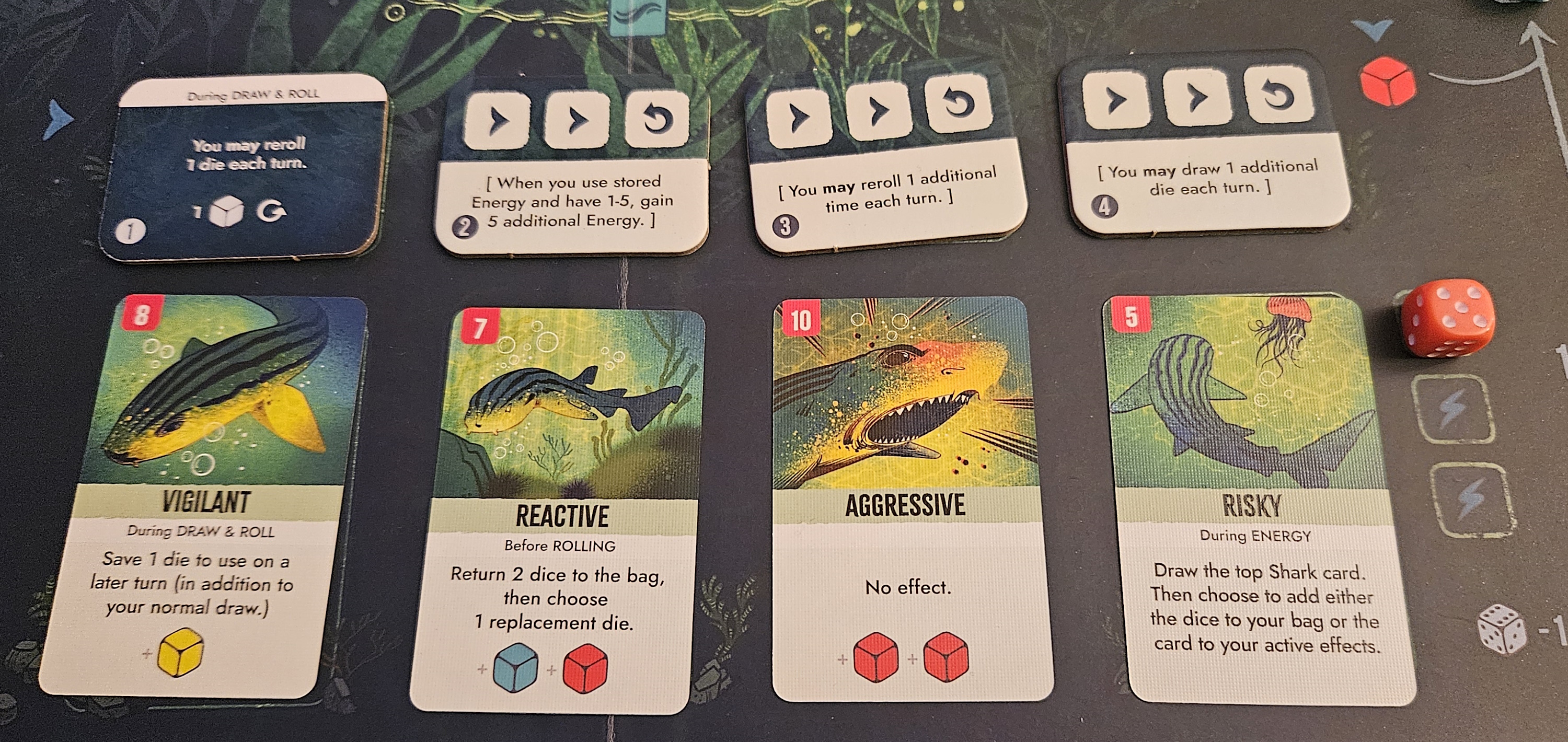
The Shark is all reflex, but you can hone those reflexes over time.
That said, the Octopus exists apart from its habitat as well. There are two paths to victory for the Octopus. Either it exhausts the Shark, remaining concealed long enough that the Shark gives up and… I dunno, goes wherever sharks go. Or it finds and consumes four prey. This is dangerous, however, as the Octopus will need to briefly reveal both itself and its morning meal, ringing the dinner bell for the Shark and bringing it rushing over.
In practice, it’s more or less essential to pursue some combination of these two avenues, peeking out to draw attention so that the Shark doesn’t just glide around forever. The Octopus is both hunter and hunted, and must use its superior brainpower to succeed. This is no small task. New cards can be purchased into your deck, but these require the Octopus to reveal blocks. Those blocks can be hidden again, but must be regularly swapped or shuffled if the Octopus wants to keep the Shark from narrowing its buffet options too quickly. Meanwhile, the Octopus has options. It can see the Shark, letting it hide in hard-to-break cover or only reveal itself when the Shark is facing the other direction.
Where the Octopus is afforded quite a bit of control over its actions, limited mostly by the sequence of cards it draws from its deck, the Shark runs on instinct. Each turn, the Shark draws a pair of dice from its bag and rolls them. Depending on the color of these dice, the Shark can either ride the currents to move around the map faster, nuzzle the kelp for a glimpse of what’s hidden behind those blocks, or lash out in a burst of violence. It’s possible, with some blend of dice-luck and card-luck, to kill the Octopus outright, even fairly early in the game.
This chanciness is, unsurprisingly, a difficult pill to swallow. It’s also what sets Kelp apart from so many of its peers. Hidden movement games have always grappled with questions of chance versus determinism, between happenstance and emphasizing the logic and/or smarts of its players. Kelp tilts the balance toward luck, and in the process puts both of its protagonists through their own crucibles. For the Octopus there are shuffles, when multiple blocks are slipped into the bag and dealt back out onto the table. There’s no knowing whether you’ll slip out of sight or wind up right back in your starting position. For the Shark, it’s the whole bag-building exercise, the right dice never seeming to appear at the right moment. For both, there’s a card-playing minigame when the Shark catches the Octopus, which can result in the latter escaping or becoming fish food. The game’s systems offer chance garnish atop a platter of chance, with a side course of chance for those who want some variety.

The Octopus learns new skills with experience.
There are two ways of looking at this. The first is that for a weathered hidden movement veteran like myself, this bombardment of random inputs and outputs alike often strips away any inkling of strong agency. There are still choices to make, but they’re closer to hedged bets than, say, true bluffs. As the Octopus — which, it should be noted, is the harder of the game’s roles to play well — I can fill my deck with powerful moves and booby-trap the board, but coaxing the Shark into a fatal error still requires a deft hand. Eight deft hands.
On the other side of the coin, this also heightens a different range of emotions than these sorts of games usually tickle. Where many hidden movement games lean hard into logic, probability, and deduction, Kelp manages to feel more organic. I’m reminded of the persnickety line-of-sight rules in something like Specter Ops or the icon-counting of Mind MGMT. These are both tremendous games, some of the best in the genre, but they operate according to an impersonal skillset, asking the players to crunch movement distances and peek around corners, to assess evidence with abacus-like precision, to sketch little flowcharts of possible escape vectors.
Kelp sidles out of the path of the avalanche almost entirely. It’s more about acting on gut feelings, on jumbling information or trying to blur one’s eyes in order to better catch any movement. As the Shark in particular, it requires a constant revolt against the tyranny of your in-game limbic system, putting those instincts to use as they float to the surface.
To be clear, I still prefer the other mode. Kelp is lean and vicious. Sometimes overly so, especially for that poor Octopus. But it grows weaker with experience. As its players learn its tricks — which upgrades are valuable, how to ride the currents to arrive almost anywhere at a moment’s notice, whether to add more dice to your pool now or later — its competition frays around the edges. Learning the game is a cinch, but so, in a sense, is over-learning it. It thrives in that middle ground, after the systems have clarified but before they’ve grown so transparent that the Shark can see the Octopus on the other side. Sadly, as crests go, it doesn’t last long.

Don’t move don’t move don’t move…
While it lasts, however, there’s something good and primal here. Kelp offers a more immediate hidden movement game, one that thrums with its hunter’s cold blood in place of the cold calculations that usually dominate the form. It’s sleek, deadly, and short-lived. Like a Shark. Like an Octopus.
(If what I’m doing at Space-Biff! is valuable to you in some way, please consider dropping by my Patreon campaign or Ko-fi. Right now, supporters can read big stonking essays on the movies and video games I experienced in 2024.)
A complimentary copy of Kelp: Shark vs. Octopus was provided by the publisher.
Posted on March 13, 2025, in Board Game and tagged Board Games, Kelp: Shark vs. Octopus, Wonderbow Games. Bookmark the permalink. 3 Comments.

 SPACE-BIFF!
Thank you for this! At the time they were running their crowdfunding campaign I was interested in it, but the marketing was too slick. It felt like they were trying to appeal to someone who wasn’t like me (or anyone I enjoyed playing games with, for that matter). It looked pretty and the concept looked sound, but I held off. I’m very glad to hear the game itself is as good as it looked when I first saw it.
Happy to help, and thanks for reading!
Pingback: Burned Notice | SPACE-BIFF!