Strategic Prayer

Faith. On a few occasions, I’ve written about the prospect of board games as expressions of belief. More than one designer has made the attempt, usually by offering some perspective on history, as in The Acts of the Evangelists, The Mission, and Nicaea, but not so often by reflecting on individual devotion. I suppose Ierusalem: Anno Domini is the closest I’ve seen, with its sacramental closeness, but that one was so burdened by its gamier elements that any deeper relationship was washed out with the flotsam.
Imagine my surprise when such a game appeared on my table, not born of my native Judeo-Christian education or background, but courtesy of the third branch of our shared family tree. Designed by Ahmad Salahuddin, Usolli is about performing salah, the five daily prayers of Islam, amid the hustle and bustle of modern life. It’s lighthearted but earnest, sweet and funny and focused wholly on personal action. And although I have a few hangups about Usolli as a game, I appreciate what Salahuddin is trying to do here.
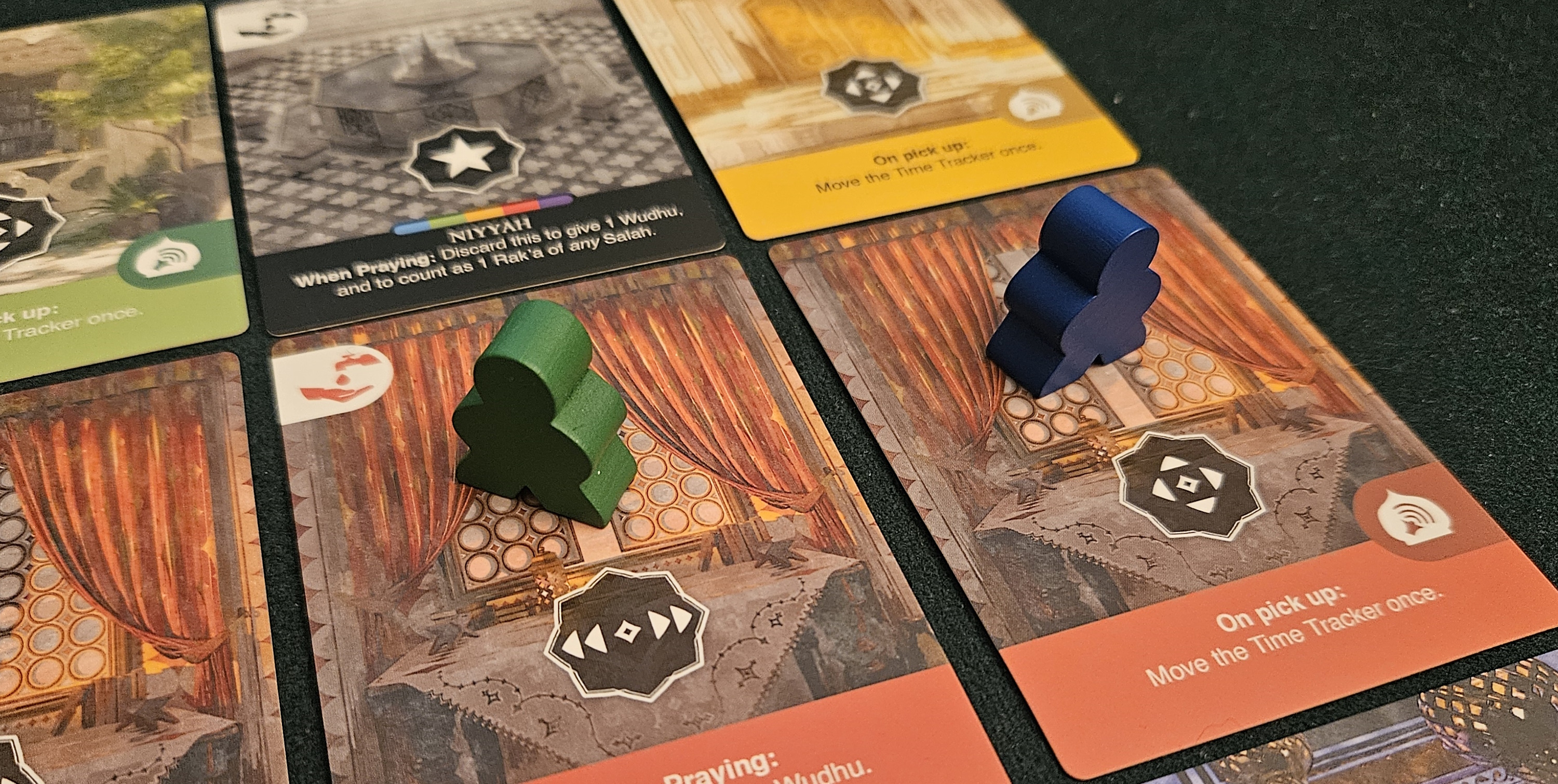
Collecting raka’at to use in my salah.
Like a Sunday school lesson, Usolli begins with the basics. Set aside the actual prayers; those will come later. For now, the nitty-gritty of each turn revolves around collecting raka’at, the discrete components — bows, prostrations, phrases — that must be strung together to form a complete prayer.
The process for gathering these raka’at reveals Usolli at its gamiest. Your pawn stands atop the rak’a cards themselves. Each one prescribes some form of movement — sliding left and right, moving in any orthogonal direction, rare wilds that let you jump anywhere in the display. You shift your pawn to a new position and then claim a card from those that now surround you. At any given time, you’re hunting for suits that correspond to the five prayers, plus the necessary icons for washing your hands, drawing prayer beads, or maybe, in the advanced mode, for combining certain prayers into one mega-prayer.
As methods for collecting cards go, this one is deliberately restrictive. The card you’re standing on might hedge you into a corner, while nearby pawns prevent you from stepping where you like. Worse, you’re on the clock. Certain cards move the timer forward, threatening to blitz past the proscribed time for each prayer. There are methods for getting around more easily, but this usually requires you to shed another rak’a card. Which is no small deal, because praying is expensive.
Okay, maybe that isn’t the best phrasing. I’ll try again. Praying is a huge imposition on the integrity of my hand of cards.
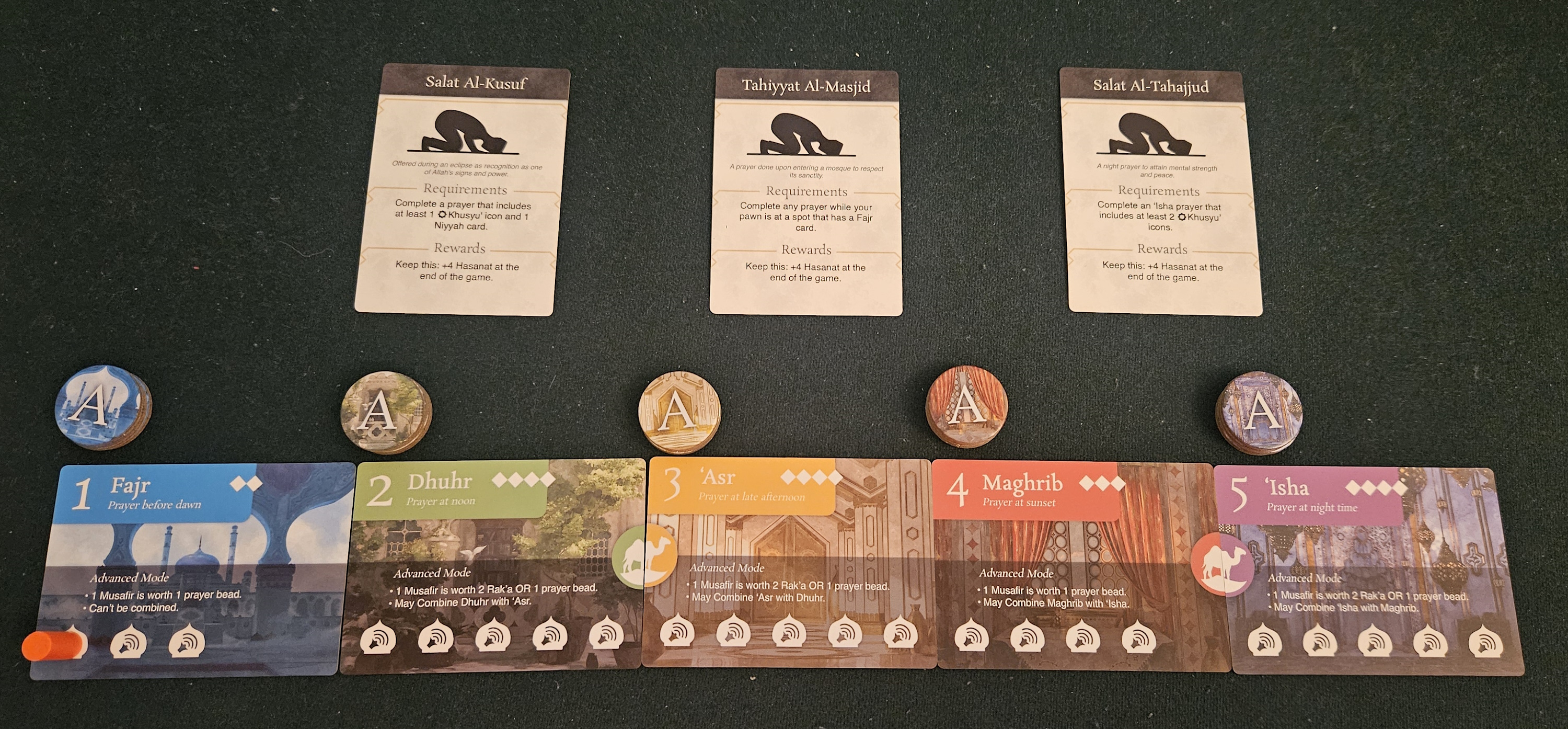
The five daily prayers.
At absolute best, a prayer requires two raka’at. Either it will be for fajr, the early morning prayer, or you’ll have collected a rare musafir icon to double up on the effectiveness of the card being used for dhuhr, ‘asr, or ‘isha. More often, a complete prayer requires four or even five cards. You turn them in, receive a scoring token, and the day gets closer to ending. The day’s conclusion, by the way, approaches at a shocking pace. Certain cards move it forward, but so too do completed prayers. Squeezing in all five prayers is not only challenging, but borderline impossible.
Look, I’m not going to pretend to know much about Islamic practice. The faith tradition of my youth was considered somewhat radical by most standards, but the closest thing we had to raka’at were stock phrases like “moisture,” “nourish and strengthen,” and “every fiber of my being.” Prayers were intended as reverent, of course, but they could also be flippant, often never more so than when somebody was acting overly reverential.
With that in mind, playing Usolli elicited two major thoughts.
The first is that salah seems like a rather time-consuming practice indeed, one that requires dedication and careful observance. Even if a prayer doesn’t demand a large chunk of time — I understand one might only require five or ten minutes — the process isn’t only about the prayer itself, but rather about structuring one’s day around that continual observance. The challenge doesn’t lie in finding the right cards. Given enough time, you’ll collect the necessary raka’at. Instead, the challenge arises from the game’s pacing. Even with only two players, there never seems to be enough time to squeeze everything in. With more, the pace becomes truly dizzying. At my best, I think I’ve managed three prayers. With four people at the table — which, to be frank, results in sessions that are far too brisk — I’m lucky to get in two. More often than not, by the time I’m ready for fajr, it’s already time for ‘asr. If that isn’t a statement on the distracting pace of modern life, I don’t know what is.
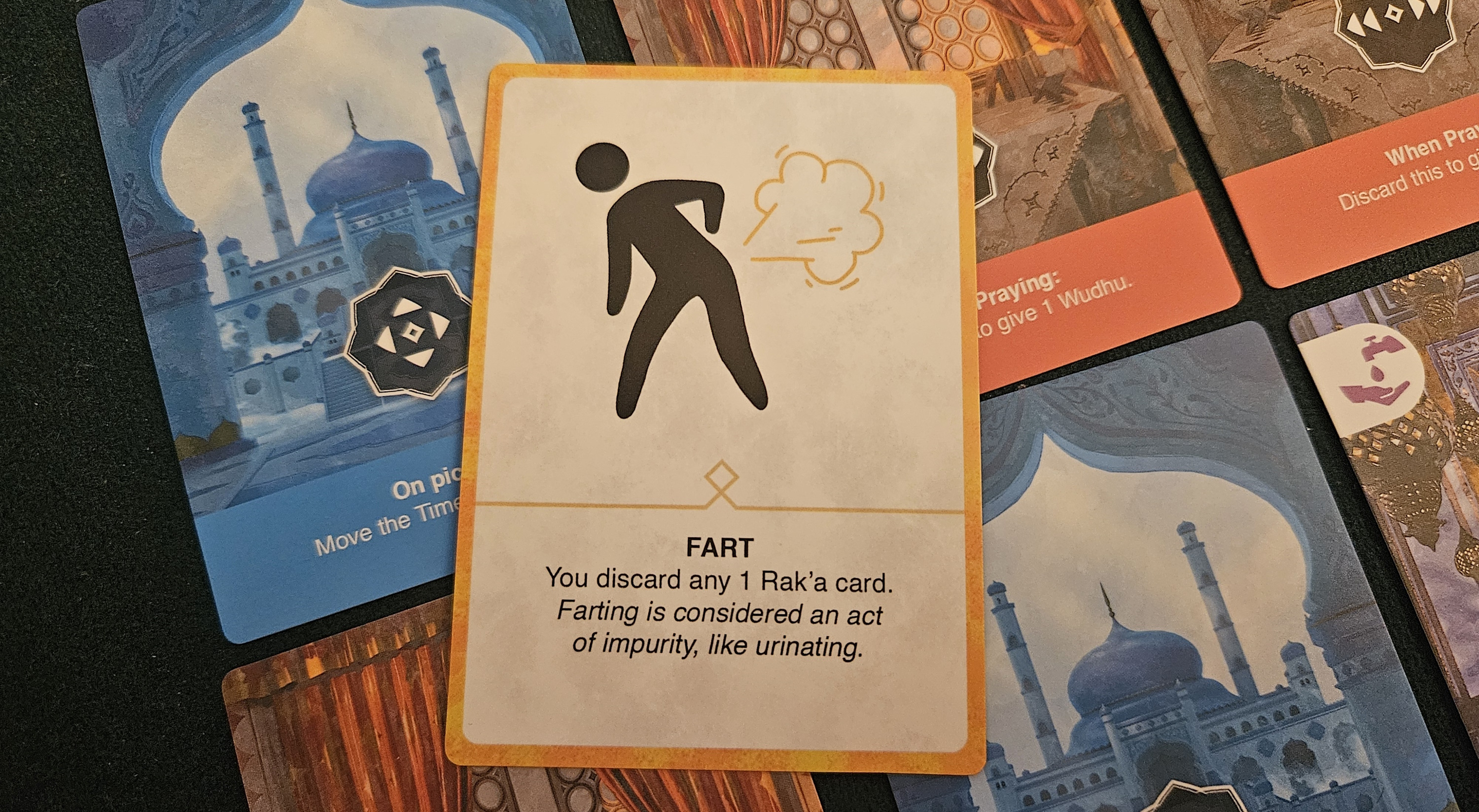
I love this.
Honestly, though, this approach is refreshing. Unlike some of the Christian prototypes I’ve suffered through, Usolli doesn’t present its rituals as easy or cheap. The game never puts its hands on its hips as if to say, “See? It’s all so simple! Anyone can do it!” Instead, it seems to acknowledge that, yes, proper observance of salah poses a real challenge. You will have to plan your day around those prayers. You will have to decide when an exception can be made. You will have to prioritize your faith.
At the same time, Usolli doesn’t treat its skipped prayers as failures. There’s no penalty or negative implication, only points you haven’t accrued. Despite being a game about proper observance, it doesn’t come across as a scold so much as an encouraging friend.
Along those lines, there’s an interesting meditation on the limits of human agency if you squint hard enough. Sometimes when collecting raka’at, you’ll be required to draw an event card. These might produce encouraging passages from the Quran, letting you draw an extra card or make a tactical swap on the display. But they might also result in distractions. Your phone rings. You oversleep. Your mind races. Your butt farts. Interestingly, these are occurrences that happen to you, rather than being presented as acts you choose to perform within the game-space.
Of course, it’s impossible to say whether this indicates something about Usolli’s perspective on the tension between Allah’s decrees and human free will. There are limits to what this sort of game can say with its assortment of mechanisms and icons. Actual raka’at, I have been led to understand, are not selected from a four-by-three display of possible gestures and utterances. But in practice, as an artifact on the table, Usolli presents itself as non-judgemental, even gently humorous. Sometimes butts gotta fart, it seems to say. Sometimes you miss a prayer.
Or maybe I’m just reading my own crap into the game. Probably. Moisture, please nourish and strengthen these body-fibers.
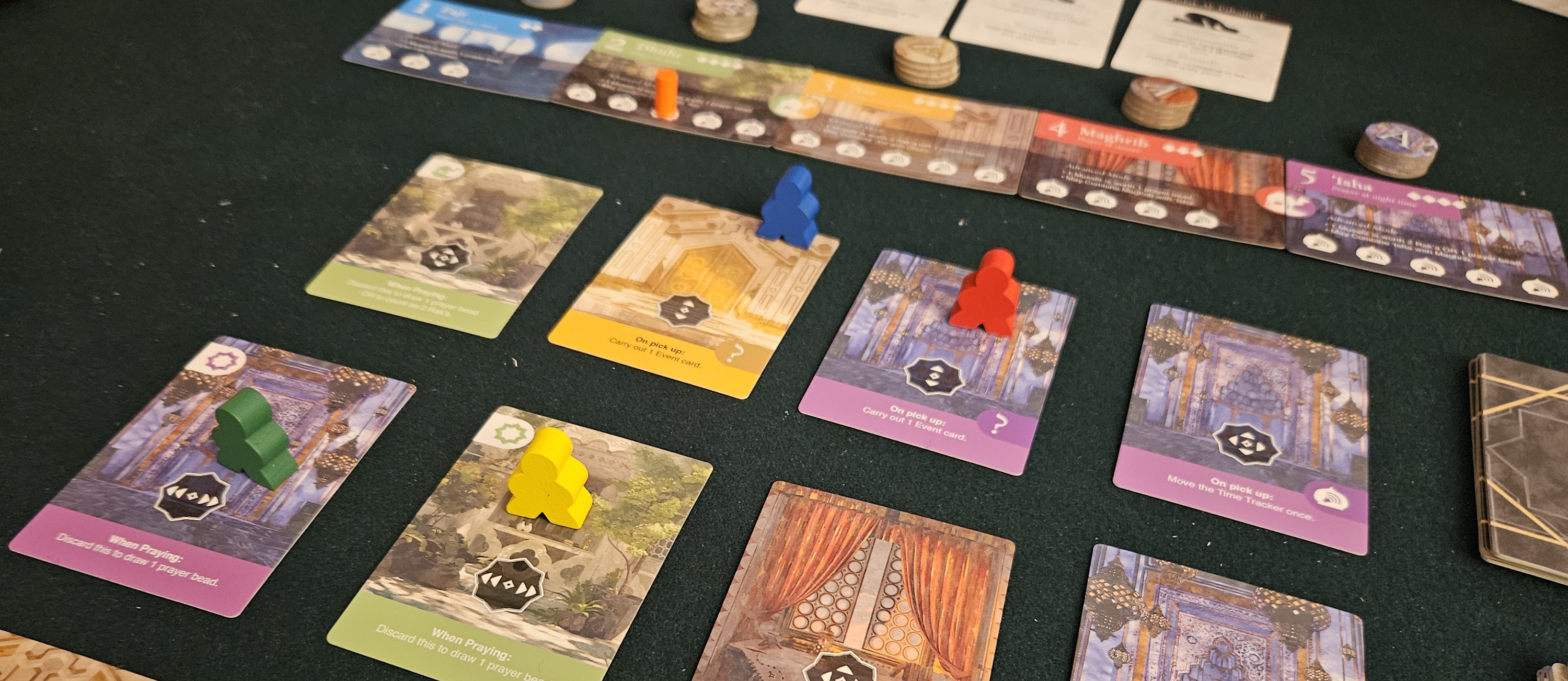
Usolli sure understands table presence.
In the end, Usolli is a warm expression of belief, gentle and colorful and inviting. As a board game, it isn’t my favorite. It’s lighter than I prefer, with an approach to card collection that suits the subject matter’s procedural nature more than my preferences of card-usage. That’s fitting, even when it doesn’t make for the most dynamic play experience. The result is a game I likely won’t play again, but which I’m glad to have spent some time with. Even when the religious tradition isn’t my own, it’s nice to wrap myself in the blanket of tradition and observance for a few minutes.
(If what I’m doing at Space-Biff! is valuable to you in some way, please consider dropping by my Patreon campaign or Ko-fi. Right now, supporters can read big stonking essays on the movies and video games I experienced in 2024.)
A complimentary copy of Usolli was provided by the designer.
Posted on March 12, 2025, in Board Game and tagged Board Games, Cardboard Quokka Studio, Usolli. Bookmark the permalink. 8 Comments.

 SPACE-BIFF!
Thanks for the review! This sounds a fascinating game.
Thanks for reading!
Due to France’s historical targets for colonisation, I am now being faced with, thought I am not muslim, the reality of prayer. I work in a youth shelter and, because Quebec prefers immigrants who already speak French, I have employees and residents who practice Islam. Seeing the struggles of a young muslim who’s always tired because he works nights and can’t sleep contiguously during the day. Wondering where an employee is and it turns out she’s off in prayer. This all make me think of this game and the struggle to balance modern (late stage capitalist) life and the Islamic faith. It also makes me realise I need to take some steps to better accommodate this struggle. A pity the game does not exist in French, or I would consider it for the work place to help others (non-muslim residents and employees) understand. At the very least, you’ve (and they’ve) made me realise I may need to change the times for my weekly staff meeting.
What a wonderful line of thought, chearns! It’s incredible the way something as simple as a game can help us expand our sphere of empathy.
The Fart card really ties the game together.
It’s the anchor carpet of the whole room, really.
Pingback: Usolli is going to PAX East! - Cardboard Quokka Studio
Pingback: Usolli As Told By Reviewers - Cardboard Quokka Studio