Magenta Four: Fruit Fight
Of course, there’s a Knizia. Fruit Fight is the final entry in CMYK’s Magenta, a series of four brightly-colored card games that each introduce a new concept. It’s also perhaps the most storied of the bunch, with multiple reissues over the years, masquerading as Hit!, No Mercy, and Cheeky Monkey. This time around, you’re apparently chucking fruit at each other, complete with blurred images of foodstuffs sailing through the air. As with the rest of this set, the aesthetic is downright charming.
The game itself? Eh. It’s fine.

Why is the fruit moving fast?
If you’ll permit me to drop an impenetrable reference, Fruit Fight operates like the mathematical representation of a push-your-luck game manifested straight out of the Hylaean Theoric World — which is perhaps an overstuffed way of saying that it zeroes in on the thrills of the genre without doing anything else to make it noteworthy.
Your goal is to amass fruit. Each fruit is worth some points. Coconuts are worth eight. Cherries are worth two. Bananas are worth four. Oranges — some with the stem of a yellow tomato, so I don’t know what’s going on here — are worth one. You get the idea. When the game ends, you want to be in possession of as much fruit as possible. As somebody who has participated in exactly two (2) food fights, I can tell you with some certainty that it’s better to avoid the food rather than absorb it, but okay. Here we are.
On your turn, you draw some cards. Drawing a duplicate fruit will cause you to bust and lose everything, but only if you have at least three cards. Usually this means you’re free to draw two cards, but, aha!, there’s an exception. When your turn ends, all your accumulated fruits stay in front of you. It’s only when the turn comes round again that you get to flip those fruits face-down, banking them as points for the end of the session. In the meantime, if somebody else flips one of those fruits, they will steal any of your matching fruits. It isn’t uncommon, then, for piles of fruits to develop, little fruit baskets and fruit cornucopias that represent rather large masses of points. Thus, if you draw your first card and it shows a watermelon (value: five points), you will steal all the watermelons visible on the table.
Which brings us around to Fruit Fight’s sole consideration: do you draw again or hold what you’ve got? Drawing might increase your potential take, but similarly increases both the odds that you’ll bust and the volume of fruit that you’ll have for other players to steal. These calculations are aided by varying card quantities. For the lower-scoring fruits, there are eleven copies of each card. For the higher-scoring cards, there are only seven. Let that influence your decisions as it will.

Ah, a dynamic hand.
To its credit, Fruit Fight manages to highlight what makes push-your-luck such a successful genre. Everything depends on the next flip, so it’s easy to focus one’s attention and energy on each draw. Busted the last five hands? Feel your heart pound as you reach for the deck! Holding ten fruits? Feel your bum clench at everybody else’s draws! Somebody just secured four strawberries? They’re almost guaranteed to win!
My reluctance with Fruit Fight has to do with a similar game I’ve been playing lately, Eric Olsen’s Flip 7. The procedure is more or less identical, with players flipping cards in hopes of nabbing a high score while also avoiding duplicates that will bust them out of the hand. Despite looking like something that would hang in a grocery store’s toy aisle, right down to the tagline that it’s “the greatest card game of all time,” Flip 7 simply feels better to play.
Some of that comes down to the way turns are arranged, with players alternating rapid-fire rather than taking a whole sequence of draws at once, but it’s also a question of odds and how intuitive they are for players to tinker with. The cards in Flip 7 are, in a word, instinctive. Duplicates exist according to rank. So there’s only a single copy of the one, but there are two twos, three threes, and so forth, all the way up to twelve twelves. This puts pressure on high-scoring players to draw or back out, as opposed to Fruit Fight’s pressure on losing players to further deepen the hole they’re in. Even more importantly, the odds are incredibly easy to assess. You know that holding a twelve and a ten puts you in a tight spot. In Fruit Fight, the odds tend to jumble into the black hole of the discard pile.
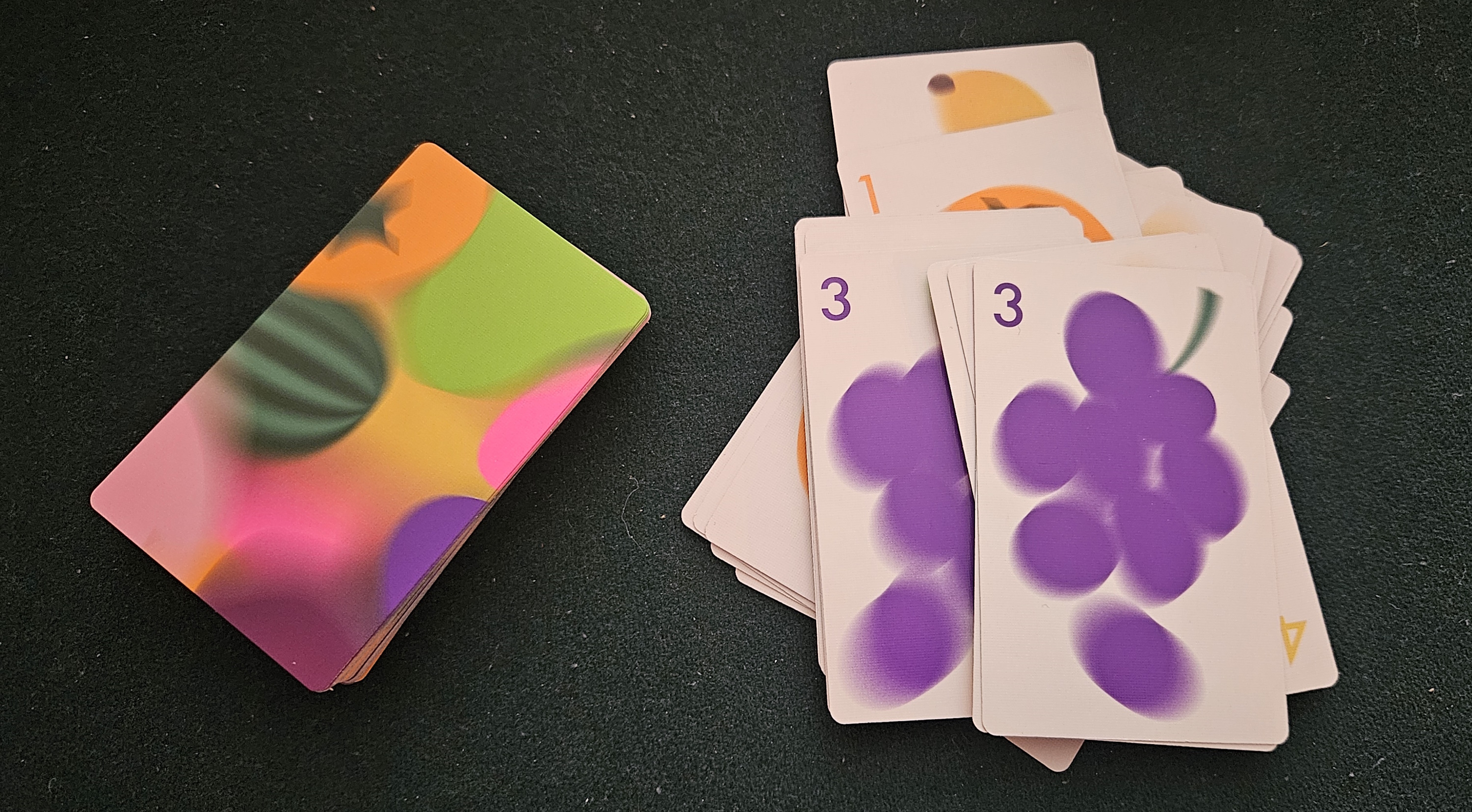
I love the art direction.
In spite of its carnival-barker advertising, Flip 7 is not, in fact, the greatest card game of all time. But it’s the more considered of the two, with a more carefully constructed spread of cards and ranks. It’s also longer and messier, including some truly pernicious draw-luck thanks to certain power cards that allow second chances or attacks on other players. It isn’t something I see myself playing more than a few times. Maybe at a family campout, and only then because I don’t really care if it gets smoky.
But the contrast highlights my hangups with Fruit Fight. Again, this is push-your-luck at its rawest. But like certain fruits (mostly rhubarb), it might have been better heated. The whole thing comes across as airy; the odds are tough to calculate, the spread of points feels off, and it tends to produce obvious runaway victories rather than tight contests. While its simplicity is unmistakably Knizian, it lacks his signature punch. I would rather play any of Magenta’s other offerings.
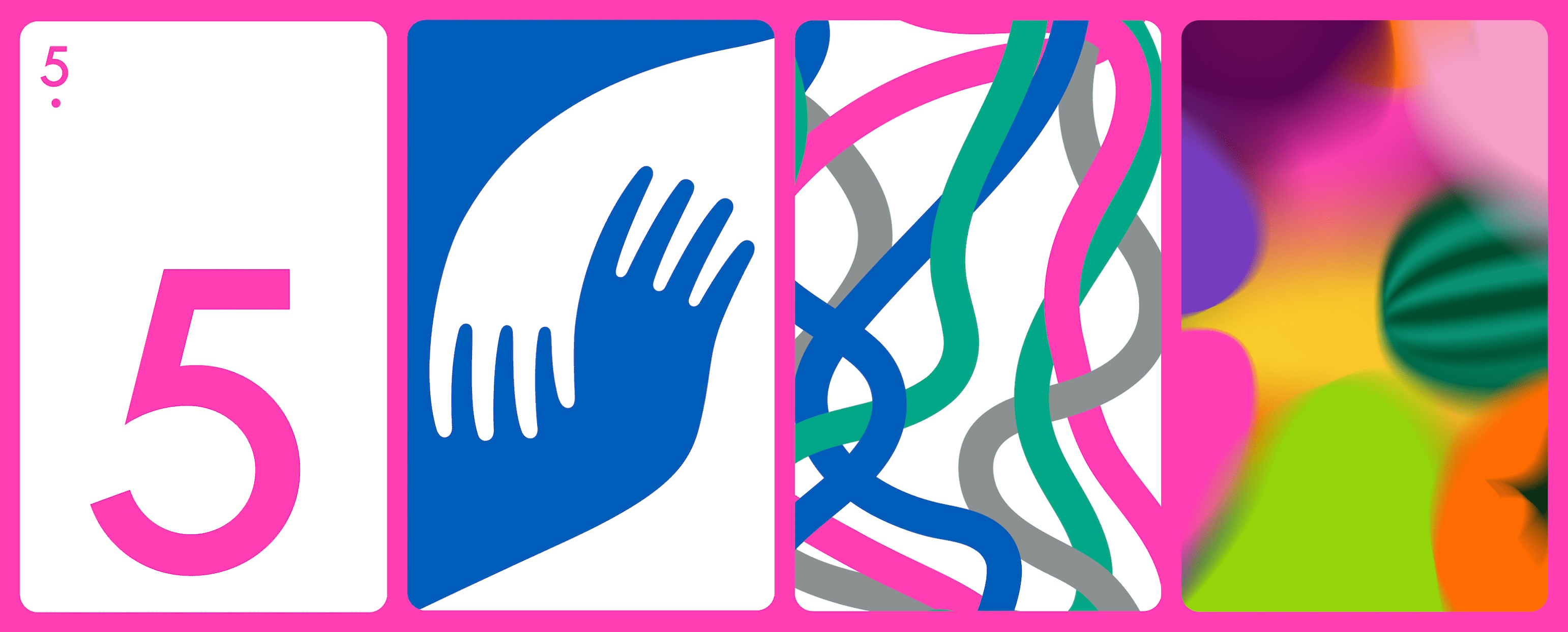
The whole collection so far.
Speaking of which, now that we’ve taken a look at the entire collection, it’s time to sum up.
Here’s the protein: The best thing about Magenta as a curated collection of entry-level card games is that it throws open doors that might otherwise remain latched. The best of them even take that extra step to highlight what makes these various genres special.
Fives, for example, is not only a pleasant trick-taker. It also demonstrates the format’s playfulness, showing how one little twist can put a new spin on the entire formula. Duos is my favorite of the bunch. It does something similar, seeming like a straightforward partner game on the surface, but also letting you tickle the odds and learn how to work with somebody despite some stark limitations.
Figment, meanwhile, is the odd duck of the flock. But it also serves as the collection’s horizon-broadener, showing that there are other ways to use cards than what most hobby newcomers might assume. I’m not only speaking about the game’s core gameplay loop, in which players assess the quantity of ink printed on some cards. Because while that’s unusual enough on its own, Figment is also a cooperative game, a relative unknown among non-hobbyists. I might prefer Warsch’s original competitive rules, with their shade of bluffing, but asking players to collaborate feels like the right move for an introductory collection.
In other words, these games function not only as welcome mats to the world of tabletop games, but also as beckoning doorways to whole new worlds. They’re big (too big!), pink (not too pink!), and inviting. Except for Fruit Fight, that is. Fruit Fight introduces push-your-luck, but lacks that extra nudge down the hallway. The result is a considerable, if sometimes uneven collection that hopefully finds the right audience. This is the sort of stuff I hope to play with my Grandma Judy, whose sole tabletop experience is one billion sessions of Mexican Train. Magenta is not for me. Magenta is for Judy.
(If what I’m doing at Space-Biff! is valuable to you in some way, please consider dropping by my Patreon campaign or Ko-fi. Right now, supporters can read big stonking essays on the movies and video games I experienced in 2024.)
A complimentary copy of Fruit Fight — along with the rest of Magenta — was provided by the publisher.
Posted on March 10, 2025, in Board Game and tagged Board Games, CMYK, Fruit Fight, Magenta. Bookmark the permalink. 10 Comments.

 SPACE-BIFF!
This was released under yet another coat of paint in Mexico last year and it has absolutely swept the light card game market. So, yeah, Grandma Judy will love it.
Another win for Grandma Judy!
i couldn’t disagree with you more on the Flip 7 comparison. I’ve been playing an imported version of Fruit Fight (the better themed No Mercy) for years and have played Flip 7 only twice but the contrast is so stark and in No Mercy’s favor for reasons that are so foundational to me as a gamer.
No Mercy is significantly shorter which is usually what you want from your push your luck card games, and certainly what you want from a filler. It’s very reliable in that the game ends when the deck runs out, and the decisions aren’t going to cause AP.
Flip 7 on the other hand you’re playing to a target score that takes quite awhile to grind towards, and is much more of a variable target based on player count (it’s painful with too many) and the luck involved.
Flip 7’s other big weakness compounds the length issue, it’s so low on interaction! Forget about how there are special power cards that can cause you to lose a turn, you’re still always just waiting and watching someone flip that doesn’t have any affect on you. Compare that to Fruit Fight where everyone is all in at all times! Both games you can pay attention for the card counting, and the spectacle but Knizia does an infinitely better job of making it a shared environment.
You spoke more highly of the Flip 7 puzzle, but in Fruit Fight you have a multi layered one. It’s not just about your own probability of busting, which you will use your guy about card counts to feel out, it’s also about the relative upside of losing what you have and the odds of a big steal based on what other players have on the table. Interaction to me isn’t just doing something to someone else, for me it’s caring about them sharing a table with you. Fruit Fight encourages it and Flip 7 makes almost no effort to.
I’m also just not a fan of the Flip 7 powers and especially annoyed by the flip 7 concept itself. So you pull off this highly improbable feat that almost certainly won’t be worth the risk and what do you get? It’s a small point bonus? Wtf is that??? If I flip 7 different number cards I should win automatically right there! I should retire as my group’s Flip 7 King! It’s just disrespectful and I refuse to accept it.
I can’t fully endorse Fruit Fight, name or otherwise, No Mercy though? It knows what it’s about, fast western shootout fun where you have no mercy for your fellow players and the game has no mercy for you.
Amen to every word of this!
Thanks for your perspective, Cosmo. As noted, however, I’m not really “endorsing” Flip 7. I’m speaking to my preference for how it expresses its odds. You can disagree on that point as well, of course! But I’m using it primarily to illustrate one of my problems with Fruit Fight.
I don’t really understand that point though. Both games have an easy to remember cards distribution and a discard pile to track if you can be bothered.
Okay, Martin, your objection has been noted.
Just friendly discussion, as ever 🙂
i played Flip 7 again tonight and learned that whoever had been teaching it previously taught it completely wrong. So it’s as bad as I thought. I had previously played where each player plays out their turn as in Fruit Fight, adding cards in from of themselves until they bust or go out. However, it seems the actual rules are that you go around the table with each player adding one card or dropping out. The later produces a much better game flow and not nearly as much downtime, plus there’s a bit more of a public card counting aspect. I still prefer Fruit Fight/No Mercy but my distaste for Flip 7 is pacified.
Pingback: Moregenta | SPACE-BIFF!