Let Me Die Surrounded By Machines

Moon Colony Bloodbath is a board game out of time, and not entirely in the good sense. It owes its evocative title to the Mountain Goats / John Vanderslice collaborative EP of the same name, but the comparisons end there. Donald X. Vaccarino liked the name, liked the idea of a moon colony going extinct, and, well, that’s what prospective moon colonists are going to get. It’s not quite a joke — there is some gameplay here — but its punchline is right there on the cover.
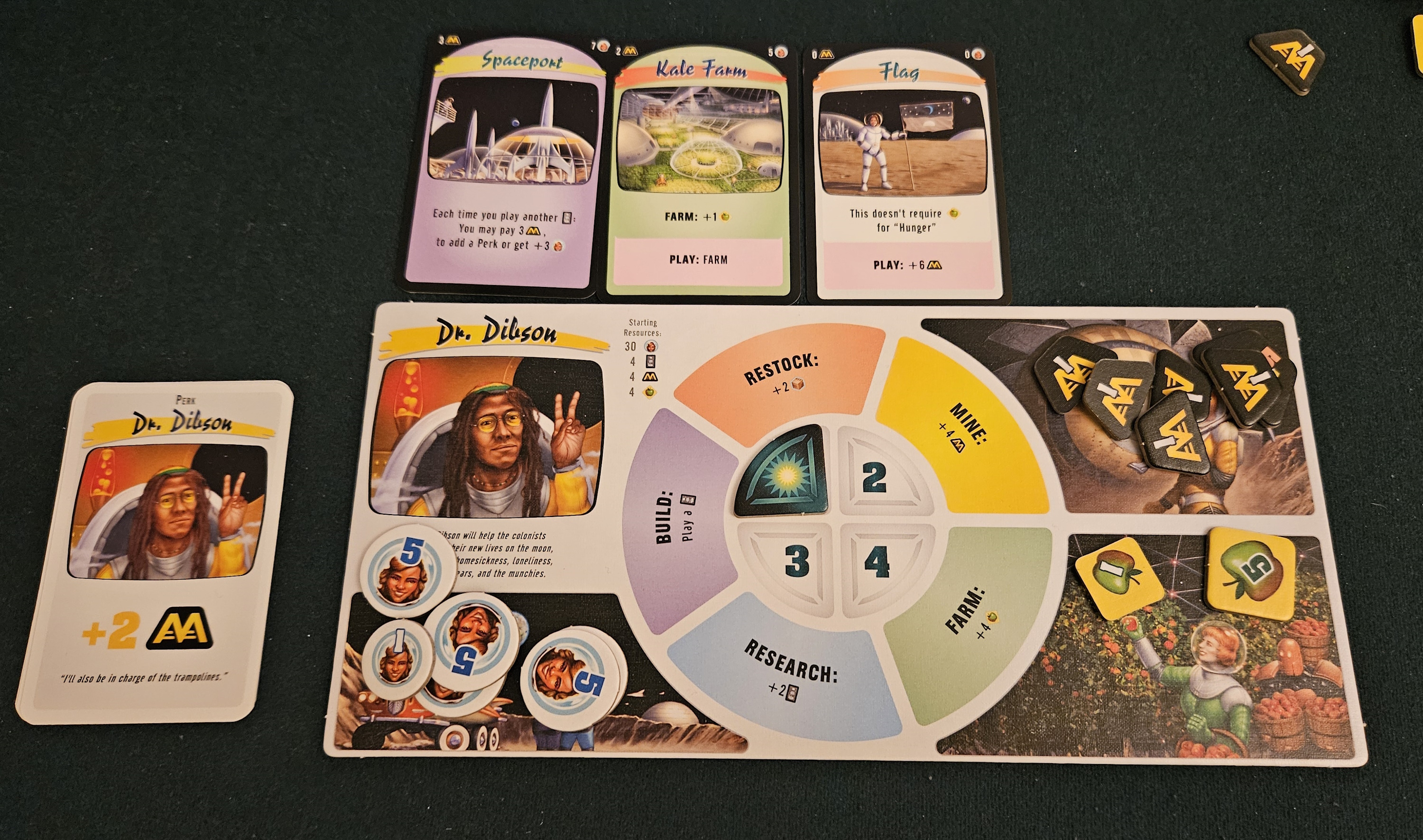
Welcome to my moon colony. Nothing is wrong.
True to its name and authorship, Moon Colony Bloodbath is a tableau-building and tableau-destroying game that doesn’t feel all that many steps removed from Vaccarino’s genre-instantiating masterpiece, Dominion, right down to the tightly managed card pool. If anything, its main departure is that it embraces its setting in a way that Vaccarino has generally avoided over his career. (Although there are exceptions! Including, for example, the underrated Android: Infiltration.)
Here, the big idea is that everybody at the table is competing to keep their moon colonies alive, no small task when everything from the absence of atmosphere to your robot butler are threats conspiring to kill you. It isn’t a deck-builder, although that genre’s irradiated helices are evident without a microscope.
Rather than working from your own tailored deck, the whole table shares the opportunities and perils of one shared set of cards. When the game kicks off, eight of these have been shuffled together. Four of them are “work,” letting everybody take a single simultaneous action. Two are twists, little modifiers that randomize the feel of each session. And the last two pose trouble for your fledgling colony.
We’ll talk about that trouble before long, but in the game’s early stages the work cards are what shapes the experience. Most of the available actions are dead simple, at least initially. Research lets you draw a couple of cards from the building deck. Farming, mining, and restocking award their corresponding resources. Building is the big one, letting you swap minerals to construct the stuff in your hand.
One structure at a time, your colony takes shape. Most cards alter an action in some way. The Silica Mine increases how many minerals you earn from mining, Tunnels upgrades restocking from a desperate action to a profit-earner, and Clone Banks adds new colonists whenever you research. Some provide splashier benefits, like a Lunacrete Factory that reduces the cost of every building or a Dome that’s worth a huge number of colonists but also adds something nasty to the shared deck. Others add special cards instead, like the Moon Hotel providing an avenue for tourists to occasionally show up or a Reactor that seeds the deck with lethal radiation when it gets destroyed.
It isn’t long before synergies present themselves, and much of a successful run comes down to hunting for and deploying those cards that complement one another. If I see a Restaurant or Hacker Lair, I’m grabbing onto them with both hands, so potent are their benefits. It has a roguelike quality to it, especially where the construction deck is concerned. Is this the run you make Recycling work to your benefit? How many perks can you slip into the shared deck? Can you wrangle a box strategy? Like the roguelikes of old, it isn’t so much about succeeding as it is about getting a little bit further than last time.
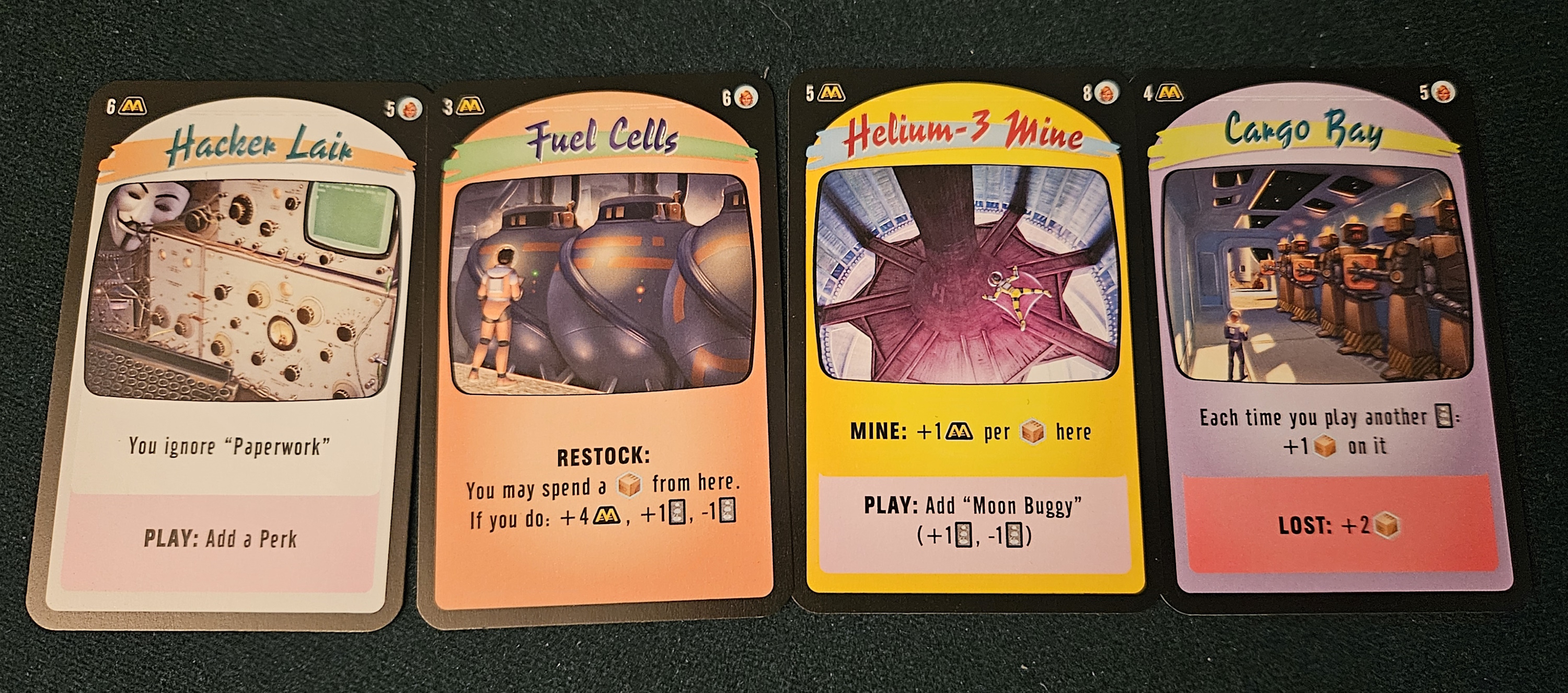
Some of the many many many structures you can build on the moon.
If it sounds like Moon Colony Bloodbath is setting you up for failure, well, aren’t you astute? Earlier, I mentioned trouble cards. There are two of these in the starting deck, and they both add extra events. These add volume to the deck, which means that the ratio of actions to events is put on a downward slope, while also reappearing each time the deck is shuffled. That wouldn’t be such a bad thing, except they all represent terrible news for your colony.
What kind of terrible news? How about a leak — that’s four colonists dead right there. Or space madness — goodbye to two more colonists. Airlock test: five dead. Moonquake: six dead. There’s a trend here, and its graph doesn’t show many upward strokes.
There is one tiny exception. The first event, Hunger, requires you to spend food for each building you’ve constructed. Any missed food is paid for with dead colonists, sure, but there is a tiny bonus for meeting your colony’s needs. When everybody is fed, two more colonists are shuttled up from Earth. Nice! The second event, Paperwork, might also be considered an exception, since it lets you draw a building card. But then it forces you to discard two building cards, so let’s call that one a wash. A wash of spilled refrigerant that chokes all life.
Colonists, it turns out, are functionally a pool of hit points. Running out of colonists means the game is over. Literally. As soon as somebody’s manpower is depleted, everybody tallies their remaining colonists and the most populous player emerges victorious. Ad astra per aspera, and so forth.
Structures stretch out this process. Most of the cards you can build provide a number of colonists. Rather than adding these to your pool, the number remains on the card until you can’t spend the requisite astronauts to cover some disaster. At that point, you choose a building to destroy and receive any leftover colonists from its number. There’s even a measure of strategy to placing cards specifically to get destroyed. The research benefit of Animal Labs is minor and unlikely to trigger anyway, but all that meat proves useful in the event of a shortage, while the Geo Labs card always bounces back into your hand when wrecked, letting you repurchase it over and over to keep your colony afloat.
Make no mistake, even well-regulated moon colonies will be trashed. This is Moon Colony Bloodbath, not Moon Colony Love-In. Vaccarino leverages the concept to the hilt. As advertised, you are indeed building a tableau and destroying a tableau, often at the same time. There’s that aphorism about how hikers don’t need to be able to run faster than a bear, only faster than their companions. That’s Moon Colony Bloodbath in a nutshell.
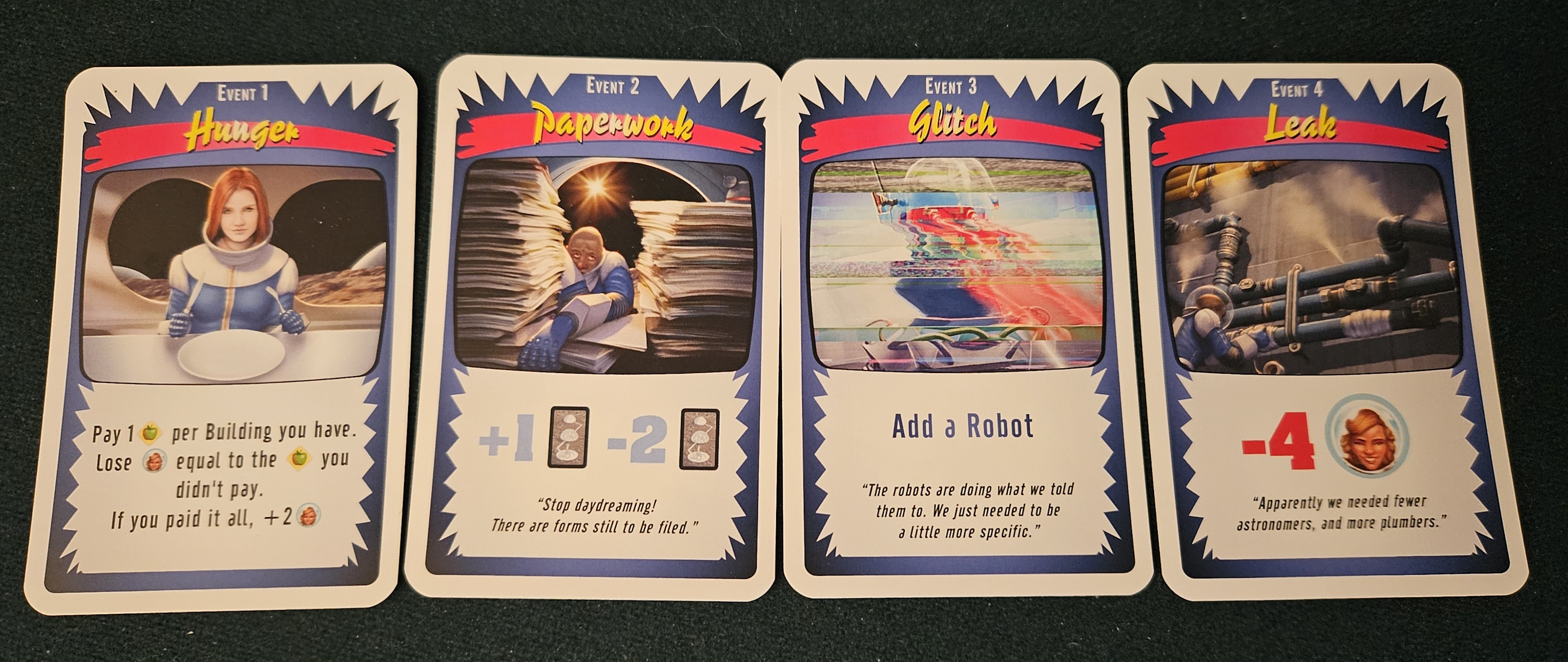
The events are brutal. They also always appear in the same order.
Unfortunately, it’s a rather cramped nutshell. While the contents of your hand change from session to session, the event deck proceeds from one beat to the next without deviation. This makes sense from a balance perspective. I certainly wouldn’t want to be hit with more moonquakes and airlock tests than hunger events.
But this staid procession reveals deeper problems. Perhaps the biggest is that there is scant variation between any of the events that befall your colonies. The only difference between a leak and a power failure lies in how many people they kill. The same goes for most of the robots that get added to the deck. There are slight variations; the Repair Robot prevents you from building on the next action, while the Military Robot pays out a few military-industrial bucks as compensation for the colonists it slays. But these attacks are, well, attacks. There’s no such thing as building insulation to prevent leaks, or blocking power outages if you have two improvements to the mining action.
Except sometimes there are ways to ameliorate or even avoid attacks! The Stacking Robot, for example, can be placated by giving it boxes to stack instead of human bodies. Accidents, the most common negative events, can be blocked with well-stocked Organ Banks. Yet these exceptions are few and far between, making them all the more precious and flattening the effect of every other event and robot uprising. There’s texture here, but applied irregularly, like a smooth white wall with occasional patches of stucco.
The closest peer to Moon Colony Bloodbath is a very different game indeed, a cooperative event rather than a competitive one, but alike in that it provides a shared deck and asks players to assemble a tableau, weather dangers that come fast and hard, and preempt the perils seeded throughout a large shared deck. That game, Peter Rustemeyer’s Paleo, could almost function as a template for what Vaccarino is attempting with Moon Colony Bloodbath, but with a keener internal compass.
Both games require players to think about the cards in their shared deck, but where they depart is that Paleo offers multiple ways to tackle or avoid them. By contrast, Moon Colony Bloodbath is about keeping your population up and little else. Within a few sessions, it grows rote. The same approaches tend to be effective. The same structures prove worthwhile. The same events murder the same quantities of cosmonauts. There are points of variance that keep players on their toes — the structures they draw, those two twist cards, maybe some robots — but they’re few and far between.
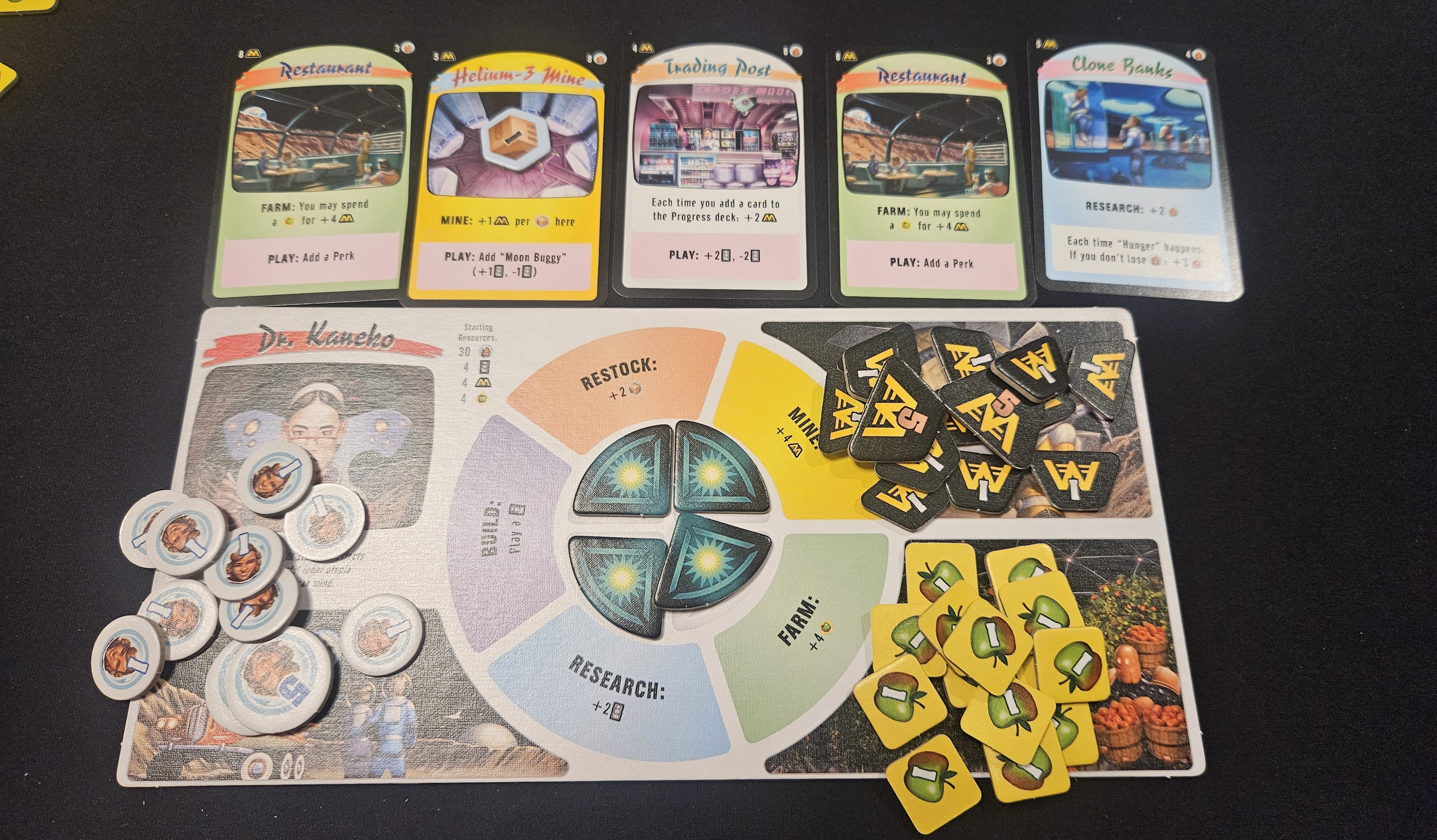
It’s looking pretty good for my moon colony, actually.
In the end, Moon Colony Bloodbath strings itself haphazardly between two poles. It’s partially a game about reacting to crises as they arise, but the tools it offers are limited in both availability and effect. And it’s partially a game about learning how to overcome the moon’s challenges, but with sequences of problems that encourage memorization over skill. With the right draws and the right priorities, winning by reaching the final event rather than by suffering the least-worst death isn’t especially difficult.
Again, it’s a game out of time. Others have done this bingo-style shared crisis jig before, and better too. Moon Colony Bloodbath is many things, some of them positive. It is fast, funny, and feels good to handle, with players shuttling tokens back and forth at a truly impressive rate. But it’s stale even as it climbs out of the hibernation pod, leaving me as cold as the corpses it litters across the lunar regolith.
(If what I’m doing at Space-Biff! is valuable to you in some way, please consider dropping by my Patreon campaign or Ko-fi. Right now, supporters can read big stonking essays on the movies and video games I experienced in 2024.)
Posted on March 6, 2025, in Board Game and tagged Board Games, Moon Colony Bloodbath, Rio Grande Games. Bookmark the permalink. 2 Comments.

 SPACE-BIFF!
wow.. it all started to sound very interesting before you shot it out of the airlock. Definite pass then. Would you care to elaborate what shared crisis jigs you regard highly? No Pandemic needed please 😅
Sure! Paleo, of course, but another great example would be Galaxy Trucker. Space Alert, too, although that’s also a cooperative game.