Adolescent Archipelago

Over the past few months, we’ve taken a look at a number of small-batch games that were designed for sale at indie markets. One forthcoming example is Juven Isle, a tile-placement and terrain-blocking game by Gary Kacmarcik, which should be available at this weekend’s Game Market Vegas.
Mostly, it’s an excuse to pore over maps and puns at the same time. Two of my favorite things!

An early isle.
Lest you think I’m overselling it, the puns truly are glorious. Assembled one tile at a time — one card at a time, really — you can’t flip anything without stumbling across puns both obvious (Dire Strait), subtle (Infant Isle), and ticklish (Prehense Isle). I’d like to see Kacmarcik’s master list, because the sheer quantity of wordplay is impressive.
Of more importance to the game portion of this game is the way those maps take shape. Carcassonne is the obvious touchstone, although there are subtle distinctions that leave Juven Isle feeling like its own creature. The short version is that there are only two terrain types, land and water, with the boundaries appearing either one-third, halfway, or two-thirds (which, of course, is one-third the other way) along the edges of each card. There are trade routes, but these are more universal than the roads in Carcassonne, always appearing along suitably wide connections. I know I’m getting too particular here, so suffice to say that Juven Isle’s maps wind up looking more organic than those in Carcassonne, with fewer sliver-shaped slices of terrain, without requiring an undue volume of gray matter to cobble together.
Which is a good thing, because Juven Isle is more about assessing trade lines than anything else. Each card contains at least one trade icon: coconuts, bananas, squids, that sort of thing. Some also feature ports. At the game’s outset, you receive a handful of tokens that correspond to these icons. After placing a tile, you’re allowed to also place a token on one of those ports, tracing those dotted trade lines like that kid from Family Circus and earning points for each matching icon you cross.
This is cool enough on its own, but little by little the map becomes crowded with these tokens. These block ports, and therefore easy access to all those icons. Before long, players are forced to trace longer routes, trying to find the exact right card to link far-flung destinations. Or perhaps they’ll use a token’s reverse side, which shows a pirate symbol, to connect to nearby unclaimed ports but block every route through that card entirely.
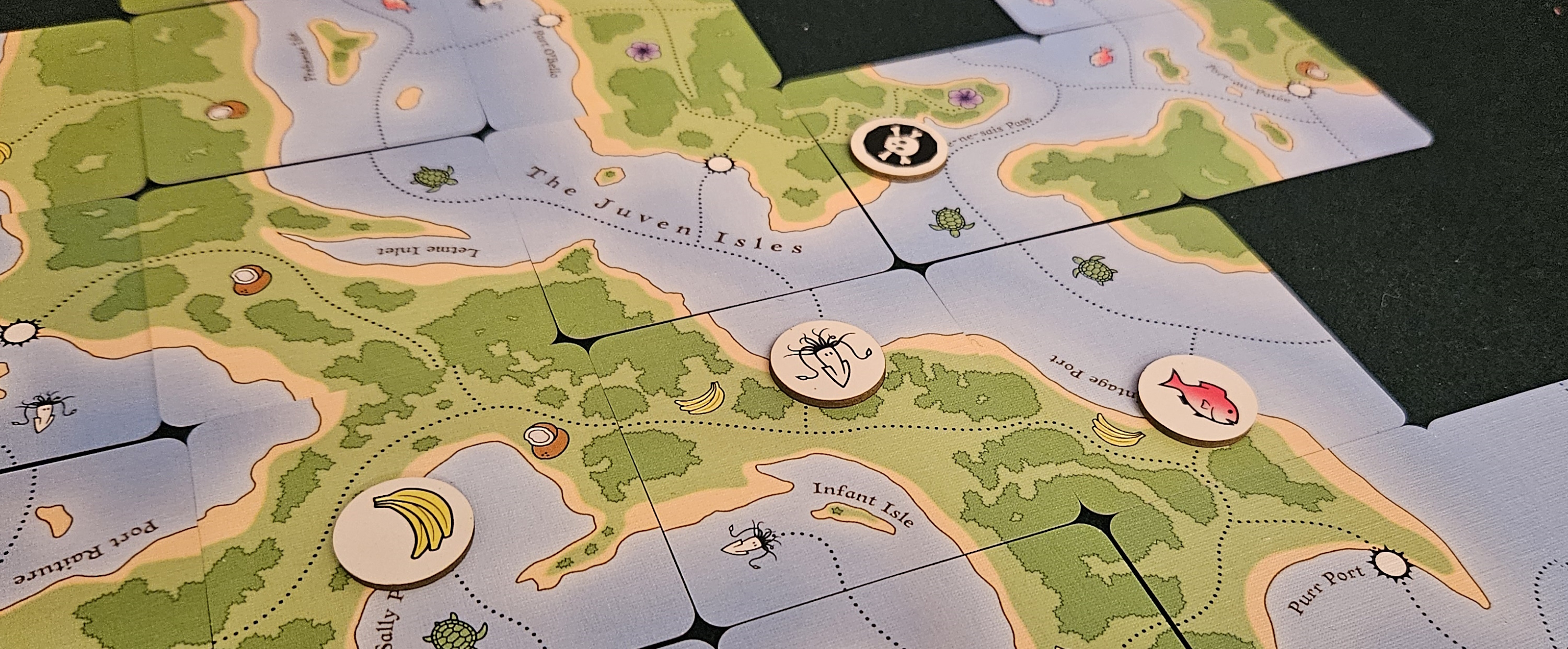
Local factions, including those dratted pirates.
Point is, there’s a sweet spot between letting the map develop so that your tokens will scrape together a bunch of points, but not waiting so long that other players’ tokens blocks the good stuff. One part brinkmanship, another part cussing out your friends for bisecting the whole map with one well-placed fishing port.
It’s also something of a race. Rather than being abstract representations of standing, points are awarded by peeling cards cards from the deck. This is a nifty trick, removing certain options from circulation and ensuring the pool is always shifting, but also putting a hard timer on the game. There’s nothing stopping someone from placing a token after the deck has run dry, but their potential earnings will be sharply capped. Again, there’s that sweet spot.
The game itself occupies something of a sweet spot. As I noted, there’s the obvious comparison to Carcassonne, but its closer comparisons are also smaller fare, its complexity and duration squeezed somewhere in between ultra-light map-builder Beacon Patrol and sustainability-chaser Lakshadweep. It’s a game for those who enjoy craning over maps, examining the placement of trails and hamlets and thinking about what it would be like to paddle out to that little islet off the tip of Exclamation Point or hike up Dist Hill.
I do have some reservations, especially around the balance between ordinary tokens and pirates, which I don’t think the game quite manages. Then again, it’s shocking how much gameplay Kacmarcik has packed into such a tiny box, with so many little decisions that still feel important. Whether you’re bridging two landmasses or blocking them off, every move unfolds some manner of long-term consideration. That’s a rare thing. That it’s so portable is just icing. I’ve bought gum that took up more space.

Eventually, those sea lanes get crowded.
All in all, Juven Isle is as diminutive as its title and nearly as charming. It’s one more example of the exciting things happening in the world of independent tabletop creators, where the freedom to unapologetically design offbeat games remains a virtue. While it doesn’t break new ground, it treads a familiar path with confidence, sidestepping some of the genre’s pitfalls along the way. I’ve always had a soft spot for games about exploration, especially those that let us inhabit the maps as we create them; in that regard, Juven Isle is not only little, but well worth its half-hour playtime.
(If what I’m doing at Space-Biff! is valuable to you in some way, please consider dropping by my Patreon campaign or Ko-fi. Right now, supporters can read big stonking essays on the movies and video games I experienced in 2024.)
A complimentary copy of Juven Isle was provided by the designer.
Posted on March 4, 2025, in Board Game and tagged Board Games, Juven Isle. Bookmark the permalink. 4 Comments.

 SPACE-BIFF!
This looks charming! I’ll try to find it at the Game Market if I can get there in time.
If you manage to nab a copy, let us know how it treats you!
Thanks for the kind words!
No, thank you for sending me your lovely game!