Magenta Three: Figment

Another week, another Magenta! After Fives and Duos, I thought I had a handle on CMYK’s approach. These are fresh spins on familiar card games, simple enough to appeal to the masses, but dimpled enough that you, a time-tested veteran, won’t grumble when it hits the table.
Until Figment. Figment is the weird one of the bunch.

Look at that color scheme!
Figment is the work of Wolfgang Warsch, the very same who gave us The Mind and The Quacks of Quedlinburg. Unlike the other entries in Magenta, though, Figment isn’t a straight remake.
But before we get into that, let’s introduce the game itself. Just as The Mind is about your lying internal clock and Quacks is about lying to yourself about statistics, Figment asks you to flop out your lying peepers. Featuring a whole deck that displays Magenta’s four colors in varying arrangements, your objective is to put these cards in order. What order, you ask? Well, it depends. Each round, you draw an arrow card. This arrow shows one of those four colors. One at a time, you now draw five (or six, depending on difficulty level) of those images and hopefully put them in the proper order from least to most that the aforementioned color takes up on the card.
This is… I would say “easier said than done,” but the issue of Figment’s difficulty is unexpectedly sticky. The illustrations are rife with optical illusions. Our primate eyes assess colors and shapes more on vibes than via raw percentages, so it’s natural to make a knee-jerk estimation of how much of any given color appears on a card. Like The Mind, this is a process that some folks will immediately claim can be gamed out. “Just count the seconds together!” they said about that game, mistaking human beings for metronomes. Here they will say something like “Just put the cards side by side and calculate the precise area of each color!”
Which, again, mistakes human beings for machines. Warsch has made a career of turning our biological quirks against us at the game table, even in titles like Ganz Schön Clever and Wavelength. At its best, Figment is deliriously frustrating. When trying to decide which card shows more green, something as simple as one shape occluded by another can trip our brains into — and I believe this is the scientific term — zonked-out mode.

How’d we do?
Therein lies the rub. Figment is extremely dependent on which shapes and arrows the table draws. We’ve been presented with some real zingers, images that had everybody huddled together, flashlight shining on the cards to eliminate glare, rotating the card around and around to determine its percentage of silver. Figment had turned us into frontier prospectors licking a handful of ore.
But we’ve also had some sessions that produced the highest possible score with very little difficulty. Figment, as I noted earlier, is not a direct remake of its previous incarnation. That game, Illusion, was a competitive exercise, with players putting cards in order but also periodically challenging that order. I’ve never played Illusion, but a few acquaintances have noted that it was interesting but flawed. The playtime was uncertain. It grew stale before long. Players could bluff, in a sense, by putting cards out of order on purpose to trip up their rivals, but the color scheme was straightforward and less tangled, letting eagle-eyed players spot those bluffs rather easily. It doesn’t take much imagination to see why CMYK rearranged the format to be cooperative.
To some degree Figment is less interesting than its forebearer, at least conceptually, although I will say that I have yet to regret my time with it. When the deck provides an easy selection, Warsch still handles the whole thing with a deft touch. One crucial addition is bidding tokens, which the group wagers on each splay. You earn one point per card in the correct order, but also the quantity of your bid if the entire thing is correct. This adds some much-needed bite to the proceedings, asking players to not only order their cards, but also voice how confident they are about that arrangement.
And when the game instead presents one difficult comparison after another, it becomes most fully itself. In those moments, Figment isn’t only about shapes and colors. It’s also about the inability of our eyeballs and brains to accurately tally them. It’s a reminder that to err is human. So human. Awesomely human.
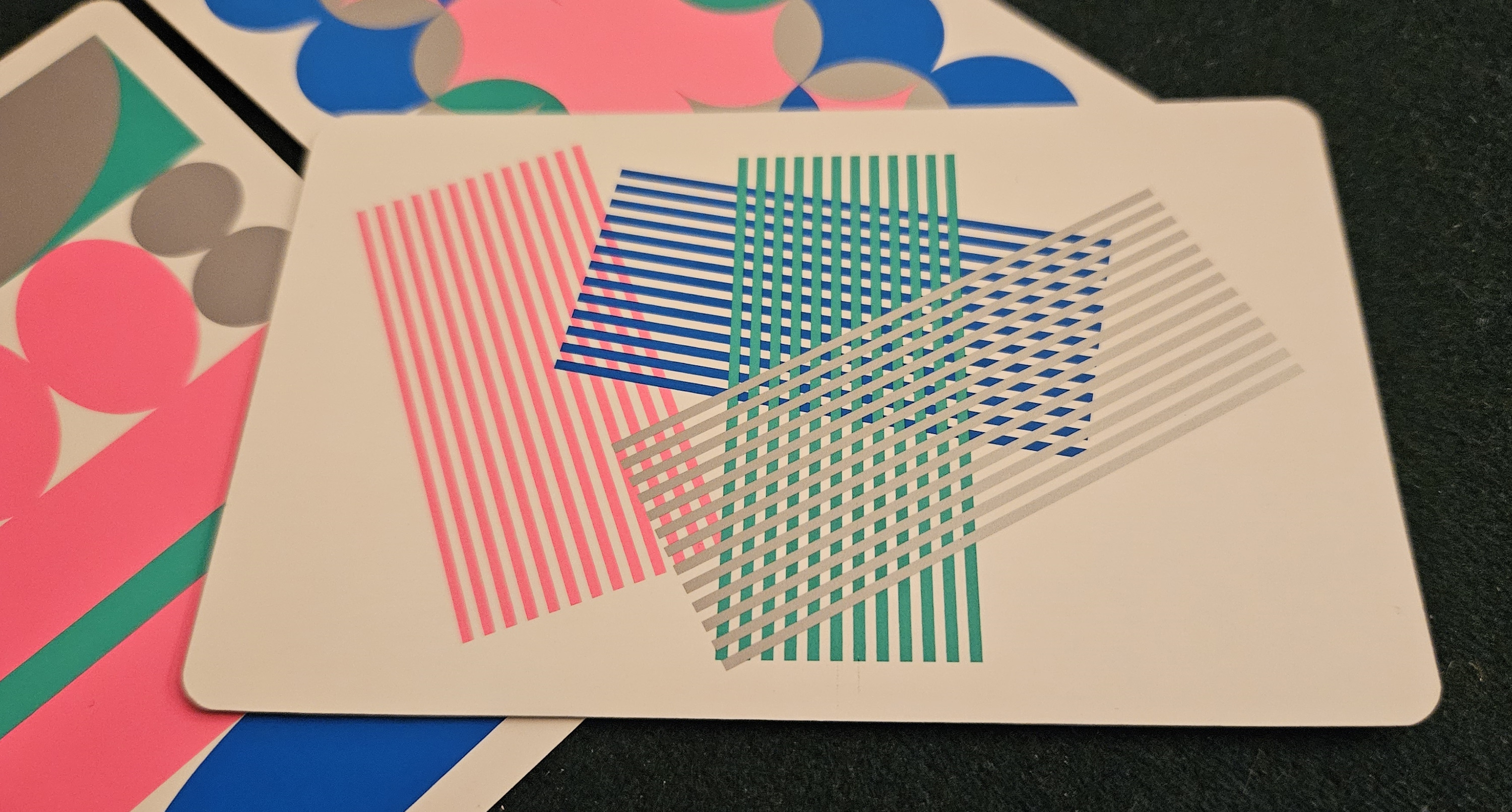
It’s an illusion, Michael.
Which brings us back around to Figment’s place in Magenta as a whole. So far we’ve seen a trick-taker and a partner game, both descended from common playing decks. That makes Figment very uncharacteristic indeed.
In a way, though, it also heightens my appreciation of CMYK’s curation. As a collection, Magenta seems to be seeking a fundamental appeal. These are jazzier versions of games one might play at the dinner table, at informal gatherings of friends, at church groups or bridge clubs. Figment is the odd duck, a game that eschews the usual trappings for a relatively distinct play mode and sans the usual ranks and suits most people associate with playing cards. Of the bunch, it’s the most likely to broaden a newcomer’s horizons. Alongside Duos, that makes it a worthy contender for this strange and appealing collection.
(If what I’m doing at Space-Biff! is valuable to you in some way, please consider dropping by my Patreon campaign or Ko-fi. Right now, supporters can read big stonking essays on the movies and video games I experienced in 2024.)
A complimentary copy of Figment was provided by the publisher.
Posted on March 3, 2025, in Board Game and tagged Board Games, CMYK, Figment, Magenta. Bookmark the permalink. 2 Comments.

 SPACE-BIFF!
Pingback: Magenta Four: Fruit Fight | SPACE-BIFF!
Pingback: Moregenta | SPACE-BIFF!