Magenta Two: Duos

Last week, I called Fives, the first entry in CMYK’s Magenta, the least intriguing of these four releases. Duos, on the other hand, is probably the best in terms of raw gameplay. Designed by Johannes Schmidauer-König, this is a remake of his 2015 title Team Play. And let me tell you, for a thirty-minute partner game, it’s as tight as they come.
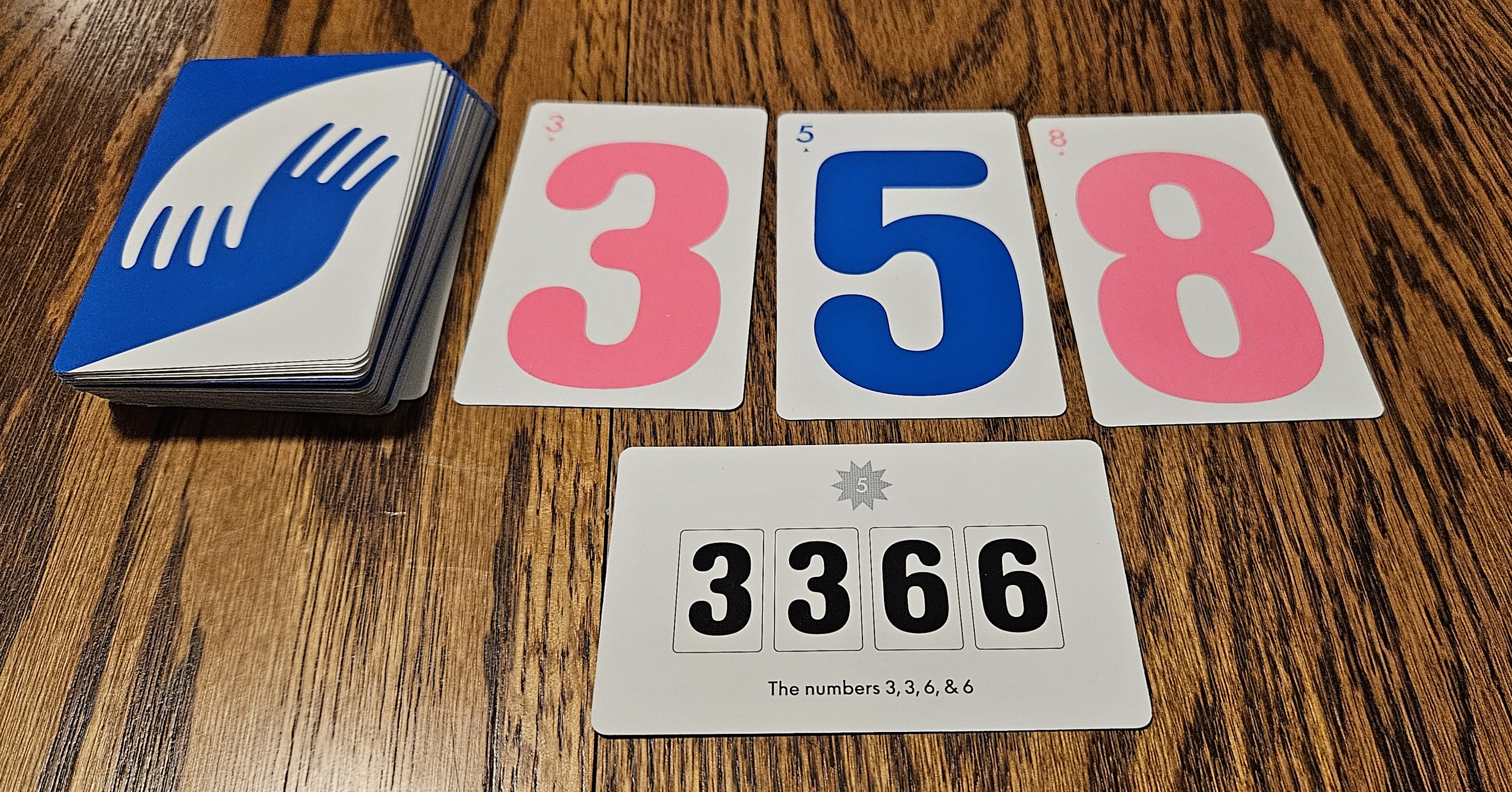
The marketplace of ideas. I mean cards.
Like every title in Magenta, Duos is defiantly abstract — to such a degree that even a weathered rag like me, who insists that most abstract games contain some kernel of cultural significance, struggles to wring out anything of substance. Not that there’s anything wrong with that! Just don’t expect me to rustle up some connection to the landgraviate politics of twelfth-century Thuringia.
The cards are divvied into two suits, blue and magenta, with ranks that run from 1 to 8. Sitting across from your partner, your objective is to build hands according to a range of goals. Each player has access to one such goal in front of them, plus one more in the center of the table that can be accomplished by anyone.
Turns are simple enough, with a small selection of options available at any given time. Cards can be drawn from the market, whether by selecting one of the face-up options or drawing blindly from the deck. One or two cards can also be passed across to your partner in the hopes of helping them fulfill their objective. As in many partner games, there’s a strict moratorium on communication. Duos is about observation: the cards your partner picks up, the goals within their reach, even what your rivals nab from the market or how often they’re swapping.
That’s because, at heart, this is a race. The endgame is triggered when somebody fulfills their team’s eighth objective. Given how simple some of the objectives are, that moment might come sooner than you expect.

Building the right hand(s).
However, that shouldn’t mislead you. Duos isn’t all about getting there first. It’s also about the quality of the objectives you accomplish.
While some goal cards might present simple objectives, such as “two cards that total exactly 9” or “the numbers 1 and 8 in either blue or magenta,” those goals are only worth one and two points respectively. Others can range all the way up to six points, although they’ll require commensurate legwork. “Five consecutive blue numbers” is a hard sell. Doubly so when your opposition can see what you’re trying to accomplish and strip the market of the necessary cards in advance of your turn.
What makes this process bearable is that you’re given a sliver of control over which goals to pursue — but only a sliver. Whenever it’s time to draw a new goal, you’re permitted a single redraw. This adds a small but crucial redoubt to these turning points. Drawing a tough goal late in the game, maybe one worth four points, doesn’t present an impossibility. You could, if you like, try for something easier. The rub is that there’s also a chance that you’ll draw something as tough, or even tougher, than the one already in front of you.
Of course, that’s where your partnership comes in. By securing the proper cards and feeding them to your partner, even very difficult goals can be brought within reach. Provided you read each other’s intentions properly, that is. There’s nothing quite like being passed the exact two cards you need to fulfill a five-point goal that seemed impenetrable only a second ago. The corollary is that there’s nothing as galling as receiving a bunch of junk. Duplicate junk. For the third time. No, Geoff, I do not need any more magenta threes. Get with the program.

Some of the possible goals.
The result is a magazine of spring-loaded darts. Every decision in Duos feels minor in complexity but sprawling in consequence. Sure, there’s some luck at play, and this isn’t some brain-burny experience. But for an introductory partner game, there aren’t many that do it better or with such panache. The next two entries are a bit wilder, a little less “normie,” but this is the title that persuaded me that CMYK was onto something with Magenta.
(If what I’m doing at Space-Biff! is valuable to you in some way, please consider dropping by my Patreon campaign or Ko-fi. Right now, supporters can read big stonking essays on the movies and video games I experienced in 2024.)
A complimentary copy of Duos was provided by the publisher.
Posted on February 24, 2025, in Board Game and tagged Board Games, CMYK, Duos, Magenta. Bookmark the permalink. 5 Comments.

 SPACE-BIFF!
Thanks for this review. I’m really intrigued by the Magenta series and am reading your thoughts with appreciation.
Thanks for reading!
Pingback: Magenta Three: Figment | SPACE-BIFF!
Pingback: Magenta Four: Fruit Fight | SPACE-BIFF!
Pingback: Moregenta | SPACE-BIFF!