The River Mild

So you’ve gone on a group river rafting trip without making a plan. It happens to everyone. Now everybody has their own idea how this trip ought to go.
Even me! Last week, I reviewed Roaring River, the latest design by Joeri Hessels and Wouter Moons, except it turns out I’d made a huge mistake that turned the game on its head. My apologies to the designers, who I’m grateful set me straight. Because while Roaring River still isn’t my favorite small card game, it’s significantly better than I assumed the first few times down the canyon.
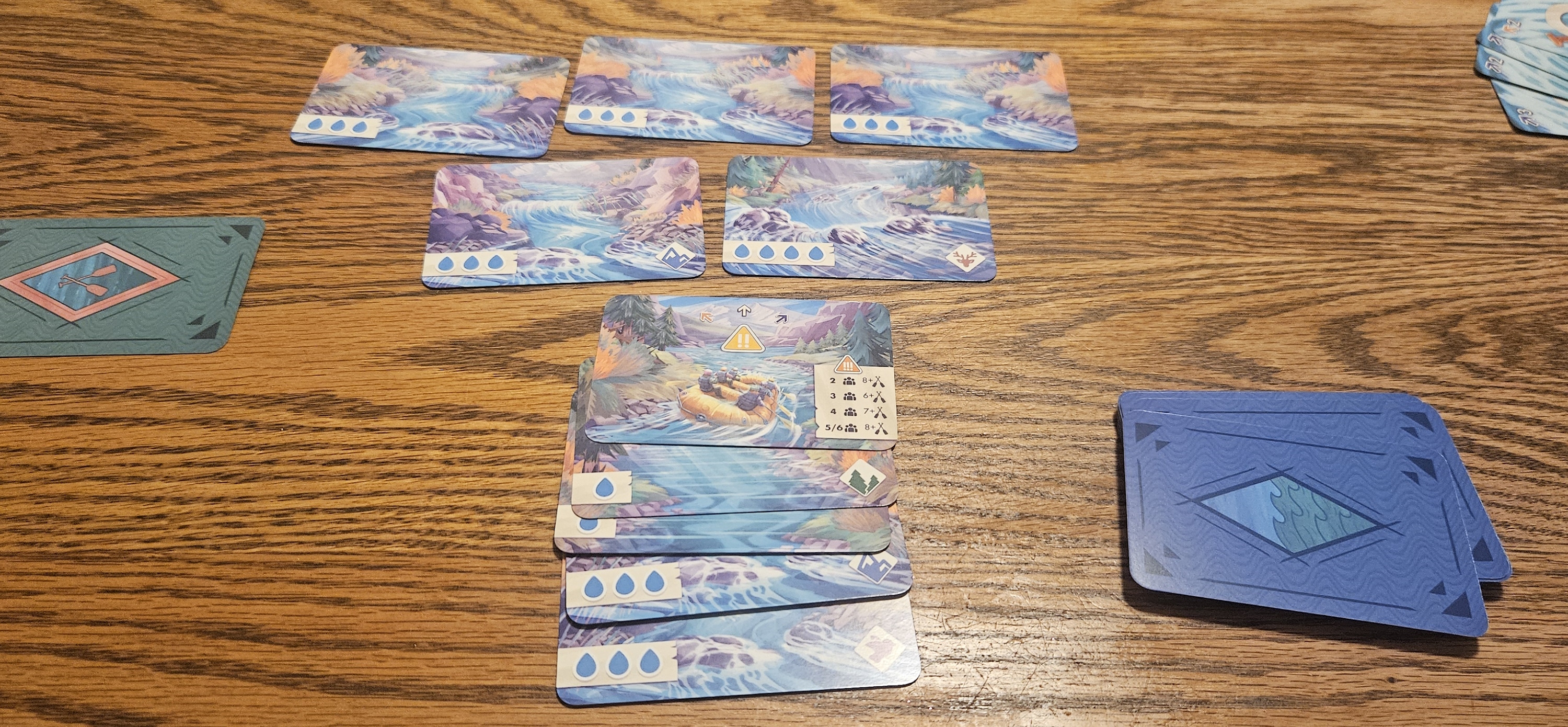
Choosing which leg to navigate.
Roaring River is either the lowest-stakes shared incentives game of all time or else the most relatable. Yes, you’re on a rafting trip. Yes, everyone has a different idea about what will constitute a pleasant time. No, nobody is willing to collaborate so that everybody can get a little bit of what they want out of their weekend.
Every turn revolves around two snippets of information: the lay of the upcoming river and the cards in your hand. Seeded at random from the deck, the river is presented as a series of forking opportunities to catch white water, glide peacefully downriver, or see various sights. Control of the raft is divided between players. Everyone has a hand of paddle cards, which can be played to influence whether your boat goes right, left, or straight down the middle.
As the raft progresses, cards are stored behind it, creating a history of your trip. In theory, you can consult this history to deduce the desires of your fellow players and therefore counteract them. If so-and-so intends to see waterfowl at all costs and there’s an upcoming cactus wren on a branch, well, you’d better paddle hard if there’s something you want to see on the river’s other leg.
For those who aren’t getting the vacation they wanted, there is a path to vindication. Instead of playing nice, they can lean into the big swells, paddling the boat around until it tips. When that happens, the points are still tallied, except it’s the player with the lowest score who wins. Take that, happy fellow vacationgoers!

Paddle: Shall I?
It’s a cool concept, especially for anybody who’s been on a poorly planned family vacation and understands the friction that results from multiple people wanting to do different activities, even if the conflict is as mundane as bickering over what to play on the radio during the drive.
At its heart lies the contrasting objectives of the raft’s passengers. This is also where it departs most significantly from how we played it the first few times. My assumption was that everybody’s goal was drawn face-down — apparently, I’ve played way too many social deduction games. The problem is that your goals are laid bare for all to see. And I mean it’s a problem in two senses. First, because it means I played the game like four times under the wrong assumptions, and second, because everybody at the table knows whether you’ll try to lead the raft left, right, or down the center.
This is fertile soil for some intriguing guesswork. Because you know what people want, and you know what they’re holding in their hands, it’s possible to navigate your fellow rafters’ intentions to get ahead. For example, if there’s some temporary overlap between two players’ objectives, perhaps because a card shows both some wildlife and a lazy section of river, you now have some options. You could help them paddle in that direction, but only by playing your low card. This would net you a bonus point for helping out the winning team. Or maybe you could rest for a spell, picking up some of your spent cards. Better yet, maybe it’s time to threaten to spoil the trip for everyone. By paddling along, you could unsettle the raft and bring it one step closer to tipping over. Then again, maybe these short-term buddies don’t intend to play their big cards, assuming that their alliance is enough to see them through. In that case, maybe it would be a good time to break the other direction…
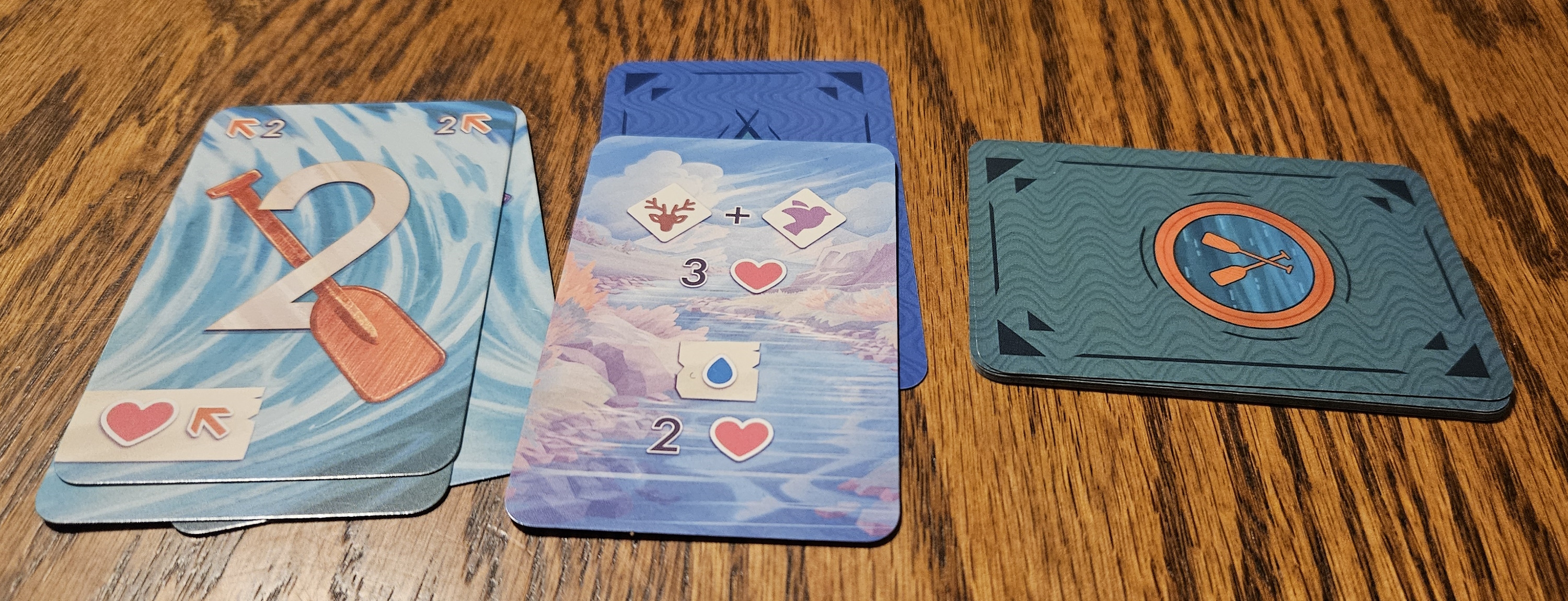
Maybe it’s time to tip this raft…
It still isn’t a perfect game. As before, the incentives are a little too muddy, and the game a little too short, to ever clarify into something like informed control. In practical terms, players are bidding on the direction they want to take the raft. These bids, though, are often made over minute dribbles of points. Given the diffuseness of your objectives, it’s also possible that you’ll want to go both ways at once, with only the slightest variance in value between them.
Similarly, points can also come from another source: cooperation. One of your cards for each direction, the lowest of the batch, awards a point if that side happens to win. By going with the flow, it’s often possible to win four points, give or take, by the end of the game. That’s no small amount, possibly just under half of a competitive score. It may well be enough to tip the whole session in your favor. For at least some of your ride, it’s more worthwhile to go along with the crowd than to pull the raft into choppy water. That doesn’t exactly make for an exciting whitewater trip.
Still, Roaring River’s clarity is enough to generate one tense turn after another, especially when everybody exerts situational awareness of who wants what and who’s still holding which paddles. These moments only appear two or three times per game, but operate as microcosms of why shared incentives are so gripping. Trying to decide whether to lean into a leg of the river that’s worth a bunch of points, but will also boost the score of your buddy in the lead, makes for some good gaming.

My goal is to get wet.
There’s a spot I’ve rafted a couple of times where the Green River flows into the Colorado. For some distance afterward, the mud-slick waters of the Green mingle with the… well, the Colorado River isn’t clear, but it’s a clearer hue than the other. They blend slowly, traveling side by side like two mismatched ribbons.
Roaring River reminded me of that confluence. This is a game about navigating its own confluences, these ones social rather than physical. It helps, too, that the game is about rowdy kids pulling their paddles in opposite directions. Roaring River isn’t a great game, but it’s an affable little thing, putting some of the hobby’s weightier concepts on display in miniature.
(If what I’m doing at Space-Biff! is valuable to you in some way, please consider dropping by my Patreon campaign or Ko-fi. Right now, supporters can read a 3,000-word overview of the forty-ish movies I saw in theaters in 2024.)
A complimentary copy of Roaring River was provided by the designer.
Posted on January 21, 2025, in Board Game and tagged Board Games, Jolly Dutch Productions, Roaring River. Bookmark the permalink. 4 Comments.

 SPACE-BIFF!
I appreciate the correction, even if I’m not too interested in the game itself. Thanks!
Thanks for reading!
I second this, even though it’s not a game that I’m likely to play, thanks for the updated review.
I never read the first one, being usually up to a week behind on these articles, but this does seem like the kind of games that me and mine go for. Although, the article does have me wondering if it might be too short for me to properly invest myself in the game. A lot of short games, for some reason, fail to stay on the table long enough for me to get invested in the play. Although, it’s not just length that does it, as I get wholly invested in every play of Win, Lose, or Banana and there is no shorter game, and I can think of plenty of long games that kind of just feel like all fiddle with no game attached. Just going through the motions. Walking through the part.