Photograph of a Battlefield

Persistent readers will be well aware that I’ve been writing about some of the titles to come out of the recent Indie Games Night Market. Three of them, High Tide, Out of Sorts, and Torchlit, were among my favorite tabletop experiences of 2024.
Chris Lawrence’s Propaganda represents a different manner of showing from the Night Market, both tonally and in terms of polish. Where that previous trio had been fashioned to a high sheen, functioning almost like an audition — and indeed, two of them have since been picked up by publishers — Propaganda is an act of unsettlement. It is the most starkly “indie” of these indie games, confronting players with difficult questions about the media we regularly consume.
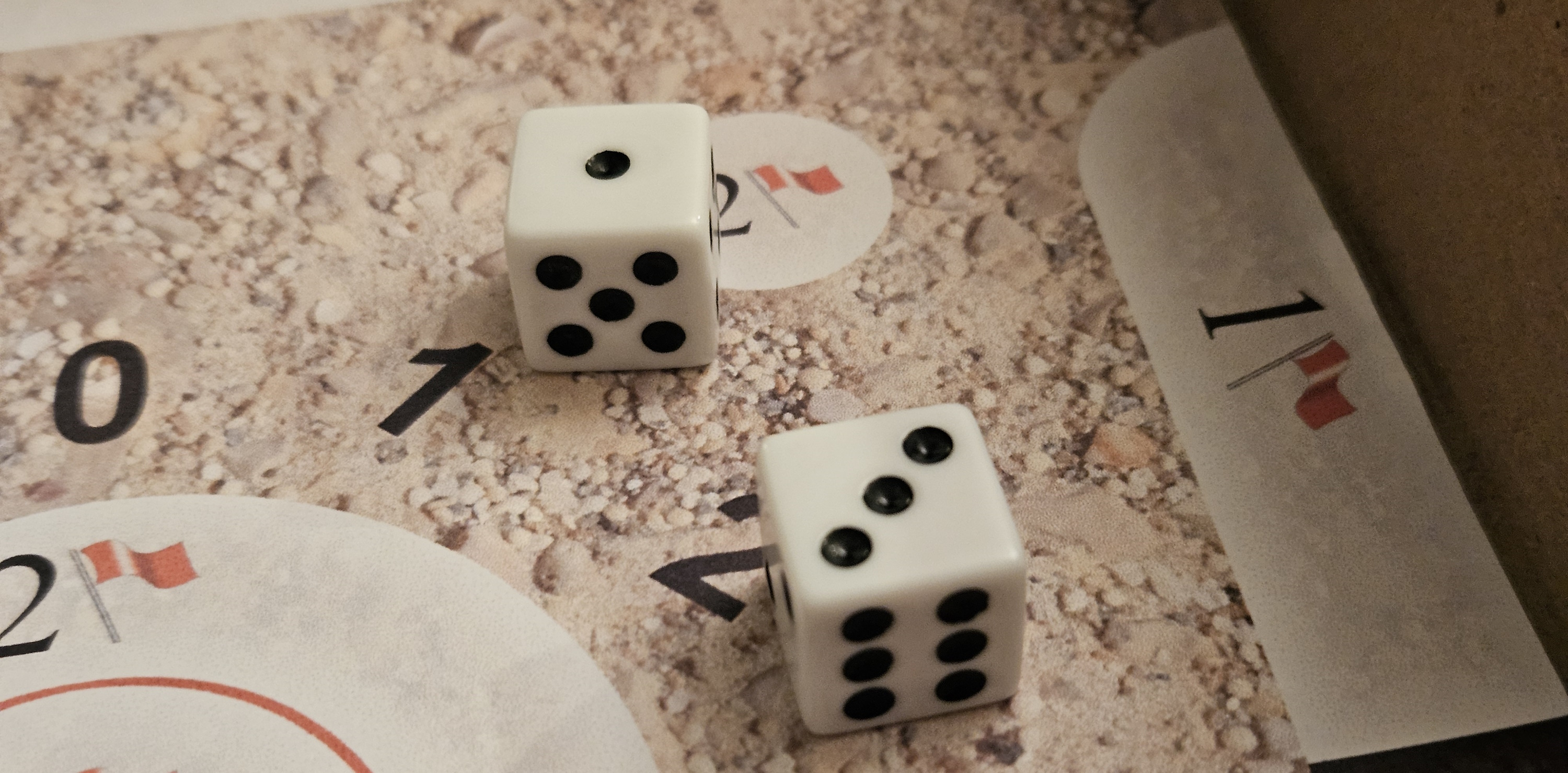
These far-flung shores.
It’s oddly fitting that a game this ambitious should appear so mundane in its presentation. Rather than aiming for an impressive production, the craftsmanship of Propaganda is simple. Lawrence has pasted two sheets of paper into the base and lid of a box, baggied twenty-four dice, tossed in a few colored cubes and a score tracker, and called it a day.
The implications of those components are anything but simple. It begins with a battle. Exactly how that battle is expressed varies with player count. For simplicity’s sake, I’ll stick with the three-player mode.
Two of our players become belligerents in war. Both are assigned a color of dice, white or black. To wage war, they simultaneously fling three dice each into the box, ideally rebounding them from their respective back-ends to clatter onto scoring spaces. They will repeat this process three times, first adding another trio of dice, then later removing a few from the box and throwing them again. Their objective is to achieve as high a sum as possible, hopefully overwhelming their opposition’s number. Aiding in this endeavor are a pair of combat cards, one per side, which award additional strength to their owner for rolling specific numbers.
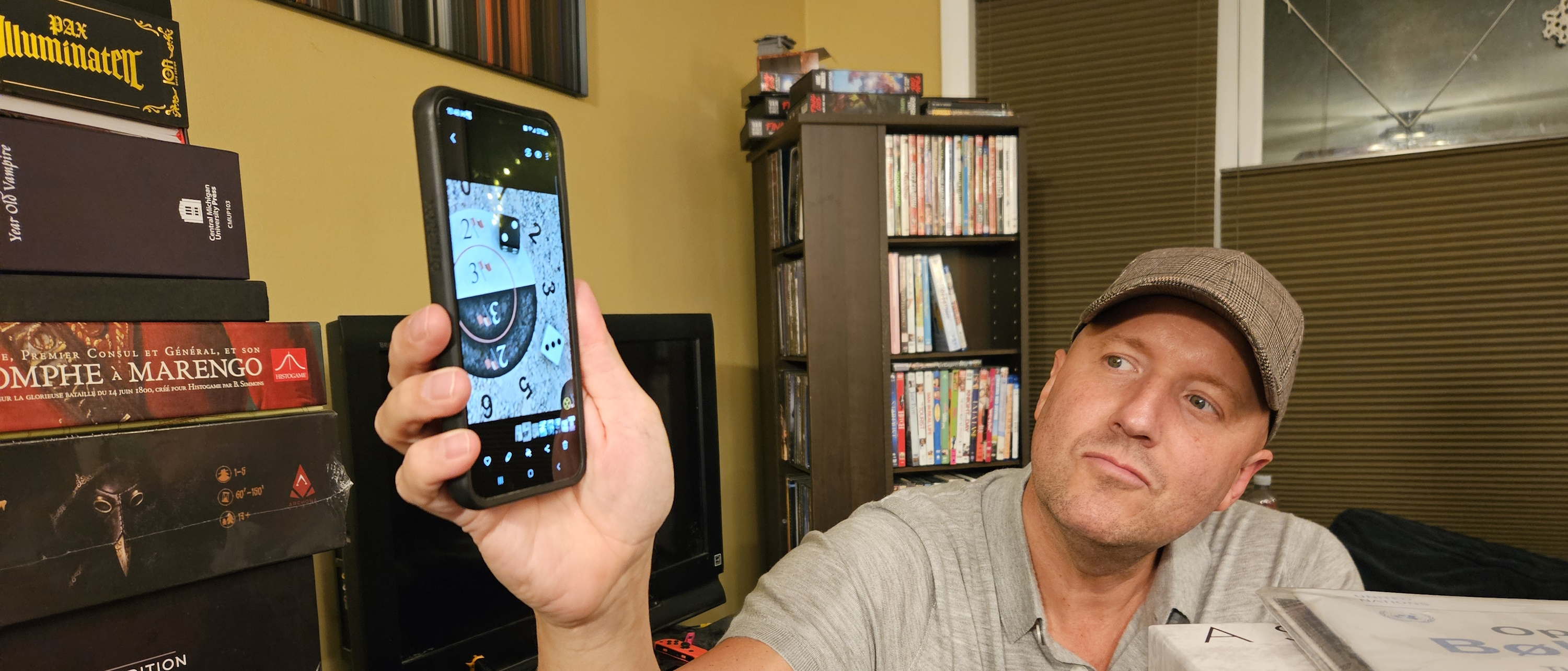
Examining the evidence.
Along the way, Lawrence adds something essential. With each throw, both players snap a picture on their phones. The rules for these pictures are as straightforward as the production, but set in stone: each image can only show two dice, presenting a limited snapshot of the wider war, and is prohibited from showing the contents of either side’s combat cards.
The importance of these images soon becomes obvious. The third player — or everyone who didn’t take part in the battle, should there be more than three people at your table — has been sequestered from the conflict. In our case, we weren’t willing to depart into separate rooms, so we heaped up a dividing wall of board games. This extra player now takes on the role of a global superpower. They are presented with the images, along with impassioned pleas from the conflict’s belligerents. After these hearings, each superpower assigns some amount of additional strength to one or the other side of the conflict.
At this point, everybody’s objectives diverge. As a belligerent in the war, your goal is clear enough. By scoring a higher strength than your opponent, you earn victory points. The greater the differential, the more you score. As a superpower, you want the conflict to break even. The closer in sum those two sides are, the better your score. It’s only when there’s a clear winner that the superpower scores nothing.

The current standing of the international war effort.
In theory, this process then repeats, with superpowers rotating into the belligerent roles and vice versa, until a handful of wars have been fought and tallied. This is the “game” portion of the game, a concession to playability and balance that, honestly, isn’t all that necessary to the point Propaganda is making.
As a statement, Lawrence has crafted something chilling, even in this raw state. Every step of Propaganda makes its own argument, and nobody comes out looking rosy. The isolation of its superpowers from the conflict. The selective documentation of its belligerents. The curtness of the war hearings. The flippancy of those delivered arms. The intent behind them, meant to prevent the emergence of a clear victor — or the possibility of a new competitor for the superpowers.
I play something like two hundred new board games every year, and Propaganda feels like it’s jabbing a finger in their face. Because it isn’t only photographs that are carefully framed. It’s everything. The edges of a battlefield hex map. Who gets included as an in-game faction. The threshold for concluding a session. What counts as victory points. Anybody who’s huddled in a map’s corner to prevent a flanking maneuver or leveraged some persnickety scoring rule to their advantage has taken advantage of a board game’s artificial framing.
To be clear, framing is necessary. There’s no such thing as an all-encompassing board game. If there were, nobody would — or, indeed, could — play it. But Propaganda puts the framing front and center. It asks us to think about how we frame conflicts in play, where their assigned boundaries terminate, why this particular game concludes after three wars rather than four, or one, or none at all. Those are worthwhile questions for a medium that necessarily begins every project with the question “How much ground will this game cover?”

A Harvest of Death.
Of course, tabletop design isn’t the only target in Propaganda’s sights. Its scope is broader and more pressing, casting doubts on the information we ingest. Those questions have become even sharper as generative imagery threatens to erode our capacity to discern truth from falsehood. In a FAQ on BoardGameGeek, Lawrence notes that players are free to edit their images. Given the paucity of the game’s information state, it’s hard to imagine the benefits of doing so. But the mere possibility of falsified imagery introduces a certain degree of uncertainty. Can players ever be certain that what they’re being shown is accurate?
To some degree, this has always been the case. Given the game’s emphasis on photography, the touchstone that springs to mind is Timothy H. O’Sullivan’s collection of war photographs.
Taking part in the American Civil War, O’Sullivan was a low-ranking member of General McClellan’s staff, working as a topographical photographer and at some point joining Mathew Brady’s project to document the war via photography. At the time, this was a radical proposal. When it came to covering warfare, photography was considered direly limited compared to political cartoons, battlefield paintings, or print reporting. A camera could only open the smallest of windows onto a scene, immortalizing a mere blink rather than describing the wider issues at play. How could a photograph express the true scope of something like a battle?
In the aftermath of Gettysburg, O’Sullivan made his attempt. The eight prints he developed were stunning, and although the enterprise wasn’t a commercial success at the time, they came to be considered the premier images of the Civil War when they were compiled in Alexander Gardner’s Photographic Sketch Book of the Civil War. A Harvest of Death in particular proved shocking to the public, revealing a battlefield strewn with corpses.
But Harvest wasn’t proof that the camera was a faithful auditor of reality. Closer examination revealed at its contents had been carefully staged. Another of O’Sullivan’s photographs, Field Where General Reynolds Fell, had been developed of the same scene as Harvest from a contrasting angle, describing the exact same corpses as Union patriots rather than abandoned Confederate traitors. Across another two plates, A Sharpshooter’s Last Sleep and The Home of a Rebel Sharpshooter, O’Sullivan and Alexander Gardner repositioned the eponymous sharpshooter’s body; the blanket used to drag the boy’s corpse is visible in the second photograph.

The pip of a die at 30x magnification.
In each of these cases, photographs had been revealed as not only evocative, but dangerous, capable of adjusting the truth every bit as much as cartoons or paintings. Propaganda centers these issues. By only snapping an image of two dice at a time, players are naturally incentivized to show the war at its most dire, with opposing dice poised menacingly over their objectives.
At the same time, this imposition also serves to limit Propaganda’s effectiveness. When superpowers are presented with scenes from the ongoing war that all appear more or less similar, they’re right to doubt their veracity — or at least their totality. Propaganda raises sweeping questions about framing, staging, and representations of reality, but keeps their scope so constrained that the game becomes one of bluffing rather than representation. Winning at Propaganda is about appearing persuasive, grounding its skillset closer to a party game than a wargame.
I’ll put it another way: Propaganda is a very difficult game to avoid developing. It’s bad practice for a critic to give advice. We’re at our most useful when discussing the artifact as it was presented to us. But Propaganda is so close to making some truly incisive points. Those points, however, would require the game to deepen its portrayal of warfare. This is a game, for instance, where atrocities should be represented. As dice, of course! But atrocities nonetheless. Similarly, superpowers ought to be beholden to their own internal considerations.

A Spartan standoff.
This isn’t without precedent. Two games spring to mind. In the aftermath of the United States’s catastrophic withdrawal from Afghanistan, some commentators rightly asked about the veracity of something like Brian Train and Volko Ruhnke’s A Distant Plain, which presented an avenue for U.S. forces to declare victory. Except, as both the designers and other critics pointed out, that same game had also argued that U.S. victory was no such thing. The American player’s goal wasn’t to win the war. It was to withdraw at an expeditious moment. It was to appear successful without actually being successful.
The better example is Mark Herman’s Pericles, a fascinating game that ought to have a hundred imitators but has yet produced none of note. (Partially because Pericles also needed some serious development, but I digress.) In Pericles, four players are given coupled roles as Athens and Sparta in the Peloponnesian War. Instead of functioning solely as belligerents, however, they also serve as conflicting polities within the Athenian and Spartan governments. While one player conducts the war, the other criticizes their actions, calls for peace, insists on hosting Olympic Games — anything, basically, that will undermine their ally’s position. The ultimate isn’t the side that win the war, but the dominant faction within the victor’s city-state.
Propaganda stands on the cusp of making similar arguments about the nature of victory. In some ways, it’s poised to make those arguments even more sharply thanks to its emphasis on abstract battles, untrustworthy visual representations, and simplified geopolitics.
But it isn’t there yet. Currently, it stands in an awkward middle ground. Its battles are too one-note to present many opportunities to warp reality, while its wider considerations are more taken with tally-sheet equilibrium than allowing the superpowers to do much more than guess at which belligerent is bullshitting them harder. Propaganda raises questions, hard questions, but doesn’t quite know what to do with them on the table.
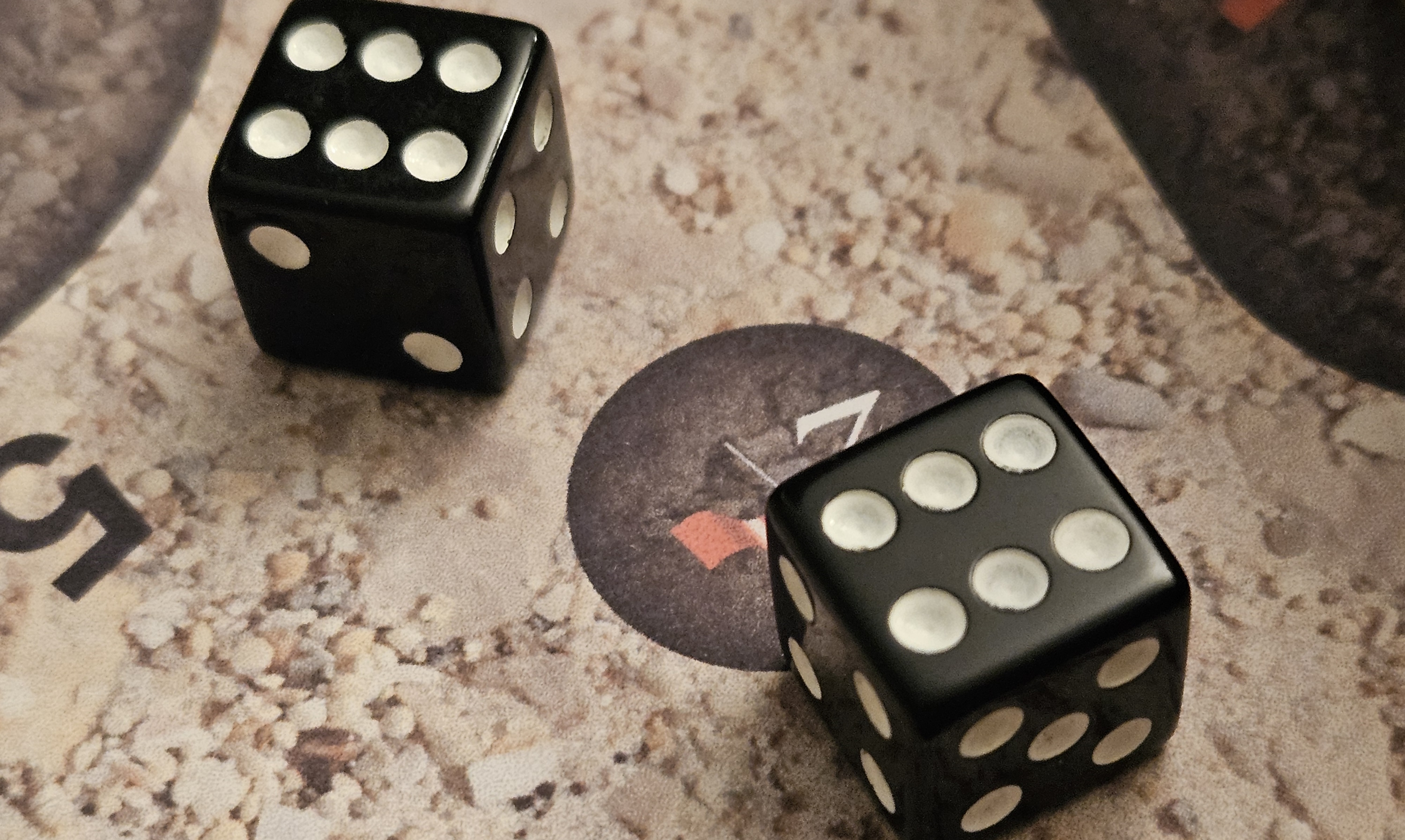
Hostiles.
In one sense, this is exactly what I was hoping to see from the Indie Games Night Market — abrasive, difficult games, those that would naturally struggle to find an audience or a publisher, but that are ambitious and boast a distinct perspective. Propaganda is all of those things. Right now it is a sparkler; it could be a thunderclap.
(If what I’m doing at Space-Biff! is valuable to you in some way, please consider dropping by my Patreon campaign or Ko-fi. Right now, supporters can read a 3,000-word overview of the forty-ish movies I saw in theaters in 2024.)
A complimentary copy of Propaganda was provided by the designer.
Posted on January 9, 2025, in Board Game and tagged Board Games, Eternal Studios, Propaganda. Bookmark the permalink. 9 Comments.

 SPACE-BIFF!
Huh, this is quite interesting!
Another game that uses smartphone pictures and framing in a creative way is Bycatch, a game about drone warfare where players hold hands of cards, and choose which cards of their rivals are eliminated based on badly focused cellphone pictures of those hands, taken the previous turn by a phone held backwards.
https://boardgamegeek.com/boardgame/170174/bycatch
Re the American withdrawal from Afghanistan in 2021, there was an academic paper on gamer/player/(designer) reaction to the event via A Distant Plain.
https://www.tandfonline.com/doi/full/10.1080/13642529.2024.2339120?src=
Thanks for sharing, Brian! What a fascinating game Bycatch looks to be…
You’re welcome. Rules are on BGG but I don’t know how you could get a pre-made copy. Anyway, more of a gesture than a competitive game, as the dolts commenting on it there prove.
Fascinating concept.
Yes.
Interesting. Scary. Or both. As usual, fascinating piece of writing. It reminds me (a little) “The Cousins War”, where players bluffing about their potential strength in battle. This one looks like a step further in more contemporary and more difficult times.
I should try out The Cousins War!
Interesting that phone cameras are appearing more and more as a game component. I’m reminded of “Picture Perfect”, a logic and memory game where you have to arrange an argumentative family for a photo in a way that respects as many preferences as possible (I want to be in the front! I want no one to see Brittany’s face!), but then at the end you take the actual photo with your phone, which is scored.
Yeah, I played another phone-centric game over the weekend! It’s called Signal, it’s another game about communicating with aliens, and it allows players to take pictures or videos of the alien’s moves in order to rewatch them and deduce the alien’s hidden rules. Very clever.