Bottle Princess

Since all I play anymore is trick-taking games, it seems fitting that I should inaugurate the New Year by writing about two titles that have been occupying my winter break: Bottle Imp, the reissue of Günter Cornett’s 1995 classic, and Rebel Princess by Daniel Byrne, Gerardo Guerrero, Kevin Peláez, and Tirso Virgós.
What’s their unifying thread? Mostly that trick-takers are often accused of being “themeless.” Probably because they often are. But these are two examples of how to imbue a trick-taker with a tangible setting, and in the process aid players in remembering the import of all those individual plays.
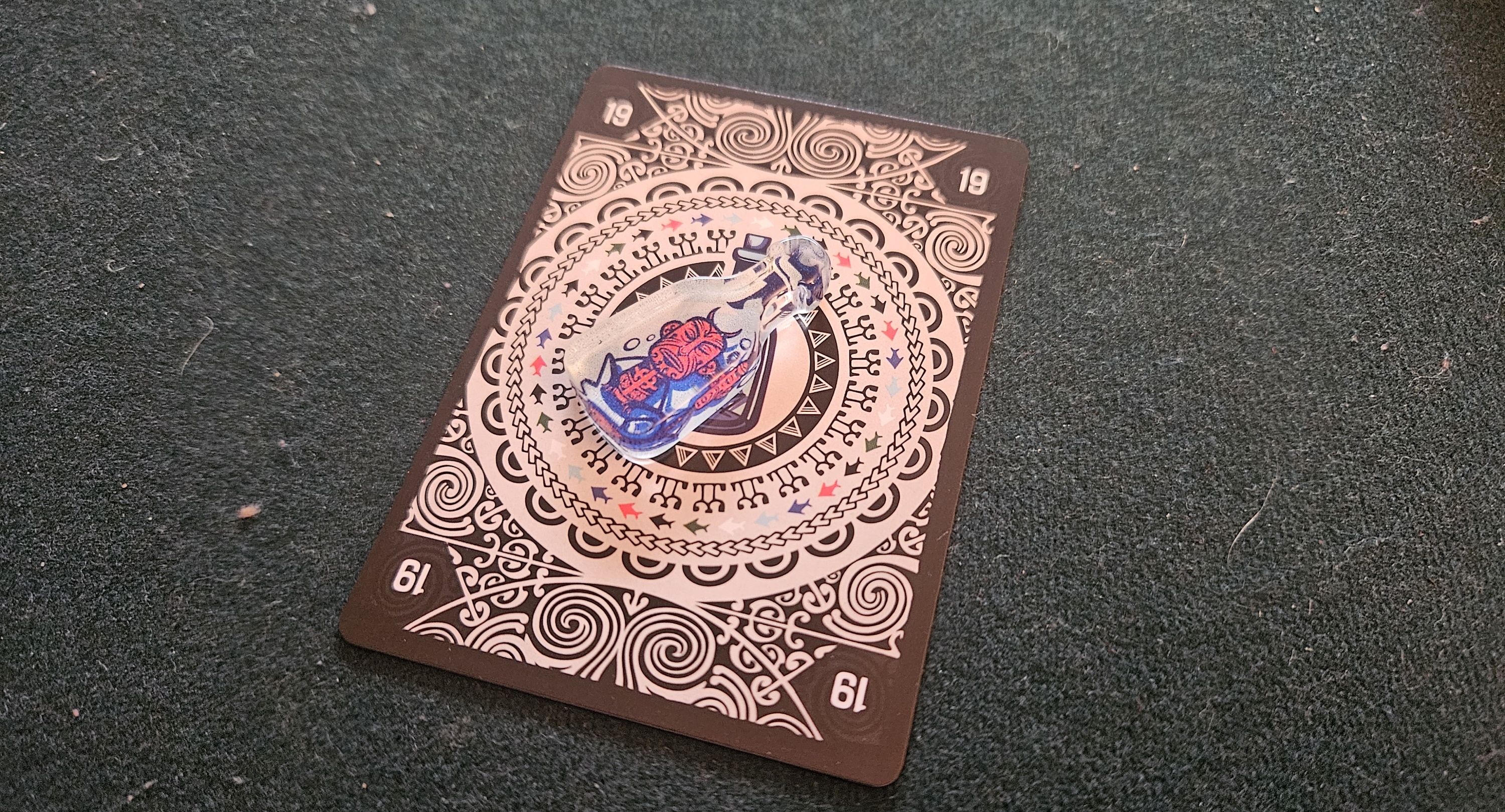
Pop that cork!
Based on the short story by Robert Louis Stevenson, Bottle Imp revolves around a single demonic idea: what if you could purchase a bottle that granted all your wishes, but the demon contained within also sent you straight to hell when you finally passed on? The trick is that you can sell the bottle, shifting all those wishes and their attendant curse along to somebody else, but only at a loss.
I don’t often care about fluff, but Bottle Imp is one of the few games where I regularly read the introduction aloud to the table. For one thing, it was written by Robert Louis Stevenson, so the prose isn’t as shameful as your usual board game fare. For another, Stevenson’s description of the bottle imp is an apt explanation for the game’s whole thing.
Like most trick-takers, your goal is to take tricks. But rather than falling prey to the tyranny of high numbers, anybody can steal a trick by bidding low. Exactly how low is the lingering question. When the hand begins, the bottle imp — which in this remaster is a lovely resin thing that’s a joy to handle, not to mention also pulling double duty for sessions of spin-the-bottle — has its current price set at 19. Playing a card lower than 19 means the bottle imp is up for grabs. Whoever plays the highest rank below that sale price will steal the entire trick, including all the high-scoring cards other players may have bid. Well done! You just swiped a whole bunch of points!
But this is where the curse kicks in. The card you used to win the bottle imp becomes its new price. Unless you want to lose the hand outright — and worse, subtract a bunch of points from your overall score — you will need to move the bottle along to somebody else.
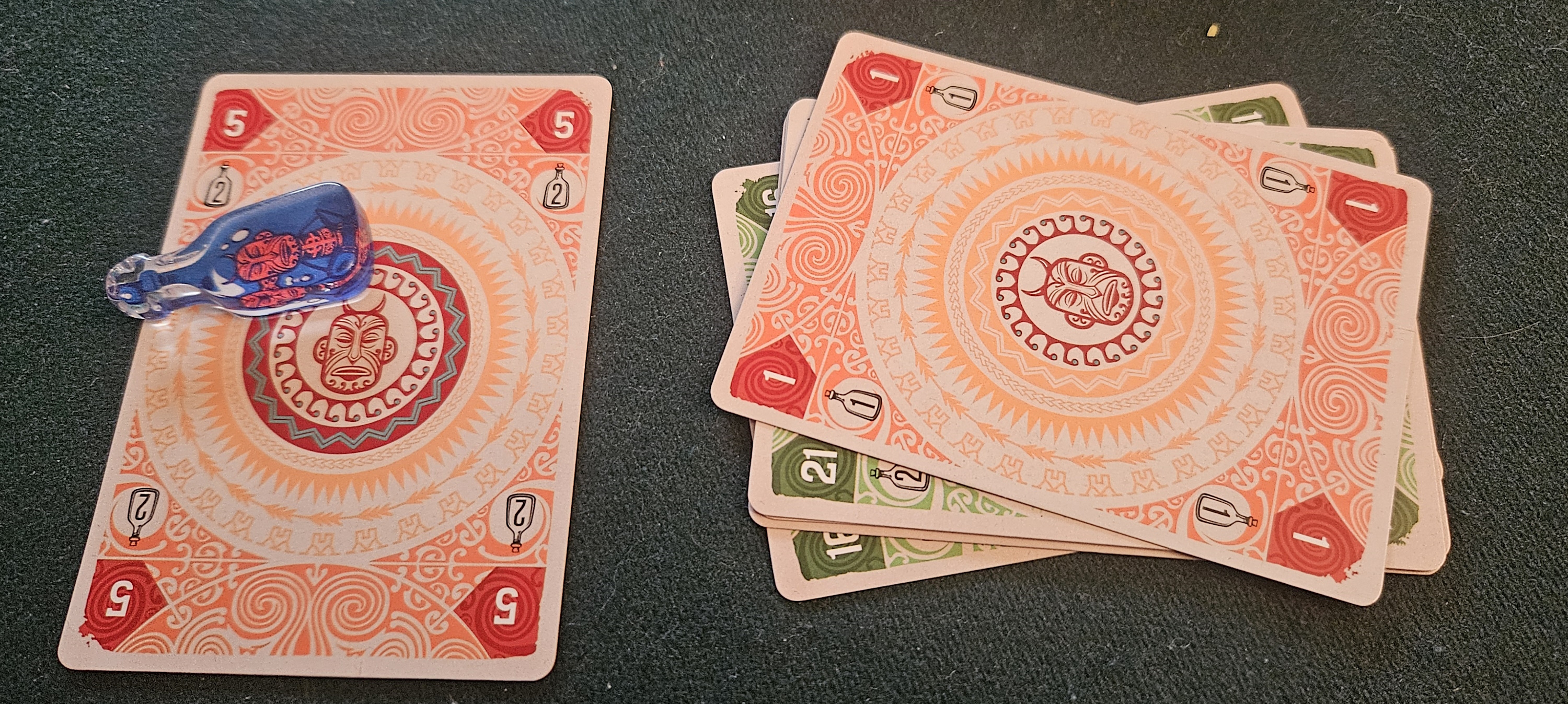
Not looking good here…
The tension is magnificent. Bottle Imp is swingy, especially once players begin stealing valuable plays. When the three players before you toss high-ranking cards into a trick, each higher than the last, only for you to swipe the whole thing by marginally undercutting the bottle’s current value — those moments feel like true devil’s deals.
But holding the bottle for two, three, four tricks in sequence? Agony.
There’s some card-counting involved. We are talking about a trick-taker here. Because the highest bid wins the bottle, there are windows for shedding lower-valued cards. Then again, it’s also possible to get stuck shedding the wrong card because you’re forced to play in-suit. Each hand is an examination of that core tension, whether enough low-valued cards can be dismissed to force the bottle onto some hapless recipient. The result is wonderfully textured, each hand felted with little trembles of anticipation, held breaths, much-needed exhales.
Along the way, the game’s premier accomplishment is that it suits the fiction so well. Even with the benefit of Stevenson’s story it can take a hand or two to come to grips with the whole thing. Without it, the entire thing would fall apart, or at least be that much more of a pain to teach. It’s easy to see why this game is getting another edition. If you had told me Bottle Imp was designed yesterday instead of 1995, I would have believed you. That’s how cleverly modern it feels.
My little black book.
Take Rebel Princess, which is so modern that it’s only a couple years old and already has both a second edition and deluxe edition. Much like Bottle Imp, this is a trick-taker that puts its fiction through its paces. You’re a princess at a slumber party. Only, ick, a bunch of nasty princes keep sneaking in to ask for your hand in marriage. Fie, nasty suitors, fie! What part of “girls’ night” did you not get through your thick skulls?
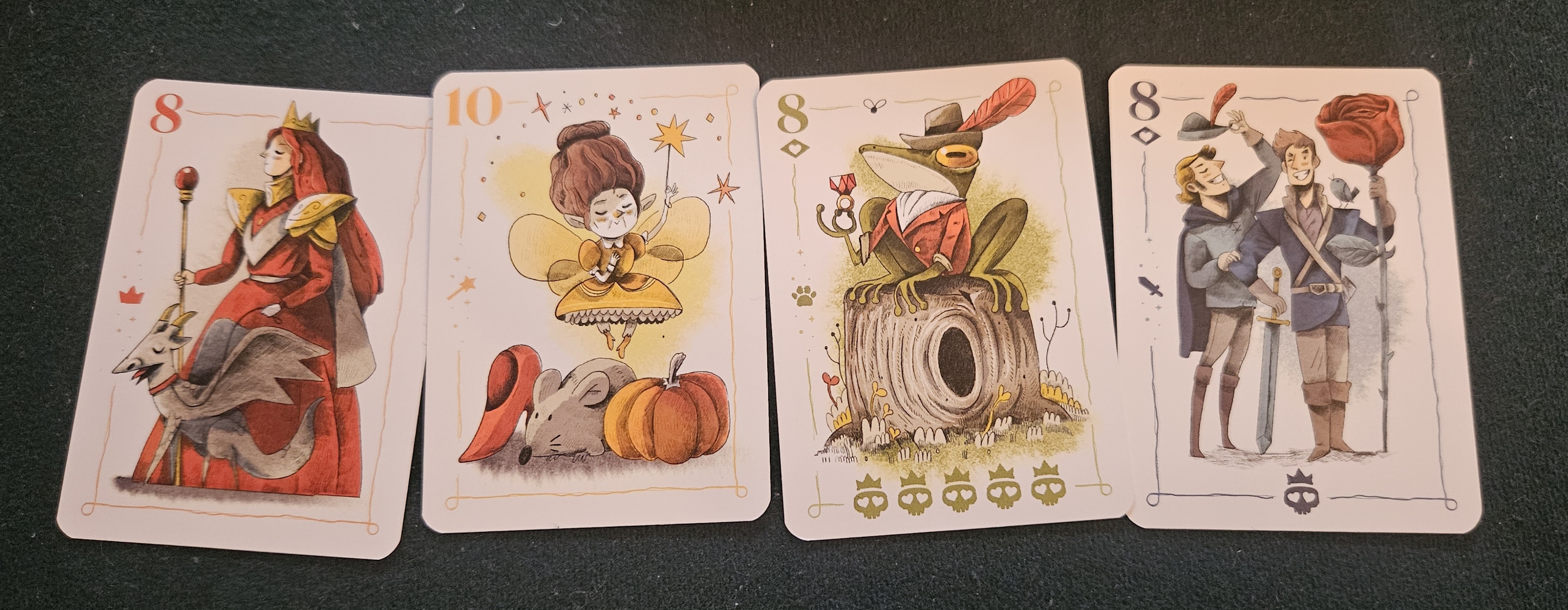
In game terms, Rebel Princess is about avoiding proposals. These mostly arrive in the form of princes, the most despised of the game’s four suits, but there’s also a toad worth a whopping five proposals. Because the frog is a prince, of course. And you have to kiss him. And after transforming back into a prince, your princess is confronted with the crushing obligation to put a tidy bow on some fairy tale. As a feminist text that challenges the Disneyification of our expected courtship rituals, this pumpkin is ripe for dissection.
Where Rebel Princess seems a bit more modern than Bottle Imp, or at least more trendy, is its variable powers. Every princess has her own ability. As a master wilderness guide, Pocahontas can choose who will lead the next trick. Snow White can send her hench-dwarves to lower a card’s rank to zero. The Little Mermaid can siren the leading princess into playing a suit of her choice.
Similarly, each of the game’s five rounds represents a different portion of the slumber party. The night might begin with a masquerade, forcing everybody to play their cards face-down, then morph into a session of musical chairs, with cards being passed after each play. Rather smartly, the final hand tends to be the swingiest. Perhaps everybody pools some of their cards to offer to the current trick’s winner, or maybe your fairy godmother appears to negate marriage proposals altogether.

Each princess has her own way of avoiding trouble (proposals).
Where Bottle Imp is marked by its tension, Rebel Princess is bubbly and thrilling. Losing streaks still happen, moments when five princes kick down the door to ruin your day, but it’s friendlier, not quite so card-county. As long as you know whether the toad has appeared, you’re holding onto the right information.
But while its fiction isn’t quite as indispensable as Bottle Imp’s, Rebel Princess still leverages its story to the hilt. It’s one thing to avoid a particular suit. Another entirely to be given a solid reason why that suit is so disagreeable. Rebel Princess is like playing tag. You’re always on the move, always adjusting to situations as they arise, always feeling that prickle on your back when somebody is about to jab you. Using your princess power at exactly the right moment, or adhering to the party’s rules in just the right way to avoid a proposal, feels like stepping out of the path of an oncoming bus. Or an unwanted kiss. Kiss with tongue.
Do I have a favorite? Not really. They’re such different experiences. But taken together, this is exactly the sort of thing I love from a trick-taker. These games do more than put a little spin on the formula. They lean into that spin until they whirl around and around, until they’re dizzy with it. Bottle Imp feels like fulfilling and passing along a curse; Rebel Princess feels like declaring independence from overbearing suitors. Both have a place in my growing stack of favorite trick-takers.
(If what I’m doing at Space-Biff! is valuable to you in some way, please consider dropping by my Patreon campaign or Ko-fi.)
A complimentary copy of Bottle Imp was provided by the publisher. A complimentary copy of Rebel Princess was provided by a reader.
Posted on January 3, 2025, in Board Game and tagged Board Games, Bottle Imp, Grail Games, Matagot, Rebel Princess, Zombie Paella. Bookmark the permalink. 6 Comments.

 SPACE-BIFF!
I love Rebel Princess! I’ve only played it twice so I haven’t reviewed it yet, so I’m glad to see yours and that you enjoyed it.
I think it’s a great example of a trick-taker with twists, which seems almost required nowadays.
I’m surprised you didn’t mention that it’s basically Hearts with a bunch of stuff added, though.
Thankfully, the “stuff” is great!
I’ve heard so many good things about Bottle Imp that I would love to play it one day.
I’ll look forward to your review!
These sound more like Rebel Imp.
Rebel Princess seems to be curious. It recently won the BGG Trick-rating guild’s GOTY award… but many trick-taking veterans seem to be lukewarm on it – often describing it as a chaotic version of Hearts or Tournament at Camelot lite. Still, all I read about it seems to be something I’d enjoy a lot.
Trick-taking veterans can be as dogmatic as any other gathering of veterans! So it goes.
Hm… That’s not what I wanted to imply. The TT guild is a great bunch of people and also overall voted RP their GOTY. I guess for many skilled TT players “Hearts plus card abilities” is not what they’re looking for. For me, it might be ideal.
The theme of Rebel Princess makes for a fun time. I enjoyed the inclusion of asymmetric characters, and the different victory conditions for each round help to spice up Hearts. I love Hearts to death but the game is not going to be too interesting to those not into card games in the first place.