The Fellowship of Bill the Pony
I’m a sucker for unabashed enthusiasm. The Fellowship of the Ring: Trick-Taking Game, designed by Bryan Bornmueller, is brimming with the stuff.
As you might have gleaned from the title, this is a trick-taking game set in the world of The Lord of the Rings. Except, scratch that, Bornmueller has wisely narrowed his scope to Tolkien’s first volume. This affords him some breathing room. Rather than taking us on a whirlwind tour of the entire trilogy — or all six books, if we want to be pedantic about it — Bornmueller drills down into what makes The Fellowship of the Ring so gripping in its own right. Yes, Tom Bombadil makes an appearance, alongside Goldberry, poor forgotten Glorfindel, and Farmer Maggot (now more than a menacing scythe). Even Bill the Pony is a playable character.
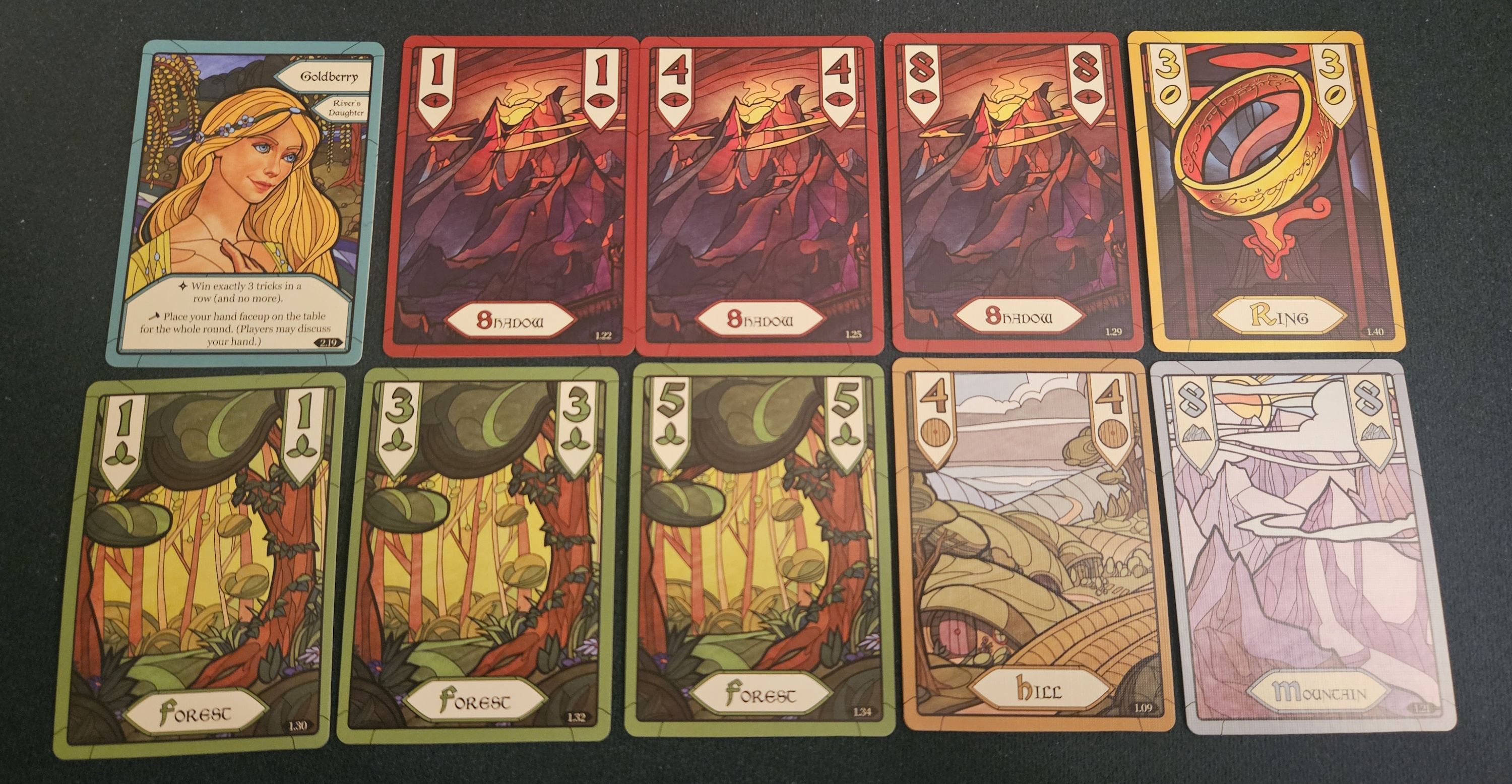
Goldberry!
Character. That’s the first major achievement of this tighter focus. I’ll get into the specifics of how those characters function in a moment, but the quick introduction is that they feel true to their identities without requiring heaps of rules. Cracking a new chapter is as much about of seeing which old friend you’ll meet as it is about figuring out the particulars of that chapter’s rules.
Speaking of chapters, the game’s second accomplishment is pacing. Much like Tolkien’s trilogy-opening novel, Fellowship is content to meander. There are eighteen chapters in all, and it’s a good handful before we step foot outside the Shire. Even then, there are plenty of diversions in Bornmueller’s ludic retelling. The major beats appear, of course, the Mines of Moria and the journey down the Anduin, even a flashback about Gandalf escaping from Saruman’s clutches. But there are also games of hidden identity in the Prancing Pony, recovering in Rivendell, faffing about with Old Man Willow. There are climaxes along the way, tense chapters that raise the stakes, as well as sessions of relative calm.
I mention that last point because the obvious comparison to Fellowship is, of course, Thomas Sing’s excellent The Crew: The Quest for Planet Nine. Like that game, this is a cooperative trick-taker that gradually escalates both its complexity and its stakes. This isn’t something you flip open to its midsection and hope to succeed on the first try. Most chapters require patience, repetition, and no small amount of luck to finally get them right.
That, too, is part of the game’s charm. There’s nothing quite like attempting a single chapter three or four times in a row, edging closer to victory with each repetition, and then watching as every trick goes to the proper winner, the suits line up just right, and the whole conundrum folds like a sheet of paper. It helps that sessions are quick, usually only lasting a single hand. Some eventually require more, but even those consume two or three hands at most. The price of failure is an extra ten minutes, maybe with a strategy-clarifying pep talk before the next deal.
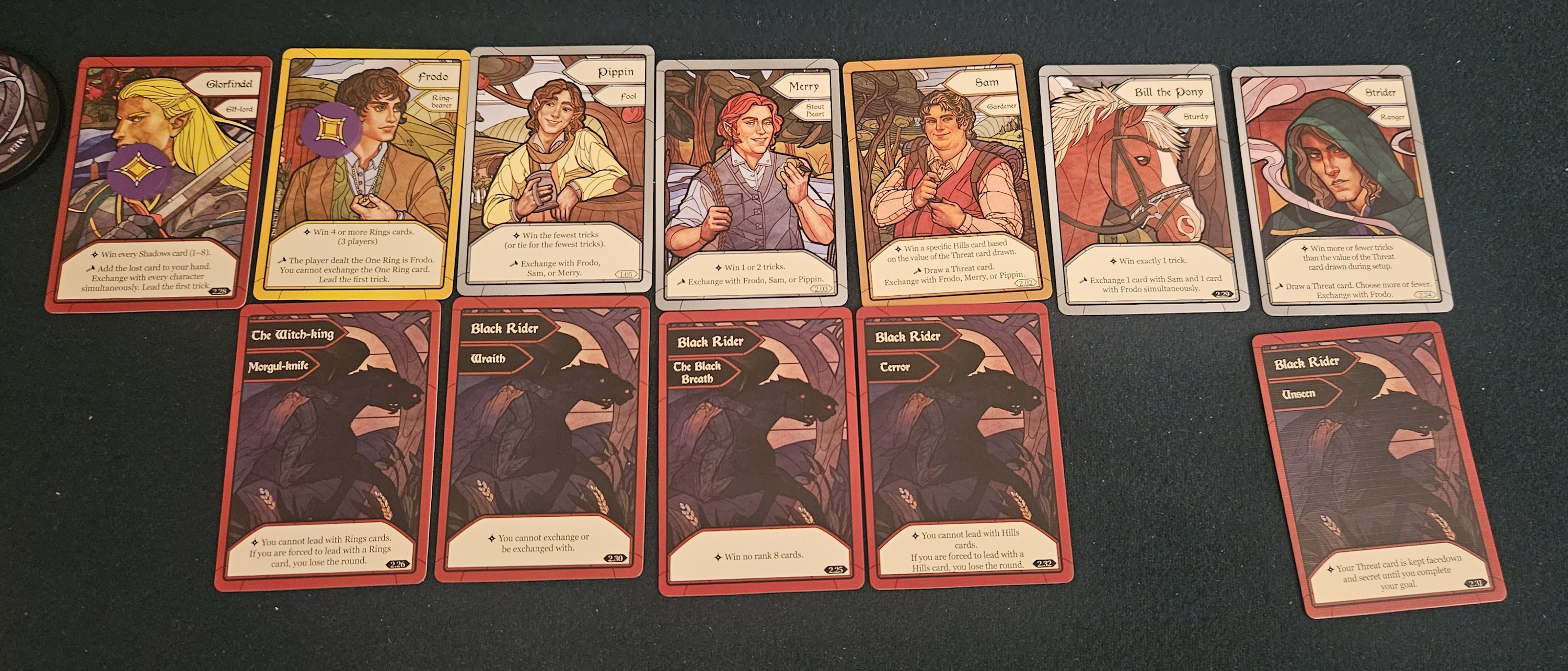
Selecting characters — including Bill the Pony!
How’s the trick-taking? Fairly ordinary, thank you very much. This is your usual must-follow trick-taker with no trump suit, although the game’s fifth suit, rings, does have one card — the one of rings, aha! — which can outright claim victory over any trick. Oh, and rings can’t be led into a suit unless they’ve been previously broken by another suit being voided. The baseline rules are nicely unburdened.
The specific chapters, of course, throw wrenches and spanners and wrinkles into the whole puttering engine. The obvious complicating factor is the victory conditions. Frodo, who is present in nearly every scenario, must secure a certain number of rings cards. Gandalf needs to win at least one trick. Sam wants to win one hills card of a particular value. That’ll come in handy down the line when the One Ring decides to tempt him. Sorry. Spoiler alert.
From there, affairs only grow more complicated. Boromir must win the last trick, but under no circumstances can he be allowed to claim the one of rings. Aragorn must win a specific number of tricks determined by a randomly-drawn threat card. Eventually, players face compounding victory conditions, not to mention disruptions of various stripes, such as Black Riders — themselves a lovely pun, being both a horse rider and a rules rider — making it impossible to lead with hills, or perhaps forcing your character to win no tricks with those high-ranked eight-value cards, or preventing anybody from swapping cards with you at the beginning of the round.
The big strategic decision comes at the beginning of each hand when players pick their characters. Whomever was dealt the one of rings becomes Frodo; he is the ringbearer, after all. Everyone else gets to select their character from a small list that varies from chapter to chapter. In trick-taking terms, it’s a massive round of contract bidding, everybody hopefully picking the character whose conditions their hand is best suited to fulfill. Heh. Best suited.

The One of Rings!
If this sounds a lot like picking tasks in The Crew, it isn’t too far off. There are a few distinctions to bear in mind, such as the way characters eventually present themselves as self-contained bundles of multiple tasks as opposed to the free-wheeling challenges of The Crew.
Still, purists might soon find themselves hungry for more. The Crew came with fifty missions. Fellowship has eighteen. I’ll leave the math to you. And while there’s a mode for mixing together characters to continue playing after the campaign, that also sheds much of the reason to play Fellowship in the first place. I appreciate Bornmueller’s instincts in including such a mode, but I’m here to chew the scenery, not throw cast members into endless configurations.
Surprising nobody, that scenery is also why Fellowship is more my bag(gins). Every character feels distinct, from their objectives to their lovely stained-glass artwork and little subtitles. (Pippin is a “fool.” Bilbo begins as “peculiar,” but later becomes “stretched.” Bill the Pony? “Sturdy.” Good Bill.) Each chapter stands out from the one before it.
This is where Bornmueller’s enthusiasm for the topic becomes so central to the craftsmanship of this thing as an artifact of play. This is as close as I’ve seen a pure trick-taker get to retelling a story. Sure, it leans on the familiarity of that story to bridge the gap between play and narrative. But it’s there all the same. Where The Crew was a love letter to a mechanism, Fellowship is a love letter to Fellowship.

GLOIN!
That, on the whole, will determine whether The Fellowship of the Rings: Trick-Taking Game is a worthy contender. For myself, that’s why it stands out. This is a game I’ve loved playing with my family — if only because we first loved this journey, these people, the luxurious pacing and sense of place that are the hallmarks of Tolkien’s writing.
(If what I’m doing at Space-Biff! is valuable to you in some way, please consider dropping by my Patreon campaign or Ko-fi.)
A complimentary copy was provided.
Posted on December 3, 2024, in Board Game and tagged Board Games, Office Dog, The Fellowship of the Ring: Trick-Taking Game. Bookmark the permalink. 9 Comments.

 SPACE-BIFF!
You had me at “ludic retelling”. I have owned/played most Middle-Earth board (War of the Ring more than 200+ times), rpg, and video game every created and that it is essence I am looking for–that is my “bag(gins)! While I do enjoy the Crew(s), I do find them a bit abstract, even with the attached narratives. I”m now trying to find the best non-FLGS to pre-order atm b/c I can’t wait til it hits the stores.
I will be using the funds from selling Middle Earth Duel (which you confirmed my criticism) and using them to fund this.
May the Valar Bless and Keep you, Lord Biff, in you efforts to point us to those “ludic retellings” of Middle Earth, perhaps the greatest modern story/fantasy world ever created. Tolkien work stands as a supreme example of his own doctrine of “Subcreation” that edifies and entertains many of you. (On a more personal note: for me JRRT Secondary World is the touchstone for Catholicism infused Christian art in the 20th century)
I can’t wait to get this one, and your review confirms all the promising info I heard of the game before. I think it was a brilliant decision to limit the story to just the Fellowship, and that gives hope for two more instalments down the road 🙂 And the art is gorgeous!
Thanks for the review.
A little birdie has perhaps confirmed that The Two Towers may be coming next year…
But don’t listen to little birdies. What do little birdies know?
I’m continually amazed by the quality and creativity that goes into the art and graphic design in something that is in some ways “just” a toy. These look lovely, and it’s great to see a different vision to the film IP images and the darker imagery from e.g. Fantasy Flight (although those are great also).
Thanks for the review. This ticks so many boxes and I expect my 10y.o. would love it!
I definitely agree about the artwork’s lighter tone. I love the film trilogy and FFG’s approach. But I also love the storybook look.
Pingback: Best Week 2024! Adapted! | SPACE-BIFF!
Pingback: Trick-Taking’s Back on the Menu, Boys! | SPACE-BIFF!
Pingback: Legend Became Tabletop | SPACE-BIFF!
Pingback: Space-Cast! #52. Fellowship of the Trick | SPACE-BIFF!