The Gooey Decimal System
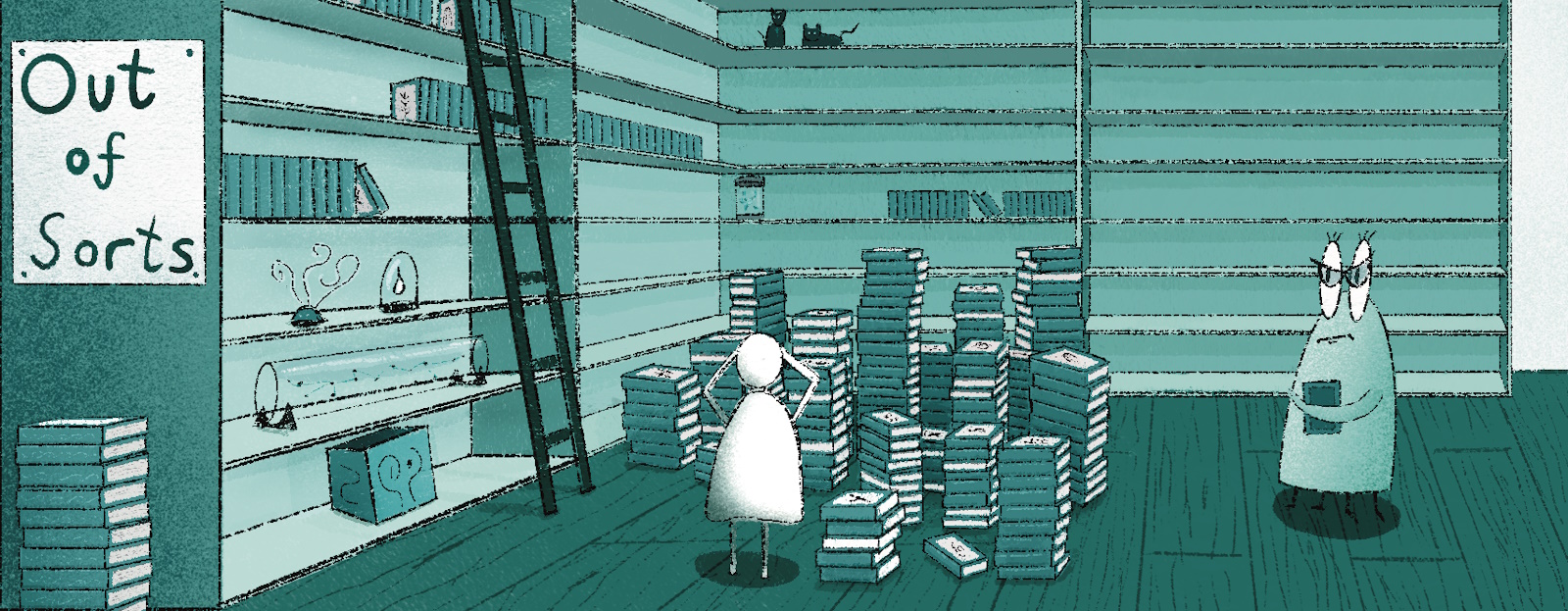
Surprising absolutely nobody, this inveterate library-hopper actually knows and utilizes the Dewey Decimal System. Unfortunately for everybody else in the human race, especially those with a far more vibrant social life than myself, the existence of Melvil Dewey’s sorting method is the one thing our galaxy’s extraterrestrials have learned about us. Now a gang of disparate humans has been abducted to sort an alien library. Eep.
2024 has been an excellent year for memory games, if only thanks to the stupendous Wilmot’s Warehouse. Connor Wake’s Out of Sorts, which like Marceline Leiman’s High Tide will be available at next month’s Indie Games Market at PAX Unplugged, is proof that the genre still has a few unswept corners to explore.
Oh no. Oh no oh no.
You might have heard of a thought experiment that philosopher and sex-pest John Searle came up with back in 1980 called the Chinese Room. The gist is that some dude is locked in a room and commanded to respond whenever a slip of paper is dropped through a slot in the door. The problem is that all of these slips of paper are printed with Chinese characters, which this poor guy doesn’t read or speak. Instead, our unfortunate test subject has a manual, also in Chinese, which indicates every possible permutation of characters and their appropriate responses. By cross-referencing prompts, the subject can respond with perfect accuracy. He can simulate a conversation, but with zero understanding of what is actually being communicated.
And that, ladies and germs, is what large-language models are doing whenever they “converse” with you.
Out of Sorts presents something similar to players. You are the test subjects trapped in the Chinese Room, passed characters that, without context or even a sufficient body of work to begin the arduous task of translation, you cannot possibly understand.
But there’s a wrinkle, one glorious wrinkle, that begins the gyrification of this game’s cerebral matter. You are not a computer. You are a human. A thinking human that sees faces in tree branches and animals in clouds, one who’s so starved for context that you can’t help but spin stories about every detail that passes before your eyes, buzzes in your ears, or tickles the hairs on the back of your neck. These aliens were right about one thing. Sorting nonsense into categories is what you were born for.

Can you match nonsense to these categories? I can!
When Out of Sorts begins, the table is presented with three categories. Some are concrete, like “cats” or “plants.” Others are more conceptual, like “geology,” “alchemy,” or “mysteries.”
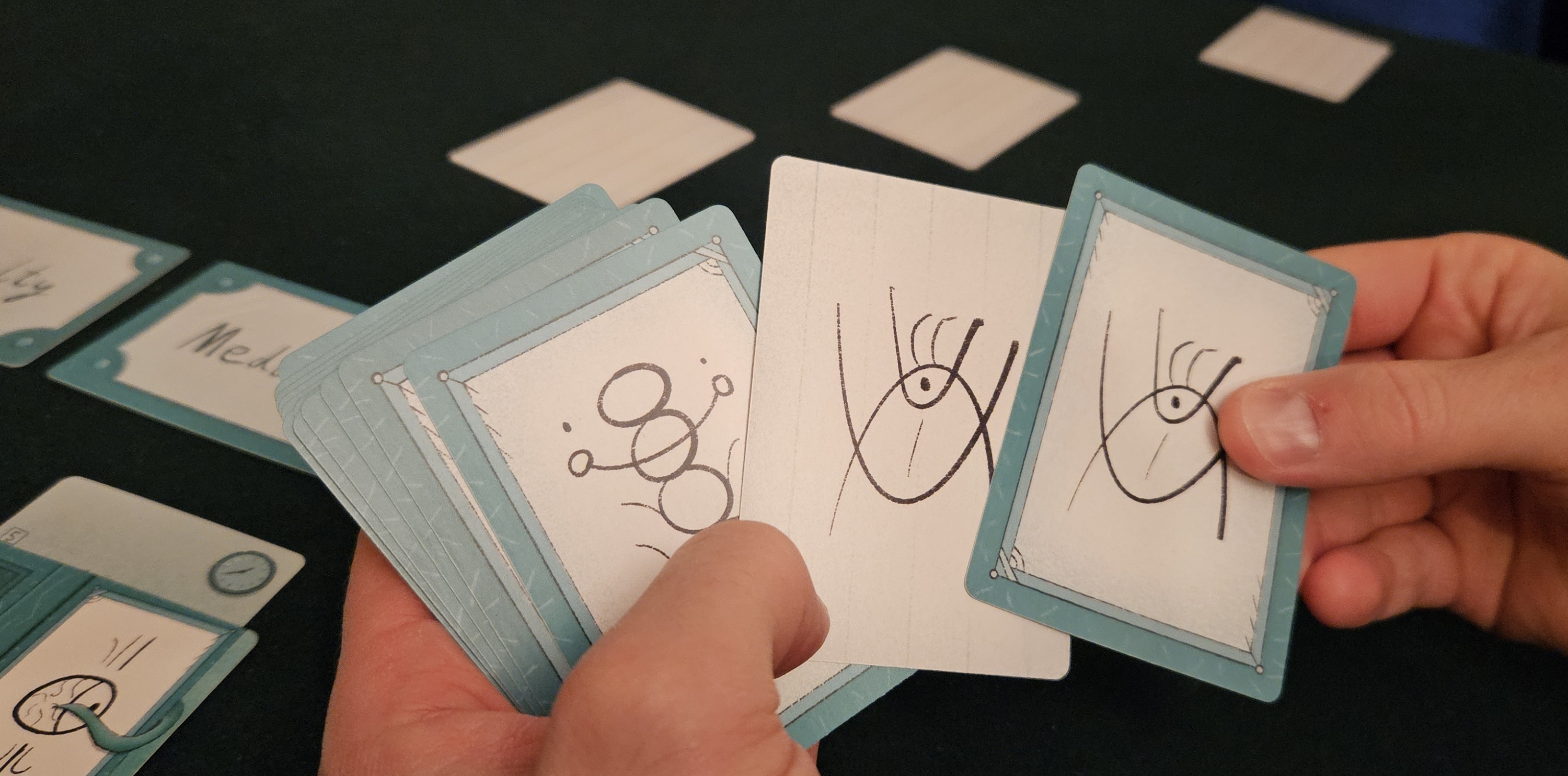
There are two roles. All but one person become Finders. When each round begins, the Finders are passed prompts showing alien squiggles. Either they match these prompts with the cards they’re already holding, or, if they don’t possess them personally, they must find the match by describing the images to their peers. Expect a lot of “No, not a squiggle like that. A circle. Inside another circle. With three bips next to it. YES, JANE, I SAID BIPS. FIND THE BIPS, JANE.”
Once properly paired, these are then passed to the Sorter, the game’s other role, to be arranged into a concealed hand according to whatever logic the players agree upon. Finally, the sorted index cards are shuffled and some portion of them are revealed to the table. The Finders are then required to put these in order according the Sorter’s master list. Of course, the Sorter is prohibited from showing their hand or communicating in any way. In philosophical terms, the occupants of the Chinese Room are having their personal Dewey Decimal System stress-tested. Probably on pains of atomization.
Oh, and the entire thing is timed. You have twenty minutes to repeat this process as many times as possible. Completing nine cycles guarantees victory. I’m not wholly convinced that’s possible, but there’s a scoring system for those who don’t make it all the way to the end, and the game begs to be replayed to improve your margins.
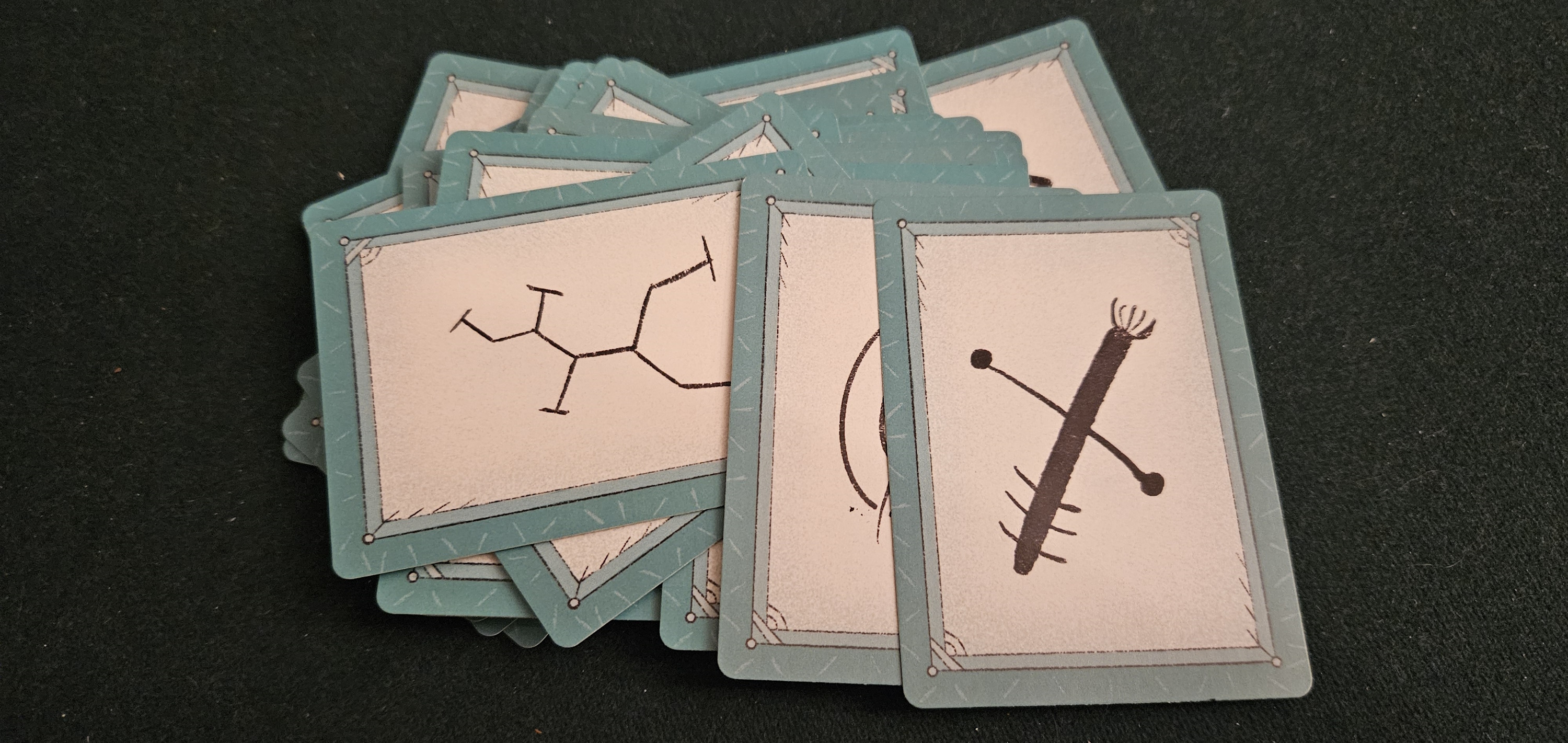
All those shuffles necessitates that the Sorter embrace a dexterity role.
Let me tell you, the entire thing is a riot, and it’s hilarious to boot. This is the sort of game that gets people screaming — at their fellow Finders when their descriptions don’t make any damn sense, at the Sorter for their proposed categories, with laughter whenever something goes right, wrong, or right and wrong at exactly the same time.
Here’s an example. Early on, you only need to sort five cards. No problemo. You could brute-force the symbols even without the advantage of those three categories. But the next round adds five more cards, and then five more. By the fourth round, you’re scrambling to recall the relative position of twenty cards. Now it’s more or less necessary to fudge the categories. Yes, this card looks like a reptile. But this other one looks like eggs. Is that a pre-reptile, then? Should it go at the very beginning of the Sorter’s wad of reptile cards? Or would it be easier to invent a new category, one that sits on the threshold between reptiles and travel? The egg becomes a wheel. That’s how reptiles travel. Yes. You have done it. You mad genius.
Now remember it.
Certain details are easy to overlook, but nonetheless demonstrate that Wake is a designer to keep an eye on. For instance, the Sorter’s role is partially reliant on dexterity, requiring multiple shuffles and deals. When something goes wrong and they have to shuffle the prompts all over again, everybody’s eyes are on them like they’ve climbed to the top rung of a traveling circus without any experience at trapeze. Similarly, the pressure gradually shifts as the game progresses. Early on, finding matches is difficult because the Finders are holding so many dang cards. Later, as their hands thin out, that portion of their job becomes easier while the memory aspect grows ever tougher.

REMEMBER.
Much like the nonsense symbols in Wilmot’s Warehouse, little stories emerge. Sequences of cards become stories: a squiggle is an embryo, so an oval becomes a fertilized egg, then a fractal array becomes a primordial enzyme. A zigzag through an arrow becomes the passage of armies across a border. Something that looks like a floating eyeball — an ideogram so obvious that it could be nothing else in any other context — becomes a dutiful sundial so it can slot into the “time” category. Nothing breeds creativity like necessity and a deadline.
What a perfect little game. My only complaint is that I wish Wake had included additional categories in the box. There are only seven double-sided cards, enough to produce plenty of combinations, but not so many that I haven’t begun to see individual repeats. On occasion, games will provide blank cards for inventing your own powers. Out of Sorts is maybe the first time I’ve ever wanted something like that. “Anatomy” category, here we come.
Still, I’m smitten. As an experiment in memory and time pressure, I have yet to experience anything quite as hectically charming as Out of Sorts. And as a thought experiment, it’s one more reminder of what it means to be human — to be this living, creative, semantically thriving being, capable of channeling static into constructed meaning. We are a miracle born of carbon atoms and cerebral creasing. Every now and then, a game reminds us of that.
(If what I’m doing at Space-Biff! is valuable to you in some way, please consider dropping by my Patreon campaign or Ko-fi.)
A complimentary copy was provided.
Posted on November 12, 2024, in Board Game and tagged Always Awake Games, Board Games, Out of Sorts. Bookmark the permalink. 14 Comments.

 SPACE-BIFF!
Great review! Succinct and enticing!
I can’t seem to find anywhere that sells the game though
It will be sold at next month’s Indie Games Night Market. After that, I don’t know if the designer intends to sell the game more widely.
Thanks for checking. Hopefully it will at least be available on tabletop simulator or similar in the future
I did a second print run since the night market went well. So if you missed out, you can buy a copy here: https://always-awake-games.square.site/product/out-of-sorts/1
Thanks for the lovely review!
Connor, do you consider the possibility for selling a Print-n-Play version?
The shop linked above does not ship to Europe (at least Hungary).
Hey! Good timing, I actually just finished putting together the PnP. If you’re still interested you can grab a copy here: https://alwaysawakegames.itch.io/out-of-sorts
thanks for checking it out : )
I MUST try this.
I got disillusioned from sci-fi nowadays (pessimistic, cynic and political), but my favourite author, Stanislaw Lem, wrote a masterpiece, His Master’s Voice, about humans trying to decipher a message(?) which may or may not come from extraterrestrials(?) or God(?). It’s a tour de force.
This game reminds me of my excitement when I was reading that book. Or when I was watching Arrival’s first part. (The second part… ewww.)
Great, thank you! 🙂
Pingback: Journeys in the Dark | SPACE-BIFF!
Pingback: That’s Not Two Minds! | SPACE-BIFF!
Pingback: Best Week 2024! Combined! | SPACE-BIFF!
Pingback: Photograph of a Battlefield | SPACE-BIFF!
Pingback: A Desire for More Cows | SPACE-BIFF!
Pingback: Afterlives | SPACE-BIFF!