Smurf-Hopping

I only recently got the memo that we’re now calling the entire shared-input genre, roll-and-writes and draw-and-writes alike, “smurf-and-writes.” Which… look, I’m not the king of taxonomy around here, but at a certain point we linguistic descriptivists really ought to consider putting our foot down.
Anyway. Rivages, designed by Joachim Thôme, is an island-hopping smurf-and-write (hurk) that isn’t nearly as smurfy as most of its peers. By which I mean it’s less about those shared inputs than you might gather from its laminated maps and dry-erase pens.
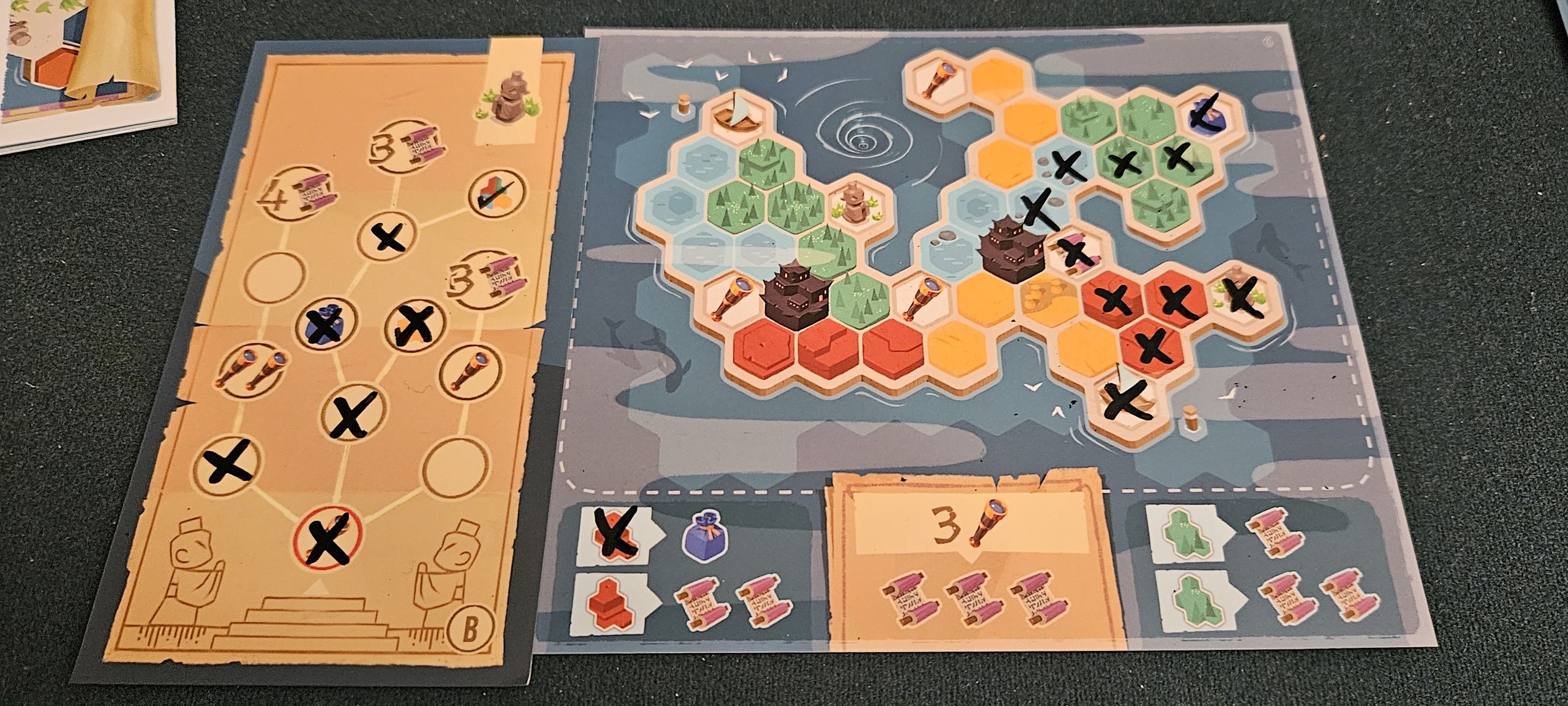
Visiting one colorful island.
For those who haven’t got the slightest idea what I’m talking about, Rivages is the latest in a long and faddish line of board games, most dominated by either identical sheets of paper or dry-erase boards, that focus on players using similar inputs — whether rolled dice or drawn cards — to then maximize their individual scores. The most popular example is probably Welcome To…, but for my money I’d rather play Hadrian’s Wall or Fliptown.
Or even The Guild of Merchant Explorers, a doubly appropriate touchstone to Rivages given its island-hopping gameplay and sanitized colonial setting. Here the concept is similarly inoffensive: long ago your people settled this island chain, only for some cataclysm to subject the archipelago to a hard reset. Now you’re here to retrace your steps, rediscovering lost treasures, towns, and totems as you go. If some of those objects seem more, ahem, tribal than the others, Rivages seems to prefer that you not squint too closely at what might be growing between the tiles. Fair enough.
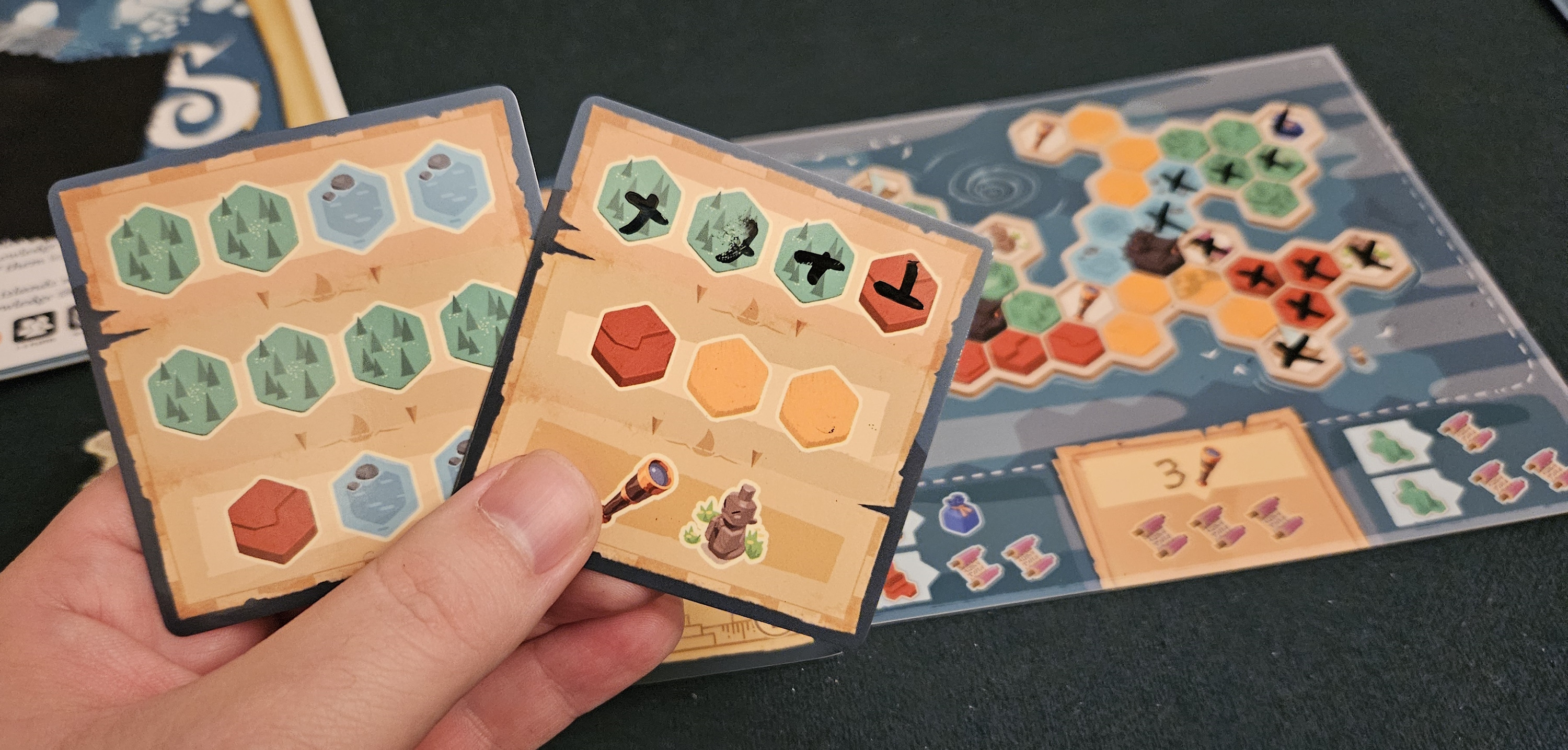
Choosing which line to use.
But what appears to be a fairly boilerplate smurf-and-write (aggh) soon reveals two hidden tricks that set it apart from many of its peers.
The first is that the game’s player inputs aren’t smurfed at all. Instead, this is as much a drafting game as anything else. Right at the beginning, everybody draws two cards that each show three rows of possible actions. You may choose either topmost row, marking off its hexes to explore the corresponding terrain on your map. Once everybody at the table is finished, you then pass these cards clockwise and receive another pair of cards. Now you mark another row, except you’re working from the leftovers that were passed to you. Little by little, cards are used up, at which point they’re thrown away and replaced by fresh offerings. This cycle continues until the deck runs out, at which point, well, hopefully you’ve optimized your expeditions better than your peers.
Like most examples of this genre, Rivages is played largely in isolation, your fellow players no more present than if they were occupying some distant isle. True, it’s possible to glance at the next player’s map, perhaps to mark off the option that would be most useful to them. Honestly, though, this isn’t that sort of game. Charting your own course is tough enough, what with all the many bonuses these maps produce. There are free moves to unlock, objectives that award points, idols that bump you up a separate bonus track, and little goodie bags that award all sorts of perks. Played carefully, it’s possible to chain these together to impressive effect, marking off cascading bonuses that are the equivalent of two or three turns at once.
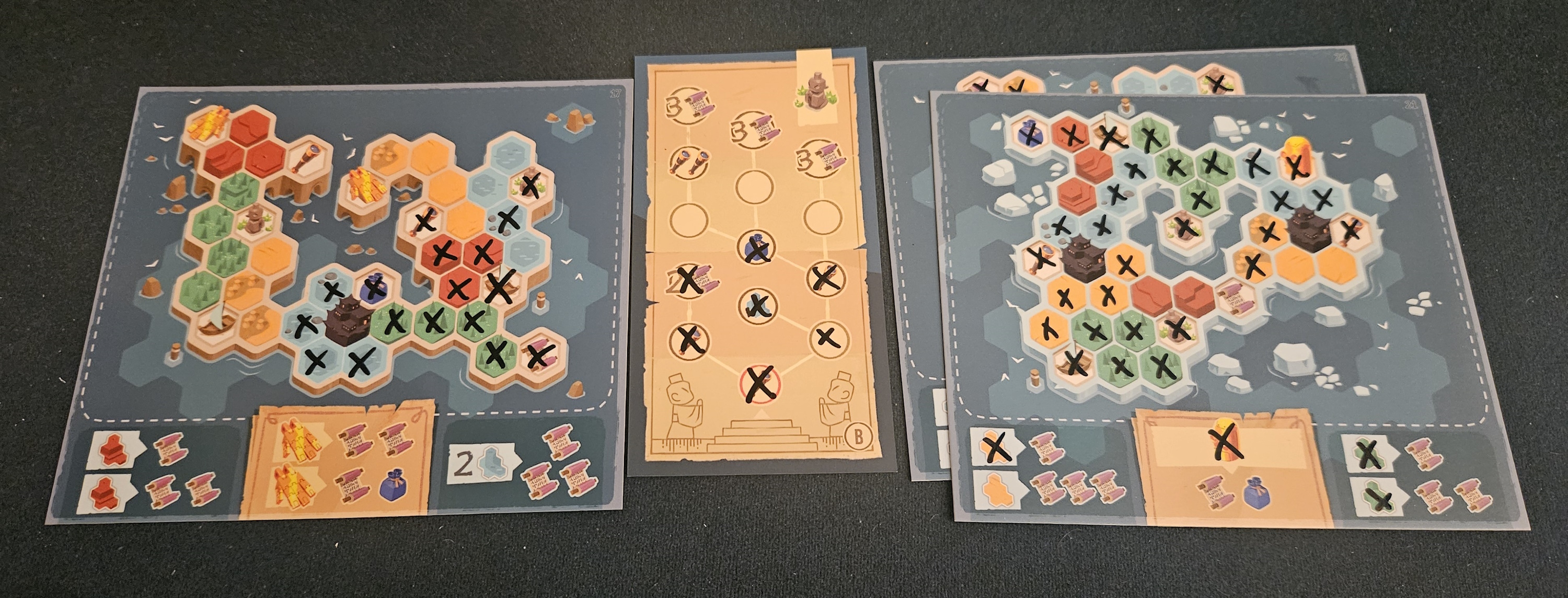
Visiting three colorful islands.
That’s only the first dimension of Rivages. Rather than settle on a single destination, here you’re free to abandon your current island and move onto another. Indeed, those who hope to maximize their scores will undoubtedly ditch certain isles after assessing certain objectives or goodies too remote to bother with. It’s in this respect, as a game about assessing odds and values, that Rivages most fully embodies the genre it otherwise edges away from. Determining potential payouts is what smurf-and-writes (gaaah) are all about.
It’s a smart move, one that calls to mind the ability to back out of a match in Air, Land, & Sea. If an island’s objectives are too far-flung, well, there’s nothing stopping you from nabbing a few easy trinkets on your way to the nearest pier. If anything, the islands are perhaps too balanced. Rather than putting the onus wholly on players to evaluate the relative merits of any given landing spot, most of the earthen lumps in this archipelago boast similar payouts. Some additional texture wouldn’t have gone amiss.
Still, Rivages occupies an interesting middle ground. Its strategy isn’t especially tangled, but there’s more to pick through than first meets the eye, with some clever adjustments to the usual formula. It feels especially good to abandon an island halfway finished, opting instead to brave another, ideally easier frontier.
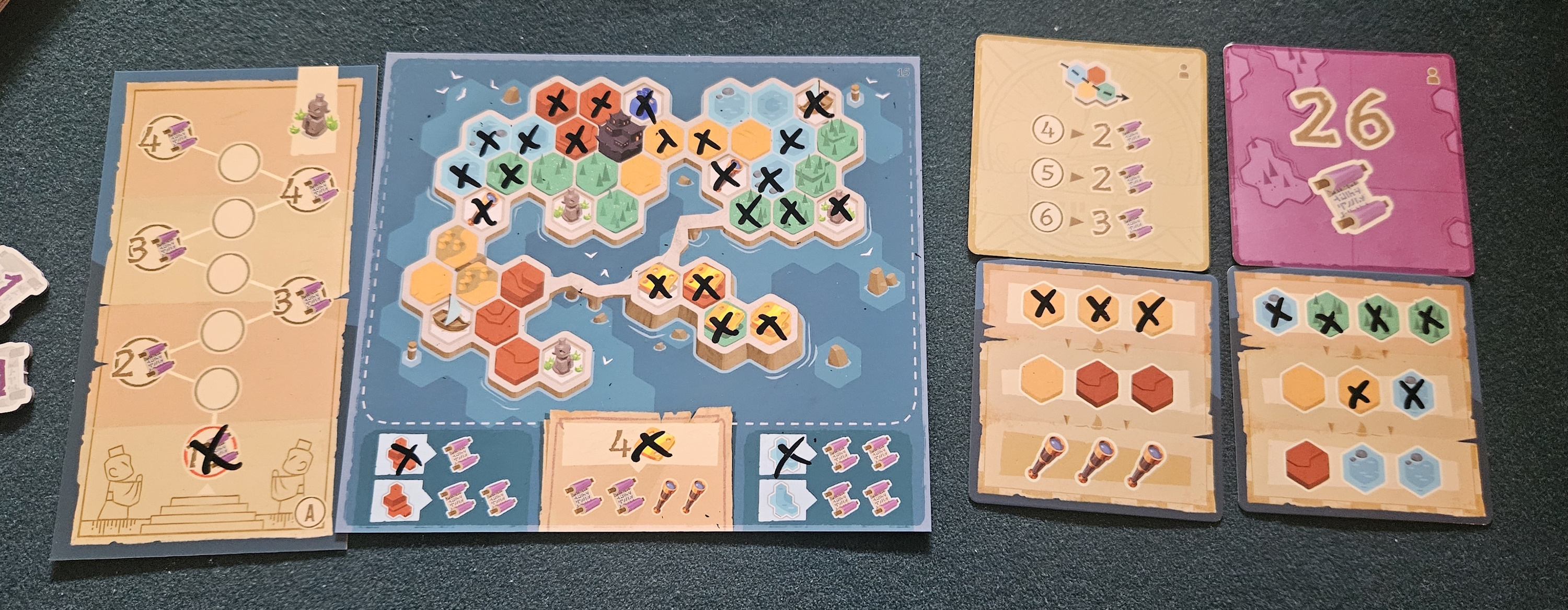
The solo mode isn’t dramatically different from multiplayer.
That’s the crux of the thing, and it’s a surprisingly effective hinge from which to hang this game. I find that I often abandon an isle too readily, thinking the next spot will afford breezier shores and swift points, only to find the next outcropping every bit as rocky as the last. In ludo veritas and all that. Either way, Rivages offers a minor, if approachable and effective, take on the smurf-and-write. Gaaarrrble.
(If what I’m doing at Space-Biff! is valuable to you in some way, please consider dropping by my Patreon campaign or Ko-fi.)
A complimentary copy was provided.
Posted on November 11, 2024, in Board Game and tagged Board Games, Pandasaurus Games, Rivages. Bookmark the permalink. 13 Comments.

 SPACE-BIFF!
I’ve been out of the loop too long. Who decided “smurf-and-write”? Were they justly punished? What’s the rationale?
I don’t know who inflicted the epithet on us, but I suspect it has something to do with the Smurfs looking identical. Surely it doesn’t have anything to do with online smurfing. Or maybe it does? Who knows.
Well, public flogging is barbaric but perhaps we should make an exception.
Anyways, hope you’re doing well Dan. Even though I’m on a bit of a hiatus from board game stuff I try to read the occasional review.
Thanks for reading even though you’re on hiatus, Marc!
This is the first I’ve heard of this terminology. Are you sure that it’s really a thing, and someone wasn’t just playing a prank on you?
I went from never hearing it to hearing it all over the place. There must be some sort of conspiracy afoot.
Rage, rage against the smurfing of the write.
(Please, it’s such a bad term.)
I’m 99% sure the Dice Tower came up with the term, mostly as a joke. I remember watching some video where they were talking about roll and writes and flip and writes, and they they looked at a Crowdfunding project of some Smurfs game and riffed their way into “smurf and write.” The idea being that smurfs use the word “smurf” as a replacement for other words, so it works in the place of “roll” or “flip.”
I’m surprised to hear it’s taken on, it was just a dumb joke.
“I’m not the king of taxonomy around here, but at a certain point we linguistic descriptivists really ought to consider putting our foot down.”
Wouldn’t that make you a prescriptivist rather than a descriptivist?
Yeah, that’s kinda the joke I was going for. I might call myself a descriptivist, but the instant something hits my ear amiss, it’s time to enforce some RULES.
I won’t be calling it that. “Blank & write” is a perfectly fine term.
Fair!
The most popular example is probably Welcome To…, but for my money I’d rather play Hadrian’s Wall or Fliptown.
If given a choice, I will always go for Sid Sackson’s Solitaire Dice from A Gamut of Games. Like many genres, I feel like Sid Sackson nailed it decades before anyone even designed a second game of its ilk.