That’s No Shadow Moon
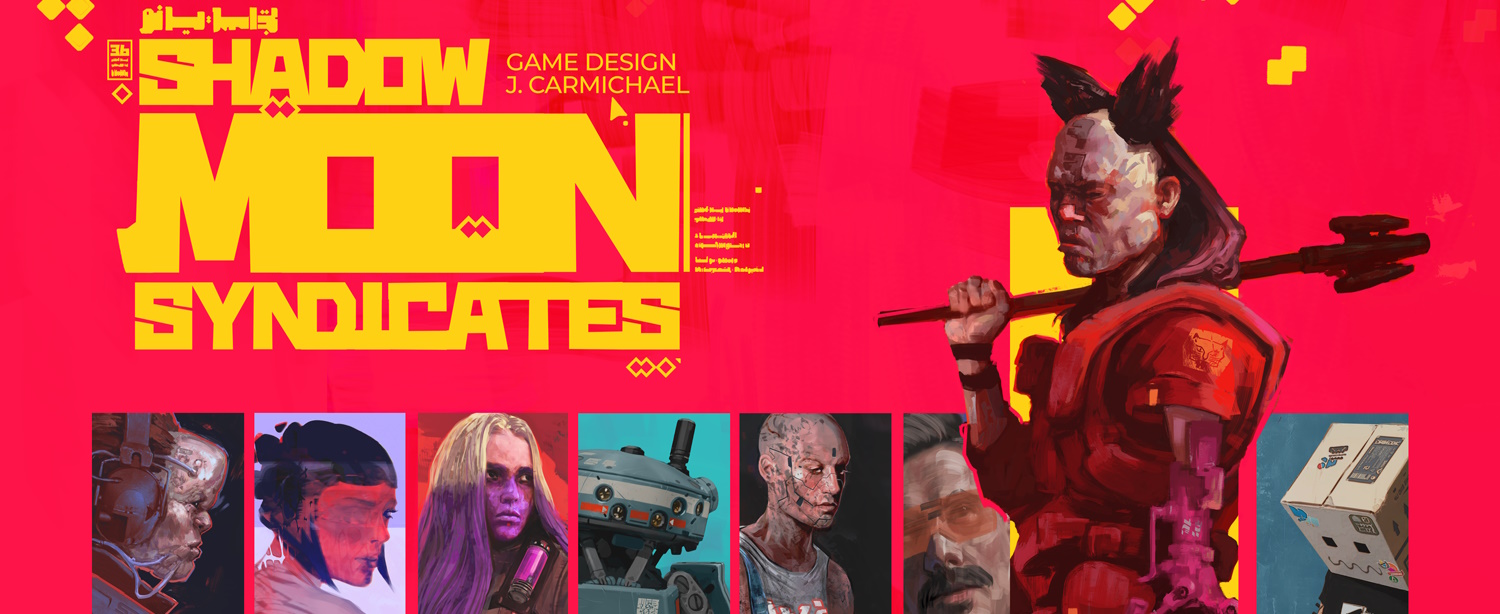
Shadow Moon Syndicates, the second design by Jarrod Carmichael, brings out my inner cynic. It might have something to do with the setting, all grungy piping and colorful gangs grappling over the guts of a husked-out asteroid. Or it might be the particular blend of chip-stacking, hand-building, and shifting objectives, which feels like somebody played Paolo Mori’s Ethnos and wondered why it wasn’t more complicated.
But then I come back to the star of this particular showdown: the cards. Oh, those cards! What marvelous little bastards!

Ever lived on a shadow moon? I have. It’s dim.
Before we can talk about the cards, we need to set the scene. This is the Shadow Moon, a telling epithet if ever there was one. The entire place is about as cozy as an abandoned wasp nest with a few loose wires stuck through it, which has also had its bottom half soaked in gasoline. There are hints that it might have once been a pleasant enough place, with districts like Presidio and Avante brushing up against the Underhive and Maze. From a kilometer out it all looks the same, magnesium girders and rust-colored glass.
Like countless metropolises before it, the sprawl is also a font of opportunity. Control of those districts is worth cool cash, paid in protection rackets or rigged casinos, and there are gigs aplenty for enterprising up-and-comers. Rinse enough credits and you could anoint yourself the sovereign of this place. In an age when sports betting has gone digital and the ultra-wealthy buy space programs and news empires alike, shaking down a bodega or pulling off a heist is very nearly honest work.
It’s a feast, then, albeit a feast for vultures and a moveable feast at that. Nothing is permanent on the Shadow Moon. Played across three rounds, the safest investment is found in control of those districts. Get too cozy, though, and rivals will eliminate your chips, launch coups that overwhelm you with sheer volume, or — and this might be the toughest pill to swallow — simply leave you alone in your corner while raking in the biggest bucks elsewhere.
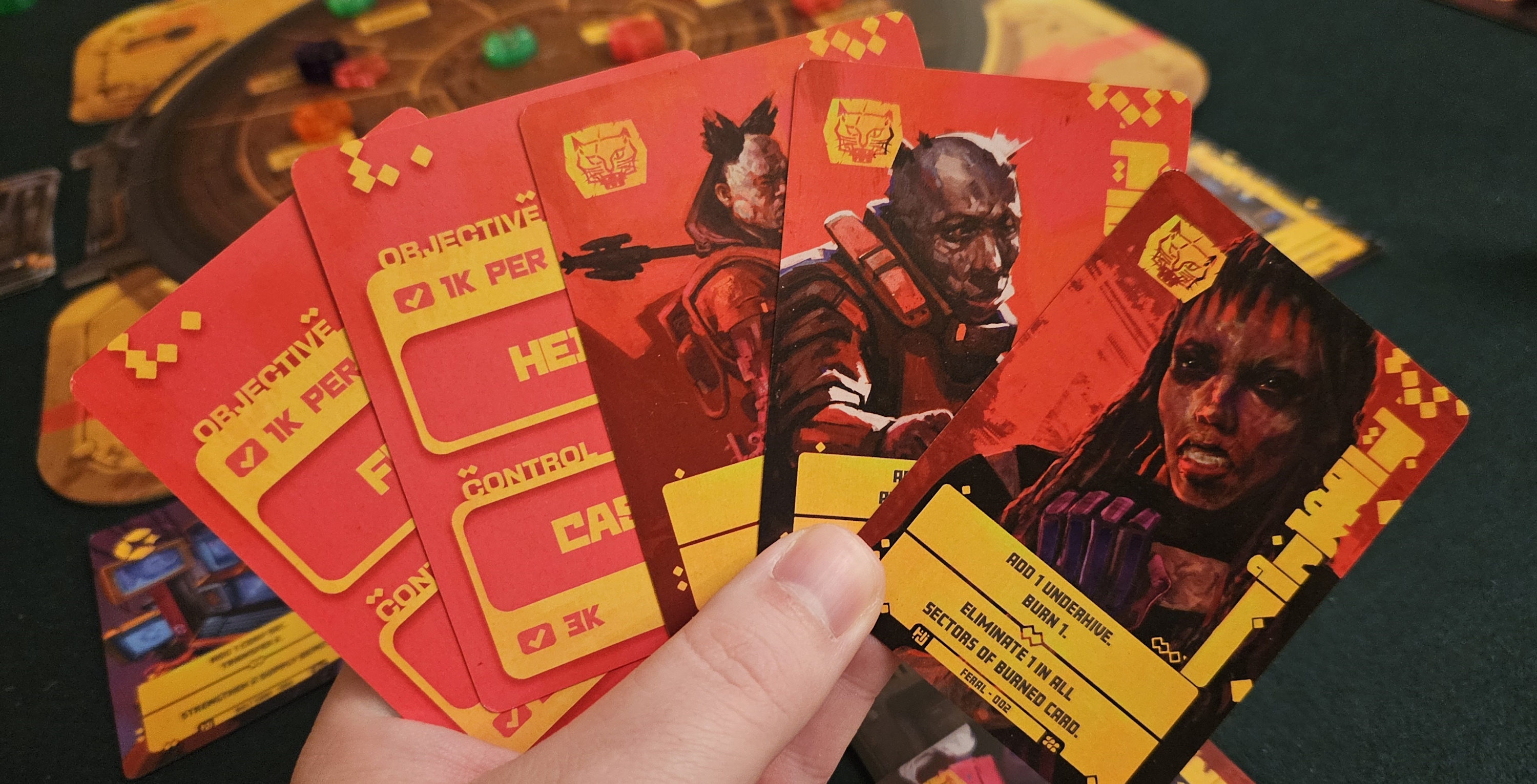
The red faction seems angsty.
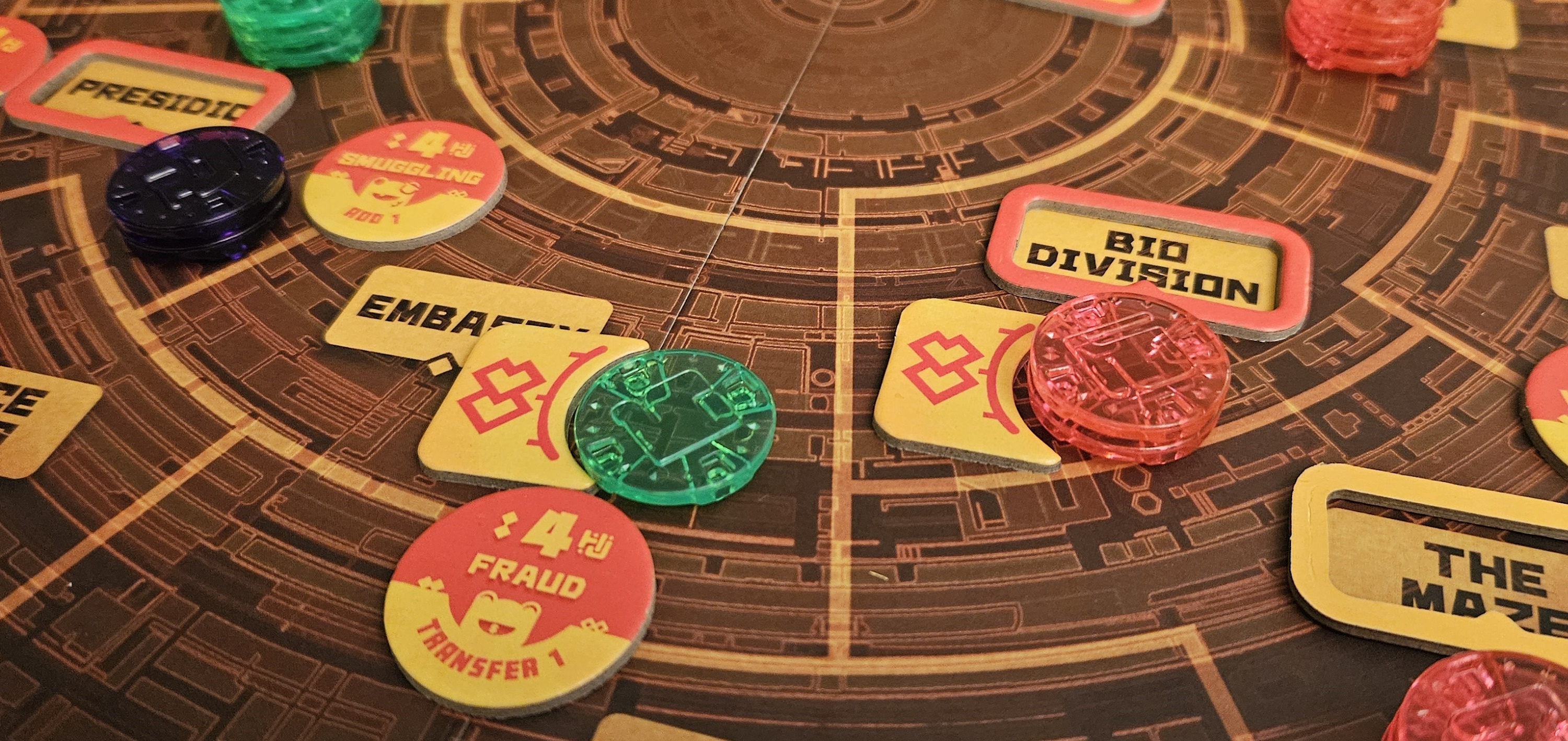
That’s because the lion’s share of any criminal empire’s gluttony is found in the jobs it takes. At any given time there are five of the things, spread across the map. Literally spread, in this case, across two districts at a time. Drawn at random from a bag, these jobs keep everybody on their toes, forcing them out of their natural territories and comfort zones. Maybe there’s a heist riding the border between Corp Sec and the Arcano Complex, which you desperately want to claim because you’re holding a pair of objective cards that make heists worth extra credits. So you pile your counters into one of those zones, racing against a rival syndicate.
Crucially, completing a job deletes the control you used to claim it. This presents a series of tough choices, asking whether you want to finish a gig right now or wait until after districts are scored. The game’s scales favor jobs slightly. That’s because jobs are worth not only points, but also afford freebie actions that can further bolster your forces or disrupt everybody else’s plans. Still, it can be tempting to wait a few turns on the off-chance that you’ll claim a job later, although leaving a morsel out in the jungle carries its own risks. There’s really no telling when somebody larger and meaner will swoop in to claim your quarry for their own.
And there are plenty of very large, very mean predators on the Shadow Moon.

Managing my gigs, thugs, and objectives.
I’m speaking, at last, about the cards. Carmichael has created quite the system here, injecting tremendous variety and testiness into a game that would have otherwise been unremarkable.
There are ten syndicates in total, although you won’t see all of them in a single session. Depending on player count, anywhere from five to seven are shuffled into a single shared deck. Think of them like suits, or again like the fantasy races of Ethnos. The big departure from Mori’s centaurs and elves is that every card is unique. Rather than sharing a single identity and ability, every syndicate has its own home turf and gameplay tendencies, but surprising breadth in how they express those archetypes.
This is also where Carmichael shows off Shadow Moon Syndicates at its most playful. One faction is composed of corporate security goons who have decided to finally work for themselves. They naturally cluster around the Corp Sec district, but also specialize in locking down their territory, making it impossible for rivals to mess with their pieces. They’re perfect guard dogs, in other words, great for bunkering on safe turf but not especially potent elsewhere.
Another faction is the mining union. Housed in the Works, the moon’s plumbing center, these fellas excel at dumping immense numbers from their home base into the surrounding districts. Their limitation is that they struggle to travel any farther from home — at heart, they’re still shy about tracking dirt across the fancy carpets on the other side of the station.
Or there’s the Legion, cyborg assassins who add cards to the discard pile and then trigger their burned abilities. Or the Founders, whose influence reaches the station’s far corners but struggle to show backbone once a fight starts. Or a gang of punks who love to kill enemy pieces. Or another gang that screws with the cards everybody else has splayed in front of them.
Do you think the embassy workers mind the ruckus?
That last ability might not sound exciting, but disruption plays a huge part in Shadow Moon Syndicates.
Indeed, it’s one of the game’s premier tricks. Rather than sticking to a single suit, you’re tasked with manipulating every side at once. During the first and second round, you’re dealt a hand at random. Each turn allows you to swap out a card, whether from a changing contract market or from the top of the deck. It isn’t enough to find good cards; early on, a worthwhile goal is to find cards that match one or two suits.
This is important because every card has two abilities. One on top, which always triggers, and one on bottom, which only triggers if the played card matches the suit of the one on top of your personal discard pile. To get the most out of your cards, it’s necessary to play successive syndicates.
Enter disruption. First of all, other players might tinker with the cards you’ve used, swapping topmost cards between players or even dumping something from the deck onto your pile. So much for those extra actions. Then again, this isn’t always a bad thing. Building a mono-syndicate is often counterproductive, locking your forces into a tight cluster of districts and depriving you of useful abilities. Often the best hand is one that utilizes two or three syndicates in tandem, focusing on one before gliding to the next.
Over the course of a full game, you get the chance to build such a hand. After the first two rounds, you set aside a portion of the cards you used. These are now locked. When the final round begins, these locked cards become your new hand. From those five to seven factions, you’ve forged a personal syndicate that’s all your own, staffed with reliable contractors and lackeys. Time to see if you have the juice to rule the moon.
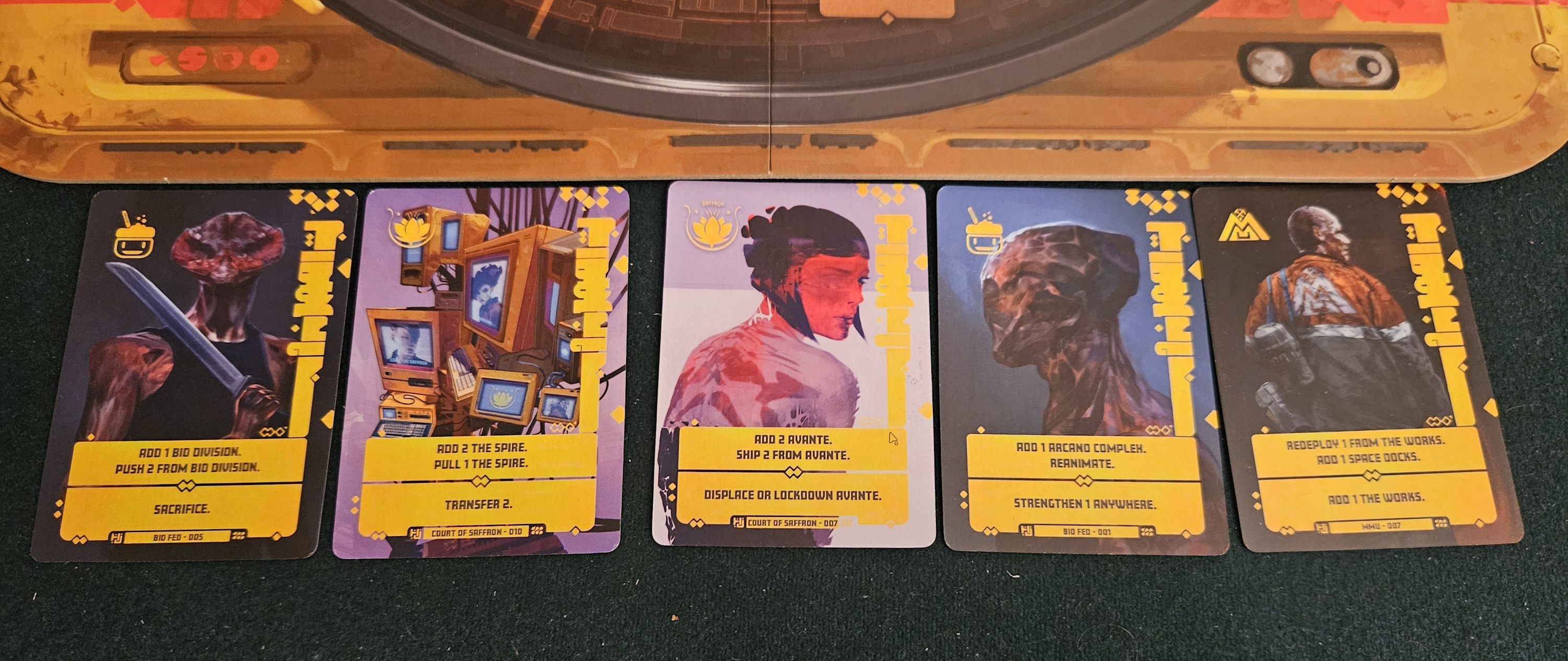
It’s important to build a strong hand.
This emphasis on building the perfect hand goes a long way toward dispelling the game’s baggier elements. Play order matters quite a bit, with later players getting the last word on bids for control, and the game’s method for determining it only rarely seems equitable. Meanwhile, those moveable gigs have some potential to frustrate, especially when a freshly drawn token lands directly onto a player who can complete it immediately. Boo.
The worse offender, however, is the game’s objective cards. Everybody gets three of these up-front and can decide when to deploy them. Early on, they provide either a few extra credits or refresh one of your completed gig tokens, neither of which is especially exciting. In the game’s final round, the leftovers become public objectives, potentially spilling out a bunch of points for controlling districts or having completed gigs of the proper type. This is more exciting by far, but also more polarizing score-wise.
Both of these elements are fine, just good enough to be only occasionally irritating, and with experience their effects grow more muted as players learn how to mitigate unexpected swings or select objectives that won’t award too many points to their rivals. Which isn’t so bad as things go, especially since they quickly fade into a supporting role to the syndicates.
Because, look, the syndicates — what a card system! Assembling a working hand over the first two hands feels scrappy and dangerous, while unleashing your custom syndicate in the final stretch is a feral delight. The game’s third act presents a climax not only by increasing scoring thresholds, but also by letting everybody flex the muscles they’ve built. And let me tell you, filling your hand with cards that screw with everybody else’s stack in the final round is a great way to turn some old friends into new enemies.

Slay the Spire.
On the whole, Shadow Moon Syndicates is an exciting take on some familiar riffs. Despite a few stretch marks around the midsection, it’s a taut and muscular game, expertly leveraging its card system to produce both a tense buildup and a concussive finale. Nobody wants to live on the Shadow Moon — but rule it with an iron fist? Decidedly so.
Shadow Moon Syndicates is on Kickstarter right now.
(If what I’m doing at Space-Biff! is valuable to you in some way, please consider dropping by my Patreon campaign or Ko-fi.)
A prototype copy was provided.
Posted on October 30, 2024, in Board Game and tagged Arkus Games, Board Games, Shadow Moon Syndicates. Bookmark the permalink. 5 Comments.

 SPACE-BIFF!
I didn’t realize this was up for crowdfunding already. It looks fantastic. Thank you for the heads up!
Thanks for reading!
You had me at “complicated Ethnos”
I had myself at “complicated Ethnos” as well!
Pingback: Pink Mars | SPACE-BIFF!