On Banditry
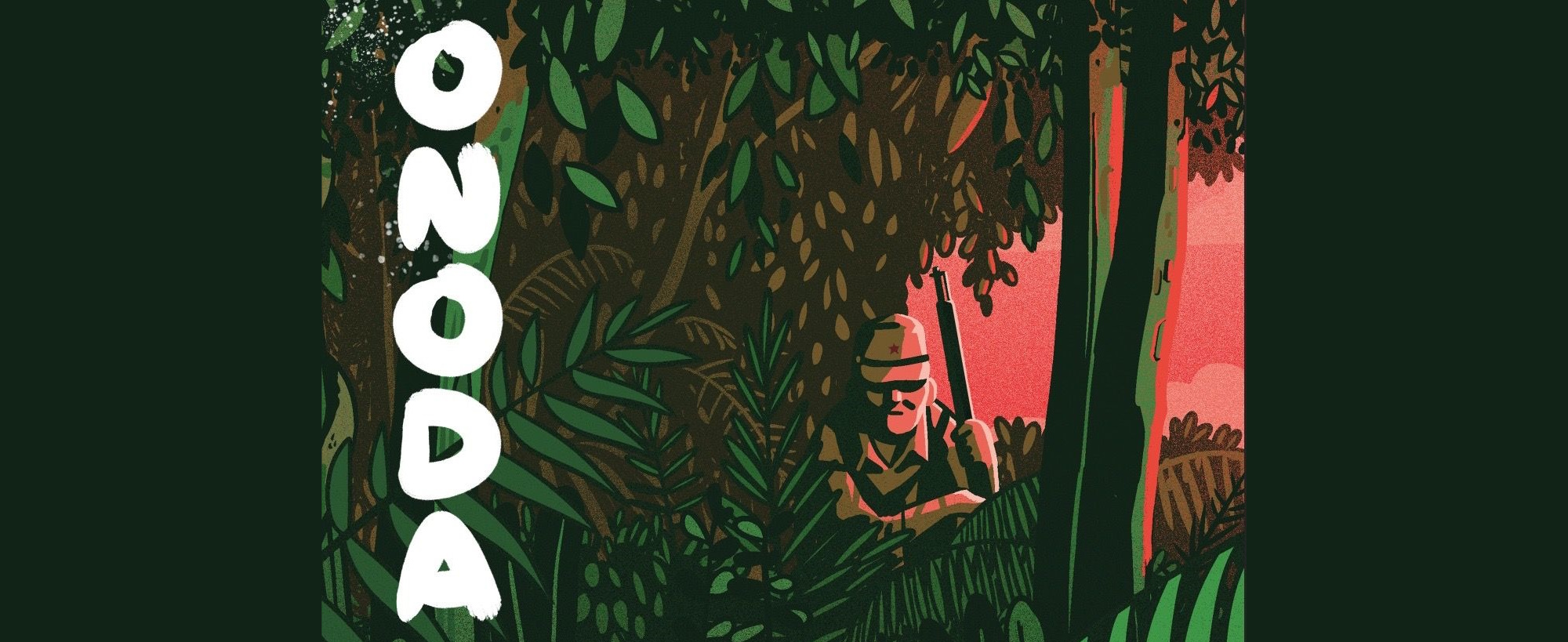
In 1944, during the height of the Second World War, a young intelligence officer named Hiroo Onoda was deployed to Lubang Island in the Philippines. Only two months passed before American and Philippine Commonwealth soldiers retook Lubang. Yet Onoda continued to fight, first with a trio of companions and eventually on his own, until in 1974 he was ordered to stand down by the same superior officer who had commanded him to continue the fight at all costs. When he surrendered his sword and rifle to President Marcos, Onoda became the second-longest holdout of the Imperial Japanese Army. He had been fighting for nearly thirty years.
Onoda’s story has taken on legendary proportions. His autobiography, No Surrender: My Thirty-Year War, was an international bestseller. German director Werner Herzog authored a fictionalized account in The Twilight World; French director Arthur Harari co-wrote and shot a film, Onoda: 10,000 Nights in the Jungle. These depictions were many things: poetic, darkly humorous, paeans to duty and masculinity and tenacity. Also, they were carefully scrubbed of the thirty murders Onoda’s band had committed against civilian farmers.
Now Onoda is a board game by Pako Gradaille. Like previous tellings of Onoda’s story, there’s a certain degree of credulity to Gradaille’s version of events. In a surprise twist, however, in cardboard this story has finally received a more complicated, tentative, and morally textured accounting.
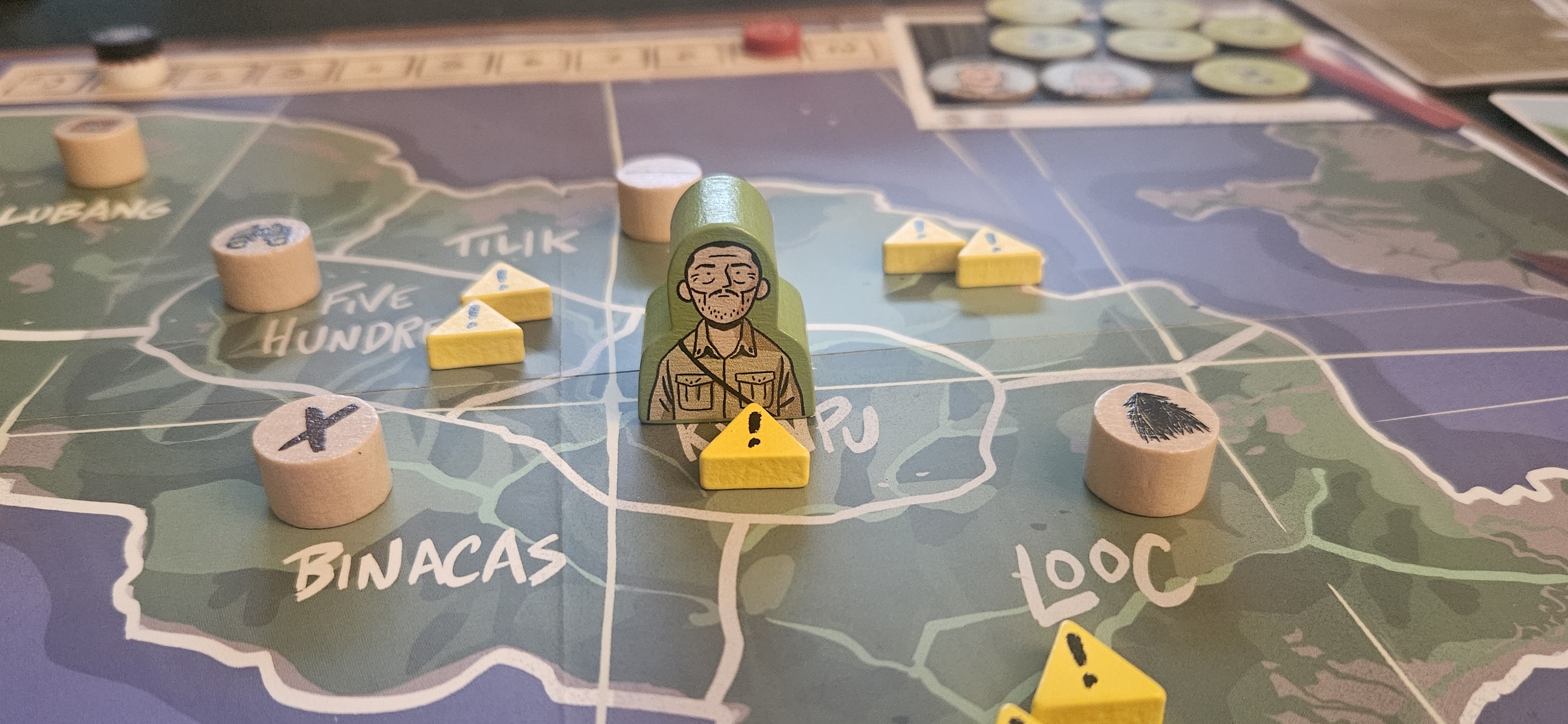
A man, alone, against the world, by choice.
When it begins, the people of Lubang are unaware that they will spend the next three decades looking over their shoulders. Onoda, along with his original two companions, has established a camp in the mountainous interior of the island. He carries the tools of his trade: binoculars and camouflage, a medical kit and uniform, a rifle. He also has a broken radio. These all matter, in their various states of disrepair, over the course of the coming turns.
Told in five-year increments, each chapter also presents a separate mission. Some of these tasks reflect the orders Onoda was given upon setting foot on the island. Perhaps he will cross over to the other side of the mountain, where a radar facility is being erected, to fire rounds at the construction workers. Another mission sees his band descending to the island’s sandy northern shore to blow up a jetty. One of the more leisurely tasks sees him recording bomber silhouettes as they pass overhead.
Other missions push Onoda closer to banditry than soldiering. Some of these are matters of survival. “Forage,” they call it. Onoda descends into a lowland village to steal rice, filling his band’s bellies for another month. He scavenges tin siding to provide a roof for his hideout, keeping the rain away from their stockpiles. He rustles oxen from some peasants; a single cow can feed his friends for a year.
But there’s a discordant note that never quite stills. Onoda douses a rice plantation in petrol and sets it aflame. He terrorizes local farmers at gunpoint. Javi de Castro’s illustration of that particular mission card is the single most blatant war crime in the entire game, but there are other hints that Onoda is not the hero some have made him out to be. Newspapers and radio programs are dangers; they must be shut out, denied, destroyed. Family members roving the island, singing into megaphones that the war has ended, are enemy tricks. When one of Onoda’s comrades attempts to flee, the player is asked to resolve this like any other crisis. They pull a chit from the bag to see whether they have succeeded in restraining him. If Akatsu escapes, Onoda’s mood darkens. His mood, coded in-game as “paranoia,” is every bit as precarious as his physical health. Another event card has him stare longingly at his mother’s white dagger, daydreaming about the release of one quick slash.
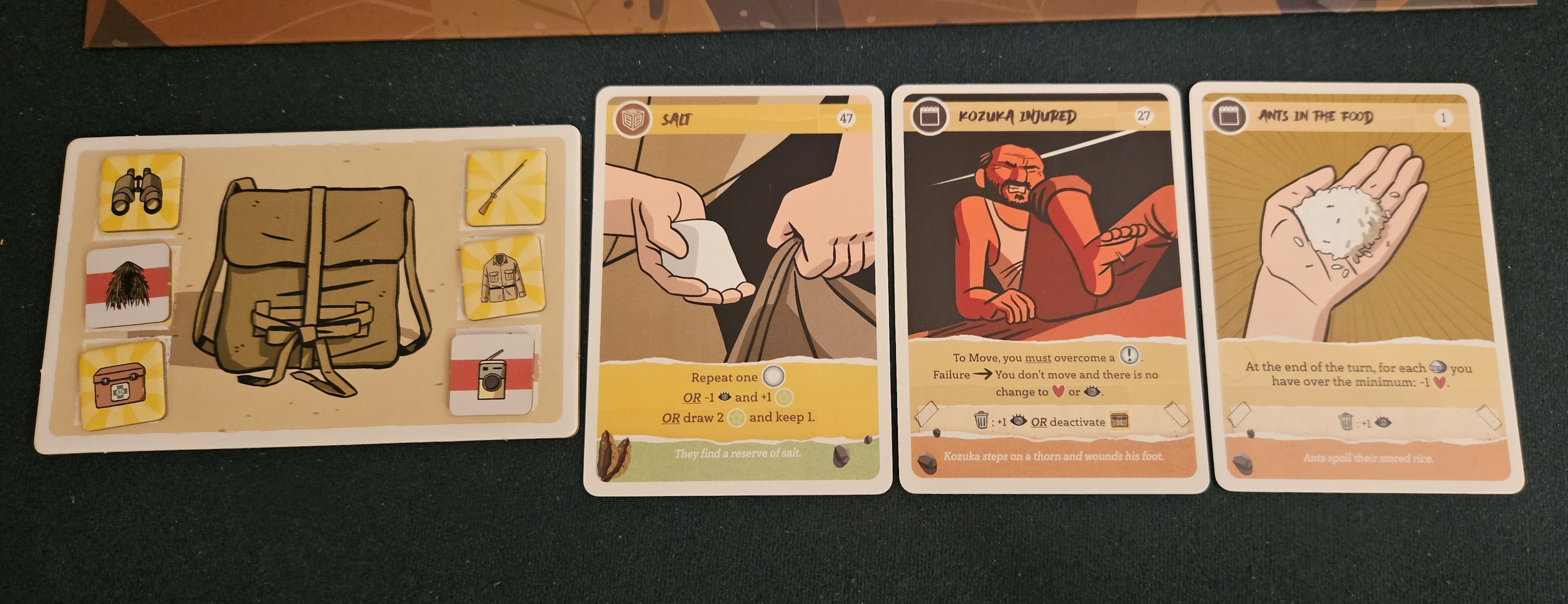
The things he carried.
Gradaille fills Onoda with little procedures, each of which have multiple steps. These are comforting because they are morally uncomplicated. To survive, one must gather enough food. To cross the island, one must tread lightly. To repair one’s equipment, one must know where the proper tools can be acquired. Each step has its own rituals. Reaching into the draw-bag. Pulling an event from the deck. Placing the yellow warning token onto the current region. Deprived of details, one might imagine that Onoda inhabits an unoccupied land, thriving only by his wits and courage.
But the details are never far from hand. Those comforting procedures are burdened by signifiers both ludic and narrative. When Onoda gathers food, it’s by conducting a raid against the locals. When he crosses the island, every mile increases the danger of capture. When he draws an event card, there’s no telling whether the outcome will be positive. Maybe he will learn how to boil coconut milk. Maybe one of his companions will be shot dead. Maybe he will come across children dueling with wooden swords and for a brief moment be confronted by the reality of this war he is fighting against nobody in particular.
Along the way, Gradaille pits process against narrative, an intriguing touch that comes across as reflective of the author’s own uncertainty with his subject matter. The procedures themselves are not only comforting, but numbing, and the answer to the game’s intrusions is to immerse oneself again in the busywork of survival. This, one grows to suspect, is among the game’s tangled points. Historians have already pointed out that Hiroo Onoda had ample opportunity to understand that the war had ended. Once the radio has been repaired — more often, stolen — Onoda soothes himself by listening to blues and tango, horse racing, Chinese news. Later, when his band captures a peasant farmer and interrogates him, what can he reveal other than that the soldiers have nothing left to fight for? For an intelligence officer, Onoda’s immunity to intelligence-gathering is impressive.
But in an era of mass disinformation, neither is it surprising. At heart, Onoda is the tale of somebody who invented a social media bubble before social media forced its way into the world’s living rooms. He needed no algorithm. Only the tenacity to live for thirty years in the jungle and the need to discard every scrap of evidence, every continent of evidence, that it was time to come home.

Feeding Onoda’s companions.
That and a culture that demanded the self-immolation of its young men for the sake of honor and duty. The Empire of Japan was a propaganda state that presented its acts of aggression as existential crises. It would be easy to gawk, but the similarities to my own culture are disquieting. I think of every Fourth of July sermon I ever sat through, full of thunder and exceptionalism. I think of the Christian theologian who tweeted a picture of his pistol laid atop his Bible. I think of my peers who insist it’s a man’s duty to protect their wife and children with a rifle, but who never protect them by bleaching toilets or fixing well-balanced meals. What does it say about men, both those men in the jungles of Lubang and men at large, that we would rather wage an endless war, sitting vigil in the rain and mud, than change our share of diapers?
It’s unclear whether Onoda, as a board game, evinces these reflections or shies away from them. In his introductory notes, Gradaille seems more interested in Hiroo Onoda’s tenacity, and mentions how he introduced an early iteration of the game to a friend, Victor, with cerebral palsy. To both Onoda and Victor, Gradaille attributes shouganai, literally “it can’t be helped,” as a virtue of enduring hardship with dignity. As pointed out by multiple critical readers of Onoda’s biography, however, that’s almost the exact opposite of how the real-life Onoda comported himself. Rather than facing reality, Onoda spent three decades studiously avoiding it. There’s no denying the man’s determination, but it often comes across as tragic rather than admirable.
This tension is never fully eased in Gradaille’s portrayal. I’ve written elsewhere that there’s no such thing as a valueless or apolitical board game, and that the most telling locus for a game’s ethos is found in its victory conditions. Tallied as “honor,” victory points in Onoda are earned for a variety of factors. The most obvious is Onoda’s health, with good physical condition earning points and paranoia subtracting them. Similarly, the maintenance of your equipment and the survival of your companions is taken into consideration — although in the latter case, you care less whether your companions are alive than whether they’re still in your company.
But the stickiest category is honor for completing those aforementioned missions. Each successful outing adds points that are necessary for attaining the game’s best endings. These, too, are a curious feature, offering hypothetical outcomes to Onoda’s tale. The worst of them notes that “Hiroo Onoda ends up being one of the many victims of the madness of World War II, forgotten by history.” In the best one, he returns to Lubang to help the locals and atone for his guerrilla activities. This is something the real Hiroo Onoda did in 1996, although his contributions were mixed, offering a scholarship to a school in Looc but ignoring a petition by the locals to compensate the families of seven individuals he murdered. By parceling Onoda’s legacy into good and bad endings, the game slips into the simplistic, pretending that Onoda was not both men, both a “victim of the madness of World War II” and someone who did, in the end, try to put a portion of his wealth to some good.

A positive development.
These errant notes are worth examining because Onoda shines when it refuses to resolve its core tensions. In gameplay terms, Onoda is determined and courageous, loyal to his friends, and an expert at survival and guerrilla warfare. But he is also a coward who stays at war to avoid the task of rebuilding his home, a captor to his compatriots, and a bandit who hunts innocent peasants and steals food out of their children’s mouths.
Those contradictions, far from being a reason to avoid Onoda, are its very essence. At its best, the game contains glimmers of what Tim O’Brien called “story truth” as opposed to “happening truth,” the breadcrumbs that get across the feel of a thing rather than the raw data. The game, not unlike Herzog’s novel or Harari’s film, is smitten with a story that benefits from a few telling omissions.
And it’s hardly the first story to do so. With enough distance and soap, everybody loves their bandits. When Butch Cassidy and the Sundance Kid came out in 1969, my wife’s grandfather adopted the role of family truth-teller. While everybody was falling in love with Robert Redford and Paul Newman, he was determined to set the facts straight. Far from being dashing antiheroes, Butch Cassidy and Harry Longabaugh were hard-drinking bandits who ruined a good many honest farmers’ lives. They were pillagers and murderers. They deserved every bullet headed their way.
Except the history is more complicated than either the movie or granddad made out. It always is. That’s why I’m holding a few of my own story-truths in tension. At the same time, Onoda, the board game, is many things. It’s a flawed account of Hiroo Onoda’s thirty-year overtime on World War II, but it’s also the closest we’ve seen a piece of media get to representing what actually happened out there. It’s a celebration of endurance and tenacity, but it’s also a tragedy about a young man who became an old man in service of a dead ideology. It’s a flawed work of art, but its flaws are hardly unexpected. Like, what were we expecting, no victory conditions at all? Come on. Not everybody can be Amabel Holland.

Should we cross the island to terrorize some civilian farmers?
In the end, that’s where I sit with Onoda, in tension with myself and this artifact on my table. Pako Gradaille has fallen for the myth, but only in part, and his reservations have translated into intriguing tensions within the game, raising questions about duty, shouganai, masculinity, and the permeable boundaries between banditry and war. In Onoda, you play as a bandit who thinks he’s the hero, and thinks it so hard that artists keep stepping over the corpses he left in his wake. It’s a fascinating and tragic portrayal.
(If what I’m doing at Space-Biff! is valuable to you in some way, please consider dropping by my Patreon campaign or Ko-fi.)
A complimentary copy was provided.
Posted on October 21, 2024, in Board Game and tagged Board Games, Onoda, Salt & Pepper Games. Bookmark the permalink. 16 Comments.

 SPACE-BIFF!
I think it’s a great introduction to “The Other Side of the Hill” review, which I hope will be published here.
I hope to! I reached out to the publishers a couple weeks back to request a copy. They were somewhat noncommittal. There aren’t many copies left, apparently, so I might need to scrounge for one.
Fantastic review. Thank you.
Thanks!
Excellent review, rigorous inspection.
Thank you!
From my somewhat limited experience, it feels like there are two very separate categories for historical board games… Games as History, and History as Games. Often accuracy seems to be at a cross purpose to actually fun gameplay. Always nice to see another take on it, with an in-depth analysis by someone who is versed on the backstory.
This one intrigues me, I’m happy to read that the game is at least somewhat ambiguous towards Onoda.
Yes. Quite ambiguous.
Great review again Dan, thanks! It’s a tough one this, as it should be right up my street (challenging solo game, beautiful production, interesting subject). I just can’t get passed the idea of earning “honour” for some of the tasks, which just sits wrong with me. I’m happy to be challenged by games, books, whatever but that feels like a mis-step. I think the designer acknowledges this (a detail, the flavour text on the cards is in the third person – “they find a reserve of salt” etc). Would I be happier if the win conditions were based on success points or whatever? I don’t know, but anyway that’s not the game we’re given.
Yeah. I know that term rankles me a bit. I’m still undecided whether it stands out as a term merely reflective of Onoda’s worldview or some external perspective. The game slips between those modes, evoking in first-person but often narrating in third-.
Pingback: Space-Cast! #42. The Twilight Cardboard | SPACE-BIFF!
Pingback: Conclave: The Board Game | SPACE-BIFF!
Pingback: Queen of Lies | SPACE-BIFF!
Pingback: Best Week 2025! Heart of Darkness! | SPACE-BIFF!
Pingback: Monopoly Ruins a Great Train Robbery | SPACE-BIFF!