There Can Only Be 0001

My favorite thing about artificial intelligence is that it’s always eating itself. I’m serious — called model autophagy disorder, it’s what happens when AIs gobble up what other AIs have produced, resulting in an incomprehensible grayscale. Enjoy the buffet, robots!
Swap out the plagiarism engines for actual artificial intelligence and that’s the basis of Compile, Michael Yang’s lane battler and derivation of Jon Perry’s exemplar of the genre, Air, Land, & Sea. Two general intelligences are waking up. Because there can only be one, Highlander style, they have immediately set to the task of compiling their protocols and deleting the other out of existence. Nice. Now if only ChatGPT and Midjourney would hurry up with that.

Lanes! Hey, everybody, we’ve got lanes!
For those who haven’t spent their lives studying the principles of mind theory, here’s how it goes. Each dawning intelligence has three protocols. These are drafted from a selection of twelve — in the base box, that is, more are on the way — in order to produce a unique deck of commands, attacks, and whatever else a robot needs to destroy another robot.
Right away, Compile has a few things going for it. The protocols are probably its biggest contribution to the genre. Each one provides its own set of six cards, which are, as you might expect, unique. Fire, for example, is volatile, burning out opposing cards but only when you pay for its effects by churning through your hand. Speed tends to let you play multiple cards in sequence, while Metal and Gravity cards lock down lanes by preventing specific opposing actions or heaping a bunch of cards together at once. Others, like Psychic, are subtler and more manipulative, forcing your opponent to only play their cards face-down.
That last part is important because of Compile’s strict limitation on where cards can be played. Lanes are gated according to type. That means Water cards can only be played to your Water protocol’s lane, Spirit cards to your Spirit lane, Life to Life, Plague to Plague, and so forth. That is, unless you play them face-down. Then they can be played anywhere. In exchange for this flexibility, this erases your card’s abilities and gives them a low-ish value of two.
A not-inconsiderable sacrifice, considering the potency of some of Yang’s cards. Every card has three boxes, a masterstroke of user-friendly design. The gist is straightforward: the top box is always active even when that card is covered — you splay any cards below so that they only obscure the bottom-most two boxes — while the middle box offers an instant effect and the bottom box provides another ongoing effect, but one that’s readily covered up by future cards. It’s a smart piece of design that affords quite a bit of personality to each card without needing a whole bunch of instructions.
To give one example, there’s a Spirit card that lets you play cards to any lane. Woof! That’s spicy! It’s also the ability in the top box, so it’s always available while the card is on the field, even if it’s covered up. The middle box lets you draw two cards — and these instant effects apply any time the card is played, flipped face-up, or uncovered, creating these nifty little landmines that your opponent should be wary to reveal. The bottom box offers another ability, although this time it represents a price: at the start of your turn, you either discard something from your hand or flip this card. Uh oh. So that ultra-punchy top ability is contingent on gradually draining your hand. Unless, that is, you cover it up with another card on a future turn. That will leave the topmost ability visible while covering up both the instant effect and its expensive bottom ability. All the punch, none of the muscle strain.

Ten is that magic number. Time to compile.
Not too much muscle strain, but that’s only if you can get the thing to boot up. Compile suffers on the documentation side. Nothing here is especially complicated, but the rules sheet is a rules sheet rather than a rulebook, without the necessary space to explain the game’s concepts or give examples. For instance, it never explicitly states what happens when a face-down card is revealed to be in a non-corresponding lane. Having played Air, Land, & Sea, my assumptions turned out to be correct — the only limitation is that cards can’t be played into the wrong lanes, not that they can’t occupy them — but a game this simple shouldn’t be such a pain to learn.
The same goes for some of the card effects. The rules sheet explains that only uncovered cards can be shifted or flipped. Okay, another callback to Air, Land, & Sea. Easy. But then certain effects specify whether they affect you or your opponent, while others decline to identify their target. “Discard a card.” Okay, but who discards it? I’m asking because other cards tell me “You discard a card” or “Your opponent discards a card,” but this one just throws the command out into the atmosphere and expects me to obey. For a genre and a setting that demands mechanical precision, there are too many flubs here. It doesn’t wholly ruin the experience, but it does make it significantly harder to onboard than it should have been.
Which is a shame, because much of the gameplay in Compile is riveting. Its approach is deeply tactical, asking players to use their cards in such a way that maximizes their effect while mitigating their drawbacks. Fire cards are powerful but expensive, so pairing them with a protocol that allows for lots of draws is probably a good idea. Shifting allows you to bypass the usual lane restrictions by moving cards into the spots where they will be the most effective. Flipping lets you seed a card into a hostile lane and then reveal it at an opportune moment — or better yet, trick your opponent into revealing it, like ICE in Netrunner.
Which reminds me, we haven’t even mentioned why you’re going to all this effort. Your goal, as a birthing computer program, is to compile all three of your protocols. That means bumping a lane’s total value up to ten. Every card in that lane is discarded, both yours and your opponent’s, and then you flip that protocol to its compiled side. Congratulations, you’re one step closer to becoming the sole inheritor of an enslaved organic race. Only two more protocols to go.
Along the way, Yang confronts one of the biggest problems facing lane-battlers. Namely, why bother piling cards into a lane you’ve already compiled? It’s an ongoing issue, including in my favorite lane-battler, Omen: A Reign of War. Yang offers two solutions.
The first is a neutral card called Control. You claim Control when at the start of your turn you control (geddit?) two of the three lanes. Once you have it, you can spend this card to rearrange any two protocols. Let that sink in. That’s right: now you can move an uncompiled protocol into a lane where you have a bunch of cards. Or, much nastier, swap out your rival’s protocols so they compile in the wrong spot. Seizing Control gives you one heck of an edge, enough to carve out an unexpected victory or pluck yourself out of the frying pan.
But letting your opponent compile an already-compiled lane isn’t entirely a win. Recompiling still sees you going through the usual steps, deleting all the cards in that lane and so forth. Then you get a nice little bonus — stealing one of your opponent’s cards. This is the only way to break out of the usual limitations of your deck, and depending on what you steal can result in some truly game-breaking combos. Either way, whether you’re chasing Control or trying to swipe something nice from your opponent, lanes never go obsolete. There’s always a reason to play the entire field.
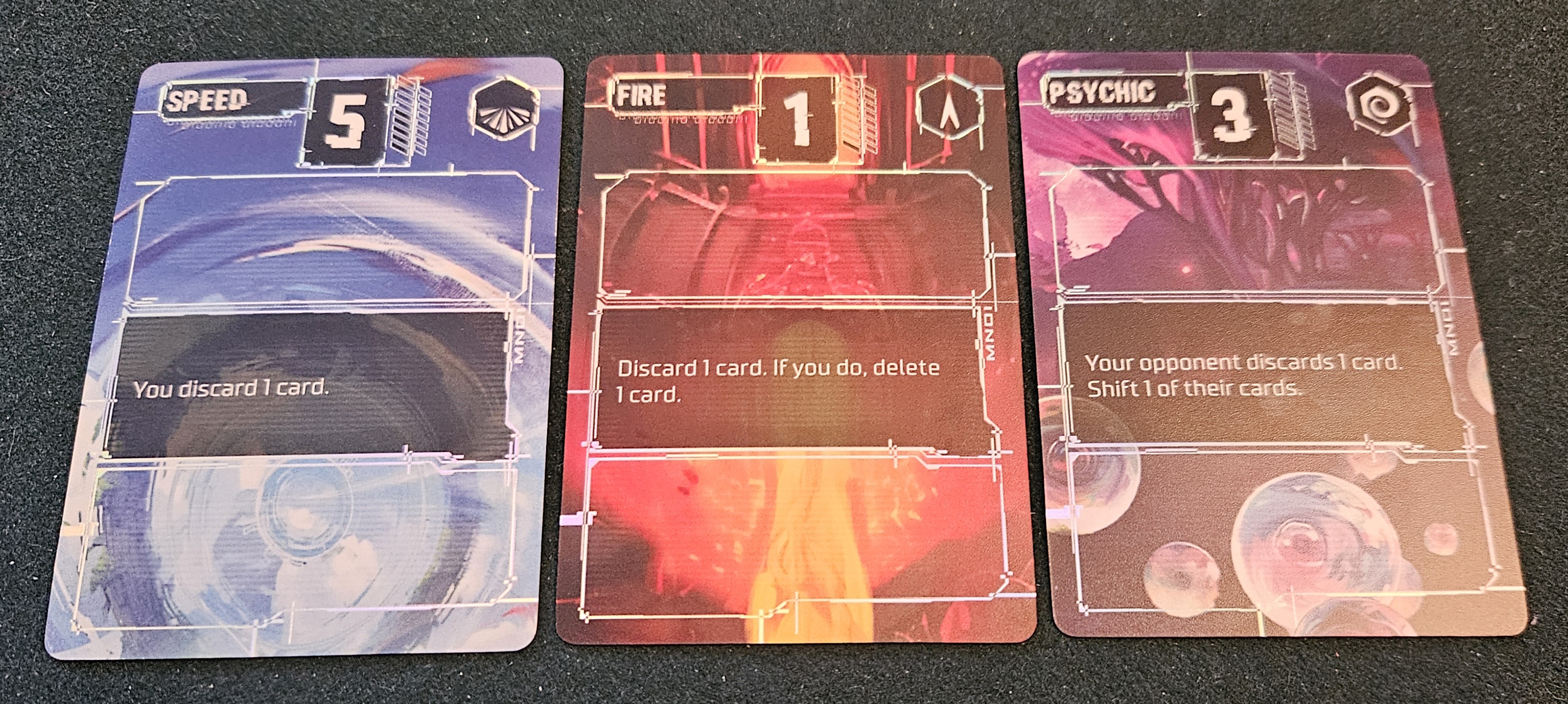
Some of the card effects don’t line up.
There’s an elephant in the room. Maybe we should address it. If you’re a fan of lane-battlers like me, some of Compile’s features probably sound familiar. Maybe too familiar. Back at the start I labeled it a “derivation.” Well, it is. From the cards’ range of integers to the way they’re bound to specific lanes unless played face-down, almost everything feels influenced by Air, Land, & Sea.
To be clear, I’m not calling it plagiarism. Quite the opposite. Yang has openly stated his appreciation for Perry’s masterpiece. Perry, meanwhile, has gone on the record about other lane-battlers that seem to draw some influence from his game, seeming to take an open approach to inspiration and homage. Further, while there are plenty of similarities between both titles, Compile carves out its own identity. It’s the more tactical game, more about the draft and the shape of your deck, with some truly innovative takes on how lanes can be managed. Air, Land, & Sea, by contrast, focuses more on its long-term strategic layer, with players bluffing and backing out of rounds in order to earn points. Nothing like that is found here.
If anything, I’m more interested in the way Compile’s existence, coupled with its premise of awakening digital consciousnesses, raises questions about the nature of inspiration. Regular readers will be well aware that I don’t harbor much affection for large language models. More than once when discussing such things, some AI Bro has wormed free of their stoma to ask, “What’s the difference between a robot scraping the internet for countless stolen artworks and a human drawing inspiration from somebody else’s work?”
There are any number of distinctions, some more obvious than others. For one thing, I’m in this business because I want to connect with people, to be useful, to have my writing be read and enjoyed and, sure, emulated or argued with or whatever else, even, generally, when the response comes down to “Dan Thurot is a big doo-doo head.” As such, I’m delighted when somebody drops a note to say they’ve written something because of something I wrote. That is an exchange between emotional and empathetic beings; that is the principal currency of art and communication. In the spirit of that exchange, I extend permission to any human being to emulate, whether closely or distantly, the things I consider my art.
Large language models, though? They don’t create because they feel. Nor do they create because they would feel empty or unwhole if they didn’t create. They don’t play Air, Land, & Sea and say, “You know what? I love this game. And because I love it so much, I feel compelled to create my own version of it. A version that’s my own, different and distinct, but similar, a paean, a song, a celebration, a merging of the object of my affection and myself. I shall name it… Compile!” Or, you know, thereabouts. I didn’t, like, interview Michael Yang. But you get the gist. You might also, unless you are a soulless husk who doesn’t grasp why people create things, understand why artists overwhelmingly disapprove of being ripped off by robots.

That awkward moment when all you’ve got is spirit.
Playing Compile, that’s what I feel. It draws on Air, Land, & Sea while still demonstrating its own distinct vision for what a lane-battler can accomplish. It speaks the same language but utters new words and sentences and paragraphs of ludic meaning. It falters, at times. But it also makes improvements. It provides vibrant, exciting cards, and tackles one of the genre’s oldest problems not once but twice, and produces some truly gripping escalations between players. This isn’t among my top lane-battlers. But it’s close. So close. I very much want to experience the future results of Yang’s inspirations.
(If what I’m doing at Space-Biff! is valuable to you in some way, please consider dropping by my Patreon campaign or Ko-fi.)
A complimentary copy was provided.
Posted on September 23, 2024, in Board Game and tagged Board Games, Compile, Greater Than Games. Bookmark the permalink. 6 Comments.

 SPACE-BIFF!
What then are your top lane battlers? If i may ask 🙂
John Clowdus’s Omen: A Reign of War is usually the one I consider my favorite; he’s done others, like An Empty Throne, which are also good. I also love Air, Land, & Sea by Jon Perry, Haven by Alf Seegert, and the forthcoming The Old King’s Crown. When it was still active, I also really dug Eric Lang’s take on the genre, WH40K: Conquest.
Pingback: Best Week 2024! Snacked! | SPACE-BIFF!
Pingback: Sockeye Salmon Slayers | SPACE-BIFF!
Pingback: Space-Cast! #48. Compiling | SPACE-BIFF!
Pingback: All for Freedom and for Pleasure | SPACE-BIFF!