Philatelist Fatalist

The history behind the word for stamp collectors, “philatelist,” is rather charming. Derived from the Greek words for love (philos) and tax exemption (ateleia), it’s bound to the early history of postage stamps, which placed the burden of payment for a letter or package on the sender rather than the recipient. Where receiving mail had once been a hassle, often representing an unexpected payout to the carrier lest they hold your letter hostage, it now became a source of childlike joy. Here’s a gift; you owe nothing for it.
That might be the most interesting thing you learn today. Paul Salomon’s Stamp Swap sure won’t beat it.

Your objective: to assemble the best folio of stamps this living room has ever seen.
Stamp Swap is one of those games that slides off the memory like a fried egg off a tree. It hits all the right beats, except none of them nail the landing, even those it repeats just in case you missed them the first time around.
On the surface, Stamp Swap is all about the pie rule, that rawest form of justice wherein I cut the pie and you choose which piece you’d like. The beauty of such games lies in the rule’s inherent corruptibility. When it comes to dividing fruit-filled pastries, it’s easy enough to eyeball an error in size between one piece and its neighbor. Stamps, with their variable values and conflicting desirability, with some of them distributed and exchanged face-down, with their rarities not totally known in advance, are another story.
So you futz the numbers. Just a bit. Just enough so that the tally comes down on your side. You load certain desirable stamps into one pool to tempt your co-philatelists into claiming the stuff that doesn’t quite work for you. You know that Phil wants space stamps, so you put rocket ships and astronauts on display, while keeping the rare chocolate stamp for yourself. Or you see that Ateleia is trying to round up some extra forever stamps to perfect the shape of her folio, so you pit those against the fancy canceled stuff that will score big for you.
Of course, these attempts are prone to backfire. Everybody at the table knows that not every philatelist is as honest as the one from Charade. That chump returned a cool quarter million! In 1960s dollars! He could have been set for life! His grandchildren could have pursued an education instead of fighting in the eleventh French Revolution! Stamp Swap is cannier. As a game about appraisal, about hiding something in plain sight, about the thrill of getting away with the world’s lowest-stakes heist, it’s primed to work.

There are two full selection processes per round.
And it does work. It’s just that it doesn’t inspire much excitement.
Take, for example, the eponymous swap. Everybody takes their stamps and divvies them into two piles. One of these you will keep, the other will be traded away. Simple, right? Well, the first snag is that you aren’t only trading stamps. Also up for grabs are specialists who provide special abilities, exhibitors that add new scoring criteria, and even the first player marker. Already, the proceedings are growing cluttered.
But that’s only half the story. Earlier in the round was another collection phase. This is when players drafted the stuff to actually divvy up and swap. Stamps and all the rest, including the first player marker. Which means that there are multiple phases where going first matters, but that the first player can change in between those phases. Oh, and those specialists with their special abilities? Those apply any time you have the specialist in your possession, even if you’ve only picked them up to trade them away. This is probably a necessity, considering how Stamp Swap only lasts three brief rounds, but it never feels quite right to trigger the ability of a card you’re only holding for two minutes.
Meanwhile, the stamps are small and their “themes,” the details that various collectors are pursuing for points, aren’t always as clear as they could have been. Space is one theme. Vehicles is another. But what about vehicles in space? Conversely, if I prize monuments and you like animals, what if there’s a canceled stamp that looks like a highly stylized snake? Is that some sort of statue? It looks more like something you’d see in a plaza than a creature you’d spot in the wild. This game is an image lawyer’s playground. Squinting at tiny images is a form of verisimilitude, I suppose, but you don’t see me begging to shear my own wool in Catan.

The scoring cards aren’t always clear.
The best part of each round arrives when everybody sticks their stamps into their folio, Fit to Print style, with an eye for arrangements that will score the most points. Scoring isn’t nearly as persnickety as it could have been, and to its credit Stamp Swap produces an interesting scoring system that forces tough decisions.
The gist is that our stamp collecting convention is hosting four competitions. In each scoring phase, we select one competition in which to enter our folio. Because there are only three rounds, and because we can only enter each competition once, we’re forced to choose the competitions that will score us the most points, while also not jumping the gun and entering one that could have scored higher if we’d held off a bit. There’s also a final assessment with another objective to chase.
But these objectives aren’t always wholly clear. Certain terms, like “group,” are counterintuitive. Yet in a shocking reversal from most Stonemaier productions, there is no appendix to clarify the fuzzy gray areas between one objective and another. Indeed, Stamp Swap is perhaps the least Stonemaier game I’ve ever seen from Stonemaier Games.
Which isn’t to say it’s bad, mind you. Stamp Swap isn’t bad. It’s unremarkable. It has a functional core, but it’s hedged around with extra details. The psychological shenanigans of the swap and constructing your folio are the good parts. But rather than isolating and emphasizing its strengths, Stamp Swap can’t help but complicate everything. Rare stamps can’t be reserved. Specialists lend their abilities temporarily, only to kinda-sorta stop mattering in the final stretch. The first player marker is continually up for grabs. The themes are fuzzy. The competitions are fuzzy. On and on. For every positive, there’s some corresponding hitch.
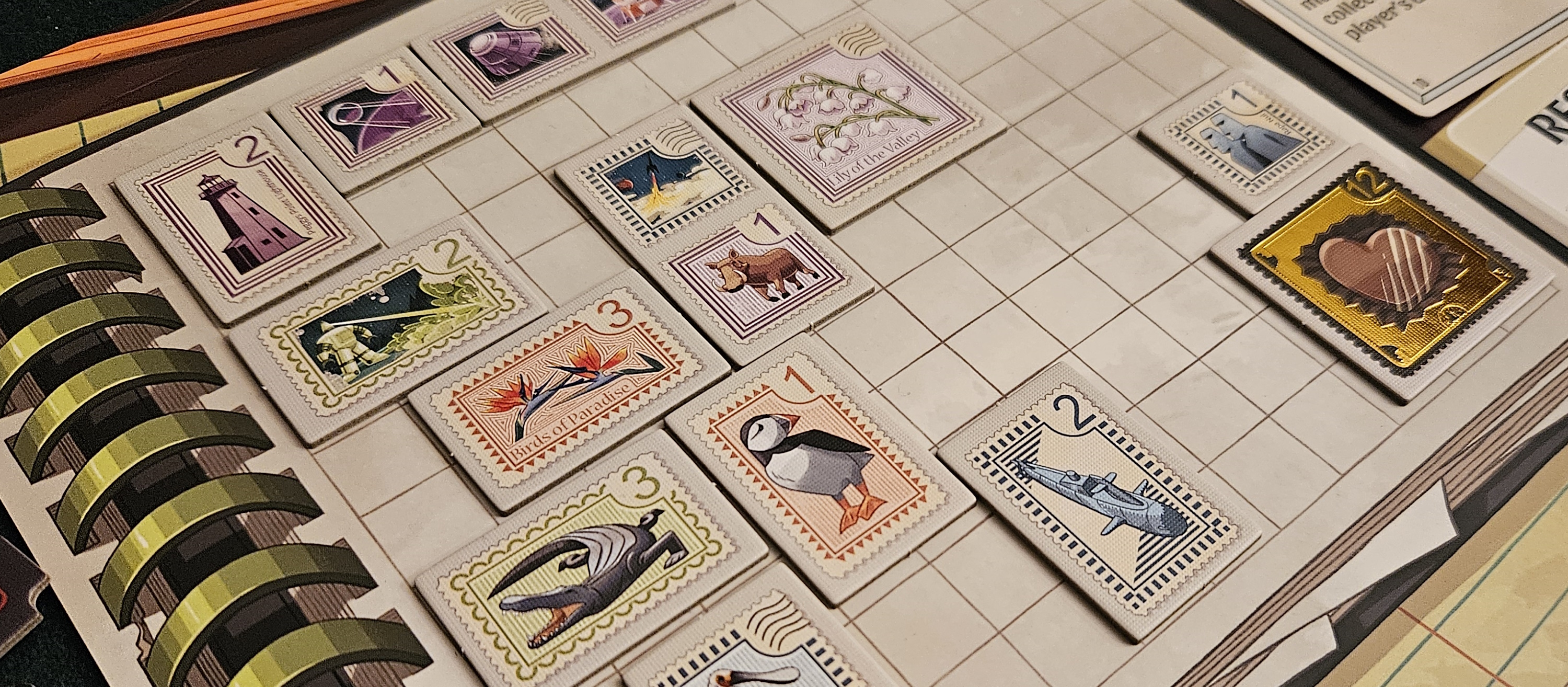
Puffin!
I’ll put it this way: Stamp Swap never gets out of its own way. There’s good stuff in here. Pulling off one of those tiny heists by tricking somebody into taking your weaker pile, that feels great. But then it’s back to the cruft, the overlong tallies, the long-winded population of the collection pile, yet another circuit of the table to collect stamps you’ll trade away two minutes later. Philately deserved better. And that’s saying something, because it’s philately, you know?
(If what I’m doing at Space-Biff! is valuable to you in some way, please consider dropping by my Patreon campaign or Ko-fi.)
A complimentary copy was provided.
Posted on September 19, 2024, in Board Game and tagged Board Games, Stamp Swap, Stonemaier Games. Bookmark the permalink. 2 Comments.

 SPACE-BIFF!
Thanks for the review! If you like to explored more of “I cut you choose”, Knizia put his own spin on the formula with the recently released Marabunta. In my opinion an excellent head to head. Keep up the good work!
Interesting! Thanks for the recommendation.