Breaking Mythwind
I like an ambitious game. Maybe it’s my abiding soft spot for Teddy Roosevelt’s Man in the Arena, despite some of the worst people you’ve ever met quoting the thing to deflect criticism, or maybe it’s my never-ending hunger for novelty. Either way, a board game that tries something different is bound to attract my attention. Even when that board game decides to get dressed by looping its underpants around its shoulders.
Mythwind, designed by Nathan Lige and Brendan McCaskell, certainly fulfills in the ambition department. To various degrees, it also does the underpants-as-pauldrons thing.

Working the frontier.
The marketing pitch for this thing would have glazed the eyes of even the most steadfast executive. In a single sentence, Mythwind is — deep breath — a gentle open-ended narrative-driven “cozy-core” legacy-alike asymmetric frontier town simulator. Dang it — with adorable and mischievous fairies in place of a problematic indigenous population, not to mention stacked storage trays that keep everything in place. So much for cramming its bullet points inside one mouthful.
But the wild thing about Mythwind is that it makes good on every point. This is a game that could, in theory, be played across ten or twenty or thirty sessions, each of them as calming as a burbling brook, so calming that the edges of one season blur into the next, until you forget what you were— wait. What’s our goal here? Are we expanding the town, or gathering enough food to stave off starvation, or suppressing that outbreak of black mold, or reawakening the ancient tower on the horizon, or what? If it didn’t sound so barbed, I’d call this thing soporific. Mythwind could cure insomnia. It’s the board game equivalent of summer break, each day merging into the next, those hot summer nights only marginally cooler than the hot summer days, limbs heavy and drowsy and happy.
Your characters might beg to differ. The idea is that each player takes on the role of a local figure crucial to the livelihood of this frontier town. Unlike other games with ongoing roles, Mythwind applies a casual touch. As seasons pass, you’re free to continue your role or swap it out. Over the summer you’re the Farmer, playing Tetris with your crops and livestock to maximize yields. Then, as autumn settles over the forest, you become the Crafter, gathering and refining raw materials so you can fashion boots and parchment and whatever else the settlement requires. Certain details are persistent, both within the town (structures, resources) and as individuals (petty cash, upgrades), but there’s nothing tying you to a single role. That’s the promise of the frontier, after all. You can become someone new.
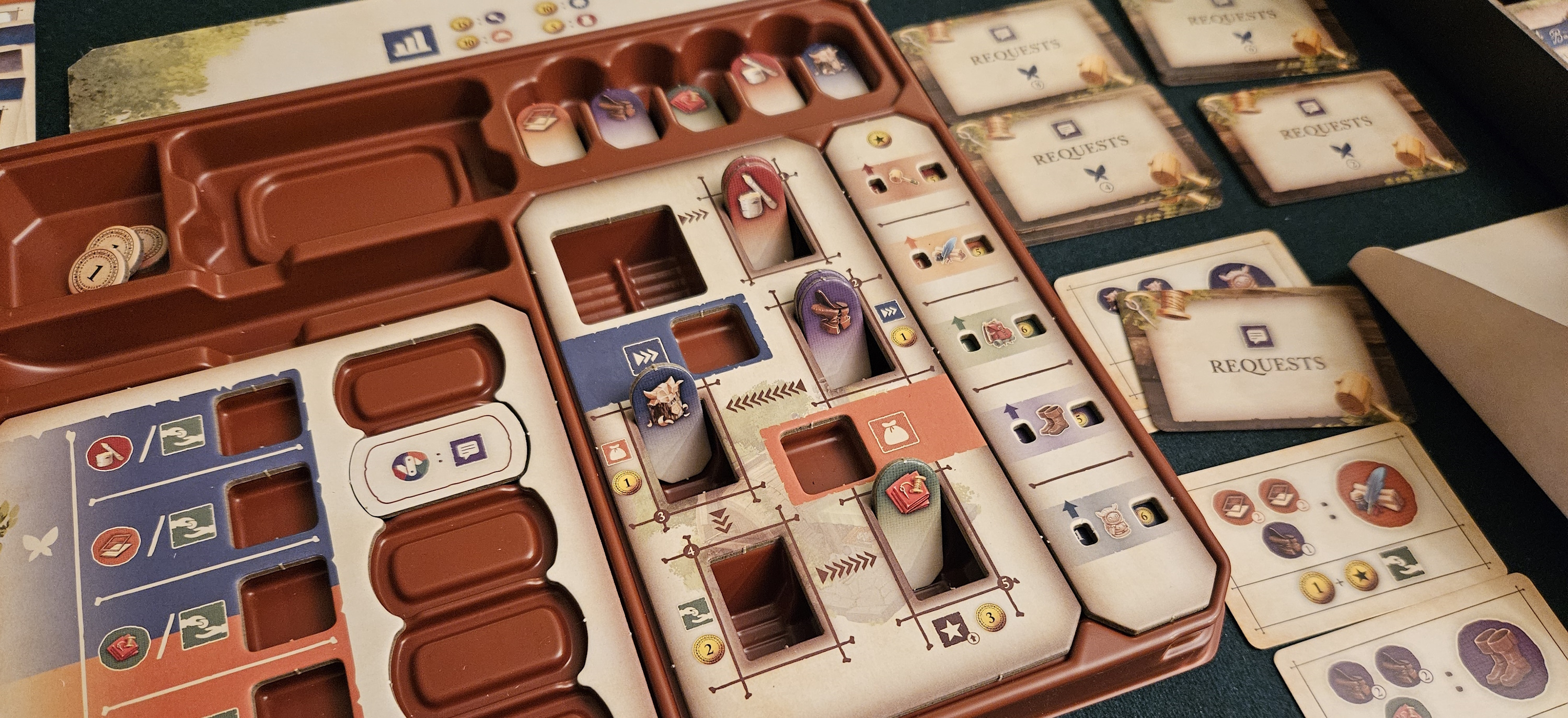
You wouldn’t believe what the Crafter does all day.
Asymmetric games are an increasingly hard sell, especially when their creators struggle to educate their players about how everything fits together, and this is where Mythwind stumbles the hardest. A visualization of its rules load might appear as an inverted pyramid. Every turn begins with players visiting the settlement to take an action. It’s worker placement, albeit an ultra-light approach to the genre. I might hire local workers to help out with my errands, while you spend the day fishing to secure additional rations for the town, or working to erect a new post office. Then, for the bulk of the turn, we go our separate ways to work our jobs, ne’er to nod in one another’s direction.
There are a few things I’ll say about this model. The first is that this makes teaching the rules a real bear. Each character is thankfully given their own rulebook, so it isn’t like we’re passing one comprehensive tome around the table. But let’s be real: not everybody is a rules reader. As the designated Guy Who Reads Rules and Teaches Rules and Answers Rules Questions, our sessions featured heaps of half-understood busywork until I could dip into so-and-so’s personal guidebook to suss out the particulars of how their career was meant to be performed. Mythwind is phasey. There are particulars that must be conducted in sequence, some of which stretch into the town phase while others don’t. There are upgrades that bend a player’s rules, and individual event reactions, and and and—
And I’m not convinced it works in multiplayer. Not only because players share so little time together and spend the bulk of their time playing in parallel rather than really playing together, but also because the game’s simultaneous play doesn’t overlap as neatly as one might hope. The Farmer, for example, is a straightforward enough role. He clears foliage, buys seeds and equipment, plants and tends crops, and sells his produce to start the process anew. But he’s also subject to the weather more than most players. Between that and a series of careful manipulations of his farm board, his turns tend to run longer than the Ranger’s. This dude is an adventurer. He stocks up on equipment in town before heading off into the wilderness to scout for resources. When he isn’t in town, many of his turns consist of flipping and reacting to a card. That puts him on the opposite end of the spectrum from the Farmer. He’s high on complexity but most of his turns are snappy.
The same is true of the other roles, as well. The Crafter sits in the middle, but the Merchant is saddled with an entire event phase of her own, modifying various prices or watching as potential customers instead trade with her rivals, before she actually gets to her main actions. It’s the perennial problem of simultaneous play. Mythwind wants to be cozy, but these jagged overlaps often leave one or two players twiddling their thumbs while everybody else finishes up their turn. Unlike most titles with alternating turns, your fellow players’ actions bear so little import on your own that there’s nothing to pay attention to.
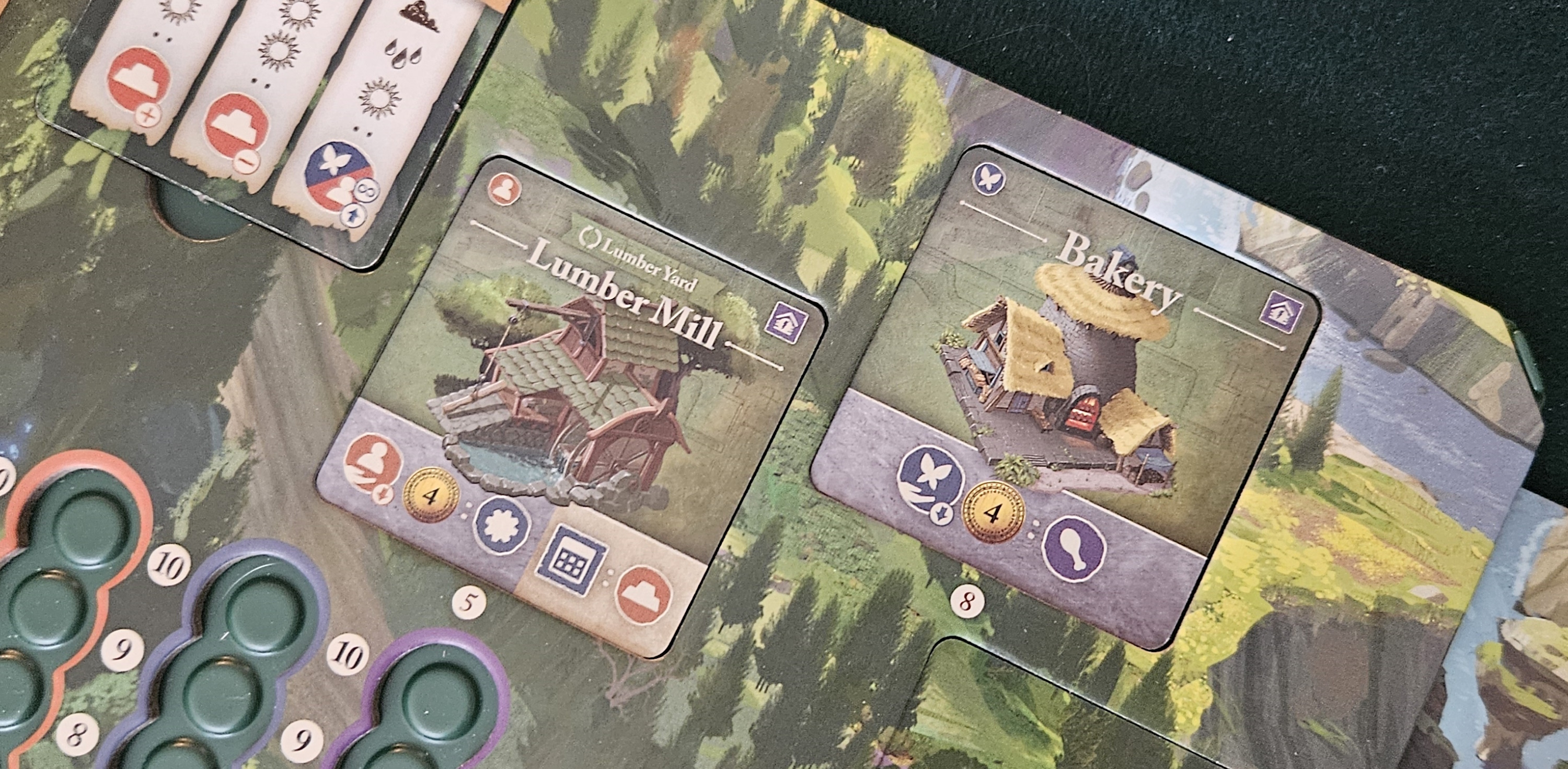
Little by little (by little), your town takes shape.
This might sound like a lot of bellyaching, but it’s in service of a larger point. Mythwind isn’t very good when played with companions. As a solitaire experience, however, it’s rather charming.
On one’s own, it can be experienced at your own pace, whether that’s a few turns or multiple seasons in a sitting. I tended to prefer two seasons. That was long enough to see my role develop, to watch as two or three structures were raised from foundations to roof beams, to flip through a few events and adventures and see the settlement’s low-stakes drama unfold. It was also exactly long enough to sit through one disc of the Lord of the Rings Extended Edition with my ten-year-old. As an activity for keeping your hands busy while watching something you’ve seen so often that you might otherwise fall asleep, Mythwind is indeed a formidable, and cozy, offering.
In light of its cozy nature and even its warm solitude, the proper digital touchstone is probably Stardew Valley, or even something like Terraria or other home-building titles, where multiplayer sessions don’t forcibly tether players together. At the table, everybody is forced into proximity even when, within the game’s fiction, they remain apart. When at last I determined to play it on my own, Mythwind settled over me like a cool breeze. There was no more waiting except when I wanted to wait. There were no more rules consultations. There was no more bickering over who got to visit the longhouse this turn — a peccadillo of worker placement that doesn’t sit quite right in the game’s collaborative environment. There was no more hurrying up a turn for fear of bumming out somebody’s evening. If I wanted to fret over a purchase or a placement, or consider buying a rival merchant’s inventory, or fly through an entire expedition as rapidly as possible, I could take each detail at my leisure. The game unlooped its underpants from its shoulders and tossed them in the hamper.
Now that’s cozy.
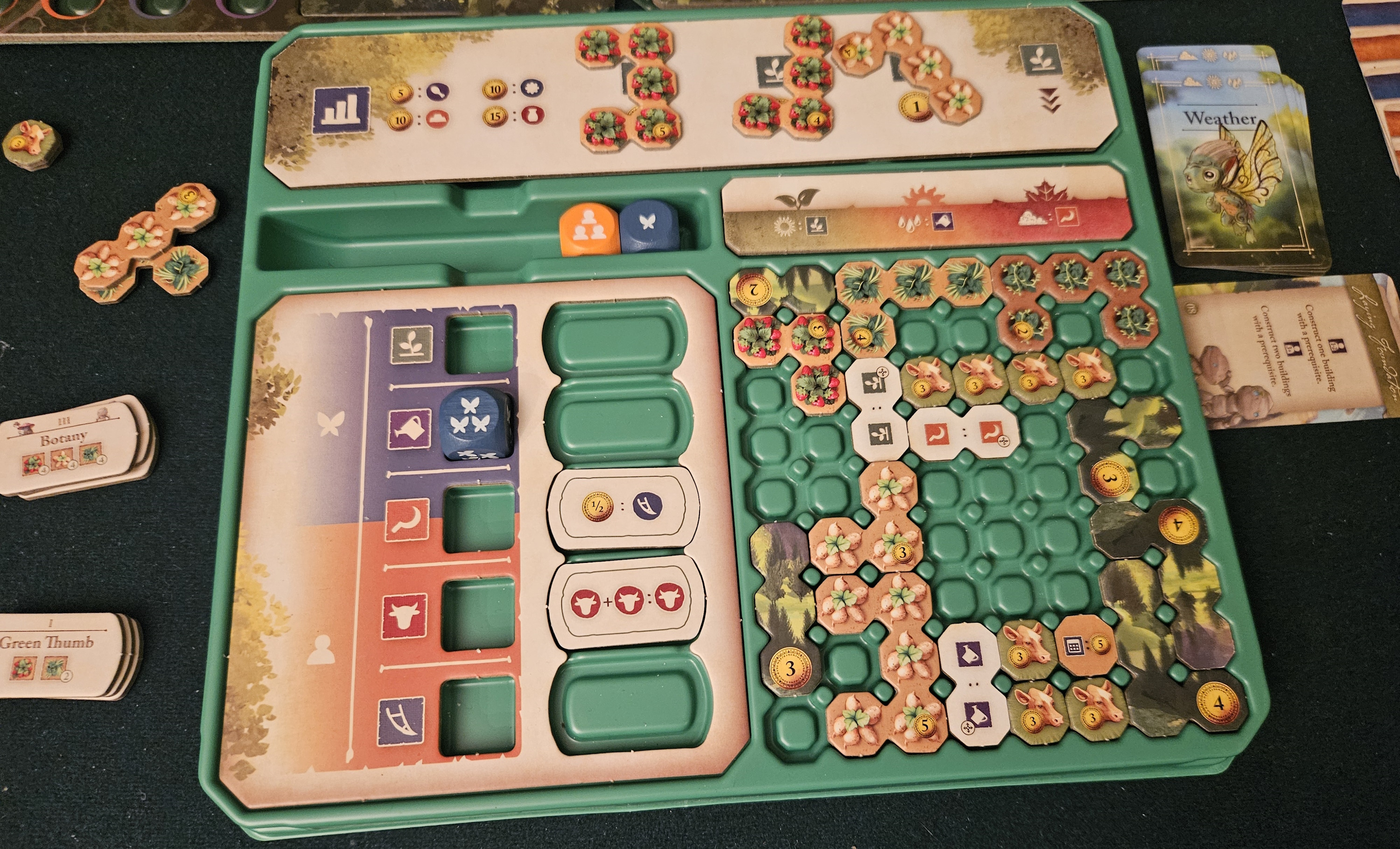
The Farmer is probably the most solid role of the group.
Like I said at the outset, Mythwind is an ambitious game. Maybe too ambitious. Maybe too loaded with concepts and roles. Maybe too open-ended. These combine to make a profoundly imperfect game. Even after three in-game years, the story is still meandering from one beat to the next without much narrative thrust. Do the stakes ever amp up? Is there a conclusion to these interactions between the town’s settlers and the valley’s fairies?
Oh, probably. But I won’t see it. I don’t feel the need. That, too, might be part of the game’s appeal. Just as Mythwind doesn’t enforce a single role, it doesn’t guilt me into sticking around until the last chapter. I came to the valley to find quiet. I was a farmer, a crafter, a merchant, a ranger. And now I will leave it slightly altered but no worse for the wear, and be content that it will be fine without me.
(If what I’m doing at Space-Biff! is valuable to you in some way, please consider dropping by my Patreon campaign or Ko-fi.)
A complimentary copy was provided.
Posted on September 3, 2024, in Board Game and tagged Alone Time, Board Games, Mythwind, Open Owl Studios. Bookmark the permalink. 12 Comments.

 SPACE-BIFF!
Whether I like this game or not, I appreciate your fart-joke title.
-Grant
PS- Will you be at SD Hist again this year?
Thanks! Fart jokes are the best jokes.
I think I’ll be doing SDHistCon again! How about you?
Yup, I didn’t think I’d be back right away, but I’m booked. I’ll see you there!
Yes. I thought it would be years until I managed to go again, but here I go. I’ll see you there!
Nice review. I think like you I came to this expecting a “cozy” multiplayer game, but found it lacking in that regard. It’s just too wonky. Can I call it too complicated? For solo gaming it’s just right, but with a group it falls apart.
Hey, call it too complicated if you like. I think it’s too complicated, too. At least if it wants me to play with a bunch of friends.
Designer Nathan here. I’m not sure if I’ll work up the nerve to read the review too closely, but I’m glad that you did it Dan. You’re the most insightful reviewer in boardgames and I’ve learned a ton from your work.
Ok, maybe I read the last couple of paragraphs. Too ambitious is fair. The beauty and the warts probably all stem from that. Most days I’m glad to have both.
Heya Nathan! Thank you for the kind words. But feel free to read the whole review — despite some reservations, I feel very positively about this game, and I’m grateful you put it out into the world!
It’s a solid review! Well written as always, but also fair and insightful.
I don’t read board game reviews to answer “should I buy this?”, but that’s how most reviewers approach the task. I read reviews to understand what it might feel like to play and experience a game, and this review is the first I’ve read of Mythwind that clearly and succinctly conveys that.
That also means that it’s the first to make me think, “should I buy this?”.
I may have poisoned the well with that, ahem, flatulence reference.
Thanks for the detailed review! I love the idea of a cozy, open-ended frontier town simulator, and Mythwind sounds like it could be a great solo experience, especially for fans of games like Stardew Valley. It’s a shame that the multiplayer aspect isn’t as smooth, but I appreciate your honesty about the pacing and the rule explanations. I think I’ll try it out solo and see if it’s the relaxing, immersive experience I’m looking for. Thanks again for the insightful breakdown!
Pingback: The New Dog-Ears | SPACE-BIFF!