Non Eventu
Prophecy is tricky. In critical theory, huge quantities of recorded prophecy fall under the category of vaticinium ex eventu, “prophecy after the event,” which is a fancy way of saying somebody jotted down some historical events in a book but pretended it was written before those events occurred. Uncovering ex eventu prophecy is a useful method for dating a document. The trick is to look for the watershed moment when the prophecy switches from accurate to nonsensical. Voila: you’ve uncovered the instant the author stopped relating history and started penning revenge fiction. For two stellar examples, see the Christopher Columbus stuff from the Book of Mormon or the politicking diadochi of the Book of Daniel.
Arcana Prophetia is all about prophecy. The supposedly real stuff, not the ex eventu kind. Designed by the same team that gave us the imperfect but gentle Kawa, this is a gorgeous production that takes cues from tarot decks and splays to weave a story about old and new gods clashing over competing visions of destiny. Metal.
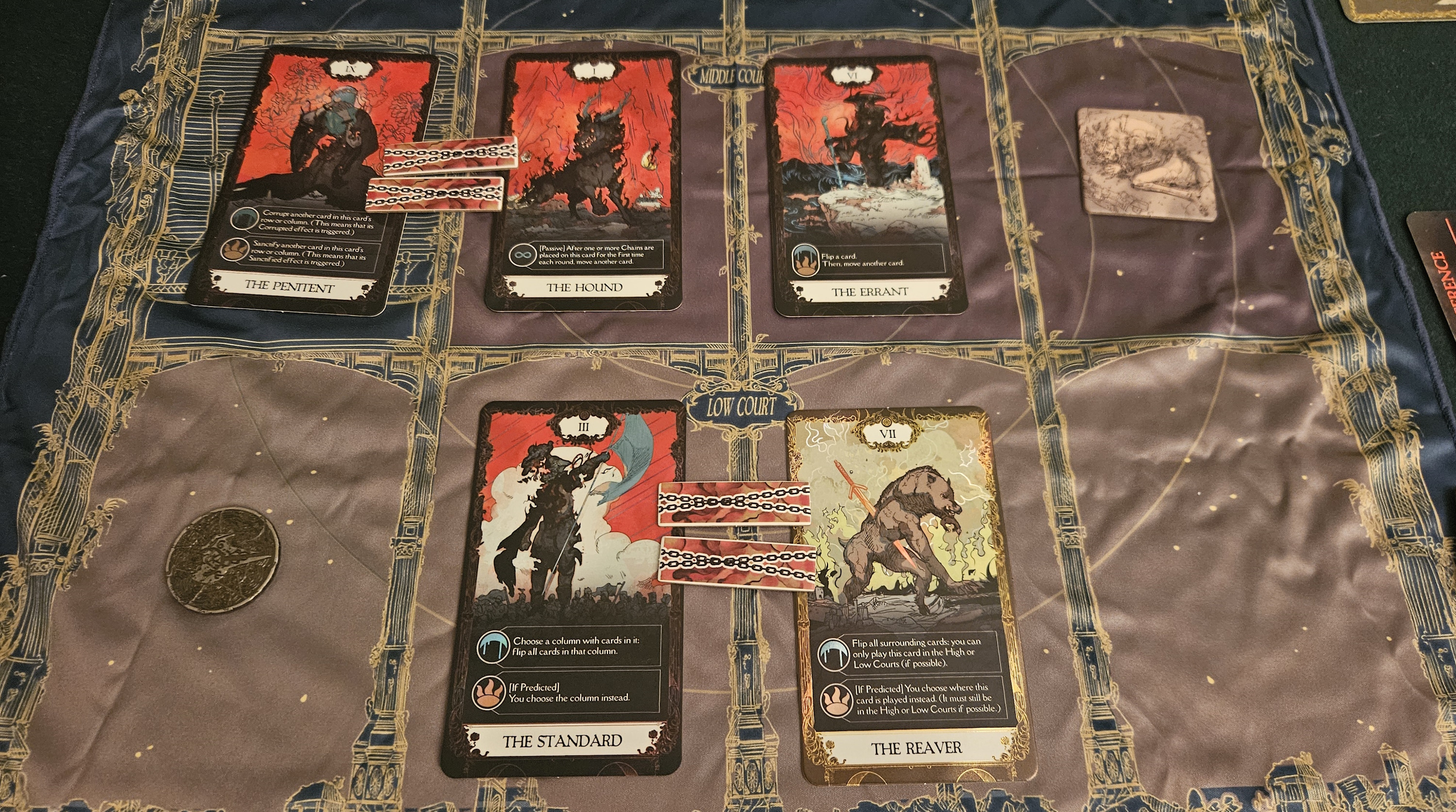
All splayed out.
The tenth and greatest god, Sol Almighty, has perished. One by one, the remainder of the pantheon is falling to madness. Two claimants remain. The Last Sovereign, standing firm against the onrushing inchoate. The Fates, susurrating a song without rhythm or melody. In time, only one will remain.
Okay, so the fluff behind Arcana Prophetia isn’t any more coherent than your run-of-the-mill apocalypse text, all grave names and big portents. Fortunately, the game provides a tidy shorthand. Every one of the tarot cards in its ample deck is dual-sided. On the one side you see a vision of the old gods, whole and pure and golden. On the other, their newer corrupted visage, red and ragged. All that remains is the need to remember which side you’re playing.
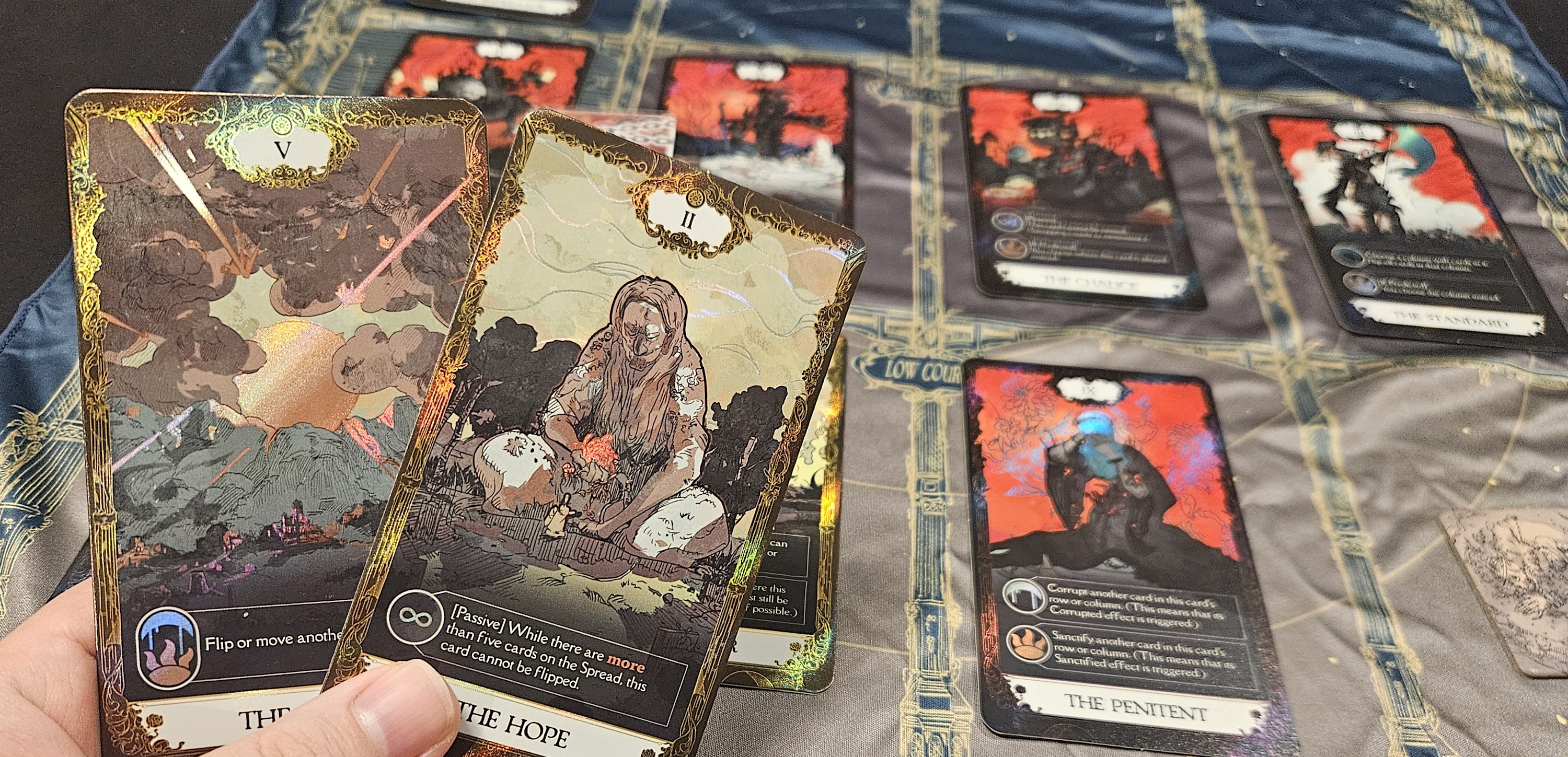
Sessions are compact. Crafted to emulate a tarot spread, only nine cards — out of the ten in the Fates’ hand — will be played in any given match. Their placement is paramount, sorted across three courts. Adjacencies and rows and columns matter depending on the cards currently in rotation. Chains may appear to bind cards together, preventing them from shifting or flipping. I was charmed when Fred Serval included rules for a tarot reading using the cards in A Gest for Robin Hood. Arcana Prophetia pushes that trend to its furthest extreme. Here every card is an entity or occurrence in a cosmic duel. Between the artwork and the mystical flair, it’s weirdly effective. I get chills just flipping through Nayth Okutri’s illustrations of pierced and gluttonous deities, lone banners fluttering on creased battlefields, sickly moons sagging low in the heavens.
What to play…
It isn’t that I believe in this stuff. Nah. The mystical is a reflection of the inner self. But what a reflection. Once upon a time, I was a Mormon missionary. Knocking doors, we ran into a young single mother who’d been dealt a bum hand. An early pregnancy, an absent partner, problems with addiction, the works. As we got to know her, she admitted to a penchant for tarot. I’d never held a tarot deck — even face cards were forbidden in my childhood home — but I’d been reading up on the stuff and offered to give her a reading. She agreed. I took the cards in my hand, shuffled them together, and laid out a Celtic Cross. Then I told a story. This card meant one thing, that card meant another. This upside-down card, uh oh, that’s an inverted so-and-so. This young woman gave her opinion now and then. The spread, in the end, encouraged her to get clean. The next day, she joined a twelve-step. Last I heard, she was still going strong.
The thing is, I didn’t do anything. Okay, I vacuumed her apartment and arranged to have some food delivered. But I didn’t do anything in terms of helping turn her life around. The cards didn’t do anything, either. It was all her. My little story, the cards, they provided a reflection of something she already wanted. They gave her the extra oomph to pull herself along. She found an inner strength that had been there all along. That, to me, is the power of all this stuff. Tarot. Games. Stories. They’re our inner selves let out into the atmosphere for a few minutes.
I’m telling you this because I need you to believe that I wanted Arcana Prophetia to be an amazing game. I wanted it to be the equal of those illustrations, a worthy tradent of the myths we pass from one generation to the next, a keeper of the inner selves we pour into prophecy. I wanted it to ignite that spark.
But it isn’t. It doesn’t. And the problem stems from the way the game handles prophecy.
Guessing, I mean prophesying, the future.
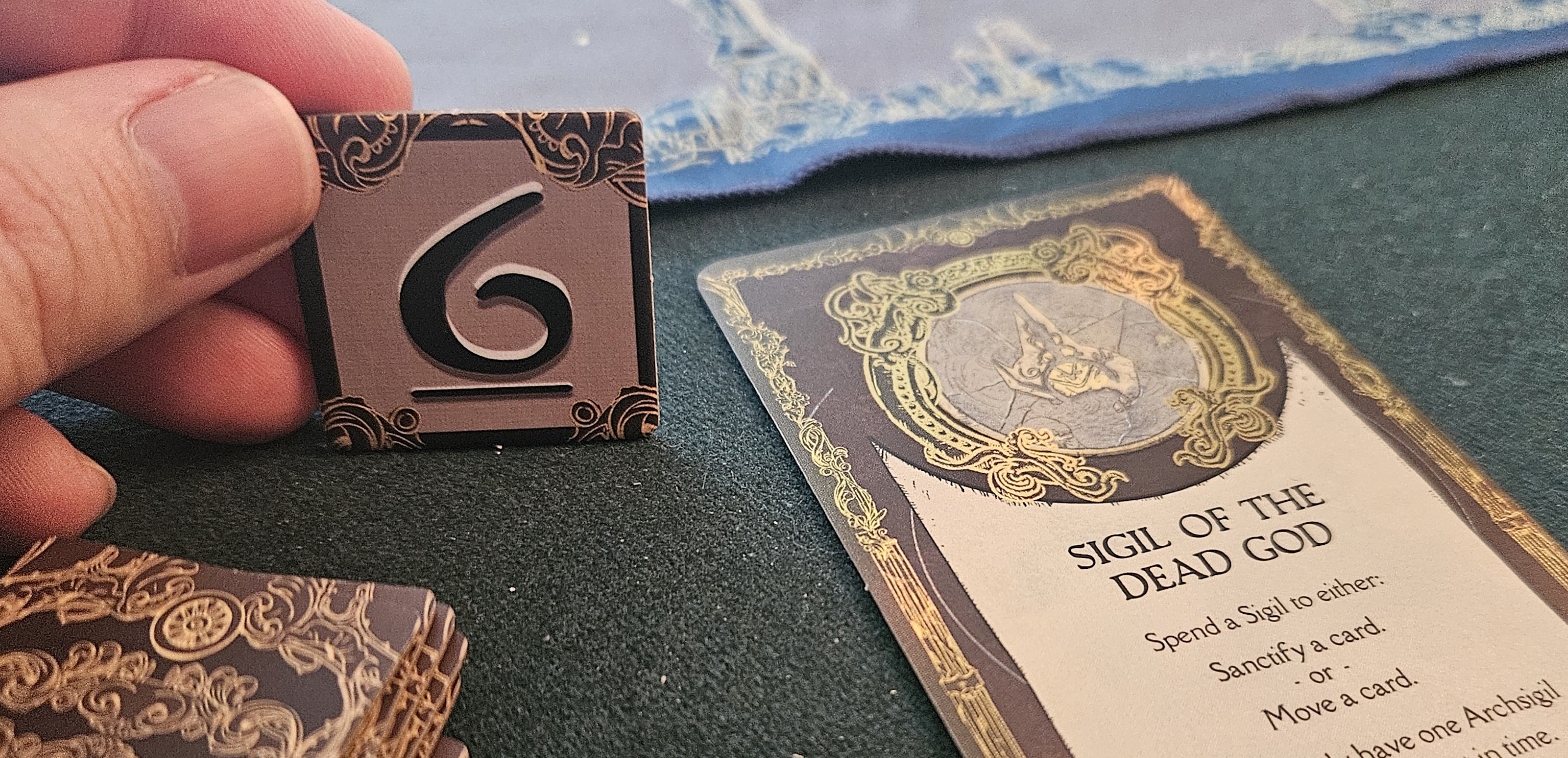
Each turn revolves around a prophecy. The Fates select a card to put into the spread. The Last Sovereign guesses which numeral that card will be. Depending on which side wins, the card is placed on either its sanctified or corrupted side. This in turn triggers different abilities. There are other details — sigils that trigger extra abilities, faces that alter the rules, those aforementioned chains — but the gist holds true no matter what.
The problem is that the Fates aren’t striving toward anything. Oh, they have a goal. Both sides hope to have the most cards showing their color once the ninth and final card has been placed. But the Fates don’t rely on any particular card appearing at any given moment. When they stick a card into the splay, it could be any old thing. The proper numerals might add a chain to the board, locking the card in place, but even these are minor adjustments rather than game-making stratagems.
By contrast, the Last Sovereign only succeeds when they correctly prophesy which numeral the Fates select. Except they have nothing to go on. Oh, they know there are only nine possible digits. Over time, as cards are placed, there will be fewer and fewer digits to guess at. But there’s no major distinction between one card and another. As one friend pointed out, the easiest way for the Fates to win is by selecting cards at random, thereby depriving the Last Sovereign of making informed guesses at all. The game isn’t merely imbalanced. Imbalance is fine. Rather, it has a very real possibility of locking out one player altogether.
Compare this with other games that do the “guess where your opponent intends to go” thing. Not Alone sees stranded astronauts scouting a path to escape a monster-infested jungle. City of the Great Machine is about rebels gathering support and flipping the proper switches to overthrow Google the robot police. These objectives provide just enough information to their opposition — the jungle monster, the robot police — to inform those players’ prophecies. This is a core component of all hidden movement games. Unless the concealed player values some destinations over others, the searching team has no way to determine where they might appear next.
In Arcana Prophetia, that’s precisely the problem. The Fates have no objectives. They need nothing, seek nothing, value no piece of ground over any other. Their goal is merely to evade. And that means they can do pretty much anything they like. You could almost play this game solo by shuffling the Fates’ cards into a concealed deck. As the Last Sovereign, your guesses would only be slightly less informed than against a human player.
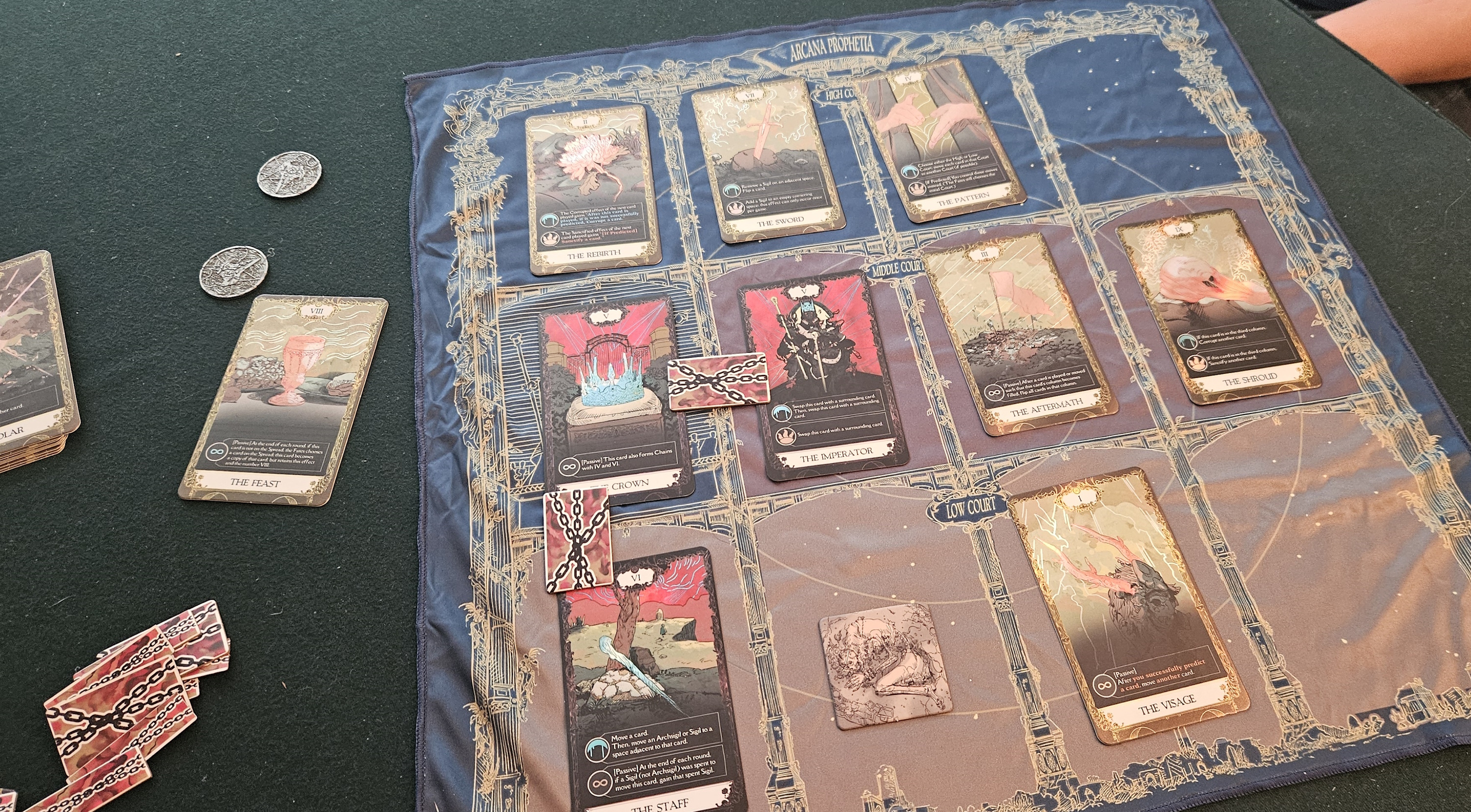
I do love how Arcana Prophetia looks.
It’s a shame. Arcana Prophetia is gorgeous. More than that, its creators understand the deep appeal of this stuff — the ragged cosmologies, the divine reflections of the inner self, the ape-brained delight of putting these kernels of meaning into discrete rows and columns. We arrange ourselves into clans over stories for a reason.
But they apparently don’t understand hidden movement. For all its prettiness, and in spite of how badly I wanted to like it, Arcana Prophetia isn’t prophecy ex eventu. It’s prophecy non eventu.
(If what I’m doing at Space-Biff! is valuable to you in some way, please consider dropping by my Patreon campaign or Ko-fi.)
A complimentary copy was provided.
Posted on August 29, 2024, in Board Game and tagged Arcana Prophetia, Board Games, The Aerie Games. Bookmark the permalink. 2 Comments.

 SPACE-BIFF!
This was a beautiful story. If only the game lived up to it.
Thanks. So it goes.