Biomoseying Along
Gricha German’s Biomos is a game with an important point on its mind. Could have fooled me. Let me propose a rule: if you intend for your game to make an important point, consider leveraging the medium’s unique strengths rather than squirreling that point away in the back of the rulebook. To be sure, the point is a sobering one that deserves widespread attention: over the past half-century, our planet has witnessed a 70% decline in monitored wild animal populations. That’s hard to fathom. If only somebody had modeled it in, say, a board game so we could visualize such a catastrophe.
Instead, Biomos moves in almost the exact opposite direction. You are a planet attempting to gather disparate biomes in order to sustain life. Even as a plaything with nothing on its mind but the accumulation of victory points, it fumbles the essentials.
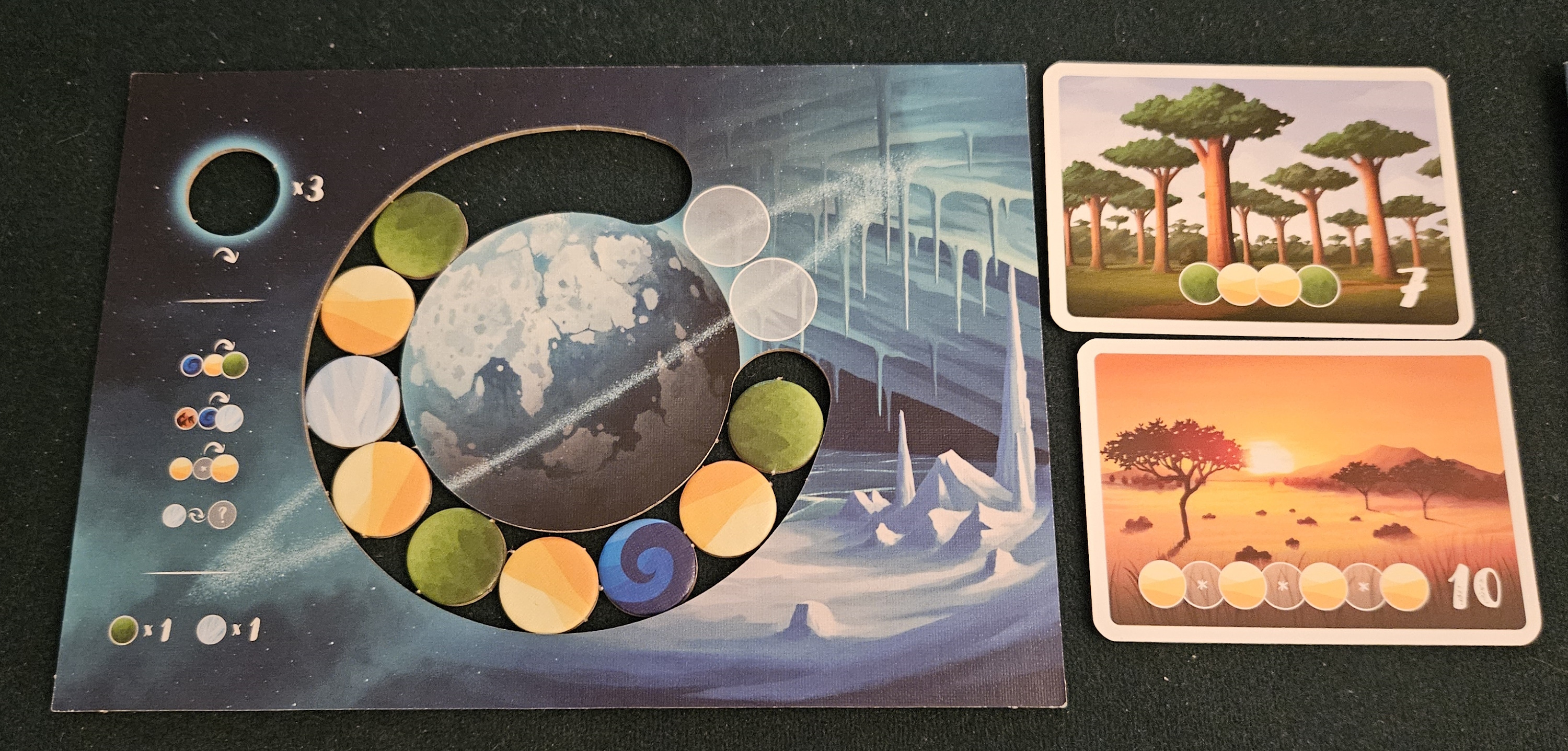
Crafting a happy ice planet.
Drafting. Oh, drafting. How I love thee, drafting. How thine warmth, um, warms mine breast.
On the surface, Biomos is a drafting game, and a perfectly serviceable drafting game at that. The game begins with five circular tokens on the table. These are the terrains on offer, a selection of forests, deserts, mountains, oceans, and glaciers that every growing planet desires in order to mature into its fullest self. On your turn, you select a token and add it to your planet. There are a few particulars to this equation, such as various planet types that yearn for glaciers or mountains, or a moon that awards bonus points for matching terrain down on your planet — which makes Earth a real screw-up with that dead rock up there — or a couple of slots that can’t be manipulated once terrain is tucked into them. But it’s simple, straightforward, refreshing token drafting.
Making matters tougher, these tokens aren’t replenished until they run out. This adds some spice to an otherwise plain bowl of rice. It’s one thing to select from a pool of five tokens, but another to choose from only two or three — and another entirely when you’re forced to take the last remaining token before the refresh.
This is where your planetary actions come in. Once per turn, you can make an adjustment. Water can transform a desert into a forest, or mountains can freeze oceans into glaciers, or glaciers can transform other terrain into more glaciers (if only!). Provided there’s a replacement token in the bag, these adaptations are essential to fostering just the right amount of diversity.
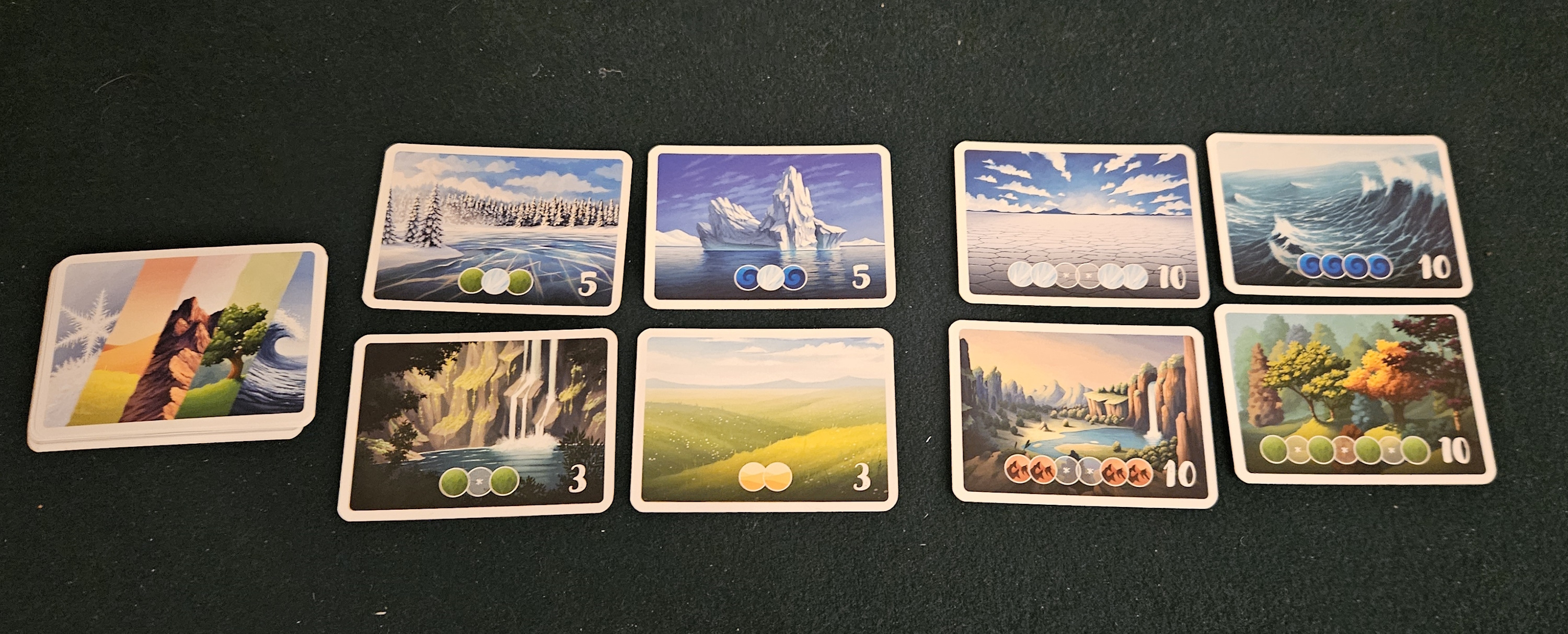
The goal offer. It doesn’t work.
Diversity for what? Well, that’s where Biomos trips on its shoelaces. The lion’s share of your points are derived from biomes, combinations of terrain printed on cards. If you have the right combination — a precise arrangement of forest, glacier, and forest, for instance, or two mountain ranges separated by some other terrain — you can claim one of these biomes to secure its points for yourself.
Breezy. Also barely functional. Biomes are nearly always a cinch to complete. Most of the time, a biome is completed by having only two or three terrain tokens in the proper sequence. There are a few tougher cards on display, but these don’t replenish like the easier fare. Biomos soon becomes a game of dribs and drabs. Have two deserts next to each other? Points. Seas and glaciers? Points. Make a minor adjustment to a nearby stretch of terrain? Points. Do nothing at all? Sometimes that also awards points.
This is where Biomos displays such carelessness that it slips from unremarkable to insulting. Thanks to the ease of completing any given biome, and because the market refills any gaps each turn, it isn’t uncommon for a newly drawn card to award points to somebody for doing literally nothing. A biome card appears, happens to accord to your own terrain, wahoo, points.
Let me tell you, this is never not a bummer. Even when you’re on the receiving end of such a boon, it feels grimy and cheap. I suppose this could qualify as a featherweight filler, the sort of game one plays when their brain is too hashed to run more complex computations. But there are countless games that lean into that exact headspace, and do so without feeling so patently unfair, not to mention so disconnected from the larger message they claim to espouse. This year alone has witnessed the release of two fantastic ecologically conscious board games in Daybreak and Defenders of the Wild. It isn’t enough to tell us that your game cares. Make us feel it.
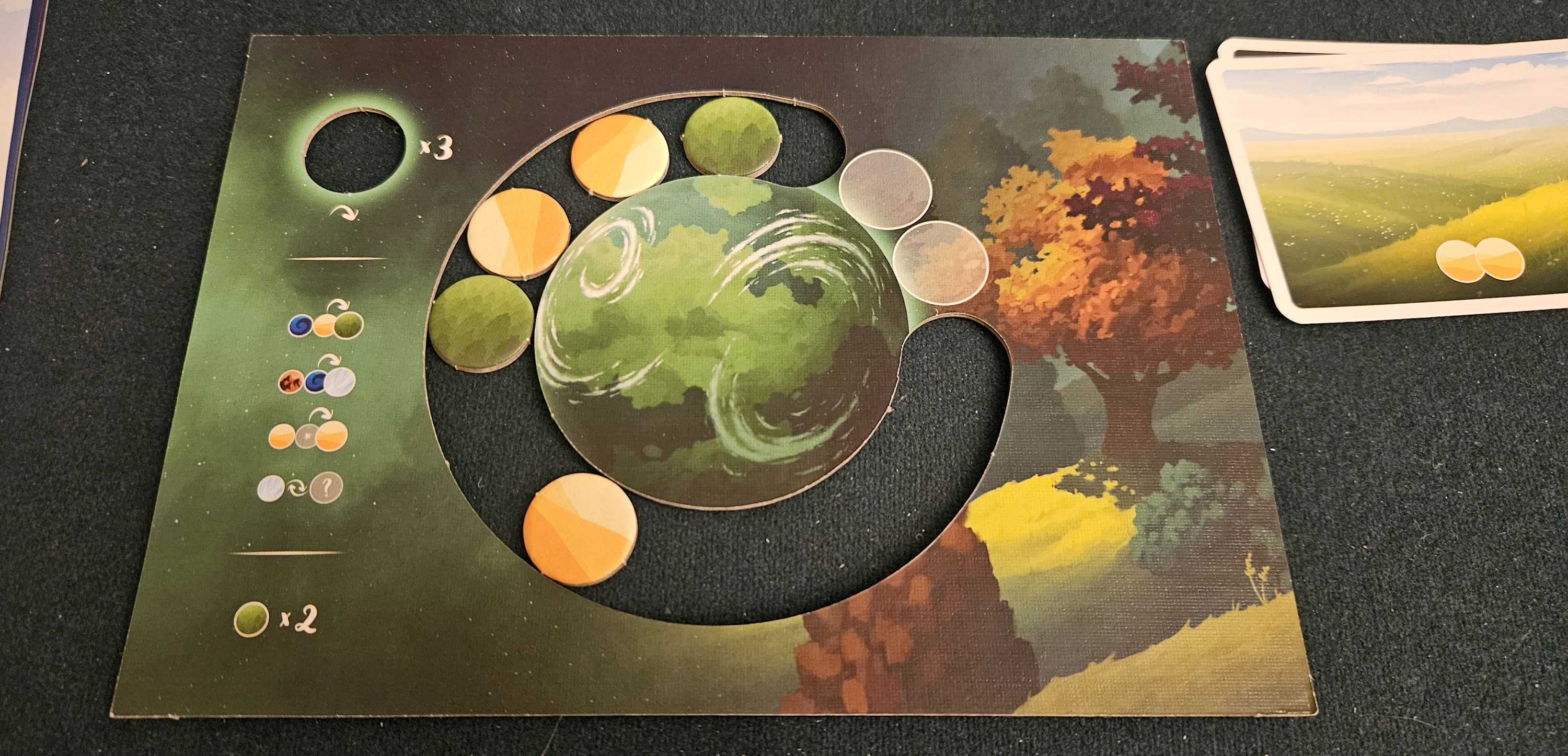
At least this planet can support life.
The whole thing is redolent of the trash that populates museum gift shop shelves, a few steps above a commemorative edition of Monopoly but otherwise forgettable. Apart from some nice illustrations, it’s flatter than a Flat Earth and every bit as hollow as our own.
Fine. I’m honor-bound to inform you that the last half of the previous sentence was a joke. In fact, our Earth has an iron-nickel core. Here’s a fun nugget for you: the same English astronomer who discovered Halley’s Comet also proposed the Hollow Earth Theory. Take it as proof that you can’t be good at everything. Unlike Biomos, however, some of us would like to be good at one thing.
(If what I’m doing at Space-Biff! is valuable to you in some way, please consider dropping by my Patreon campaign or Ko-fi.)
A complimentary copy was provided.
Posted on August 27, 2024, in Board Game and tagged Biomos, Board Games, North Star Games, Subverti. Bookmark the permalink. 4 Comments.

 SPACE-BIFF!
Wow, brutal review!
I’m also glad to read its conclusion, because I had been tempted to get it (solo game, rather cheap, French production) but read the rulebook first and thought ‘there doesn’t seem to be anything of interest in this game past the soothing artwork’. Apparently, I am not entirely clueless in judging a game by its rules.
Go ahead and judge a game by its rules! Also judge it by its cover. Why not? Life is short. Our attention is limited.
Everyone and their dog can flap on about flat earth, but hollow earth theory? That takes a true expert and/or admiral.
I’ll take it!