Walk the (Slack) Line
Peacemakers: Horrors of War fascinates me. This is my third visit to Sami Laakso’s Daimyria, a world not dissimilar to ours but populated by countless species of fur and scale and feather. Like humans, as we saw in Dale of Merchants, these creatures engage in mercantile exchange. In Lands of Galzyr, they wander off on continent-spanning adventures. And in Peacemakers: Horrors of War, they expend a great deal of energy on killing one another.
But not all of them. Horrors of War is a second stab at the system Laakso introduced in Dawn of Peacemakers, which cast characters not only as negotiators and mediators determined to cease hostilities between neighboring belligerents, but also sometimes as manipulators and poisoners. The art of peace, Peacemakers argues, is as fraught as battle itself. As a result, it walks multiple fine lines, both ludically and morally.

Aww!
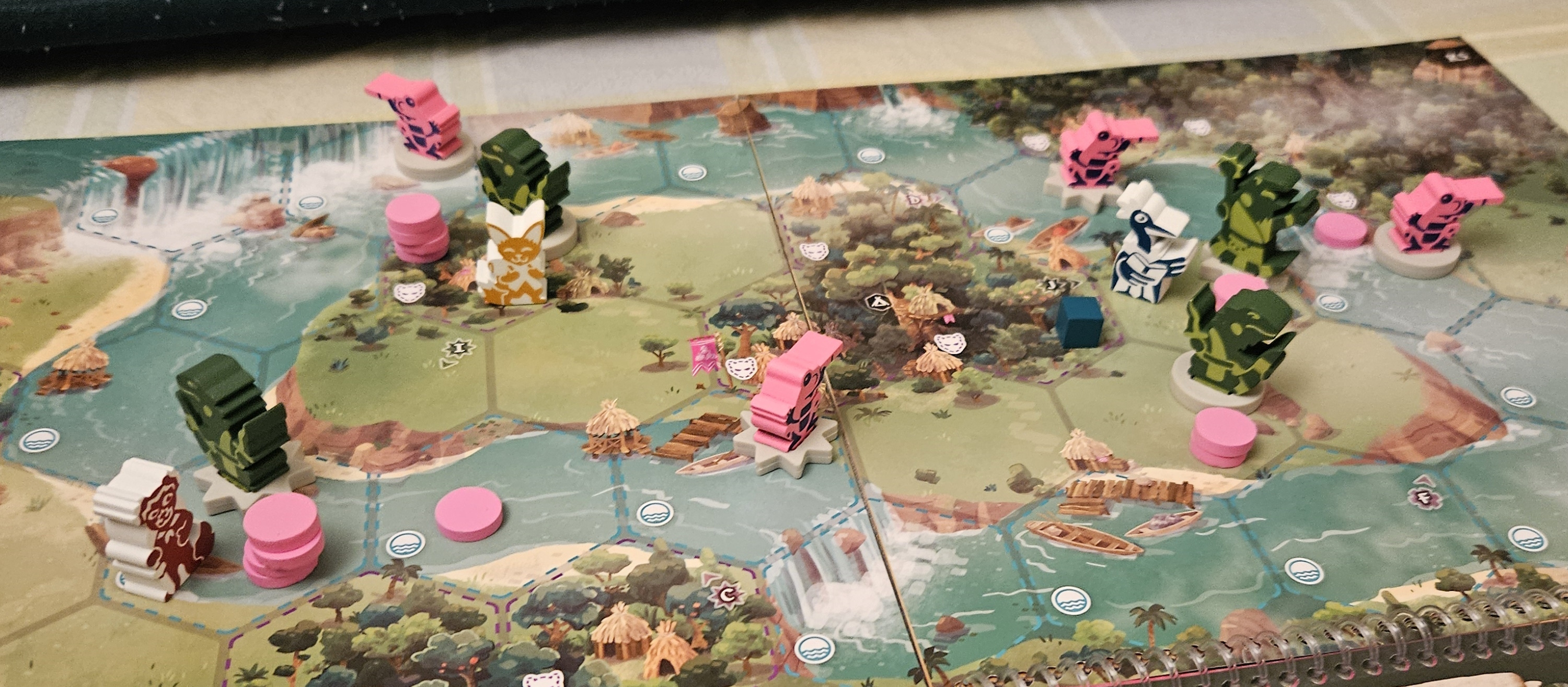
But first, check out those animals! I have yet to put this thing on the table without marveling at the production. Presented via two spiral-bound books, the maps are crisp and legible, often printing text reminders right onto the surface for maximal clarity. The various factions, of which there are seven, take a note from Galzyr and Root by being represented by painted wood rather than out-of-place plastic miniatures. Our protagonists are the brightest of the lot, splashed white rather than sticking to the native colors of the warring factions. As visual shorthand, we’re the literal white-cloaks of this tale. The entire thing is so gorgeously represented that it’s a shame once these creatures start hurling arrows at one another.
Ahem. Sobriety re-engaged.
Except, of course, the cuddliness of these belligerents is the point. One of this sequel’s interventions into the first game’s formula is that your objective rarely focuses on inflicting casualties. Certainly that’s a possibility. Suffering losses brings an army closer to capitulation or negotiation, depending on the state of its rival. There’s nothing stopping you from withholding medical aid to an ailing unit or even poisoning their supplies to hasten their defeat.
But this is a risky approach. Casualties also inflict horrors, cards representing the traumas suffered by your characters. This is a genius move that keeps Peacemakers walking those tightropes. Being devoid of hit points, your characters are effectively invincible. This makes for good gameplay. Fretting over your health while assessing the relative values of multiple armed units would probably be a step too far for the game’s target complexity level. By keeping the focus on the belligerents, your objectives are more targeted. You’re here to give advice, to intercept orders so that an army doesn’t sweep down on its target, to help fortify vulnerable targets. Your own well-being is secondary.
Which isn’t to say your well-being doesn’t show cracks. This is where those horror cards come in. Your characters may not be in any mortal peril, but their mental and emotional health is on the line. Horrors operate like debuffs. One character might develop a nervous palsy that prevents them from marching across the map, crippling self-doubt that threatens to interrupt any action, or — the most relatable affliction for an inveterate talker — a verbal outpouring that’s so off-putting that it causes a nearby army to scramble its order deck entirely. When you’ve spent half a dozen actions painstakingly investigating and reordering that deck, let me tell you, that’s a problem.
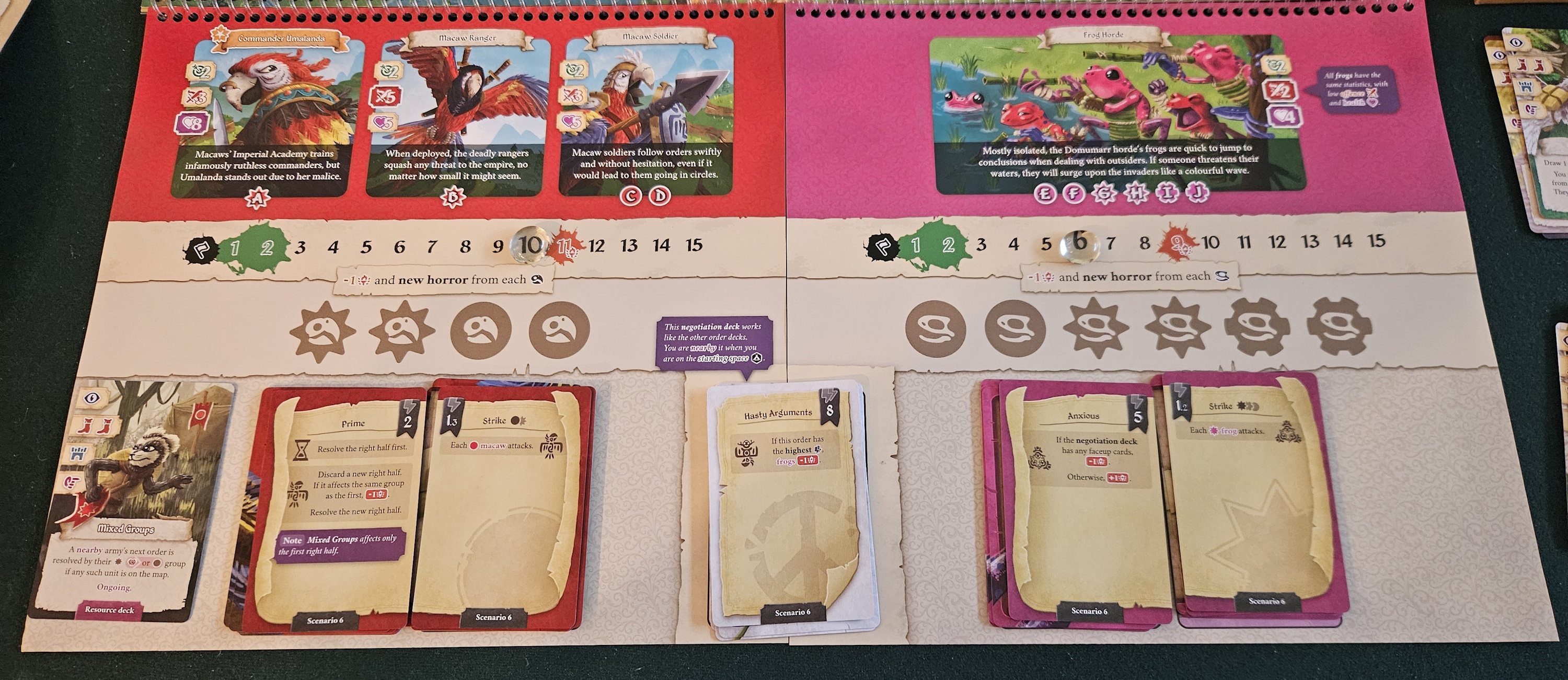
The bottom half of each page handles order resolution and morale.
That’s what I mean when I say Peacemakers walks multiple fine lines. For the sake of gameplay, your characters cannot be killed and end the session prematurely. That might make them overly potent, so horrors bring them crashing back down to earth. The danger isn’t that they’ll die. It’s that they won’t be capable of accomplishing their mission. They’re simultaneously vulnerable and invulnerable.
Another example is the game’s broader approach to armed conflict. Whenever we talk about Peacemakers, it’s reasonable to wonder aloud at some perceived both-sidesism. If only people would sit down and hash out their differences, the world would be a better place. Let’s see Putin and Zelenskyy hug it out. Right?
To some degree, but not as much as one might expect. Laakso and his co-designer Ville Reinikainen don’t seem interested in providing such easy moralizing. I’ve argued in the past that games should do the bulk of their storytelling on the table rather than through their rulebook. Peacemakers: Horrors of War does as much, but it also requires that players read the briefings and unit descriptions to get a fuller picture of the conflict at hand. This is a game about information — explicitly, as we’ll discuss in a moment — and these snippets of context go a long way toward rounding out the battles you’re attempting to halt.
There are bad guys. There are imperial opportunists. There are invaders. There are also less burdensome belligerents. In one of the game’s six scenarios, two armies have bumbled into one another in the fog and are now flailing viciously and blindly. In another, two sides wage all-out war while a third faction can’t make up their mind and keeps switching allegiances. Yet another sees mercenaries raining artillery down on a city. While Peacemakers leverages the power of fable to soften the blow, it refuses to withhold it entirely.
For instance, your characters are often expected to turn the belligerents’ own abuses against them. Those artillery-firing mercenaries? One of that scenario’s prime opportunities revolves around redirecting their shots onto their own troops. Those side-swapping invertebrates? By ensuring they betray their allies at precisely the right moment, you can humble said allies into a retreat.
It’s still simplistic. Every game about war is simplistic to some degree. But wishy-washy both-sidesism it is not. It’s a fable about expediency, the greater good, and the toll they inflict, in much the same way that Root is a fable about power dynamics.
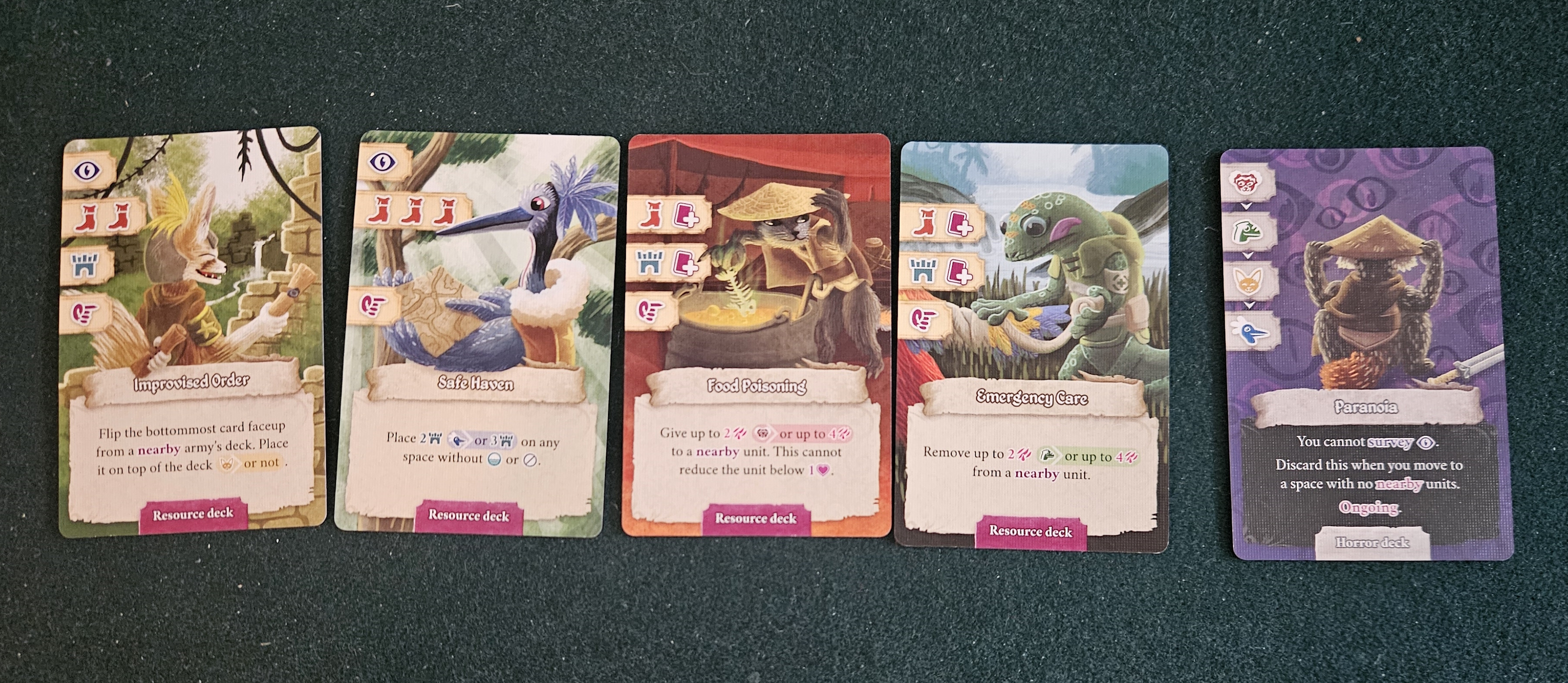
Every card is amplified in the right hands. Paws.
Actions in Peacemakers are doled out according to a strict economy. Four per turn, no more and no less. Okay, sometimes more, pretty much always because of careful planning, and sometimes less thanks to horrors. Nearly every card enables the same basic options, letting your adventurers move, investigate an army’s upcoming orders, fortify a space against incoming damage, or pass cards to their teammates. Each one also offers an ability. This is where the game’s four principal characters develop their own personality. Rather than having innate perks, each character positively modifies certain cards.
Between this action economy and Peacemakers’ carefully threaded needles, the result is a very uncommon plaything, to put it more softly than some will prefer. Every action feels tiny and insignificant compared to the armies charging each other. This, too, comes across as deliberate. Early on, it’s easy to feel overwhelmed, as though your adventurers can’t make a difference in the face of so much destruction. It’s only as many small activities accumulate that anything gets done.
This extends a certain air we might call passiveness, although that isn’t quite the right word. Often, the best approach is to do nothing at all. Especially in a battle’s early stages, when you’re still learning the contents of each army’s hidden order stacks or determining where your ministrations will best be utilized, it’s pretty common to hurry up and wait.
The outcome is a particular state of deliberation that can feel like, but is not really, inaction. I mentioned that this is a game of information. Oftentimes, watching a few inaugural movements from both armies can impart a sense for how they behave. It also helps to have more than a single turn’s worth of cards in-hand. In many cases, this results in uneven pacing, one turn featuring only one or two actions — or even none! — while the next sees players splurging everything they’ve hoarded to swing a section of the conflict toward their desired outcome.
This pacing can feel unnatural at first, almost the exact opposite of the optimization that marks most board games. But it’s also what provides Peacemakers with its most intriguing conundrums. What’s required is a paradigm shift. You aren’t passing; you’re observing. You aren’t failing to act; you’re withholding force until your potential energy is ready to go kinetic.
Lost in the fog.
Like the rest of the fine lines found in Peacemakers, there’s a delicate balance to this tightrope. Does it succeed? Despite some occasional slackness, yes, it does. I would even argue that this makes the game more interesting. Because tightropes are one thing. Slacklines are deathtraps.
And that embodies Peacemakers: Horrors of War as a whole. This is a fable that wants to convey something true about war and the costs of heroism. It wants to argue serious points while also being about spectacled bears raiding the macaw empire. That it succeeds in communicating its themes more reliably than most wargames speaks to the clarity of what Laakso and Reinikainen have crafted.
(If what I’m doing at Space-Biff! is valuable to you in some way, please consider dropping by my Patreon campaign or Ko-fi.)
A complimentary copy was provided.
Posted on August 9, 2024, in Board Game and tagged Board Games, Peacemakers: Horrors of War, Snowdale Design. Bookmark the permalink. 12 Comments.

 SPACE-BIFF!
Thank you for this review! I’ve been curious about the games in this setting, especially this one, but honestly something about the art is so off-putting that I have never touched it. Somehow where Root’s art and anime-style anthropomorphic animals are both comforting to me, something about this lives in maybe not the uncanny valley proper, but the valley next door. I get a similar feeling from Too Many Bones, a game I would probably love if I could look at it for more than 5 seconds at a time.
Sorry to hear that!
Thank you for the great review, Dan! I’m glad to see you liked the full game equally much compared to the prototype. 😊
Thanks for designing such a wonderful game, Sami!
While reading, I got the vague impression that this game plays best solo. Was that your read, or does it hold up with multiple players?
I like it both ways! If anything, I prefer it with multiple players.
This sounds really cool. Hopefully it will be shipping soon!
I believe it’s meant to, yes!
Ok – I don’t know when this changed. But when I open the jpgs there used to be little snarky jokes in the url.
Sad to say they are fully utilitarian…
Let’s get than gonzo jokes going again for the most important 1%.
Casualties also inflict horrors, cards representing the traumas suffered by your characters. This is a genius move that keeps Peacemakers walking those tightropes. Being devoid of hit points, your characters are effectively invincible. This makes for good gameplay. Fretting over your health while assessing the relative values of multiple armed units would probably be a step too far for the game’s target complexity level. By keeping the focus on the belligerents, your objectives are more targeted. You’re here to give advice, to intercept orders so that an army doesn’t sweep down on its target, to help fortify vulnerable targets. Your own well-being is secondary.
So, RPGs come from miniature wargames, which is the reason why characters can die. As they can in a wargame. This made for some difficulty with narration as if the characters can die, then survival becomes a major if not the major thematic point being made. For those who wanted their play to say something else, a whole bunch of winkwinknudgenudge cheating occured to alter dice rolls iin order to ensure that narrative points could still be made without having the characters die before getting to the climax of the story.
And then at some point, RPGs asked, wait, what if the characters can not die? And then a whole bunch of games came out playing with that. Like, characters can not die so we can tell stories about romance and memory and all kinds of things without having to worry about characters falling off cliffs and losing 2d8 hit points. And another kind of game came about as well, games where you could die, but only if you as the player pushed a conflict to that point. Like, okay, I lose this conflict because I do not want to die over it or, alternatively, I am going to push the conflict even though I might die as this is something worth dying for (which is an extremely powerful thematic statement).
Which bringing it around to this game, what a great idea to drop the theme of survival in order to focus on the theme they want. The horrors of war and the, I imagine, difficulties in obtaining peace.
That’s the kind of design decision that makes me want to play a game and experience what it is trying to say through play.
Yes! I don’t play many TTRPGs, but one of my favorite realizations was in Dogs in the Vineyard. Characters in that game only get tougher and tougher; after a few sessions, they’re almost invincible. BUT. When the game kicks up a moral dilemma, characters may oppose one another — and you’re always wagering your own health and maybe even your life on those moments. Your life is on the line, but it’s always subordinate to the issue at hand. Your life gauges how strongly you feel about an issue.
Pingback: Galzyr? Gals Where? | SPACE-BIFF!