Mount My Head on the Wall
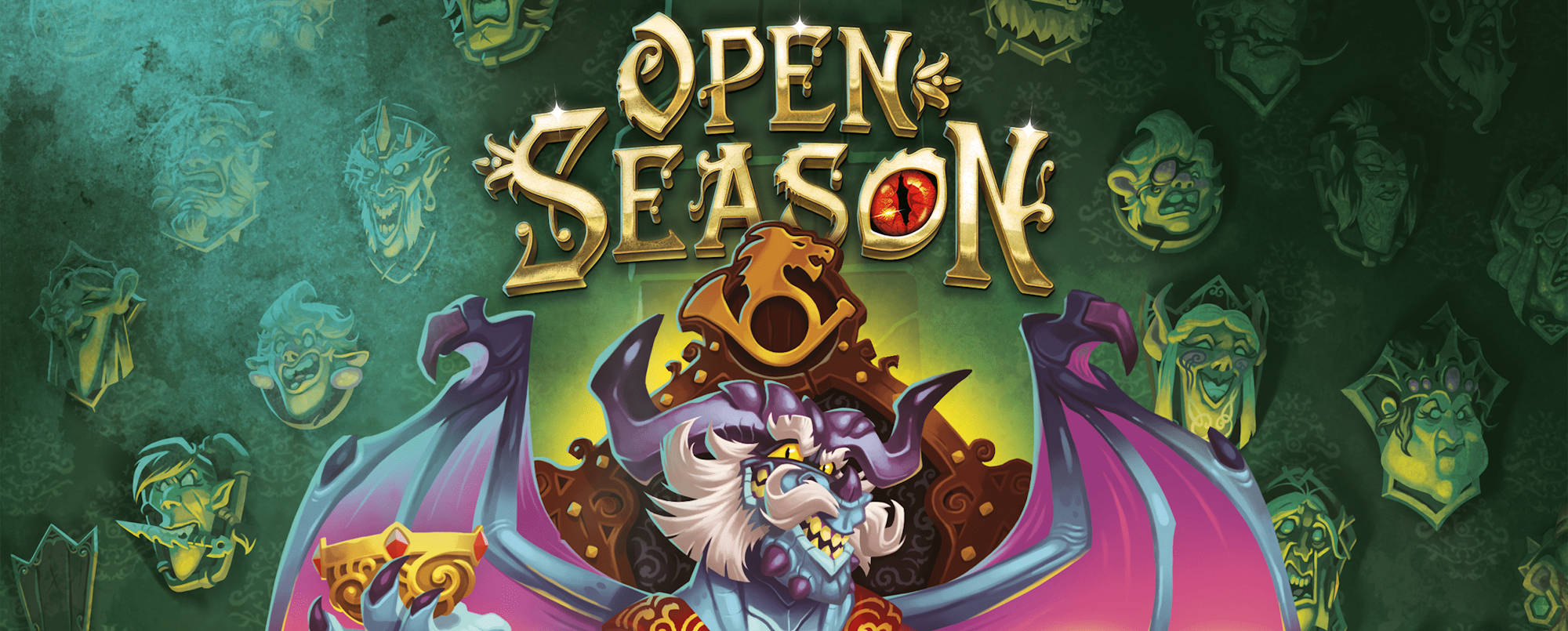
Open Season takes place after the good stuff has happened. As one of the land’s evilest evil lords, you have defeated a bunch of plucky heroes. Defeated, past-tense. Now you’re mounting their taxidermied heads on your wall. Call me crazy, but I’d rather compare paint swatches.

My wall, decorated grimly.
The same goes for the game, too. If it came down to playing Open Season or fretting over the hangings on my walls, I’d choose the latter. Maybe I just happen to find these particular visages off-putting.
At a certain raw level, there’s nothing wrong with Open Season. Winning is a combination of two broad factors: your wall, comprised of eleven decapitated heads, and a set of additional noggins off to the side, called your “accolades.” The former establishes your scoring criteria; the latter, the cards that are actually scored. For example, hanging a mage head in the “two points” space on your wall means that every mage in your accolades will be worth two points at the end of the game. But if you also hang a mage in the “minus three points” space — look, don’t do that. What are you thinking.
It isn’t only the heads that matter. Their species, I mean. There are six types: gnomes, with ugly mushrooms sprouting from their ears; elves, snide expressions cemented across their lips; barbarians, famous for being green; mages and sorcerers, one of which we kept calling “ice trolls” and the other being closer to a necromancer; and dwarves, with their goofy braided beards and dandruffy unibrows. These are further divided into five different attributes. Some heads wear earrings. Others wear eyepatches or crowns, have tattoos inked into their skin, or hold daggers in their jaws.
Each turn revolves around hanging one head and then placing the other into your accolades pile. Except, excuse me, this process is actually slower and more complicated than that. First the spare cranium enters your stock, where it potentially activates the ability of a matching head, provided one has already been placed along your wall’s top row. These abilities are varied. Not in the sense that they’re interesting. More in the sense that two of them are good, letting you take an additional head (and therefore increase the depth of your scoring accolades pile), while the other two are about as useful as shoulder-lint during an important interview. Later, these heads will then be transported to your accolades.

Check out my heads, bro.
Meanwhile, the game’s head-hanging techniques are similarly burdened. Each row can only hold one head of each type. Apart from one particular row, that is, where you’re encouraged (but not required) to hang a bunch of similar heads for bonus points. Oh, points. Points come from all over the place. The lion’s share can be found in your accolades, but you’re also assessing another half-dozen categories. One space offers a card-gathering majority contest. Another assesses attributes (daggers in teeth, tattoos, etc.) rather than species. There’s one, so small it’s easy to overlook, about collecting sets of attributes.
For a game with so many categories, however, there isn’t much to think about. All those placement restrictions more or less dictate which move is good or bad at the moment. The game even spells out which stretches of wall are best populated in what order. One spot improves a scoring category as long as you fill it in within the first four rounds. Another trio of placements will award four trophy tokens, useful for activating further abilities, provided you complete it somewhere between rounds three and six.
These guidelines are clearly intended to offset the most obvious approach, which is that hanging heads on your top row, where they will provide abilities you can activate, is incredibly powerful. But that intent goes missing once you realize that half of the spaces up there are basically pointless. I can bank another head now instead of taking two next turn? I can use trophy tokens in a new way even though I can’t even earn them until a few rounds have passed? Throw a parade. The proposed solution doesn’t encourage hard decisions; it encourages me to recognize a series of placement priorities.
And those priorities never really shift. I can enjoy a game that’s about chasing incremental points across ten categories. What I mind is when those games don’t present anything for me to solve in the moment. From one session to the next, I’m always trying to fill the same slots in more or less the same order. I’m always trying to trigger those two abilities that give me extra cards. I’m always wincing at the unpleasant whited-out eyes staring back at me.

Sigh.
As far as scalp-taking goes, Open Season isn’t worth the effort. Ugly, bland, and overly made-up. Like its nobs. Oh ho ho.
(If what I’m doing at Space-Biff! is valuable to you in some way, please consider dropping by my Patreon campaign or Ko-fi.)
A complimentary copy was provided.
Posted on July 22, 2024, in Board Game and tagged Board Games, Open Season, Sit Down!. Bookmark the permalink. 4 Comments.

 SPACE-BIFF!
Thank you for this review! It’s hard to think of a theme that would appeal to me less than mounting the taxidermied heads of intelligent creatures. It’s nice to know I’m not missing out on gameplay that would interest me either.
Thanks for reading!
I actually almost jumped out of my seat in excitement when I saw the theme for this game…! Only to sit back comfortably again when I saw it was yet another tile-placement game with set collection, placement bonuses, etc. Thanks for confirming my impression that I don’t need this game, even if I am perhaps in the minority of people who thought this looked like a cool theme initially.
Sorry to bring you back down to earth! I wish this one had proved more interesting.