Xylophone Guitar Bear

Is Xylotar’s xylophone/guitar-playing polar bear based on the keytar bear busker of Boston fame? Eh, probably. Or maybe it’s an indication of how little the window dressing of any given trick-taking game matters.
Cold as I am on the setting, I must admit that Chris Wray has once again produced something special. The big surprise of Xylotar is that it’s a hidden information game as much as it is a trick-taker. This time around, though, the hidden information is your own hand of cards.
Double-decker.
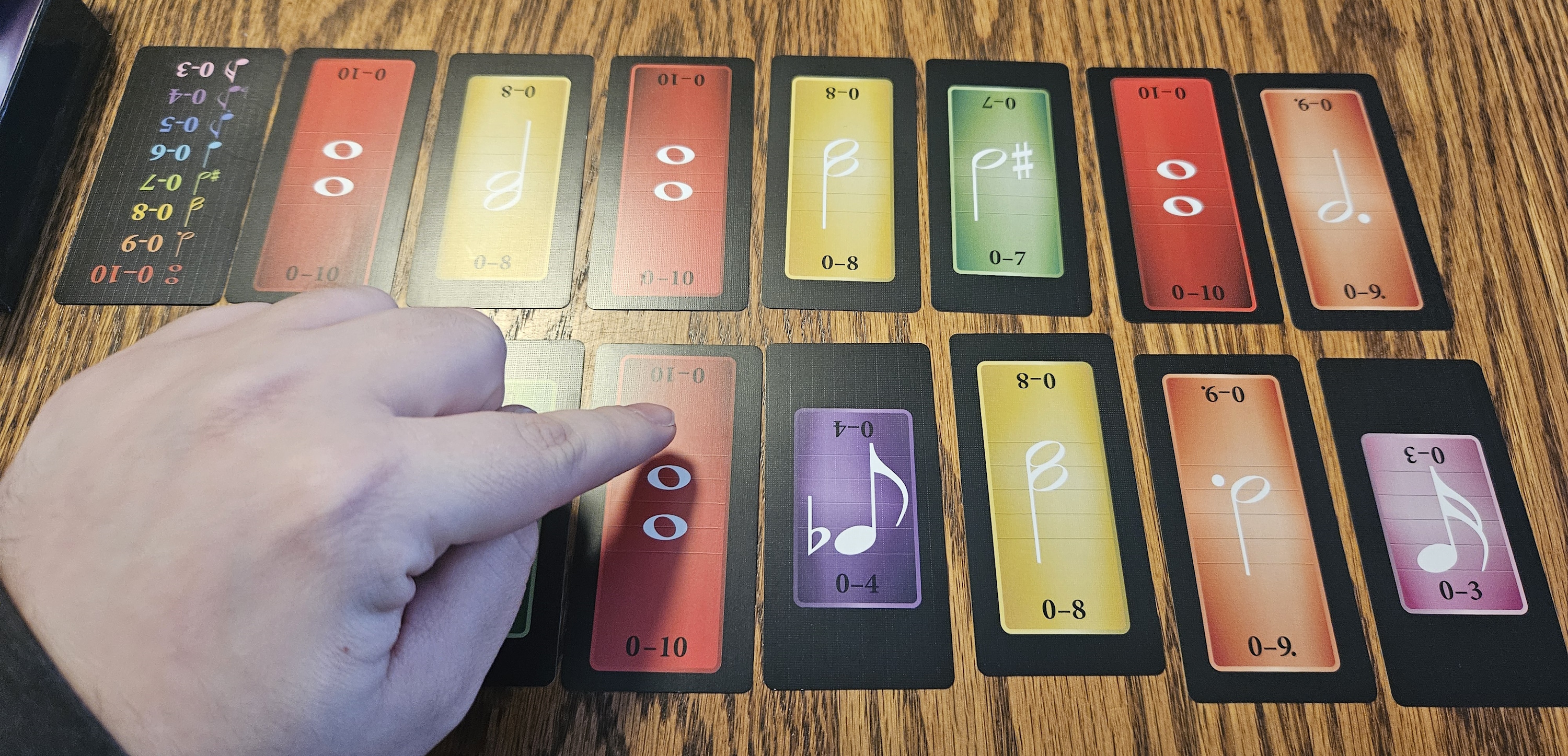
Picture this. You have a hand of cards. Slender things, tall rectangles, like you’re playing Space Base. These cards are arranged in a long row. Maybe two rows if your table could generously be described as economical. This is your xylotar, the bastard offspring of xylophone and guitar, with each card representing a single key.
They got this way when your hand was dealt to your neighbor, who kindly sorted them according to rank. But before handing them over, they flipped the whole stack face-down. Now you only have two pieces of information. The first is that every key ranks higher (or at least ties) with the key to its right. This trend continues rightward, ranks descending, until you hit the lowest-numbered keys at the end.
Second, the back of each key is visible. This reveals the key’s “suit,” of which there are eight. Each suit comprises a certain range of ranks. The red suit, for example, has eleven possible ranks, from zero to ten. On the other end of the spectrum sits the pink suit, with only four cards ranked zero to three in the deck.
You know the general position of your cards. You know the possible ranks any given card might fit into. That’s enough to begin.

There are only so many pictures I can take of this game.
Plenty of trick-taking games, maybe even the lion’s share, reward some degree of card-counting. It’s useful to know what everyone at the table is holding, so you invest at least a little bit of attention into remembering what’s already been played. There are various degrees. Maybe you only pay attention when somebody reveals a high-value card or tally how many trumps have been played. Or maybe you’re a rain man who assesses the precise location of every digit. Either way, those who take trick-taking seriously will generally watch everybody’s hands to glean those few nuggets that could turn the tide in their favor.
In Xylotar, some of that work has already been done for you. Thanks to the red suits, you can already see how many trumps everybody is holding. You can also see those low-quantity suits, the ones that leading players can use to their advantage to lock out the competition. After three or four tricks, you can deduce the relative ranges in everybody’s hand. If somebody dumps their leftmost red card, you not only get to see its rank, you also know that they aren’t holding a better trump. Smooth.
But the inverse also becomes true. You’re constantly trying to deduce the values in your own hand. When you play a card into a trick, its value is unknown. You’re not only prodding opponents to reveal what they’re holding — you’re prodding yourself. Sure, you could respond to tricks by playing your leftmost card every time. But that turns each trick into an unfocused gamble. It’s better to tickle those keys strategically, parceling out cards from across your keytar to get a sense for what you’re holding.
This becomes doubly essential when it comes to bidding. At some point during the hand, you’re required to spend a card to declare how many tricks you’ll win. A successful guess is a big deal: while each trick is worth one point, meeting your bid is worth a whopping five. Again, though, you aren’t always sure of a card’s rank. This makes bids testy affairs. The earlier you bid, the wider the range of numbers you might find yourself chasing. But bidding later can deprive you of options, pigeonholing you into a target that’s now impossible to meet. Once more, Xylotar transforms your own hand into a minefield.

When lined up single-stack, Xylotar consumes significant real estate.
It’s devious. Xylotar raises fascinating questions about the structure of each hand, about when to play a good card or withhold for a more opportune moment, about when to bid, about when to seize the lead and produce a run of wins, about when to entrap somebody else into a run so they blow past their bid. Even though I prefer my trick-takers more hybridized these days, every so often one comes along that proves that this eldest genre still has legs. Xylotar is one such title.
(If what I’m doing at Space-Biff! is valuable to you in some way, please consider dropping by my Patreon campaign or Ko-fi.)
A complimentary copy was provided.
Posted on July 19, 2024, in Board Game and tagged Bézier Games, Board Games, Xylotar. Bookmark the permalink. 5 Comments.

 SPACE-BIFF!
I can’t wait to get this played! I bought it a few weeks ago but haven’t been able to get it to the table yet.
Nice! I hope you enjoy it.
If I had any kind of photoship skills, I would demonstrate just how dull that table would look without the pie.
This article reminds me I want to get Scout to the table.
Love Scout!
Pingback: Ogling the Seers Catalog | SPACE-BIFF!